Veterans’ Day

When I visited Strasbourg Cathedral a couple of months ago, I was touched to see a memorial to American soldiers who had helped to liberate Alsace and its capital, Strasbourg, from Nazi control.
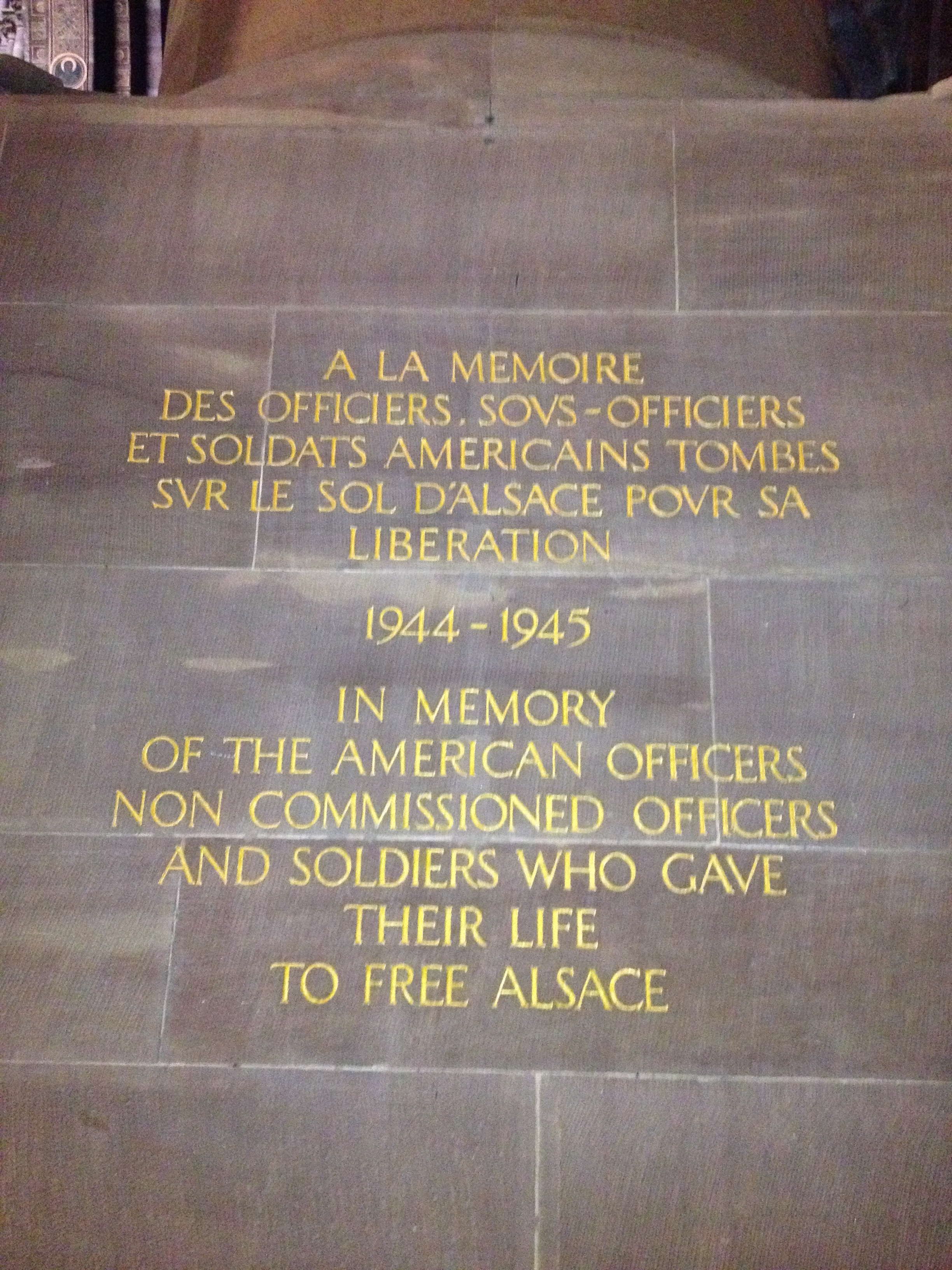
AmerMemorial

Strasbourg is just across the Rhine from Germany, and had been in dispute between the Germans and the French ever since the Franco-Prussian War of 1870-71.  I know next to nothing about that war, but I do know that Strasbourg had great symbolic importance for the Free French, led by Charles de Gaulle from exile in England.  He insisted that only French soldiers should liberate Strasbourg, and so it was.  Strasbourg and its Cathedral had enough symbolic importance that Hitler himself had visited in 1940.  Hitler declared that he intended the Cathedral to be a place of sanctuary for the German people, or possibly a memorial to the Unknown Soldier. But in the closing days of the war, while the Allies moved across France from Normandy toward Germany, French forces were assigned to recapture Strasbourg and above all to liberate the beloved Cathedral.  Liberation took place on November 22, 1944.

The day we celebrate as Veterans’ Day is known as Remembrance Day or Armistice Day in many countries.  It actually marks the end of World War I, which everyone hoped would be “the war to end all wars.”  Sadly, it was not.  But the guns of World War I fell silent at the 11th hour of the 11th day of the 11th month of 1918. The next year, the day was designated to honor veterans of all wars.
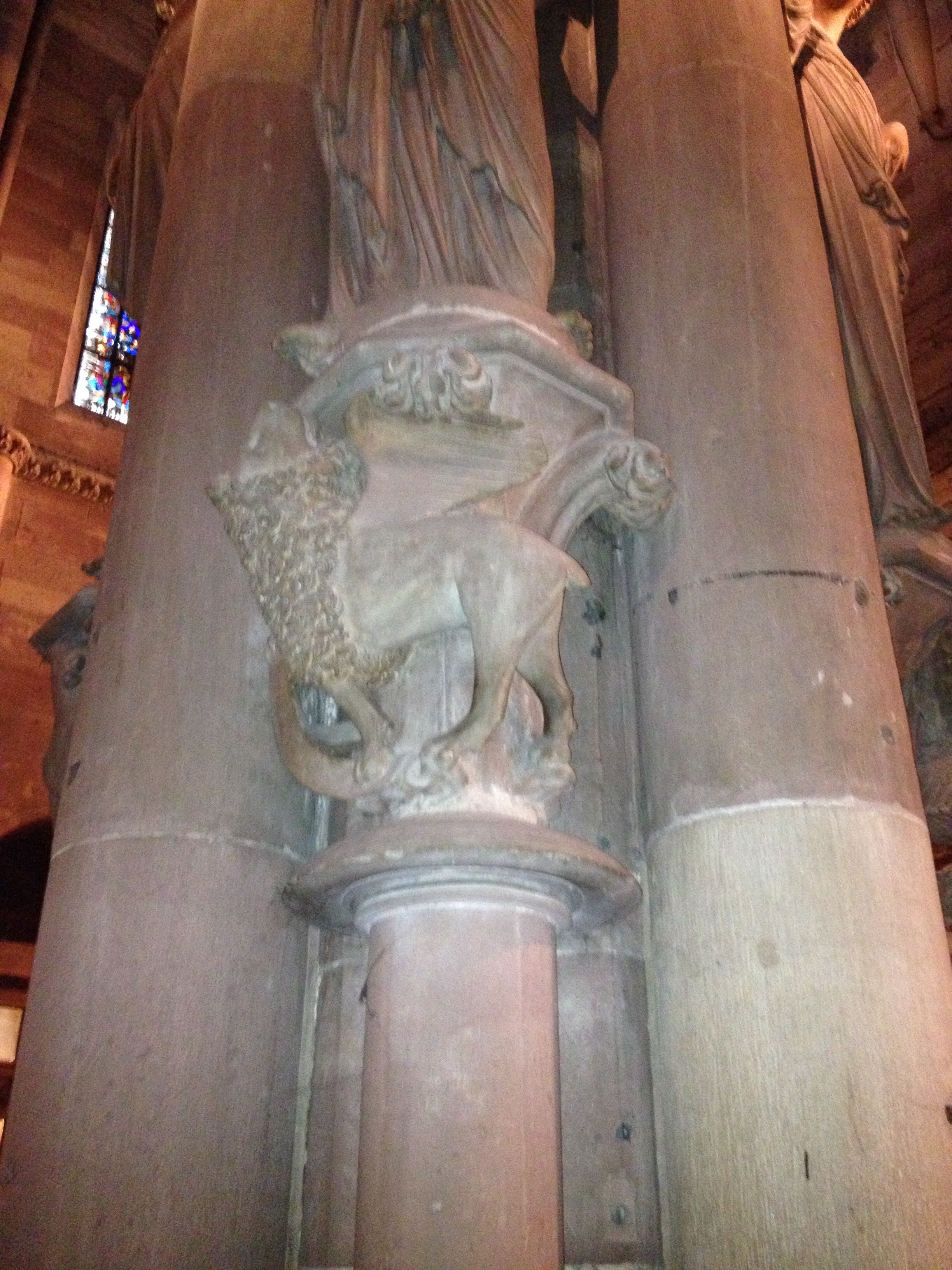
BulletsStrasCath

In the Cathedral, columns are still pocked with bullet holes.  Was there actually a battle inside?  I don’t know.  The fighting was certainly fierce.  But possibly the damage was more from the bombs that hit the Cathedral in August of 1944.

Yesterday in church, veterans were asked to stand and be recognized.  In our congregation, there were about a dozen veterans, all white-haired.  Then members were asked to call out the names of veterans they wanted to remember.  Names were spoken from all corners of the church.  Some of the voices were young and strong.  Some were old and quavering.  The people named could have filled the place by themselves. All those named had served their country with honor.

We might not all agree on the wisdom of sending American troops to the many places across the globe where they have been deployed.  But we can agree that we all owe a debt of gratitude to those who are willing to serve their country. I think we can spare some sympathy for the men and women of other countries who have been drawn into war, too. Service people are committed to dangers other than war, too. As I write, I’m sure that American service people are among those rushing to provide aid after the catastrophic typhoon that just hit the Phillippines.

Join me next time for more explorations into the art and history of Europe.
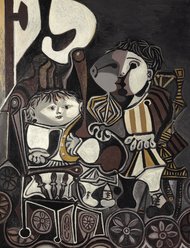
Picasso’s Soft Spot?

In the rarefied world of Christie auctions, price is always what makes news.  At a recent auction, sales were disappointing except for the price fetched for a Picasso painting from 1950, “Claude and Paloma.”  It sold for $28.1 million, much more than predicted.  I can see why.  I’d have bought it myself. To paraphrase Ferris Bueller’s thoughts about buying a Ferrari, “If you have the means, I recommend it.”

Photo from NYT article cited below

Photo from NYT article cited below

The painting depicts Pablo Picasso’s two youngest children.  What strikes me is the depiction of the baby, Claude.  In the midst of all kinds of sophisticated design elements, in a sort of cubist composition, the baby’s face stands out as almost a traditional portrait.  Could it be that the great man just melted when looking at the little child’s face?  This portrait seems a pure depiction of childhood innocence.  Maybe the artist was looking back at his own lost innocence,   when he first discovered his own talent and had no idea where it would lead him.  In 1950, Picasso had just lived through the horrors of the Second World War, which he spent in occupied Paris.  The Nazis did not allow him to exhibit, considering him degenerate.  The end of the war was a new beginning of artistic freedom.  A baby is always a new beginning, too.

The article about the Christie auction, by Carol Vogel, is at http://www.nytimes.com/2013/11/05/arts/despite-picassos-bidding-is-sluggish-at-christies.html?_r=0


Kids and Their Costumes

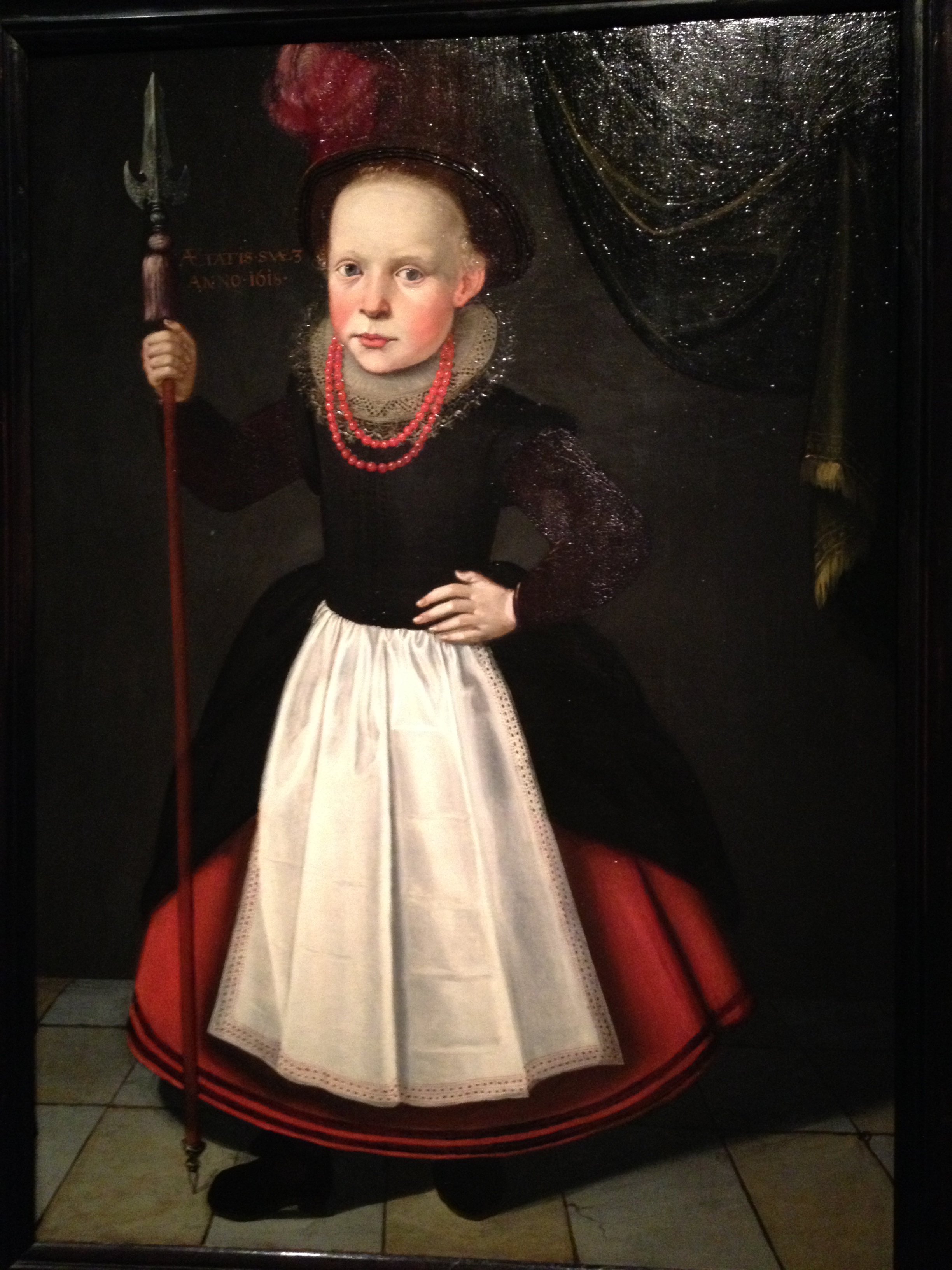
ChildMilitia

Last month in the Amsterdam History Museum, I admired this touching portrait of a solemn little boy dressed up as a militia officer, complete with a pike in his hand.  This child was no doubt a member of a wealthy family in the Netherlands of the 1600s.  The city militia of the time was not so much a military or police organization as an exclusive club for the elite.  This child’s family hoped he would grow up to be a civic leader.  At that time, children were generally portrayed as miniature adults. Still, parents must have had the same feelings present-day parents have.

images

This portrait reminded me of the costumes present-day children wear, for Halloween and for everyday play. The firefighter’s costume above is for sale at http://www.rakuten.com/prod/kids-baby-halloween-costume-firefighter-fireman/211550071.html?sellerid=23844739. I saw kids trick-or-treating in similar costumes last week.

We all want our children to grow up to be useful members of society.  I’m sure that parents in the 1600s, like present-day parents, watched each stage of their childrens’ development with a mixture of pride and apprehension.  Then as now, parents must have wished they could prolong childhood for their little ones.

Join me next time for more explorations in the art and history of Europe!

Happy Halloween!

HalloweenDogWitch

The origins of the holiday we know as Halloween are lost in the mists of time–maybe they’re Celtic or Welsh, maybe Roman.  The Christian liturgical calendar celebrates All Saints’ Day on November 1 and All Souls’ Day on November 2, thus giving the night of October 31 the name All Hallows Eve.  In parts of Europe, the three days around what we call Halloween are still celebrated as religious holidays when the departed are remembered–and when they possibly  walk the earth.  Jack-o-Lanterns might have begun as representations of wayward spirits.

Many churches displayed the relics of saints during these days.  Some historians theorize that parishes too poor to own any actual saintly relics encouraged parishioners to dress up as their favorite saints instead.  Then again, some historians believe that costumes were first worn as disguises to prevent any of the dead from seeking vengeance against their still-alive enemies.  Pretty deep stuff!

Cleopatra

As for me, I’ll be celebrating Halloween with kids–and that includes both children and adults who give themselves permission to be someone or something else for a few hours. I’m Cleopatra! I expect plenty of pets will get in on the fun, too. Happy Halloween to all!

My Own Woman in Blue

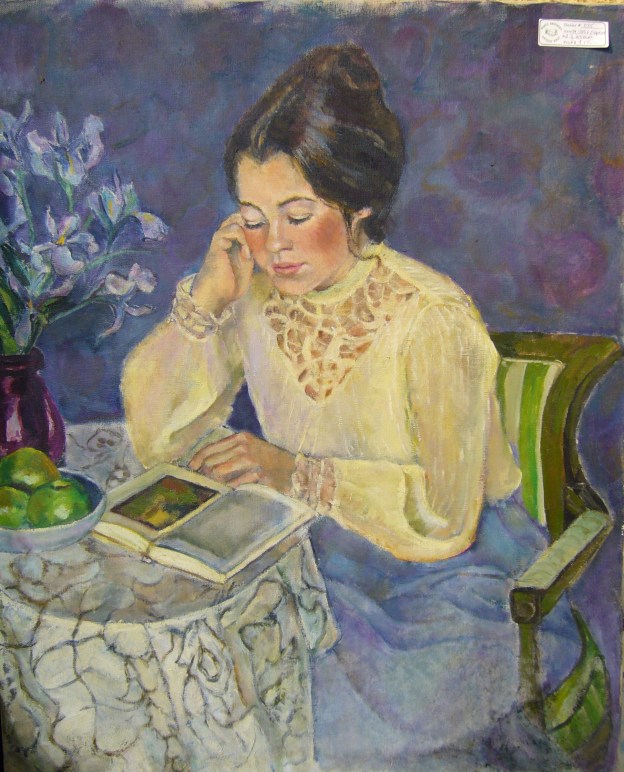
LadyCroppedMy last post was about Vermeer’s exquisite “Woman in Blue Reading a Letter,” which I saw last month in Amsterdam’s Rijksmuseum. I bought a much more humble painting for my own wall, in an antique shop in Santa Monica.  Like many old forgotten oil paintings, this one leaned against a wall with others stacked against it; in fact, there was a dent in the canvas, which smoothed out once I rescued it and brought it home.  There was some water damage along the bottom edge.  Still, the colors were brilliant. It’s one of my very favorite pieces. It’s about 2 by 3 feet, much larger than Vermeer’s. I don’t know who the artist was. But the subject speaks to me:  a woman seated in a lovely, peaceful room, absorbed in her book.

For many centuries, all over the world, women were discouraged from reading.  In places in our contemporary world, reading is still discouraged or even forbidden to women.  A woman reading is a woman not cooking, cleaning, weaving or tending a garden.  Worse yet, a woman reading might get uppity ideas about her place in the world.  Who knows what might come of a woman quietly reading, all by herself?

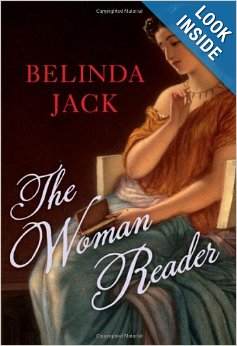
A British writer, Belinda Jack, has written a book titled The Woman Reader. In it, she explores the history of women reading, in much the same way Virginia Woolf explored the history of women writing in her book A Room of One’s Own.  In many ways, a woman reading a book is creating her own private room, her own space within whatever world she lives in. This interior space, created anew with each new book opened, is really a window onto the wider world outside. We can experience absolutely any time or place, real or imagined, when we pick up a book. We can learn new skills and new ways of looking at life.  We can learn from those who have gone before us.

I was fortunate in having parents who especially encouraged me to read, took me to the library, and gave me the quiet time to develop a lifelong love of books. I wish that good fortune for all children, especially girls.

Book cover from Amazon

Book cover from Amazon

A review of Belinda Jack’s book, by Hermione Lee, is at http://www.theguardian.com/books/2012/jul/05/woman-reader-belinda-jack-review.

Woman in Blue


Vermeer's "Woman in Blue Reading a Letter," Rijksmuseum website

Vermeer’s “Woman in Blue Reading a Letter,” Rijksmuseum website

One of the masterpieces in Amsterdam’s Rijksmuseum is Johannes Vermeer’s “Woman in Blue Reading a Letter.”  In the newly-renovated museum, there are now four exquisite Vermeers all in a row.  In his entire life the master Vermeer only produced only a total of about 34 paintings.  He never became rich or particularly famous.  He ran an inn and acted as an art dealer to make money, not to mention having 15 children, of whom 11 lived beyond infancy. The wonder is that he had any time or energy at all to paint.  He lived in the small town of Delft for his entire 43 years, from 1632 to 1675.  A local patron bought most of his paintings, so his name never spread much beyond Delft until long after his death.

Today, crowds gather in front of Vermeer’s small, jewel-like paintings.  They reward close study. In this painting and in others, Vermeer splurged on expensive blue pigments, lapis lazuli or natural ultramarine. This particular painting was just recently restored, unlocking the glorious blue and the luminous light.   Almost all of of Vermeer’s paintings were small domestic scenes, recording humble lives in humble homes. Through the centuries, the beauty of everyday life shines through in them.

Join me next time for more explorations in the art and history of Europe!

Affordable Europe: An Old Mill in Lindau

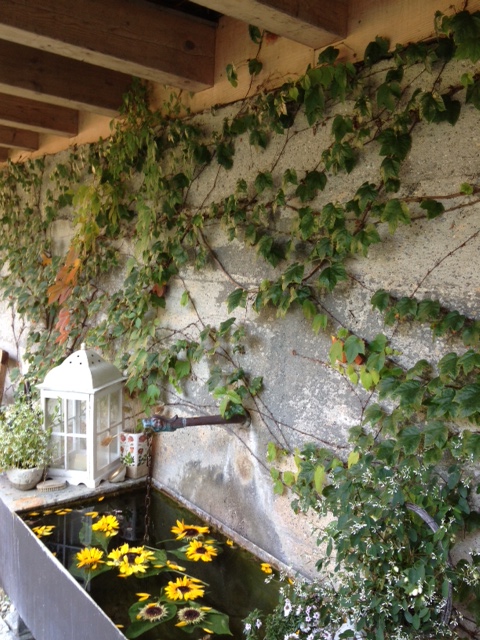
Vines

What’s your dream trip to Europe?  Some people dream of a once-in-a-lifetime trip in 5-star hotels, being waited on hand and foot, eating leisurely gourmet meals, and being chauffeured around by private guides.  That’s not me. This is the first post in an occasional series about how I manage to travel (almost) as much as I want.  Of course it’s never enough!

My dream trip is my next trip, and I’m lucky enough to be always planning a trip. (Having a spouse who accumulates a ton of frequent flier miles helps).  I’ve crossed the pond again and again, until it’s become second nature, discovering new places and revisiting old favorites.  I want to go my own way, trying my best to look and act like a local. (Europeans value their own treasures; they do a lot of sightseeing themselves). When I’m gazing at a spectacular cathedral or wandering in a museum full of priceless art, I don’t want to be thinking I have to be sure to take it all in at once.  Instead, I want to be thinking that this sight and plenty of others will be waiting for me next time.  By traveling in a reasonably frugal way, I do very often return to favorite places, learning more and delving deeper into the reasons I love them.

BackDoor

Years ago I picked up one of the very first books by Rick Steves, Europe Through the Back Door.  It’s updated every year.  I’ve been using Rick’s principles and his excellent guidebooks ever since, and have taken enough trips that I’ve moved beyond his basics.  Nowadays, though, I mostly avoid his featured hotels–just because they tend to be all booked up and full of other Americans like me.  I’m in Europe to mingle with Europeans.

After airline tickets, the biggest expense of European travel is lodging.  I’m a keen student of Tripadvisor and other online resources.  Nowadays there are so many reviews and pictures available, posted by actual travelers, that it’s pretty easy to find nice affordable places to stay with no unpleasant surprises.

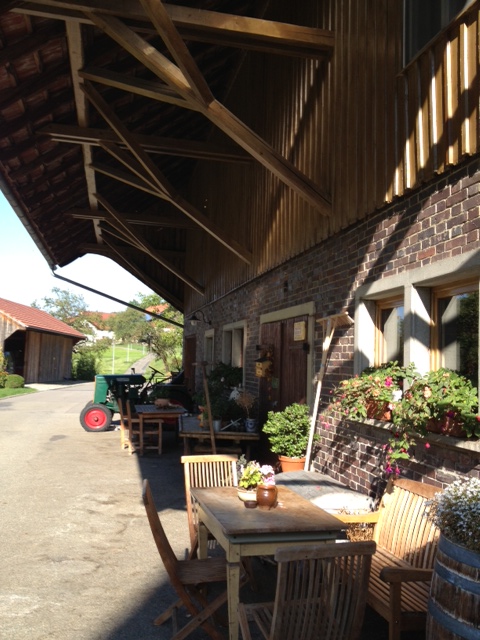
Barn

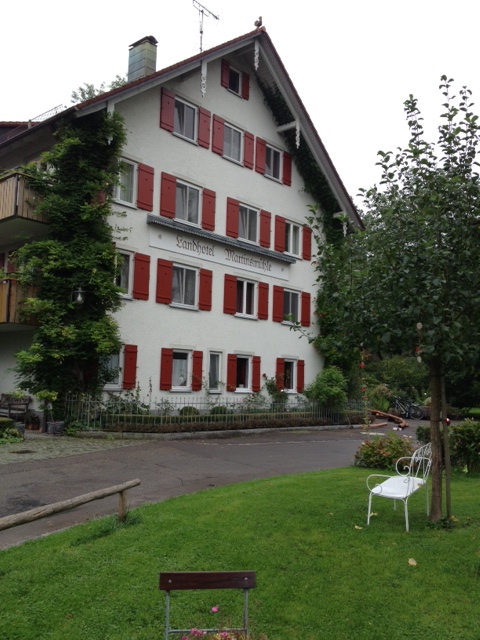
One such place, on my last trip, was the Landhotel Martinsmeuhle just outside Lindau, Germany. (With either a car or knowledge of easy public transportation, I very often seek out places just outside the center of the action). Lindau is on the northern shore of the Bodensee, the large lake known as Lake Constance on its southern shore in Switzerland.  The Arlberg area of the Austrian Alps starts just a few miles away on the westernmost shore. The Swiss Alps and the tiny country of Liechtenstein are also a short drive away.

Landhotel

Landhotel Martinsmeuhle has been in the same family for generations.  The large main building was once a mill, converted to tourist rooms decades ago, when a big selling feature was having a sink with running water in all the rooms. Bathrooms from that era were shared.

Now, all the lovely, quiet rooms have private baths. It is still a working farm on a small scale, but the real focus is on keeping guests happy. There are pretty country details everywhere.

Wagon

There are charming resident animals:  a friendly dog and at least two pretty, attention-seeking cats, goats, a pony, ducks, and rabbits. There are extensive gardens and bikes to use in the surrounding countryside. The buffet breakfast, included in the room rate, is generous enough to set me up for light eating the rest of the day. It includes goodies like homemade preserves from berries on the property.

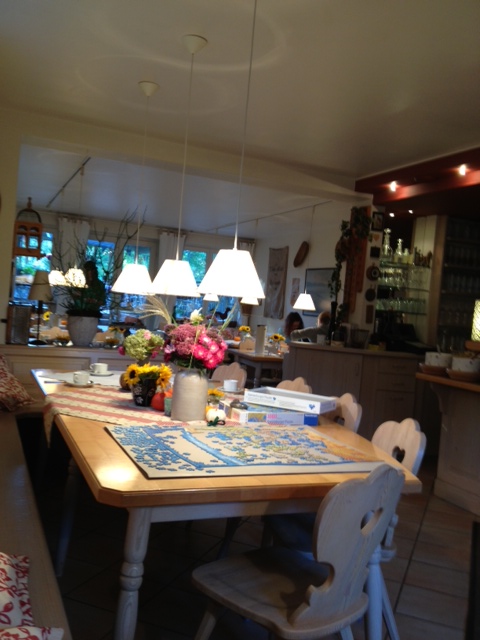
puzzle

The charming restaurant serves delicious evening meals. As a bonus the restaurant serves as a kind of living room where guests are welcome to mingle with the owner’s family and friends who stop by to visit.  There is a pretty library for use by guests.

Bookroom

The rates at Martinsmeuhle are less than what I typically pay for a forgettable interstate motel on a road trip in the USA. Europeans have been welcoming guests for generations.  They’re good at it, at all price levels.  TIme to work on my next trip!

Columbus Day

No American holiday is as controversial as Columbus Day.  Over 500 years after Christopher Columbus’s voyage to what was then the “New World,” celebrations often turn into protests.  Since Christopher Columbus was from Genoa in what is now Italy, Italian-Americans use the holiday to celebrate their heritage. Native Americans and others decry the exploitation of their peoples by the European colonizers.  We can all give some thought to history today. I am repeating some material from a previous post of mine for Columbus Day.

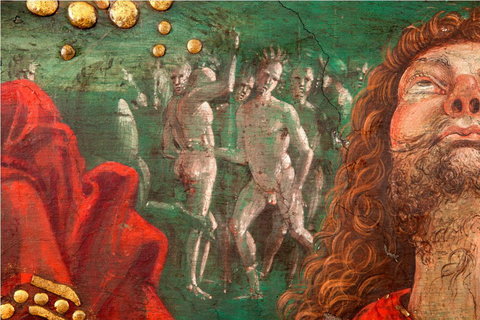
Remember the ditty, “In fourteen hundred and ninety-two, Columbus sailed the ocean blue?” Just two years after Christopher Columbus’s  voyage, in the year 1494, the Renaissance artist Pinturicchio apparently added images of the Native Americans described by Columbus to a fresco in the Vatican. Columbus called the people he met “Indians” because he mistakenly believed he had reached the East Indies, source of coveted treasure like silk and spices.

Detail of fresco showing Native Americans

News reports on the frescoes vary.  Either the images were more or less overlooked for the past 500 years, or they were uncovered in a recent cleaning of the fresco. The images are difficult to see.  They appear at the top of the open tomb.

Pinturicchio "Resurrection of Christ"
Pinturicchio “Resurrection of Christ”

The fresco, titled “Resurrection of Christ,” was commissioned for the rooms to be occupied by the newly-elected Pope Alexander VI.  This Pope was the former Spanish cardinal Rodrigo Borgia, so his rooms came to be called the “Borgia Apartments.” All the great powers in Europe at the time were much interested in the so-called “New World.” Of course, we now know that a big part of the interest in “the New World” was in exploiting the people and the riches to be found there.  But seeing this fresco gives us a little insight into the excitement in Europe over the new discoveries.  And over time, after many mistakes and abuses, a “New World” of freedom and democracy really was created.

I first read about this discovery in The New York Times, http://artsbeat.blogs.nytimes.com/2013/05/06/early-images-of-american-indians-found-in-a-vatican-fresco/. I have to thank Kathy Schiffer, in her blog “Seasons of Grace,” for coming up with the full image of the fresco.  Her article is at http://www.patheos.com/blogs/kathyschiffer/2013/04/first-ever-painting-of-native-americans-discovered-in-the-vatican/.

Today, in the midst of a government shutdown frustrating to everyone, the Statue of Liberty has reopened.  The reopening is timely.  In spite of grievous mistakes made by our country, past and present, and by European colonizers in the past, the United States still stands as a land of freedom and opportunity. The Statue of Liberty is still a cherished symbol of what America offers. An article about the reopening is at http://www.nytimes.com/2013/10/14/nyregion/statue-of-liberty-reopens-as-other-sites-stay-empty.html?_r=0.


Hemingway the Shredder Dude?

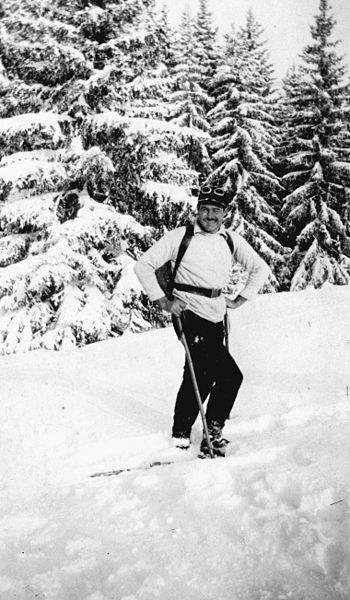
Hemingway on skis in 1927, public domain

Hemingway on skis in 1927, public domain

I liked seeing the town of Schruns last month.  It was Ernest Hemingway’s beloved Austrian winter home during his Paris years, when he was young and innocent and struggling to become a writer.  Skiing is the one Hemingway exploit I can relate to.  Big game hunting, hauling marlin out of the sea, wartime ambulance driving?  They’re all too macho, too far outside my experience.  But I know what it feels like to be alone on a mountain in a blizzard.

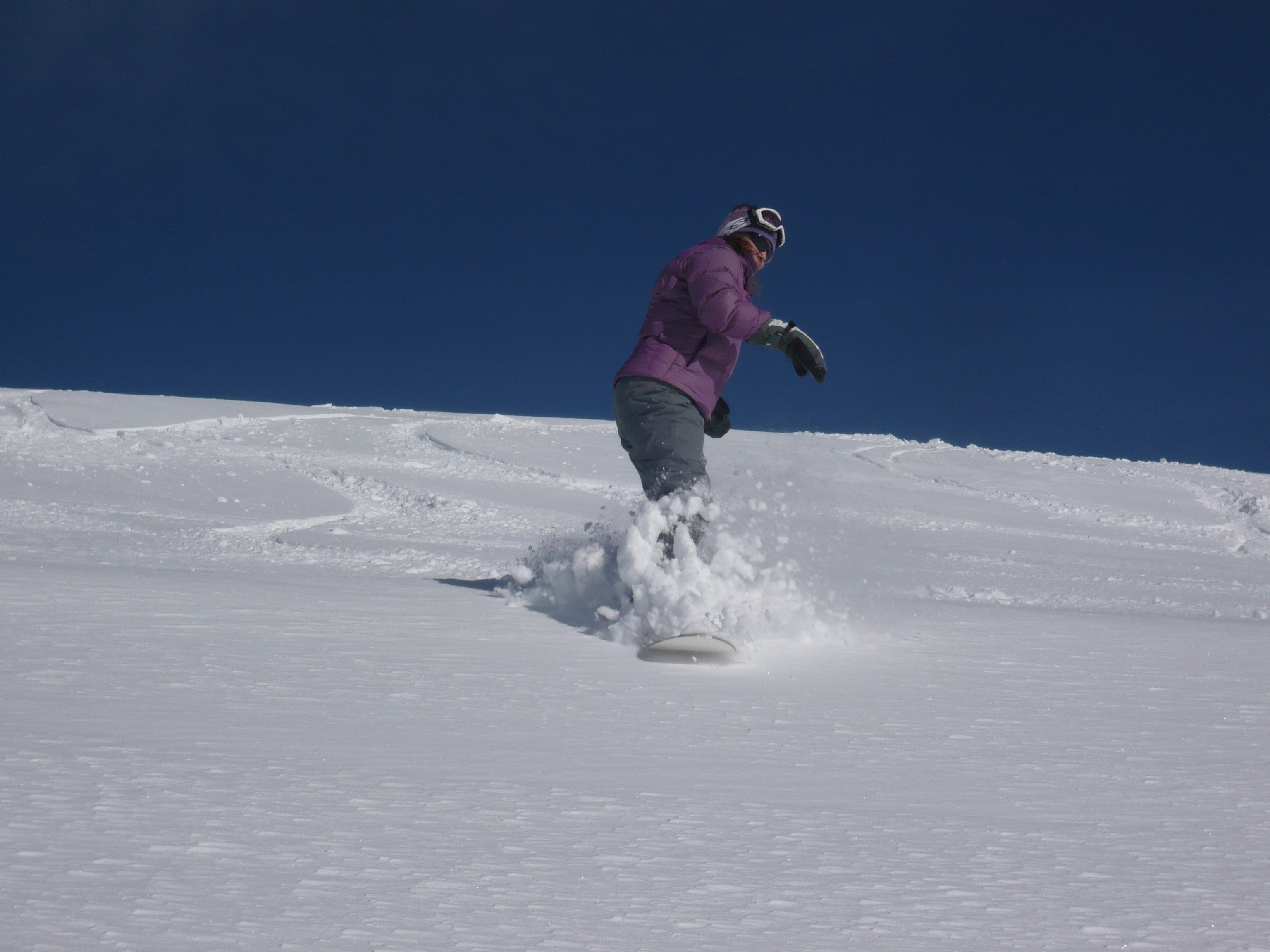
I’m not much of a back-country skier, at least so far.  Mount Werner in a blizzard is about as adventurous as I get, and it’s enough.  Some people are fair-weather skiers.  I prefer snowstorms, when powder piles up so deep and fast that my tracks fill in behind me. When the sun comes out, so do other skiers. It’s great at first, and makes for nice pictures. But soon the snow begins to get heavy and develop a crust. I like storms. Icy winds and blinding snow?  Bring ’em on. I love the mountain on storm days because hardly anyone else is out there.  Good. The mountain is mine.

MePowder4 MeSnowGhosts

I switched from skiing to snowboarding eleven years ago.  The learning curve was pretty steep, but it’s much easier on the knees.  I hope to be shredding well into my old age.

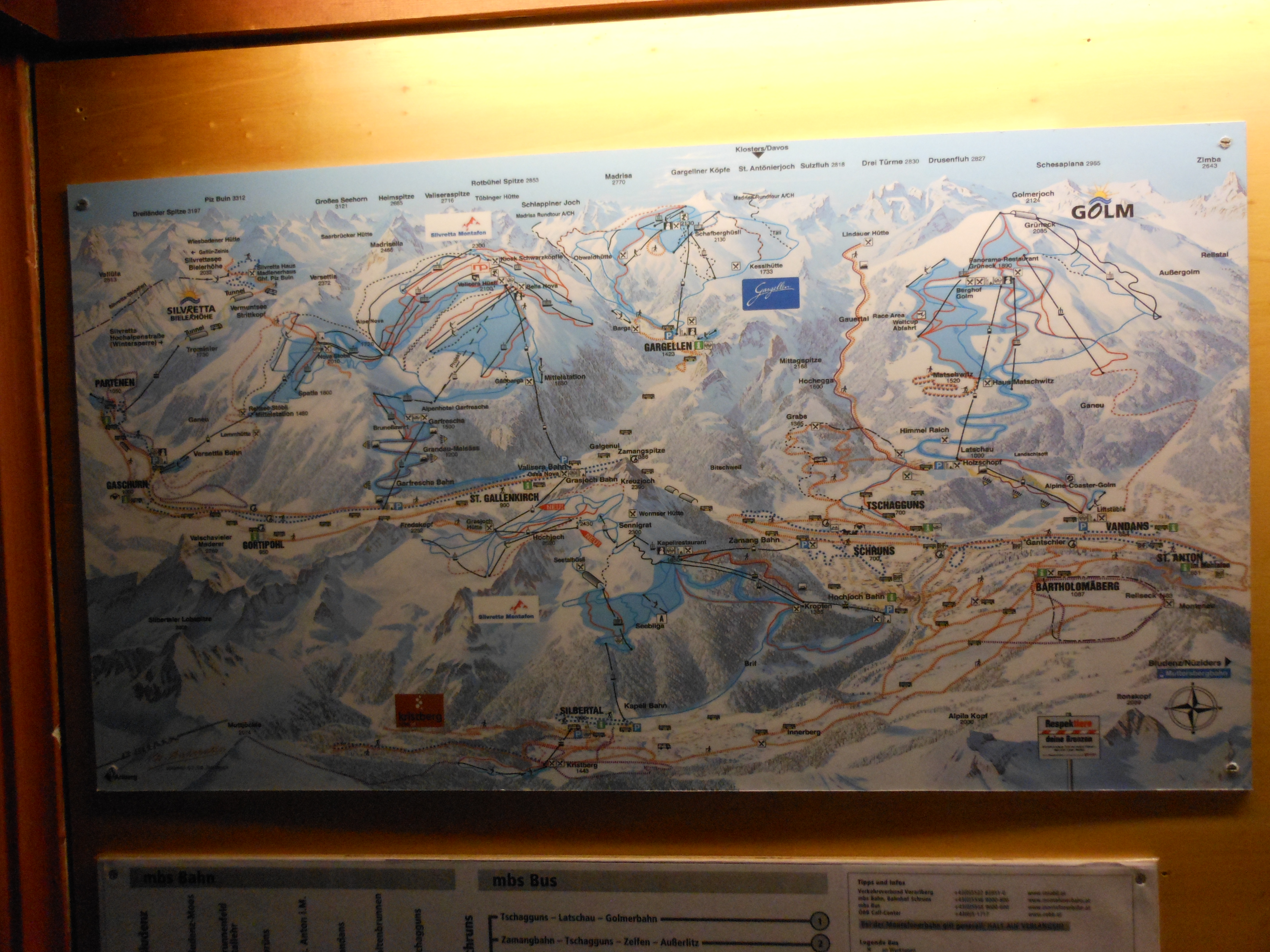
Today, Schruns still looks like a working town, unlike nearby Lech and Zurs.  European royalty and others with deep pockets fill the expensive hotels and crowd the expensive restaurants  in those resorts. In Schruns, there are probably no ski valets and it takes some doing to get to the lifts. In the 1920s, none of the present-day ski runs were neatly marked with signs.  The local people were mostly busy making a living.  They had no time for snowy hikes up into the high country just in order to risk life and limb skiing down.  Besides, they believed that devils lurked in the high mountains.

Schruns-Tschagguns Ski Map

Schruns-Tschagguns Ski Map

In Hemingway’s day, everyone who skied was a back-country skier.  There were no gondolas with heated seats and Wifi.  There were no chairlifts.  There were not even any humble tow ropes. As he recalled his life in A Moveable Feast, Hemingway wrote, “Skiing was not the way it is now, the spiral fracture had not become common then, and no one could afford a broken leg.  There were no ski patrols.  Anything you ran down from, you had to climb up to first, and you could run down only as often as you could climb up.  That made you have legs that were fit to run down with.”

Amazon

Hemingway’s mentor Walther Lent took small groups, including Hemingway’s cronies and sometimes his wife Hadley, up into the untracked high country for the ultimate reward: “unroped glacier skiing, but for that we had to wait until spring when the crevasses were sufficiently covered.”

On a ski trip to Switzerland years ago, I once skied around the rim and down the steep slope of a glacier, ending up at a remote train stop in a valley.  I don’t really claim bragging rights, because I was in abject terror most of the way down.  But I do know what a crevasse looks like:  an impossibly deep blue chasm opening up in the rutted, hard-packed snow in precisely the spot where I think I can manage a turn.  There’s no time to plan.  Survival means improvising, and later wondering how you did it.  Now that’s skiing, Hemingway style.

If Hemingway had lived to see the advent of snowboarding, would he have tried it in Sun Valley, where he lived out his final days?  I like to think so.  I wish he had lived just a little more prudently, for the sake of his liver and his aging knees.  Maybe he would not have succumbed to despair and left us too soon.  I doubt that he would wear knee pads like I always do.  I do know that if he ever buckled on a snowboard on a powder day, he would want to do it again.

Dude, he would be strong and sure and straight and true.


Hemingway in Austria

Ernest and Hadley, Winter 1922, photo from NPR article cited below

Ernest and Hadley, Winter 1922, photo from NPR article cited below

In the golden days of Ernest Hemingway’s youthful career as a writer, he and his athletic first wife Hadley used to escape wintery, gray Paris for a sunny ski town in Austria.  In the 1920s, they could live in Schruns on a shoestring all winter, enjoying crisp snow and roaring fires.  Hadley cheerfully hiked up and skied down bunny hills just behind the hotel while the great man labored at his writing, then joined him for cozy evenings.

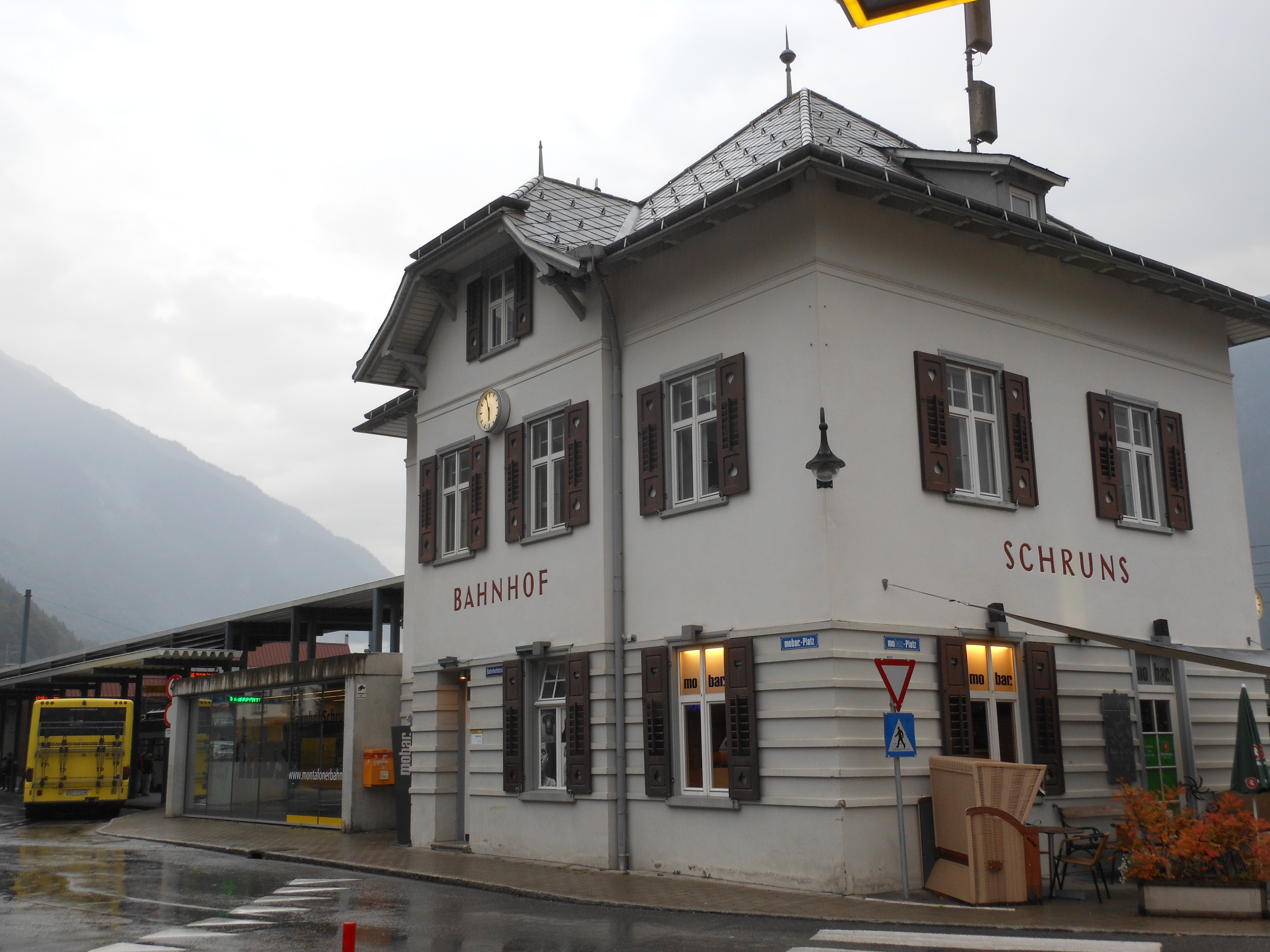
A couple of weeks ago I made a literary pilgrimage to the town of Schruns.  (Actually, it was more of a flying visit on a gray rainy day).  There is not a whole lot to see, but I found it moving to stand outside the actual railway station where Hadley and their toddler son Bumby waited to meet Hemingway after he returned from a pivotal meeting in New York, where he made his first major sale.

Bahnhof

What Hadley didn’t know at the time was that Hemingway had spent the previous few days with Pauline Pfeiffer, her supposed best friend.  Pauline would shortly become the second Mrs. Hemingway.

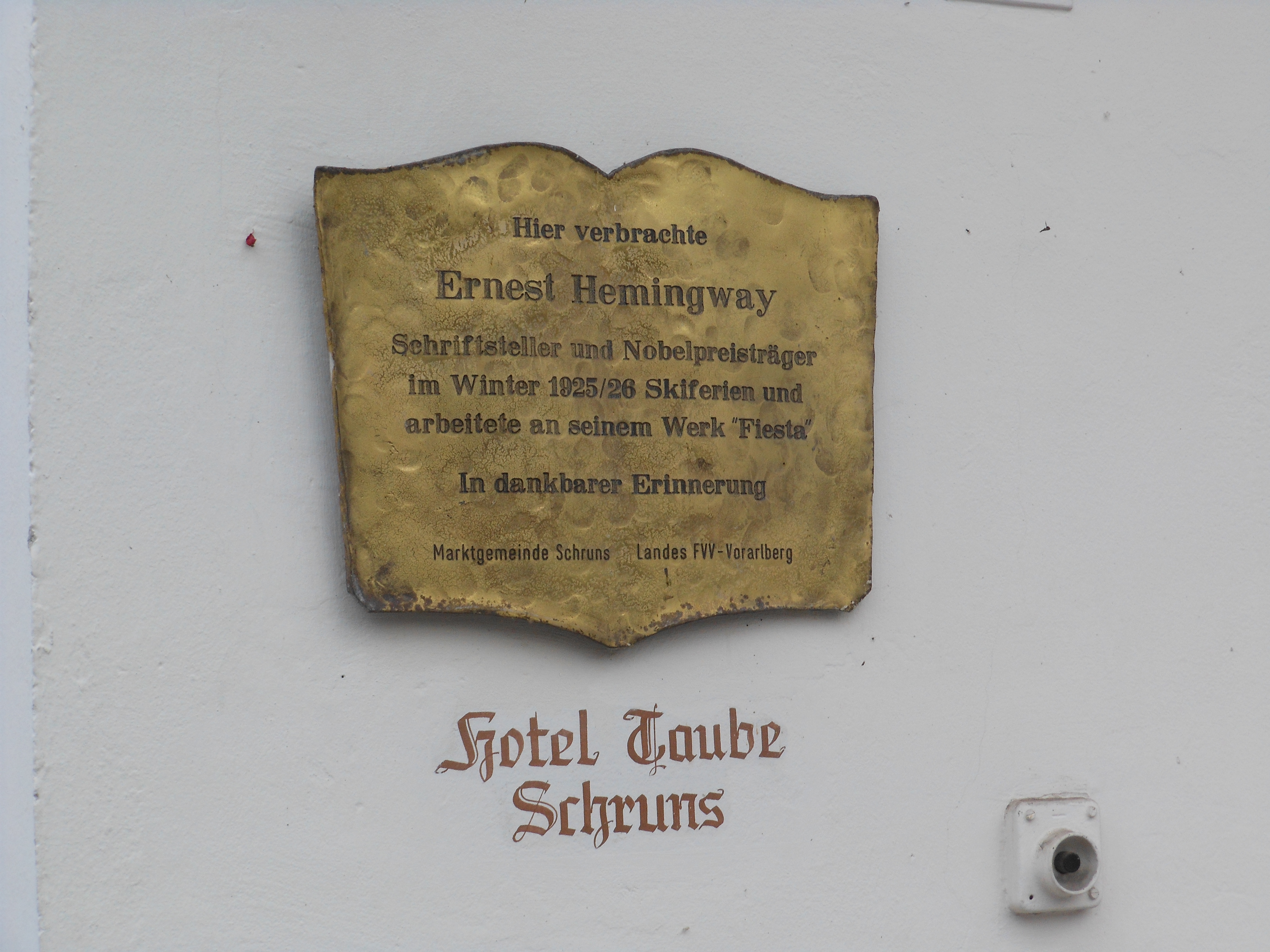
HemPlaque

The station is just a short walk from the hotel where the young family stayed–and where Pauline had previously insinuated herself for months, supposedly to keep Hadley company, while she single-mindedly pursued Hemingway.  Hadley must have been a little dim to have missed all this going on under her nose, especially when Pauline and Hemingway left at the same time.

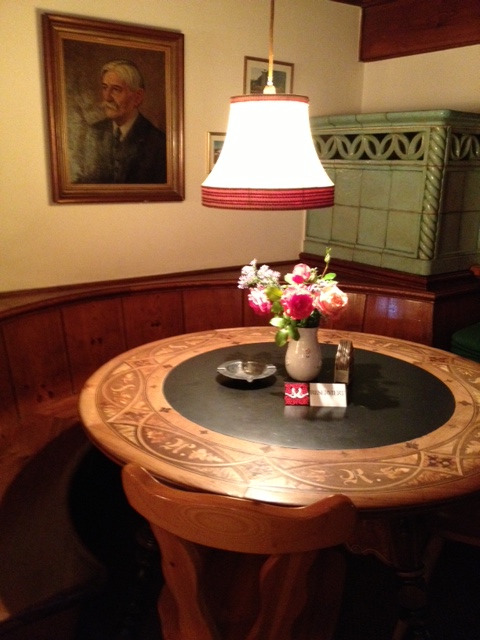
HemTable

Anyway, the hotel still stands.  It’s been remodeled inside, but there is still an actual table from the bar as it was in 1922, when Hemingway regaled Hadley, Pauline and his cronies with his skiing  and writing exploits.

I’m about to re-read Hemingway’s own account of that time in his memoir, A Moveable Feast.

Recently I read an interesting account of Hadley’s life with Hemingway in The Paris Wife by Paula McLain.

ParisWife

There’s an NPR review of that book by Lynn Neary at

http://www.npr.org/2011/03/01/134132944/the-paris-wife-dives-into-hemingways-first-big-love.

Join me next time for more explorations into the art and history of Europe–the major sights and the fascinating byways!