Category Archives: Artists

Prince Felipe Prospero: A Sad Infante

Diego Velazquez,

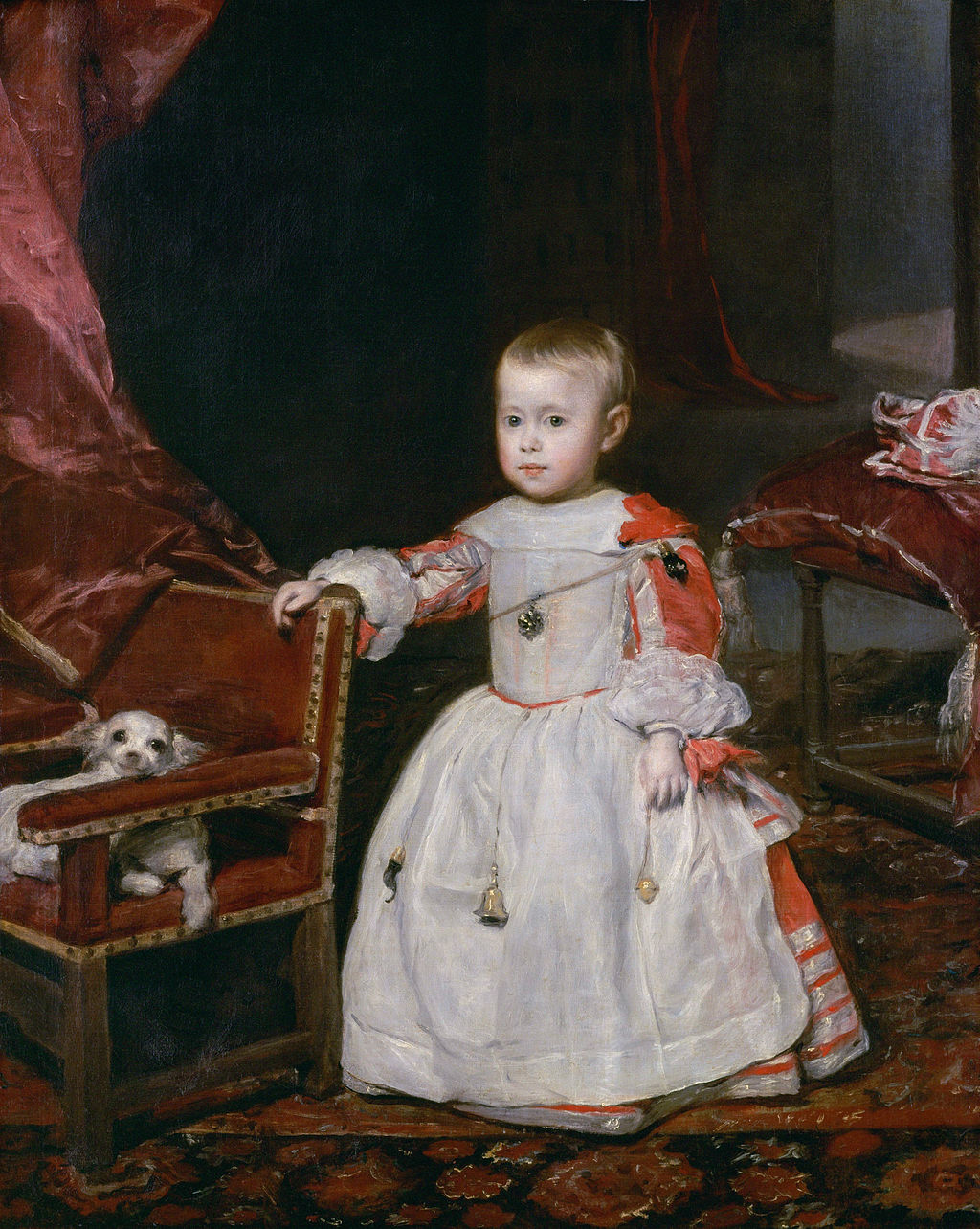
Diego Velazquez, “Prince Philip Prospero,” circa 1660, Public Domain, Kunsthistorisches Museum, Vienna

This painting is one of my very favorite works of the great Spanish court painter Diego Rodriguez de Silva y Velazquez.  It’s a loving depiction of Infante Felipe (Philip) Prospero around 1660. (Infante and Infanta were the titles of boy and girl royal children, respectively). Felipe Prospero was born in 1657. He was a long-awaited heir to the Spanish throne. His father was Philip IV of Spain;  his mother was Philip’s second wife, Mariana of Austria.  A son was essential; otherwise the husbands of Philip’s daughters would fight over the throne when he was gone.

Diego Velazquez,

Diego Velazquez, “Equestrian Portrait of Prince Balthasar Charles,” 1634-35, Public Domain, Prado Museum

The previous male heir, Prince Balthasar Charles, had died as a teenager, eleven years earlier. His death dashed the hopes of Philip IV for a stirring military career for his son.  As a devout Catholic, Philip believed that his sins had somehow caused the death of Balthasar. (Actually, the cause was most likely the collective sins of his family, who for many generations intermarried with their Habsburg cousins in order to keep their hold on power).

Felipe Prospero was greeted with ecstatic celebrations and baptized at the earliest possible moment, to the great joy of his parents and their subjects.  Water was brought from the River Jordan for the baptism.  The Spanish people celebrated with masquerades, bullfights, processions and also getting drunk and breaking up furniture. But the child was sickly, a fact that Velazquez did not try to hide.

FullSizeRender (1)

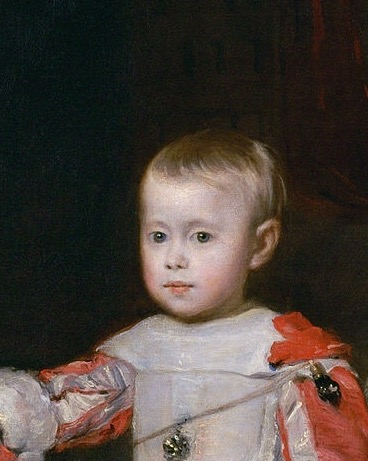
Felipe Prospero is pale. His eyes have a hollow look. Years of inbreeding between the Spanish and Austrian royal families had left him with a damaged immune system.

FullSizeRender

The amulets tied around his waist and across his chest were meant to ward off disease.

Nothing could help his worst medical problem, though.  Inbreeding had left Felipe severely epileptic. The child lived for only a short time after Velazquez painted this portrait. He died of a violent epileptic seizure in 1661, at age 3.

FullSizeRender (2)

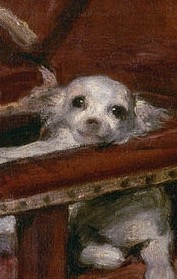
The painting captures the little boy’s wistful beauty, his fragility, and the sadness that surrounded him.  His little dog seems already to be mourning the child’s early death.

Velazquez was honored with a special exhibition last winter in Vienna.  The museum already has the largest collection of Velazquez paintings outside of Spain, and more were brought in for the spectacular exhibition. Because the Habsburgs enthusiastically intermarried with their Spanish cousins, Velazquez was kept busy painting portraits of prospective brides and grooms at various ages. The portraits are enchanting–and haunting.

Diego Velazquez,

Diego Velazquez, “Self Portrait,” 1640, Public Domain

Velazquez painted this self 
portrait the year before his own death in 1660.  I imagine the artist had a special feeling for this delicate child, so near to death at such an early age. To me, this painting is a profound reflection of the frailty and brevity of human life.My previous post told the story of Felipe’s older brother, Prince Balthasar Charles.  It’s at https://castlesandcoffeehouses.com/2015/07/27/velazquez-in-vienna/

Join me next time for more explorations in the art and history of Europe!

Gustave Caillebotte

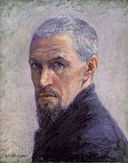
Self Portrait, Gustave Caillebotte, circa 1892, Public Domain

Self Portrait, Gustave Caillebotte, circa 1892, Public Domain

Maybe it is really best for an artist to be poor, at least at the beginning of a promising career.  It seems to me that inherited riches stopped the artistic career of a potentially great French painter, Gustave Caillebotte.

Caillebotte, 1848-1894, was born to an upper-class Parisian family; most of their large fortune came from textiles used for military uniforms. I can almost hear the family arguments that resulted in Caillebotte going to law school.  He was licensed as a lawyer in 1870 and was also trained as an engineer. (“Painting will never get you anywhere, son. Besides, why don’t you just run the family business? We need you.” This is all speculation on my part, of course). Anyway, Caillebotte was drafted to fight in the Franco-Prussian War for almost a year, 1870-1871.

He returned home safely, but rather than working in the family business or practicing law, he began serious study of art at L’Ecole des Beaux-Arts. I’d speculate that after seeing the horrors of war, he was determined to spend the rest of his life doing exactly what he wanted to do.  And being the heir to a very wealthy family gave him the means.

CaillebotteHs2

Last year while in Paris I made a trek by train about 12 miles south of the city to the country mansion of the Caillebotte family in the posh suburb of Yerres. There was a special exhibit of the artist’s work.  The champions of his work billed Yerres as “Caillebotte’s Giverny”–the tourist magnet that is the beautiful home and garden of Claude Monet. That was wishful thinking, at least for now. I doubt that Yerres will ever have the hordes of tourists that descent daily on Giverny.  But that is not a bad thing. No photos were allowed inside the exhibit; that was just as well, because it was easy to give each wonderful painting the close attention it deserved.

Caillebotte painted in a much more realistic style than many of his Impressionist friends, and often from unusual perspectives.
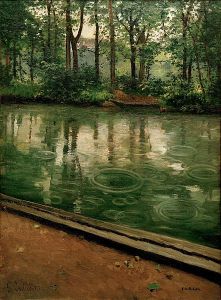
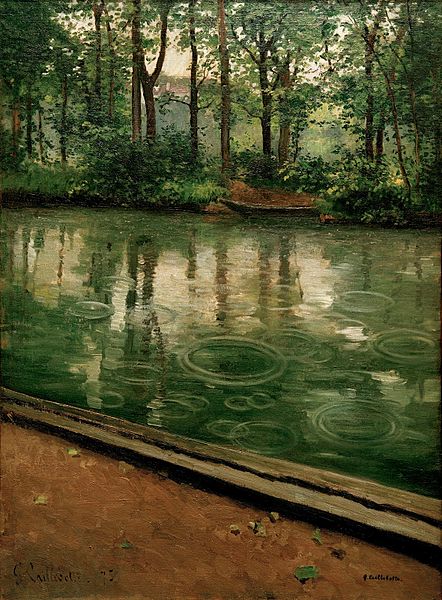
The Yerres, Effect of Rain, Gustave Caillebotte, 1875, GNU Free Documentation License

The Yerres, Effect of Rain, Gustave Caillebotte, 1875, GNU Free Documentation License

The property was much larger when the family occupied it.  But the house and grounds are still beautiful, and beautifully placed on the banks of the River Yerre. I especially loved the virtuoso painting above, depicting a moment of time as rain falls on the still surface of the river.  I loved the play of light and shadow. It was on loan from the Indiana University Art Museum in Bloomington.
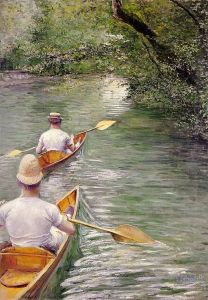
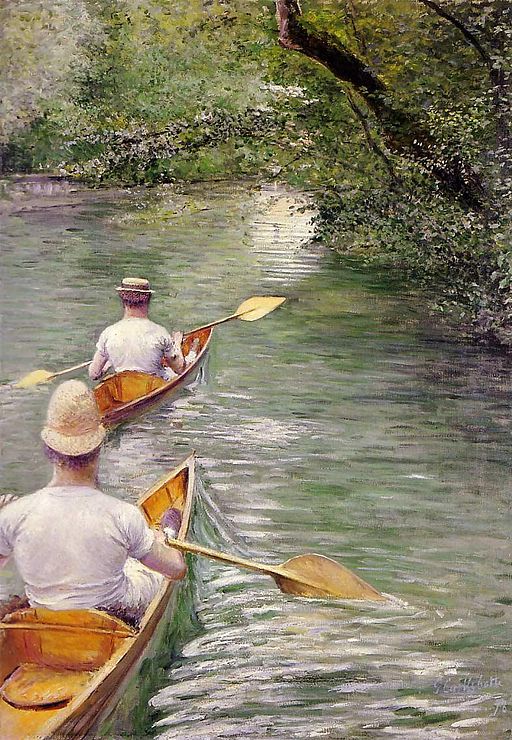
Les Perissoires, Gustave Caillebotte, 1878, Public Domain

Les Perissoires, Gustave Caillebotte, 1878, Public Domain

The exhibit had many other water scenes, like this one with its unusual vantage point just behind a pair of men paddling canoes on the river. It was on loan from the Museum of Fine Arts in Rennes.
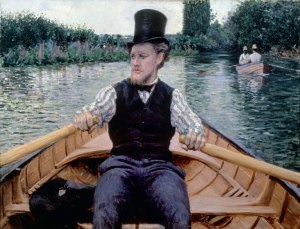
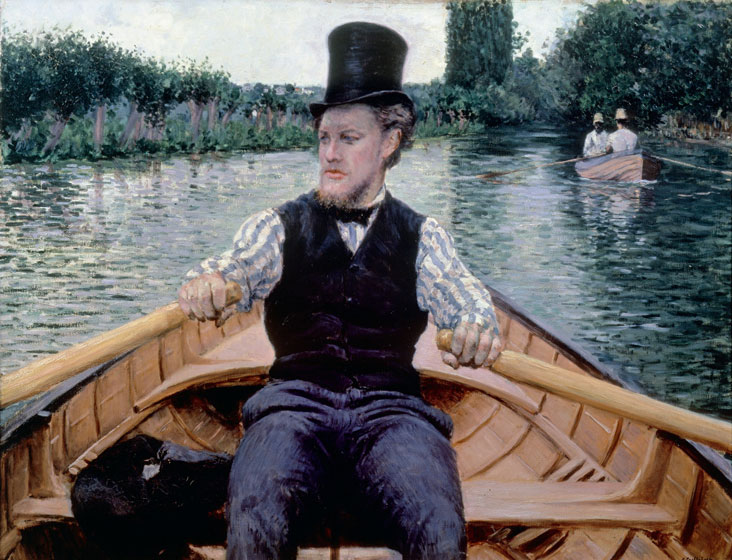
Gustave Caillebotte,

Gustave Caillebotte, “A Boating Party,” 1877-78, private collection

I stood for a long time in front of this painting of a gentleman rowing in a top hat and bow tie, and bought a large postcard of it. If I could carve out the time, I would travel to Washington, D.C. just to see this one painting again. The image above is from the website article from the National Gallery exhibit, cited below. What if the moments of our lives could be captured in a few thoughtful paintings, rather than a never-ending stream of selfies and forgotten party snapshots?

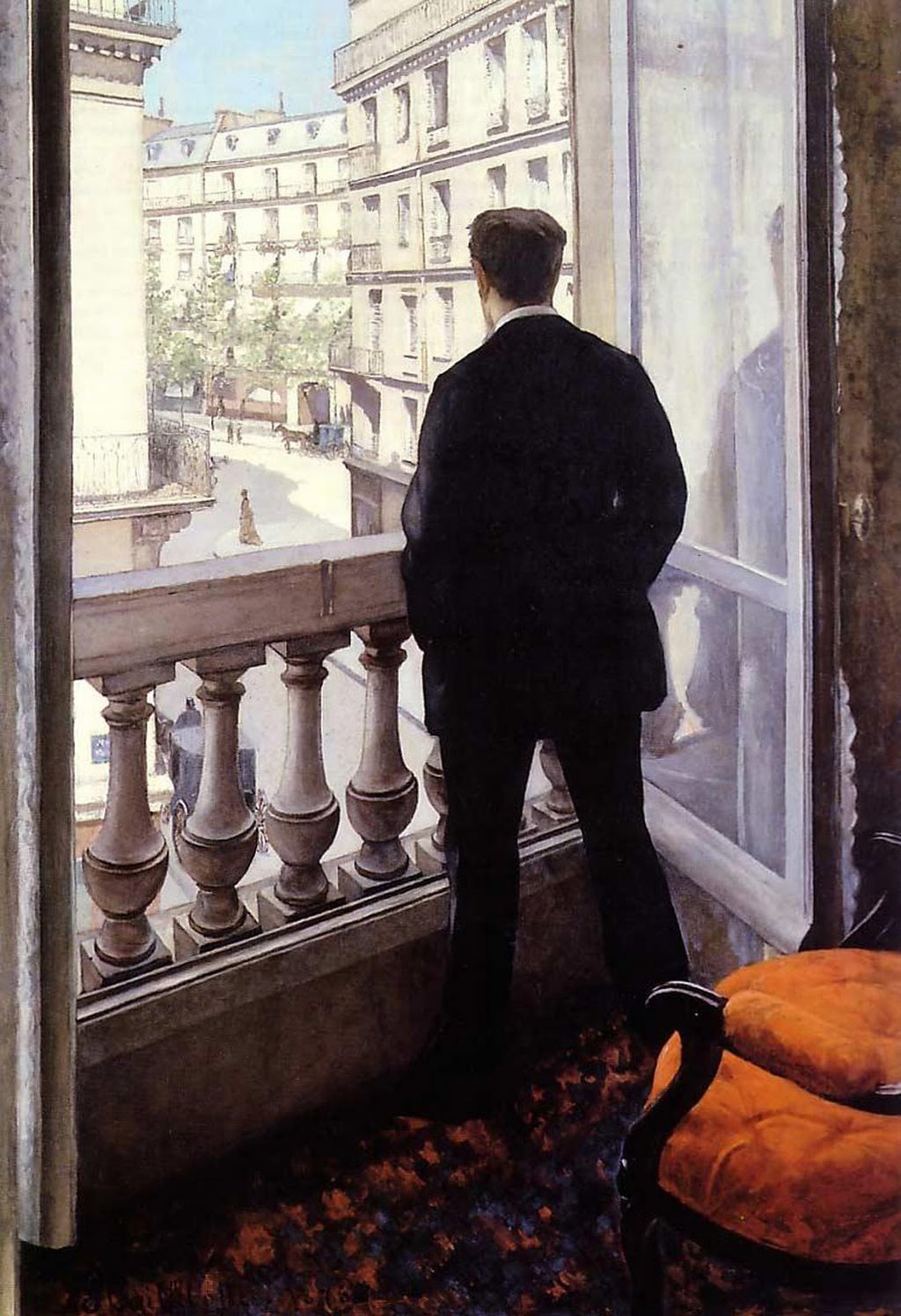
Young Man at a Window, Gustave Caillebotte,1875, Public Domain

Young Man at a Window, Gustave Caillebotte,1875, Public Domain

From his family’s Paris city home, Caillebotte also found unusual perspectives. The painting above shows Caillebotte’s younger brother looking out over the street from the Paris family home. The painting is from a private collection.
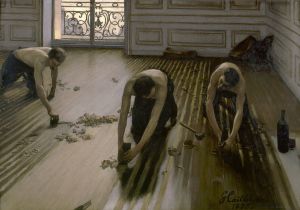
The Floor Scrapers, Gustave Caillebotte, 1875, Public Domain, Musee d'Orsay

The Floor Scrapers, Gustave Caillebotte, 1875, Public Domain, Musee d’Orsay

Caillebotte’s most famous painting, The Floor Scrapers, was controversial in his day. This masterpiece was actually rejected by the Salon of 1875. But the Impressionists loved it, and it appeared in their second Impressionist exhibit, where people stood in front of it and argued. Why? There was already a time-honored tradition of painting peasants at work in the countryside, but almost no one had honored urban laborers by painting them. The scene is believed to show a moment of refurbishment of the artist’s own studio in Paris. I love the play of soft light from the open window, the delicate curls of the planed wood, and the sweating shirtless laborers.  Did Caillebotte gain an appreciation of the work of ordinary people during his wartime service?

Sadly, Caillebotte mostly stopped painting at age 34; he was more interested in photography.  The exhibit I saw had a number of his photos, but in my mind they paled beside his paintings.  I wish he had stayed with his brushes and canvases.

For many years, Caillebotte was neglected as an artist and more well known as a patron of other artists, notably his Impressionist friends Auguste Renoir, Claude Monet and Camille Pisarro.  He bought their canvases, funded and curated their exhibits, and sometimes paid their rent.

Did Caillebotte believe he had reached the limit of his abilities and it was better to be a patron of more talented artists? Or was painting just too much hard work? He had the means to do anything he wanted to do.  What he wanted was to hobnob with artists, grow orchids, build yachts, collect stamps, and generally enjoy himself.  Who can blame him? And yet I wish he’d had a bit more of a work ethic.

Caillebotte died while gardening in 1894, aged only 45. He owned a collection of over 70 mostly Impressionist paintings, which he bequeathed to the French state on his death.  They formed the core of the state’s Impressionist collection.  Modestly, he only included two of his own paintings in the bequest.  The rest remained mostly with his family, since he had no need for money and rarely sold a painting.

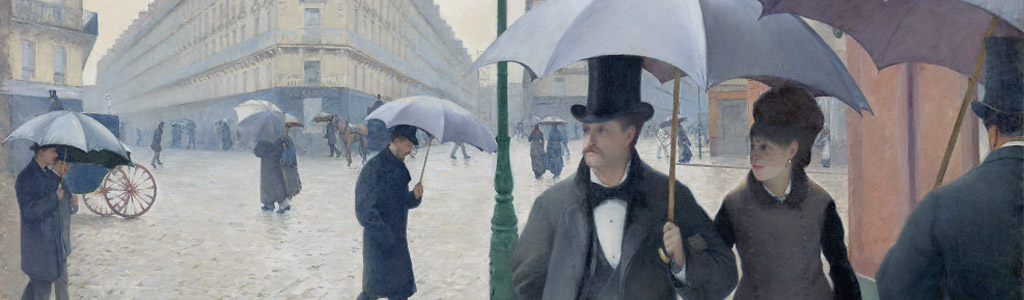
Gustave Caillebotte,

Gustave Caillebotte, “Paris Street, Rainy Day,” 1877, Public Domain, Art Institute of Chicago

Some of these paintings are part of an exhibit, Gustave Caillebotte: The Painter’s Eye, running through October at the National Gallery in Washington, D.C.  The website is at http://www.nga.gov/content/ngaweb/exhibitions/2015/gustave-caillebotte.html

Vincent van Gogh: Can We Forget About the Ear?

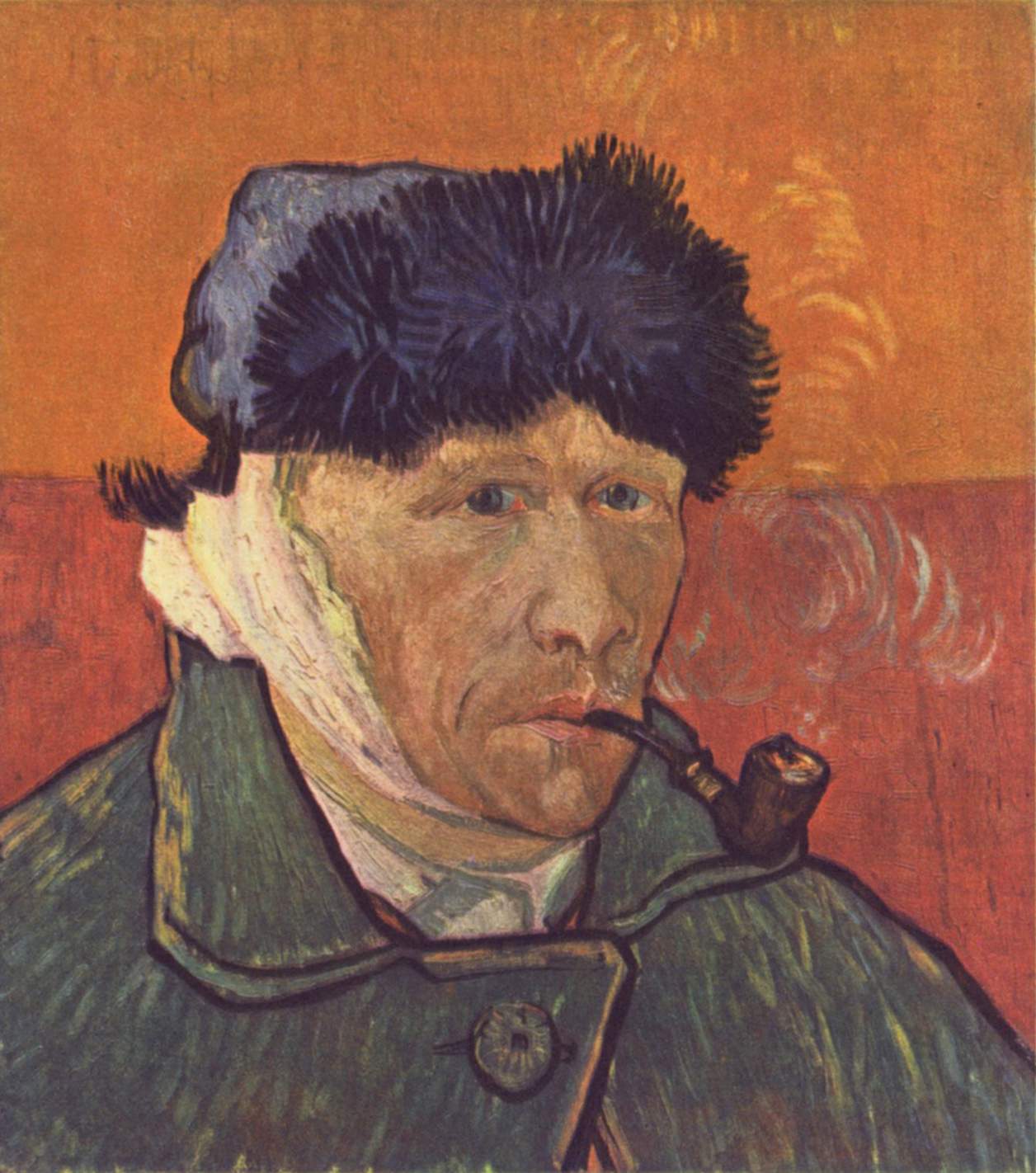
“Self Portrait with Bandaged Ear,” January 1889, Vincent van Gogh, Public Domain

Vincent van Gogh obviously had his share of problems.  Most of us don’t cut off an ear no matter how bad a day we’re having. (Actually, there is evidence that he only cut off a small part of one ear).  Today, mental health professionals would not be especially surprised by this behavior; we know now that people under severe stress do sometimes deal with their pain by cutting themselves or pulling out their hair.  My (unprofessional) understanding is that sometimes self-inflicted physical pain can be a distraction from overwhelming psychic pain.
Vincent tried valiantly to face his problems.  After the ear incident, he painted the rueful self-portrait above, showing himself bandaged. After each of his health crises, he sought the best medical care he could find. He followed medical advice, such as it was in his day.

“In a Cafe,” or “Absinthe,” Edgar Degas, 1873, Public Domain

At the end of a hard day at the easel, Vincent could have jogged five miles, lifted some free weights, and finished off the evening with a nice tall Gatorade.  Instead, he hung out in local dives and drank way too much absinthe. A little absinthe goes a long way. And he admitted that he smoked far too much, even on his deathbed. But then, he did not have Dr. Oz or Dr. Drew advising him.

Recent research at the Van Gogh Museum in Amsterdam has shown that Vincent worked methodically and with great care on his paintings. The findings are summarized in an article by Nina Siegal in The New York Times.  The director of the museum, Axel Ruger,  spoke about the recent exhibit, “Van Gogh at Work.”  Mr. Ruger said, “You discover more clearly that van Gogh was a very methodical artist, which runs counter to the general myth that he was a manic, possibly slightly deranged man who just spontaneously threw paint at the canvas.” The article is “Van Gogh’s True Palette Revealed,” at http://www.nytimes.com/2013/04/30/arts/30iht-vangogh30.html?_r=0

Vincent must have been as lucid as anyone else for much of the time. And yet, he had periods of serious craziness, including terrifying hallucinations,  that made him helpless.  And he apparently ended his own life by gunshot at age 37, at a time when he was at the height of his artistic powers.

So what was wrong with him?    To me, the most convincing explanation is that he was bipolar.  Of course, this diagnosis did not even exist during his lifetime, and there was no effective treatment.  In addition, he may have had chronic malnutrition.  He was poor for his entire life.  Once he decided to become a painter, his only income was whatever his hard-pressed brother Theo could afford to send him. Vincent was single-minded.  When faced with a choice of a new pot of paint or a nice chicken baguette with arugula, he went with the paint every time.  Not only that, but there is evidence that he sometimes ate his paint, in the heat of composition. Some of the paints he used must have been highly toxic and might have caused hallucinations in the most sane of us.

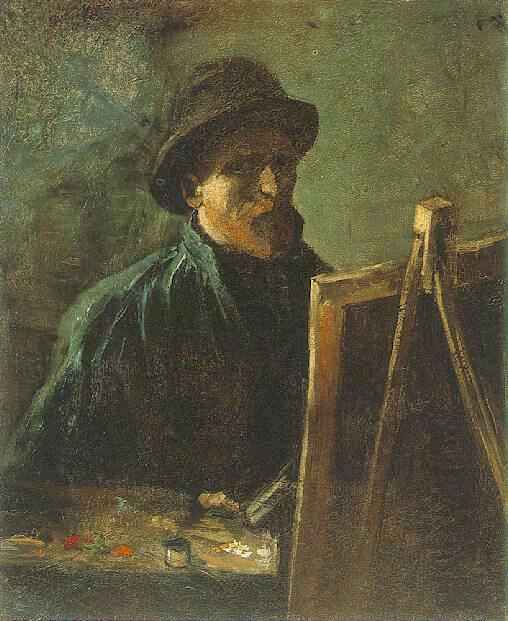
Self Portrait with Dark Felt Hat at the Easel, Vincent van Gogh, 1886, Public Domain

Self Portrait with Dark Felt Hat at the Easel, Vincent van Gogh, 1886, Public Domain

In 1886, Vincent painted the dreary self-portrait above. He looks depressed, buttoned up, shut in by his waiting canvas.  Any writer or painter knows that the blank page or canvas is a challenge and a reproach. The failed effort is even worse. Vincent’s palette in this portrait even looks dreary, just blobs of muted color. Still, the miracle is that with the love and support of his brother Theo, this man pulled himself out of his low periods so many times.  In the decade that Vincent worked seriously as a painter, he produced about 860 oil paintings plus about 1300 works in other media, like watercolors and prints.  He got on with it, even though not a single painting sold in his lifetime.

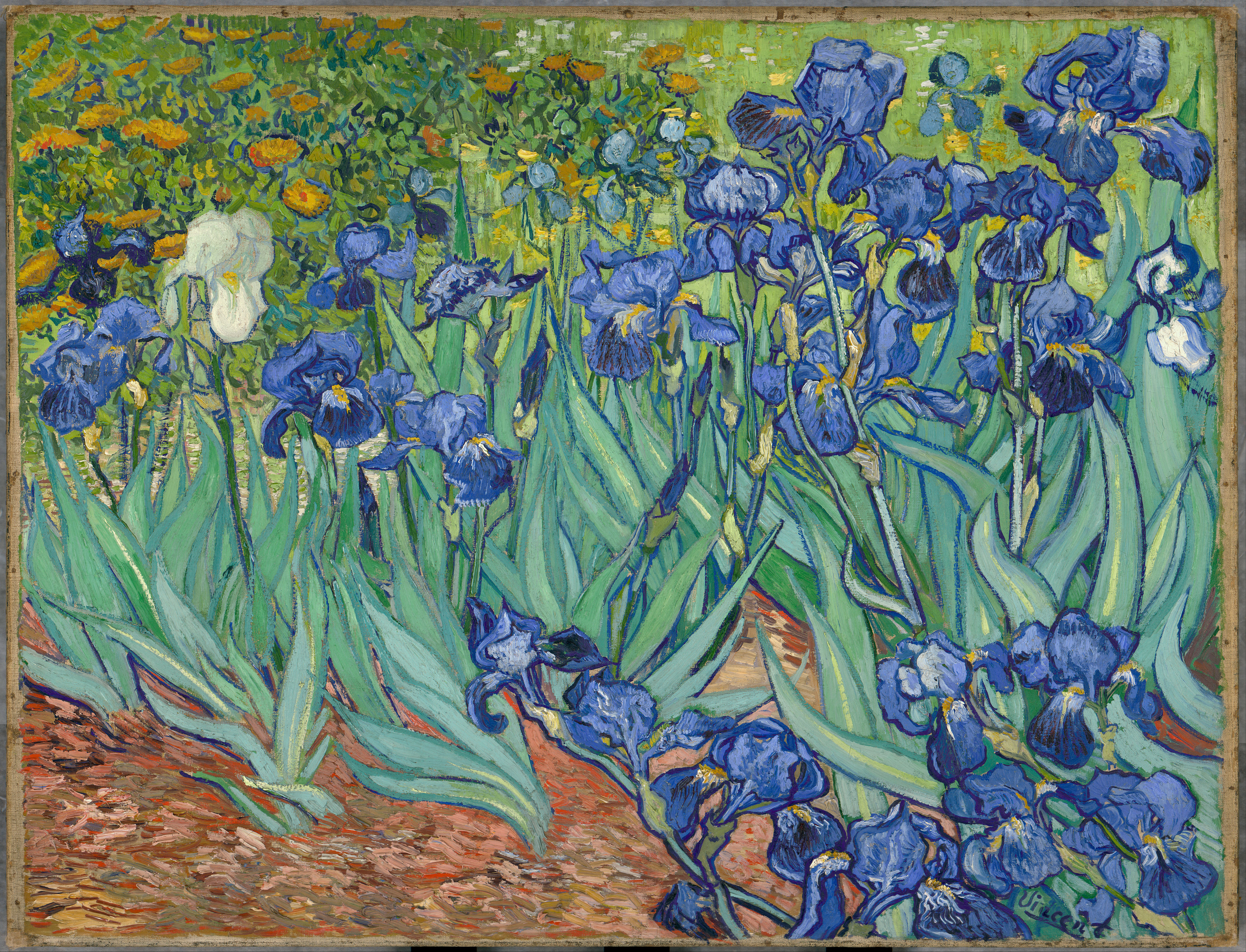
“Irises,” Vincent van Gogh, 1889, Public Domain

We have become so familiar with reproductions of Vincent’s paintings on calendars and coffee mugs that we often don’t really see them. Standing in front of an original painting, inches away from his actual brushstrokes, it is impossible not to feel Vincent’s joy in life and color. “Irises,” pictured above, is at the J. Paul Getty Museum in Los Angeles.

Are you wondering if you are reading this for the second time?  My apologies!  I had additional thoughts about a post I wrote a couple of years ago, so I revised and reposted. Join me next time for more explorations in the art, artists and history of Europe!

Vincent and Theo

imgres

In 1990, Robert Altman directed the movie Vincent and Theo, concerning the relationship between Vincent Van Gogh and his brother.  The fine actor Tim Roth plays Vincent.  The equally fine Paul Rhys plays his brother Theo. It was originally made as a 4-hour BBC mini-series, which the director Altman compressed into a feature film. Rolling Stone called the Altman movie “a masterpiece.” But then, lots of Altman films are known as masterpieces.

The film brilliantly evokes the times in Paris and in the south of France.  There is nothing very picturesque about poverty in either place.  Vincent’s brave attempts to create a stable life for himself are heartbreaking.

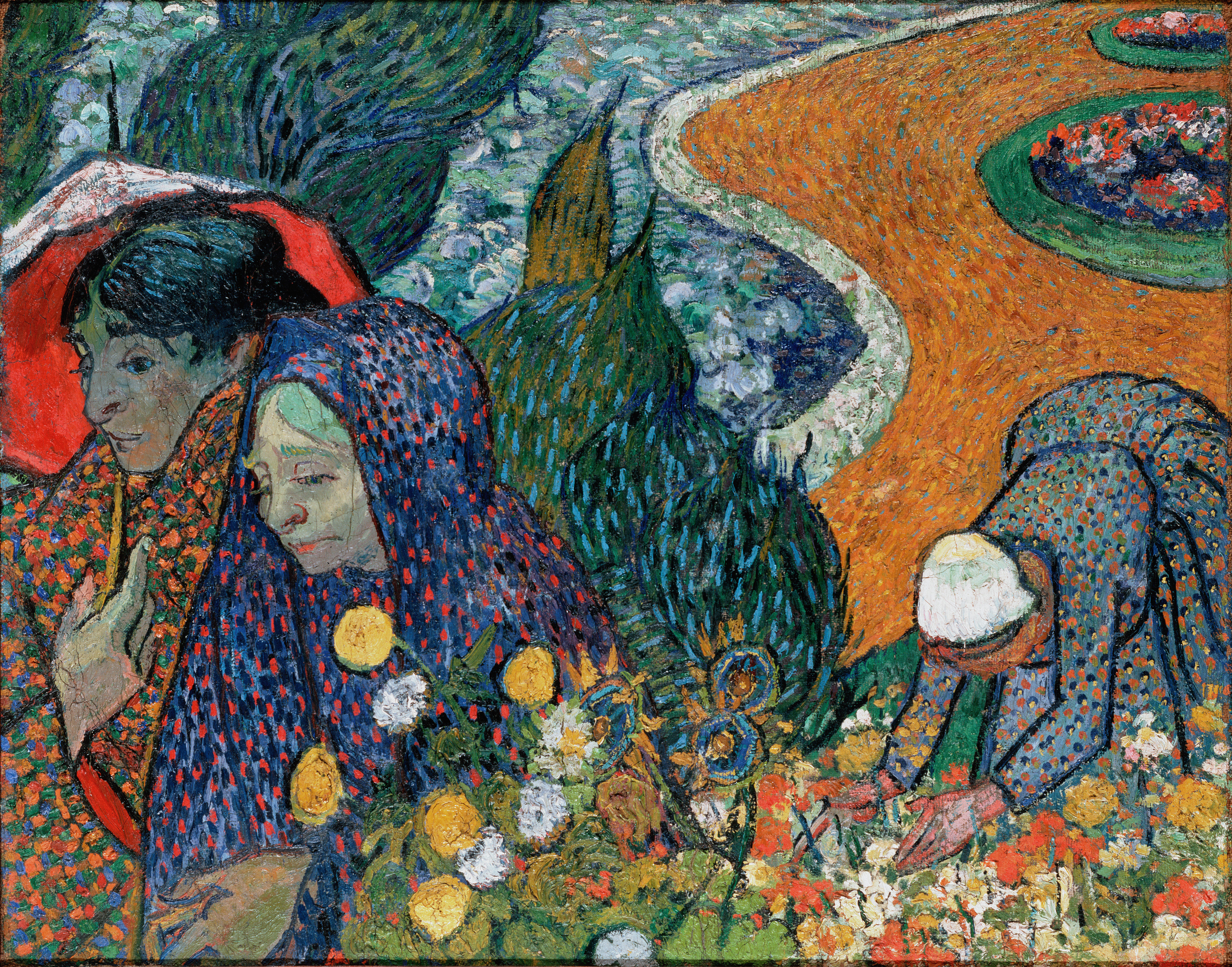
“Memory of the Garden at Etten,” Vincent van Gogh, 1988, Public Domain

In 1888, during his troubled time with his painter friend Paul Gaugin in Arles, van Gogh painted his mother’s garden at Etten from memory.  I don’t know whether I’ll ever see the original; it’s at the Hermitage in St. Petersburg.  It’s a stunning painting.  Vincent wrote about it to Theo:  “A reminiscence of our garden at Etten with cabbages, cypresses, dahlias and figures…Gaugin gives me courage to imagine and the things of the imagination do indeed take on a more mysterious character.” Which of the figures is van Gogh’s mother?  One of the sad-looking figures in the foreground?  Or the woman bent over her garden in humble hard work?  Maybe they all represent his mother, or his childhood, in some way.  I think this painting would have had deep meaning for the brothers who shared so much.

Having recently visited the Van Gogh Museum in Amsterdam, I gave the film another look.  I have always thought of Theo as the long-suffering, conventional patron of his tortured genius brother.  In the film, interestingly, Theo comes across as equally troubled.  In fact, he sometimes seems more tortured than VIncent.  At least Vincent always has his single-minded determination to paint.  Theo has self-doubts.  Why is he stuck working in art galleries?  Why can’t he afford to get married?  Finally he does marry, in spite of suffering from syphilis.  Then he has a wife and colicky baby to add to his troubles.

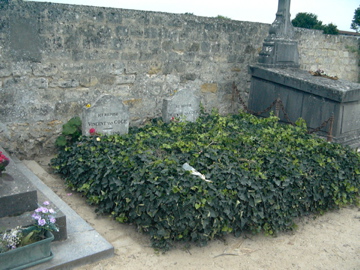
VincentTheoGraves

Theo was always in frail health.  In fact, he died just a few months after VIncent’s death.  The brothers are buried side by side in Auvers. When I visited, a few years ago, the cemetery adjoined a cornfield that could have come straight out of a van Gogh painting. The same ivy vine intertwines and covers the graves of the two brothers. It’s a lonely trek to see the graves; this is not a major tourist attraction. The brothers’ relationship, troubled as it was, gave us the gift of Vincent’s paintings, which always attract clumps of viewers in museums lucky enough to own them. Vincent could not have painted his masterpieces without the love and support of his brother Theo.

I wrote about Vincent’s mother and their loving relationship in a previous post at  https://castlesandcoffeehouses.com/2015/05/09/thanks-for-eve…m-love-vincent/

Join me next time for more explorations in the art and history of Europe!

Thanks for Everything, Mom! Love, Vincent

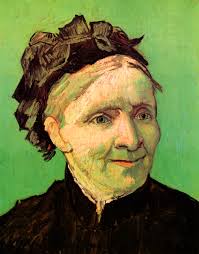
Portrait of the Artist's Mother, Vincent van Gogh, 1888, Public Domain

Portrait of the Artist’s Mother, Vincent van Gogh, 1888, Public Domain

Vincent van Gogh painted a portrait of his mother in October of 1888 during his stay in Arles, France.  This was an autumn of turmoil for Vincent; Paul Gaugin visited him in Arles, they quarreled, and the visit finally ended with the infamous ear-cutting episode.


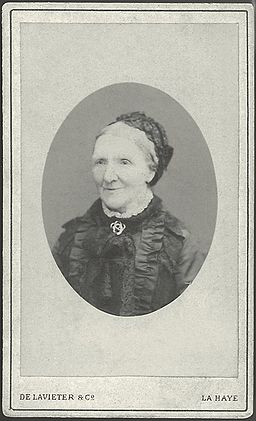
Photo of Anna van Gogh, Public Domain

Photo of Anna van Gogh, Public Domain

It seems that Vincent was missing his mother, whom he had not seen in years.  He wrote to his brother Theo that he was painting his mother for himself.  He had received a black and white photograph of her, and couldn’t bear to look at it. So he painted her in the soft glowing colors in which he remembered her. I wish he could have visited her. I think that her gentle actual presence would have helped him at this point in his life.

Vincent’s mother, Anna Carbentus van Gogh, raised six children: Vincent, Theo, Anna, Elizabeth, Wilhelmien and Cornelius.  Vincent was the oldest, although an earlier son, also named Vincent, had died.  Anna van Gogh was a pastor’s wife, tirelessly serving rural communities. Still, she found time to paint in watercolors, especially flowers and nature subjects.  She shared her love of flowers and painting with her children. As he accumulated finished canvases, Vincent used to send flowers to his mother in the form of paintings.  He sent, he wrote, “great bouquets of flowers, violet-colored irises, great bouquets of roses.”

Vincent’s parents had conservative and conventional religious views.  They were dismayed when he turned away from the institutional church and developed his own mystical religious view of the world, in which the divine was present everywhere at all times.  They could not approve of his stubborn poverty for the sake of his art, and they certainly could not approve of his unconventional love life.  But I love to think of Vincent’s mother, at her modest home in the Netherlands, unrolling a canvas from her son and finding a glorious bouquet of irises.

Irises, Vincent van Gogh, 1889, J. Paul Getty Museum, Public Domain

Irises, Vincent van Gogh, 1889, J. Paul Getty Museum, Public Domain

You can see van Gogh’s portrait of his mother at the Norton Simon Museum in Pasadena, California.  It’s one of my very favorite small museums in the world, worth going a little out of the way to visit on any trip to Los Angeles.

Happy Mother’s Day to all moms!  Join me next time for more explorations into the art, artists and history of Europe.

Jerome and His Lion

Niccolo Antonio Colantonio,

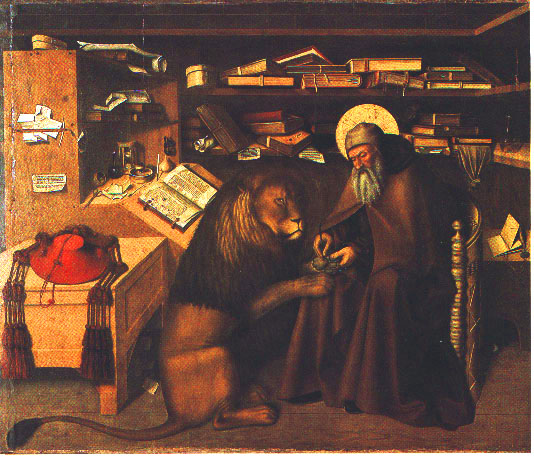
Niccolo Antonio Colantonio, “Jerome in his Study,” c. 1440-1470, Public Domain, National Museum of Capodimonte

Animal lover that I am, one of my favorite saints is Jerome, AKA Saint Hieronymous. Why? Because he befriended a lion in the wilderness–or at least so the legend goes. In the painting above, the lion has ventured into the saint’s dusty study with a thorn in his paw.  Jerome sets his book aside and carefully removes the thorn.  In other depictions, the saint comes across the lion, writhing in pain, out in the wilds. Either way, the legend is that from the moment Jerome extracted the thorn, the lion never left his side.

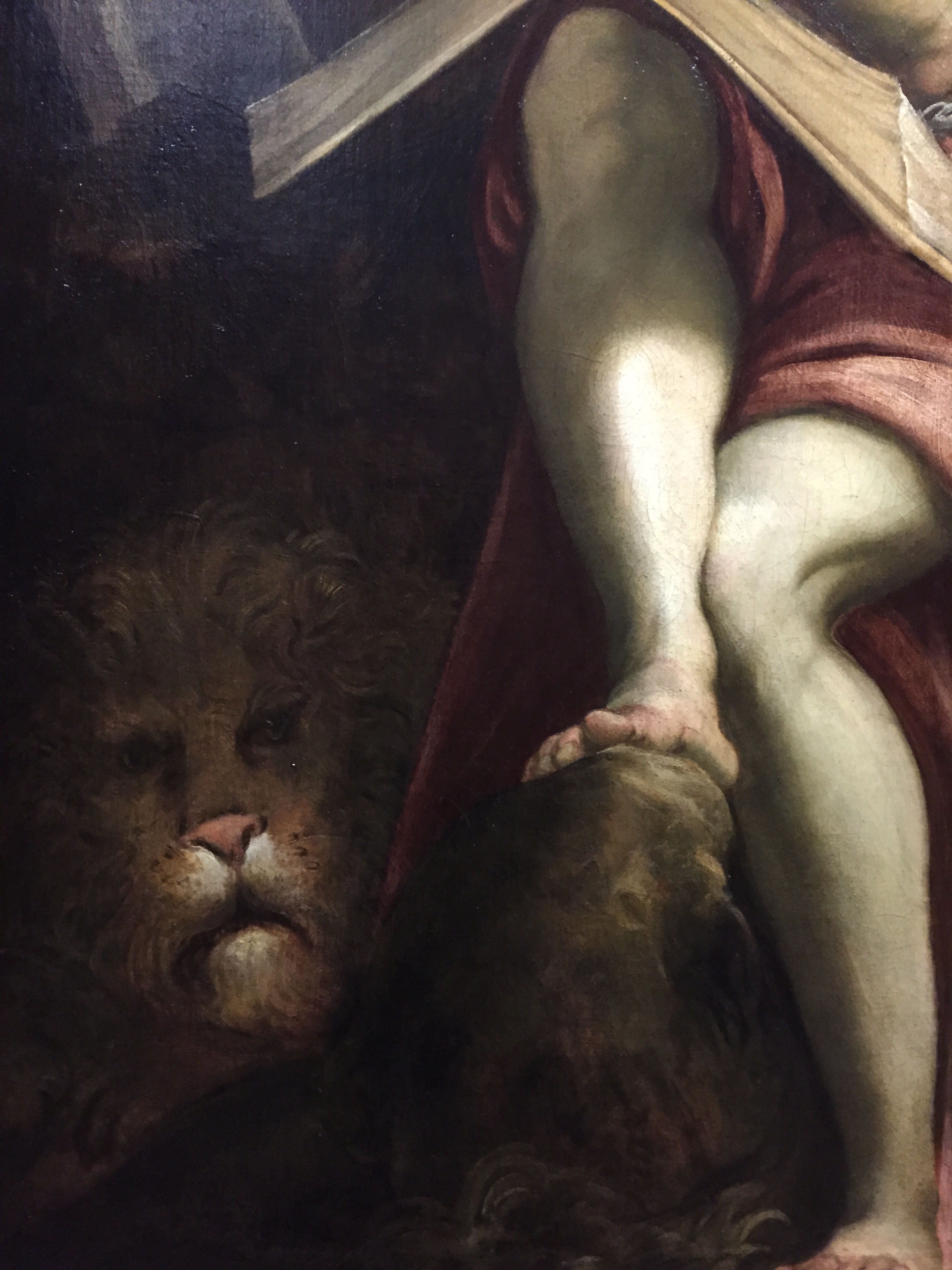
St. Jerome, Jacopo Tintoretto, Kunsthistorisches Museum, Vienna

St. Jerome, Jacopo Tintoretto, Kunsthistorisches Museum, Vienna

Jerome was born around the year 347 A.D.  He lived mostly in what is now Croatia.  A scholarly fellow, he became one of the earliest Doctors of the Church, before titles like “Cardinal” existed.  One of his main accomplishments was translating the Bible into Latin, from its original Aramaic and Greek.

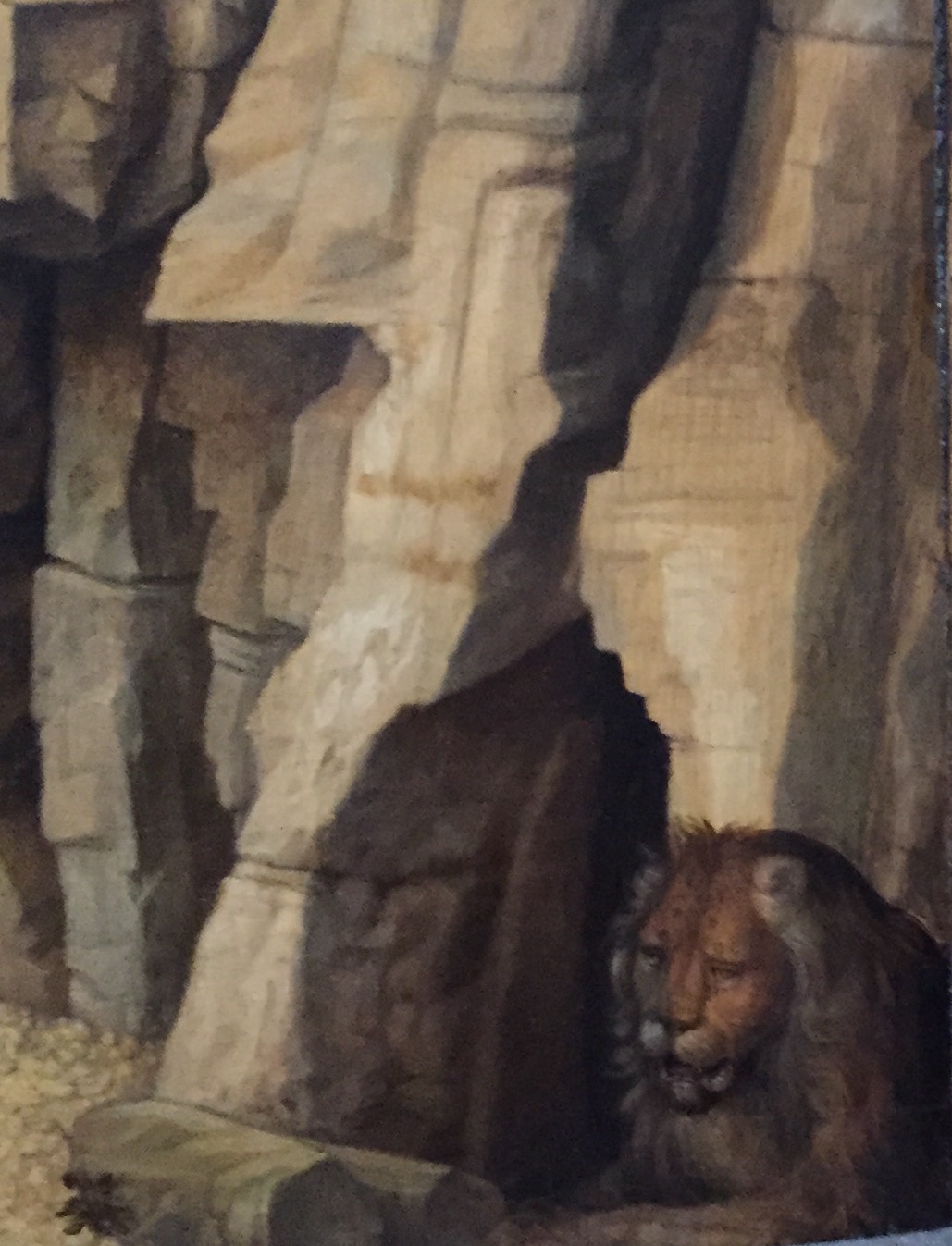
In paintings, the lion often lurks under a table or in a dark corner.

IMG_3174

I took the two photos above in the Kunsthistorisches Museum in Vienna. I love the legend, and whenever I’m in an art museum I’m on the lookout for images of Jerome and his lion. They have been painted countless times.

IMG_3495

Whenever I spot Jerome and his lion, I move in for a closeup.

Workshop of David Gerard, Saint Jerome in a Landscape, about 1501, my photo taken in National Gallery, London

Workshop of David Gerard, Saint Jerome in a Landscape, about 1501, my photo taken in National Gallery, London

To me, Jerome’s friendship with his lion is part of his concern and care for the whole creation.

Antonello da Messina, Saint Jerome in his study, about 1475, my photo taken in National Gallery, London

Antonello da Messina, Saint Jerome in his study, about 1475, my photo taken in National Gallery, London

Sometimes the lion is not underfoot, but he’s always close by. He’s a little hard to spot in the painting above. Time to move in for a closer look.

FullSizeRender (3)

The faithful lion is always present.  In the painting of Jerome in the large study above, he’s patrolling the perimeter. No matter what, the lion always had Jerome’s back.

Giovanni Bellini, Saint Jerome Reading in a Landscape, circa 1480-5, my photo taken in National Gallery, London

Giovanni Bellini, Saint Jerome Reading in a Landscape, circa 1480-5, my photo taken in National Gallery, London

If the lion’s face is shown, he always has a friendly, grateful, loyal face–much like a shy family dog. He tends to look a little wary–who is about to disturb his friend Jerome?

FullSizeRender (2)

Are these paintings just sentimental portrayals of a serious saint who should be remembered for much more than a story that may not have happened at all?  The subject is the medieval and Renaissance equivalent of sharing cute animal videos online.

On a busy day, a couple of minutes spent watching photogenic animals feels to me like a guilty pleasure. What am I accomplishing by watching a gorilla rock a kitten to sleep or a dog rescue a teacup pig from drowning?  Well, I’m not getting a thing done, but I’m pausing in a busy day to learn compassion from animals. Like those videos, the images of St. Jerome and his lion give us an appreciation of our bond with the animals who share our world. The animals mostly treat each other and our world better than we humans do. If I were St. Jerome, I wouldn’t mind being remembered as an animal lover as well as a high-powered scholar.

Join me next time for more explorations in the art and history of Europe!

Maria Christina: She Even Got the Canova!


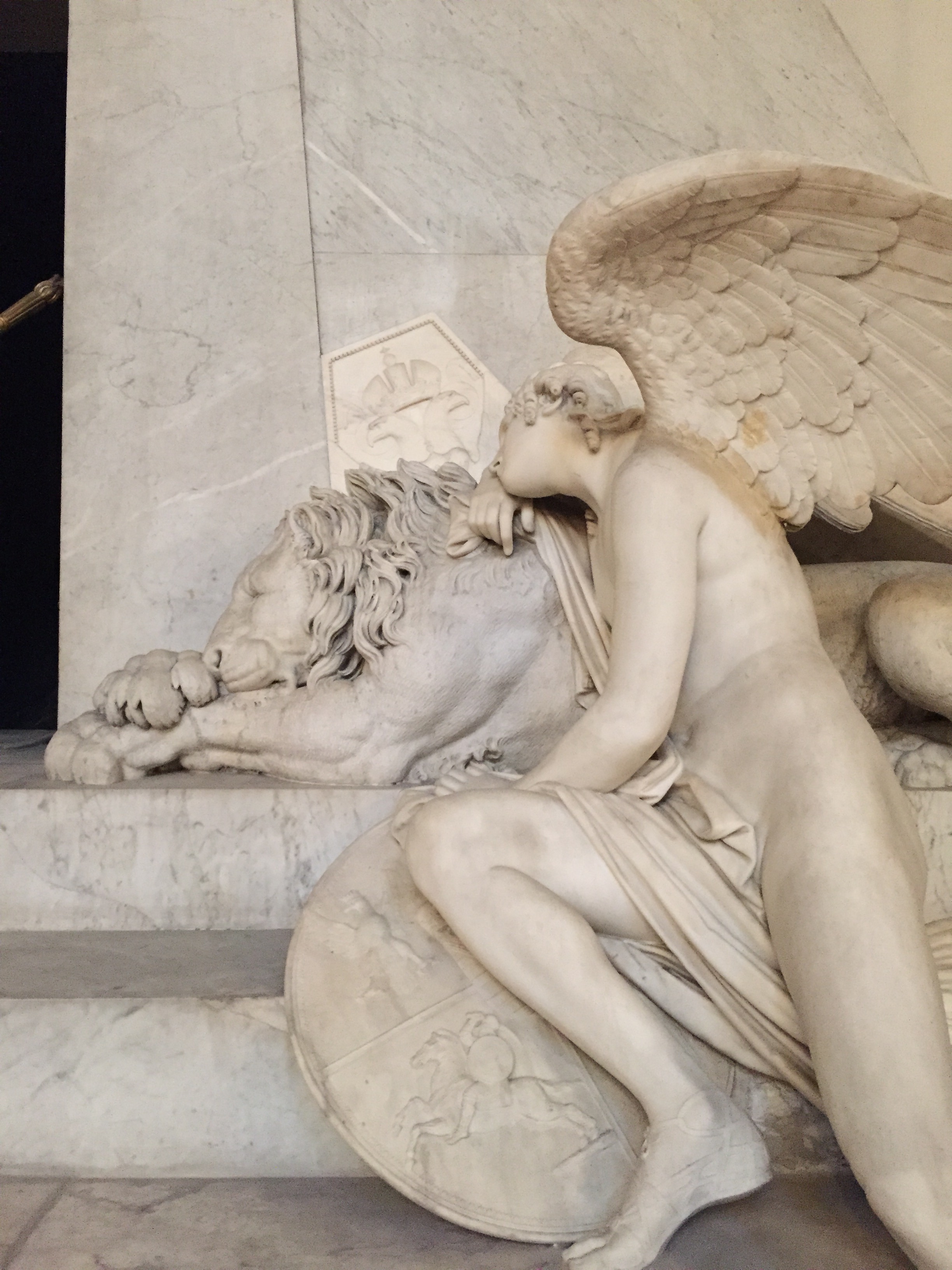
MariaChristinaCanova The Augustinian Church, adjoining the Hofburg Palace in Vienna, contains one of the saddest and most grandiose memorials I’ve ever seen.  It occupies a huge section of wall space in the family church of the Habsburgs. It was exquisitely sculpted by the great Italian artist Antonio Canova in 1805 and remains one of his most famous works.  A procession of downcast mourners slowly climbs the stairs toward an open doorway with nothing but darkness inside. Gazing into the void of that black space is truly terrifying.


MariaChristinaCanova2

A tearful lion lies beside the doorway, disconsolately resting his mighty chin on his paws.  A handsome male angel leans on the lion’s back, clearly overcome with grief. The whole structure is in gleaming white marble. Canova’s funeral monuments were mostly for Popes and Venetian nobles, plus a small one for the British war hero Horatio Nelson. Most people agree that the monument in the Augustinian Church in Vienna is the grandest and most beautiful of them all.

Maria Christina

Maria Christina

This masterpiece honors a woman who never did much of anything: Archduchess Maria Christina, favorite daughter of Empress Maria Theresa. After her death at age 56, her husband (flush with wealth lavished on the couple by the Empress) commissioned the monument.

Who is buried in Maria Christina’s tomb?  No one.  She is actually buried in the Imperial Crypt along with the rest of the Habsburgs. But apparently her husband, with the blessing of her mother, wanted everyone who attended church at the Augustinian to be reminded of her loss.

I can’t help thinking of Marie Antoinette, the unfortunate younger sister of Maria Christina. After her beheading, she was unceremoniously thrown into a common pit along with other victims of the Terror in Paris.  Reportedly, when Maria Christina heard of her sister’s gruesome death, she remarked, “She never should have married.” Of course Marie Antoinette had nothing to say about whether or whom or when she married, unlike the more fortunate Maria Christina.

Why did Maria Theresa favor one daughter so highly, out of all her 16 children?  Was Maria Christina possibly the most intelligent?  If Maria Christina had been the daughter sent off the France, might she have been intelligent and strong-willed enough to persuade Louis XVI, a bit of a dim bulb, to accept some reforms before mobs marched on Versailles? Failing that, might she have persuaded Louis XVI to decamp to a safe haven until things cooled down at home? As it was, he ignored many chances to escape.  When he finally decided to make a run for it, the carriage he chose  was a huge lumbering vehicle that stuck out like a sore thumb on the rural roadways of France.  The royal family was captured and hauled back to prison in Paris.

A previous post about the Augustinian Church is at:

https://castlesandcoffeehouses.com/2014/12/01/habsburgs-hatc…and-dispatched/

Previous posts about Marie Antoinette are at:

https://castlesandcoffeehouses.com/2014/03/21/another-tragic…rie-antoinette/

https://castlesandcoffeehouses.com/2014/12/02/marie-antoinet…dow-treatments/

Theresia11-12

Maria Theresa was not the most fair or loving mother, but she had her good points.  I wrote about her at:

ttp://castlesandcoffeehouses.com/2014/04/16/maria-theresa-…-lean-in-woman/

Join me next time for more explorations in the art and history of Europe!

Love in the Dutch Golden Age


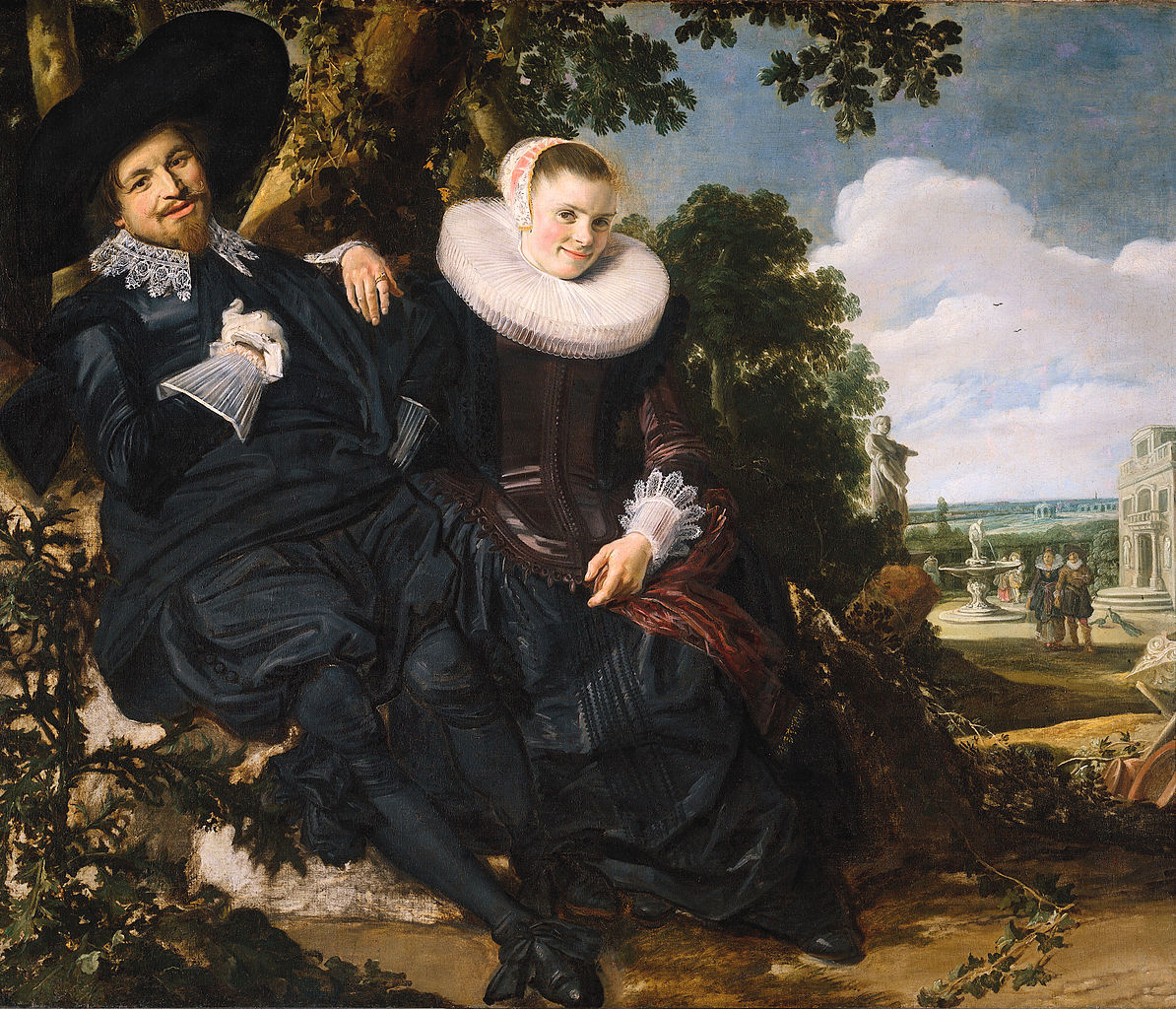
Portrait of a Couple, Franz Hals, c. 1622, Amsterdam Rijskmuseum

Portrait of a Couple, Franz Hals, c. 1622, Amsterdam Rijskmuseum

This happy couple posed for the great Dutch portrait artist Franz Hals in around 1622. They were married in April of that year.  They seem completely at ease with each other, and they exude the joy of love. They are believed to be Isaac Abrahamz Massa and Beatrix van der Laen.  The relaxed pose was unusual at a time when portraits were serious business.  However, Hals was known to break conventional norms all the time in order to show the true humanity of his subjects.  And these people were known to be friends of the artist.

Hals included references to love and marriage:  a garden of love to the right, and to the left an eryngium thistle.  This plant was a symbol of male fidelity. (Let’s hope Isaac took the symbol to heart).  I’d like to think these two joyful people enjoyed a long and happy marriage. Happy Valentine’s Day, Isaac and Beatrix!

Pixels and Pearls

PearlPixels

A few months ago in Amsterdam, I stayed at a bed and breakfast with especially trendy-but-funky decor.  One entire wall of my room was covered in little squares about the size of sample paint chips from the hardware store, all hinged together in an abstract design.  The shapes and colors were oddly familiar.

The Girl with the Pearl Earring, Johannes Vermeer, c. 1665, Public Domain

The Girl with the Pearl Earring, Johannes Vermeer, c. 1665, Public Domain

After about a day, I realized why the image was familiar.  Of course!  I was looking at an abstraction drawn from Johannes Vermeer’s “The Girl with the Pearl Earring,” painted by the still-mysterious master of light and shadow in about 1665 in Delft. Vermeer worked slowly on his small canvases of domestic scenes, but he lavished the extremely expensive blue pigment of lapis lazuli on his work, building up luminous surfaces from repeated glazes.

When I returned home, I watched the 2003 movie Girl with a Pearl Earring, directed by Peter Webber from a screenplay by Olivia Hetreed.  The story was taken from Tracy Chevalier’s historical novel of the same title. The painting creates a dramatic tension by its very subject matter:  the humbly dressed but beautiful young woman should not be wearing a priceless pearl earring. She is gazing back over her shoulder at the  viewer, as though caught in a guilty act. Yet she has an undeniable dignity and poise.

Theatrical Release Poster

Theatrical Release Poster

What’s the story here?  This is the question the book and movie explore.  In the Dutch Golden Age, as in our own time, the rich always find ways to exploit the poor. Scarlett Johansson is luminous as a servant girl pressed into service as a model for the artist.  Colin Firth plays the artist, who painted this masterpiece in 1665. The movie explores themes of class, creativity, the waste of human potential, and the tragedy of repressed talent. Repressed sexuality is there, too.

The movie asks a lot of questions. How can the powerful rich be reined in? How far should an artist go to pursue a vision? What happens if a poor girl happens to have artistic talent? Colin Firth is in fine smoldering form, and Scarlet Johansson gives him plenty to smolder about. Tom Wilkinson and Cillian Murphy (of the high cheekbones and piercing blue eyes) round out the cast. The film was nominated for Academy Awards, the BAFTA, and Golden Globes. Unfortunately it fizzled like a seventeenth-century candle at the box office, but I have it on DVD for those times I really need to retreat to the Dutch Golden Age.

In my Amsterdam room, once I realized I was looking at a pixellated version of a masterpiece, all I wanted was to see the masterpiece itself in all its glory. The Rijksmuseum in Amsterdam has several Vermeers. But this particular painting is not in Amsterdam; to see it, I’ll have to travel to the Mauritshuis Museum in The Hague.  Time to plan another trip!

Join me next time for more explorations in the art and history of Europe!

Happy Birthday, Pablo Picasso!

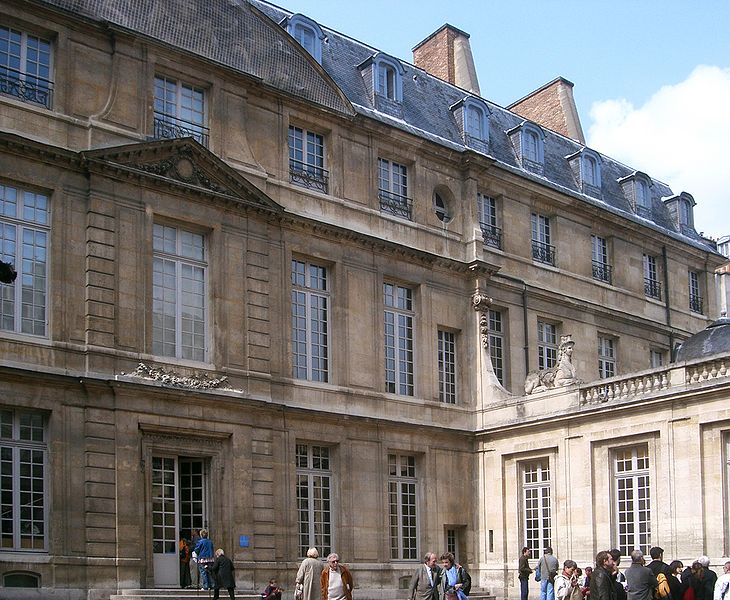
Today in Paris, the Musee Picasso reopens after five years of turmoil and $60 million in renovation.  It’s the anniversary of the great artist’s birth in 1881. (He would be 133 today!) Francois Hollande, the French President, will attend.  Throngs of art lovers will follow.  I’ll be among them as soon as I can swing a trip to Paris. When I was last in Paris, last spring, I just missed the planned May opening; it was one of many, many dates that came and went with no opening after all.

"Hotel Sale," photo by Beckstet, Creative Commons Share Alike 3.0

“Hotel Sale,” photo by Beckstet, Creative Commons Share Alike 3.0

The project was overseen by a distinguished but idiosyncratic Picasso scholar, Anne Baldassari. Five years ago, she was given the responsibility of remodeling the 17th-century mansion in the Marais district of Paris. Her uncompromising vision for the renovation turned a planned two-year project into five long years. The old museum never seemed crowded to me.  Not that many tourists made their way to its imposing gates.  The museum always felt a little damp; after all the “Maris district was once a swamp. It was always a labyrinth of rooms clearly carved out of a very old space never meant for exhibiting art.  But it was always one of my favorite museums. The space seemed appropriate; Picasso spent his entire career working in ancient spaces, both grand and humble.  He spent the years of World War II working tirelessly in studios in Paris, even though he was forbidden to exhibit his work by the occupying Nazis.

Anne Baldassari was dismissed about a year ago, after acrimonious struggles with workers, other administrators, and Picasso heirs.  But her scholarship is still respected; she was invited back to curate part of the hanging of the largest collection of Picasso paintings in the world. The museum houses about 5,000 works. In the old space, only a small fraction could be exhibited at a time. Picasso’s family donated most of these works to the French state after his death, in payment of death taxes.

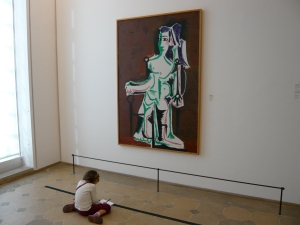
ChildPicasso

One of my most unforgettable sights in a museum was not a work of great art; it was a young child crouched on the floor of the Musee Picasso in Paris. As her mother waited nearby, the little girl moved from one Picasso painting to another, intently drawing in a notebook. She was oblivious to anything around her, and people respectfully stood back to let her work.  What she was doing WAS work, not play. Was she a budding genius, or just a kid going through a stage, as kids will? Hard to tell, but I admired her mother for patiently spending the day letting this child pursue her passion.

I think Pablo Picasso would approve.  I hope he enjoys his birthday in his renovated museum!