Category Archives: Uncategorized

Tyntesfield: Victorian Splendor Rescued

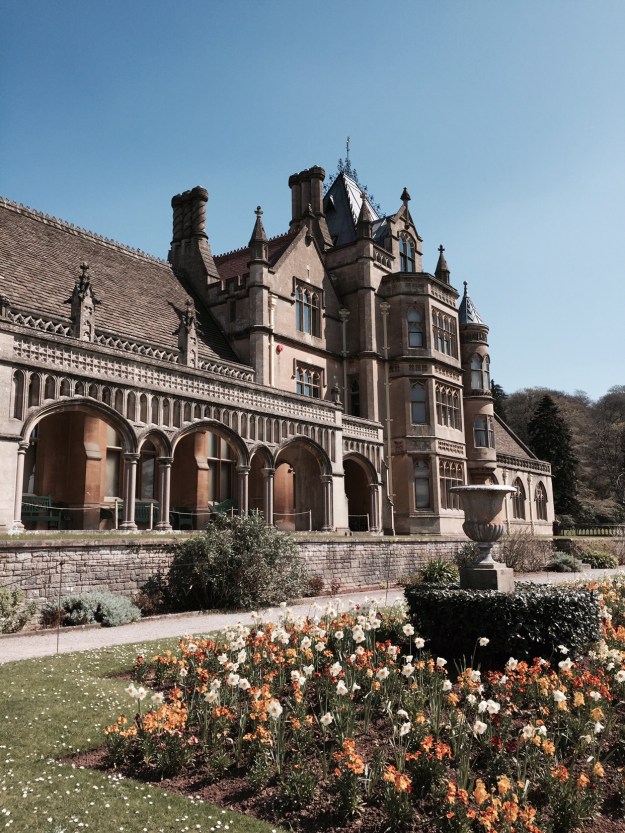
Just outside Bristol, and not far from Bath, stands one of the most beautiful country homes in England. It has only been open to the public since 2002, when the National Trust acquired it.  I visited a couple of years after the opening and can’t wait to return.

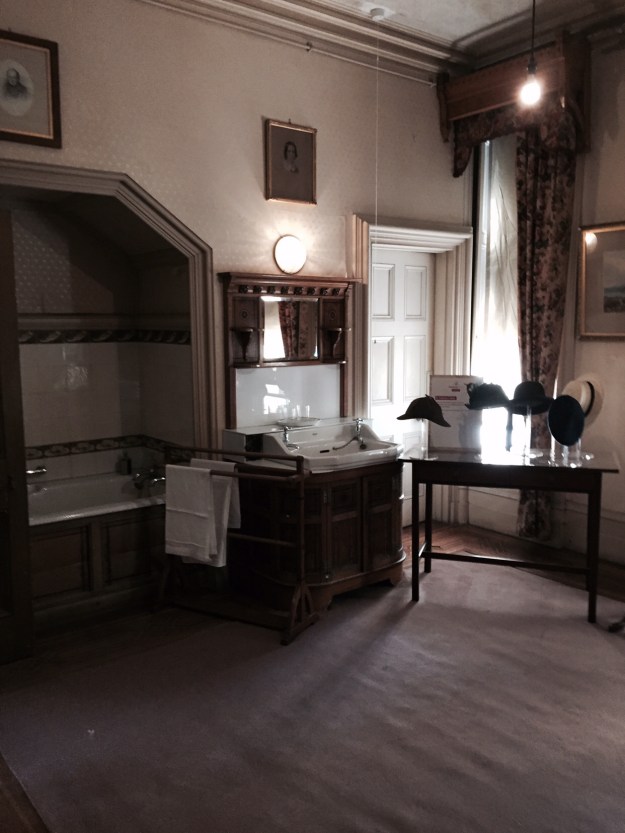
By the time the 2nd Lord Wraxall, known as Richard, died in 2001, he was the only person living in the house.  The house had been hit by bombs several times during the Bristol Blitz of World War II, and had never been properly repaired. Birds and bats took up residence in whole wings of the house. Lord Wraxall had maintained the house as best he could, but over the years the four generations of the family had simply closed off areas not in use.  So the house contained a treasure trove of historical belongings. For example, there were packages of shirts dating from the last century, still in their original wrappers as they came new from the shop.  And Tyntesfield was the last High Victorian house available for purchase in all of England.

Lord Wraxall’s will specified that the house be sold and the proceeds divided among 19 heirs.  The market value was about 20 million pounds, or  about $31 million. In addition, double or triple the purchase amount was needed for repairs. Sotheby’s took charge and began cataloging the house’s contents for auction.

Various gazillionaires were interested. (The press reported that Madonna, Kylie Minogue, and Andrew Lloyd Webber were looking).  But the National Trust of Britain, one of the two main preservation societies, managed to raise the purchase money within a period of 50 days.  (Controversy arose when a semi-secret deal with the National Lottery provided some of the money for this project that many considered “elitist”). The Trust took possession in July of 2002. This was the first new acquisition by the National Trust in many years, and the largest in its history.  Today, over 800 paid and volunteer staff work on the estate, 3 times the number at any other National Trust property. First order of business was repairing the roof. A free-standing scaffold the size of 10 tennis courts covered the entire structure for 18 months.  Then the entire house had to be re-wired and re-plumbed.  An elaborate fire protection system was installed. One by one, rooms were cleaned, restored and the furniture carefully arranged, using historic photos and descriptions.

In the meantime, visitors were welcomed.  The Trust had determined that the more people were able to see of the property, the more they wanted to donate and volunteer. Instead of the usual years of construction followed by a great unveiling, the renovation has proceeded with the enthusiastic participation of legions of volunteers.  The renovation itself is a great educational project, unprecedented in National Trust history. Elitist?  Not today.  The estate buzzes with the activity of volunteers, workers, school groups and tourists eager to bask in a lost way of life. I’m writing a number of posts about Tyntesfield because it’s such a fine example of the work of the National Trust. We can learn so many lessons from the ups and downs of a house’s history.  Good or bad, the events of the past help us figure out how to live in the future. I notice that the National Trust has now published a book all about Gibbs family history, Fertile Fortune: The Story of Tyntesfield, by James Miller, National Trust Books, 2006.  If I don’t acquire the book beforehand, I’m sure that on my next visit I’ll walk out of the gift shop with a copy. Join me next time for more explorations into the art and history of Europe and the British Isles!
Tyntesfield: The House that Guano Built

In 1842, William Gibbs’s brother Henry died during a visit to Venice.  In the same year, the South American agent for the family firm, Antony Gibbs and Sons, made a risky decision. He took out government contracts for the collection and shipping of guano from barren islands off the coast of Peru.  What is guano?  Solidified bird droppings!  William Gibbs was alarmed by the large loans necessary, but the gamble paid off.  Soon the company had a monopoly on the business, which shipped vast amounts of agricultural fertilizer all over the world.

William became a very rich man. He happily set about transforming a fairly simple Georgian house into a dream home for his growing family.  The beautiful result was Tyntesfield, completed in 1865.

William lived contentedly with his family until he died in 1875 at age 85.

Themes from nature appear everywhere in the house.

In his later years, he was affectionately known as “Prior,” because he turned his attention to spiritual matters and to good works in his community. The exquisite chapel was never consecrated, but it’s beautiful all the same. Family and servants gathered for daily prayers, and I doubt that anybody minded taking a break in this beautiful space.

Subsequent Gibbses made substantial additions of their own, and the house rang with the laughter of family and friends for many happy years.

Unlike grand houses built for show, Tyntesfield was built solely for the enjoyment of a family.  The wonderful library was filled with carefully catalogued books that were used on a daily basis by anyone interested.  Those books are still there.  As soon as the room was completed, the family began using it for amateur theatricals.

By all accounts, servants at Tyntesfield were well treated and stayed with the family for many years.

On my very first visit, shortly after the house opened, the servant quarters were just being explored.  It was possible to see, behind the scenes, how a grand home actually operated.  There were laundry rooms, boot rooms, a still room for making jams, a luggage room, rows of large containers for carrying hot water to the main bedrooms, and a kitchen with a fireproof ceiling.

House staff included a butler, two footmen, a housekeeper, a lady’s maid, a cook, six housemaids, a nurse, two nursery maids, two scullery maids, and a hall boy.  Actually, this was  a fairly modest staff for such a large house and family.  I like to think the Gibbs children, raised with the strong Gibbs work ethic, made their own beds.

Join me next time for more explorations in the art and history of Europe and the British Isles!

Britain’s Best Travel Bargain

Polesden Lacey, Tyntesfield, Dunham Massey, Cotehele, Castle Drogo, Wightwick Manor, Charlecote Park, Baddesley Clinton… just listing these names gets me itching to buy a plane ticket immediately.  And there are hundreds more.  All these places are part of Britain’s National Trust.  These are just a few of my favorite country homes to visit.  I could cheerfully spend an hour or a day at each one, but another one just down the road always beckons. There are wonderful nature preserves too, and several properties in London.

Tyntesfield, a glorious Victorian mansion

Tyntesfield, a glorious Victorian mansion

The British–including Wales and Scotland–are the best in the world at preserving historic properties.  I’m told the Irish are great too, but I’ve yet to visit Ireland.  (English Heritage is a related organization that also sells passes.  It seems to concentrate more on historic sites that might be in ruins.  I find that for my passion, country homes along with their art and furnishings, the National Trust is better.  With unlimited time in Britain, I would buy both).

Over the years, as economic conditions changed drastically, families who could no longer afford to maintain their beautiful country homes had to face hard realities.  Some, like the Cavendishes of Chatsworth, were able to turn their at least some of their properties into money-making enterprises.  Others sold them and divided the profits among the heirs.  (Many of these properties ended up as golf clubs, upscale hotels, or homes for rich rock stars, and the history was pretty much lost).  Other families generously planned to transition their homes and treasures into historic sites we can all enjoy.  The National Trust of Britain does a stellar job of preserving and maintaining these properties.

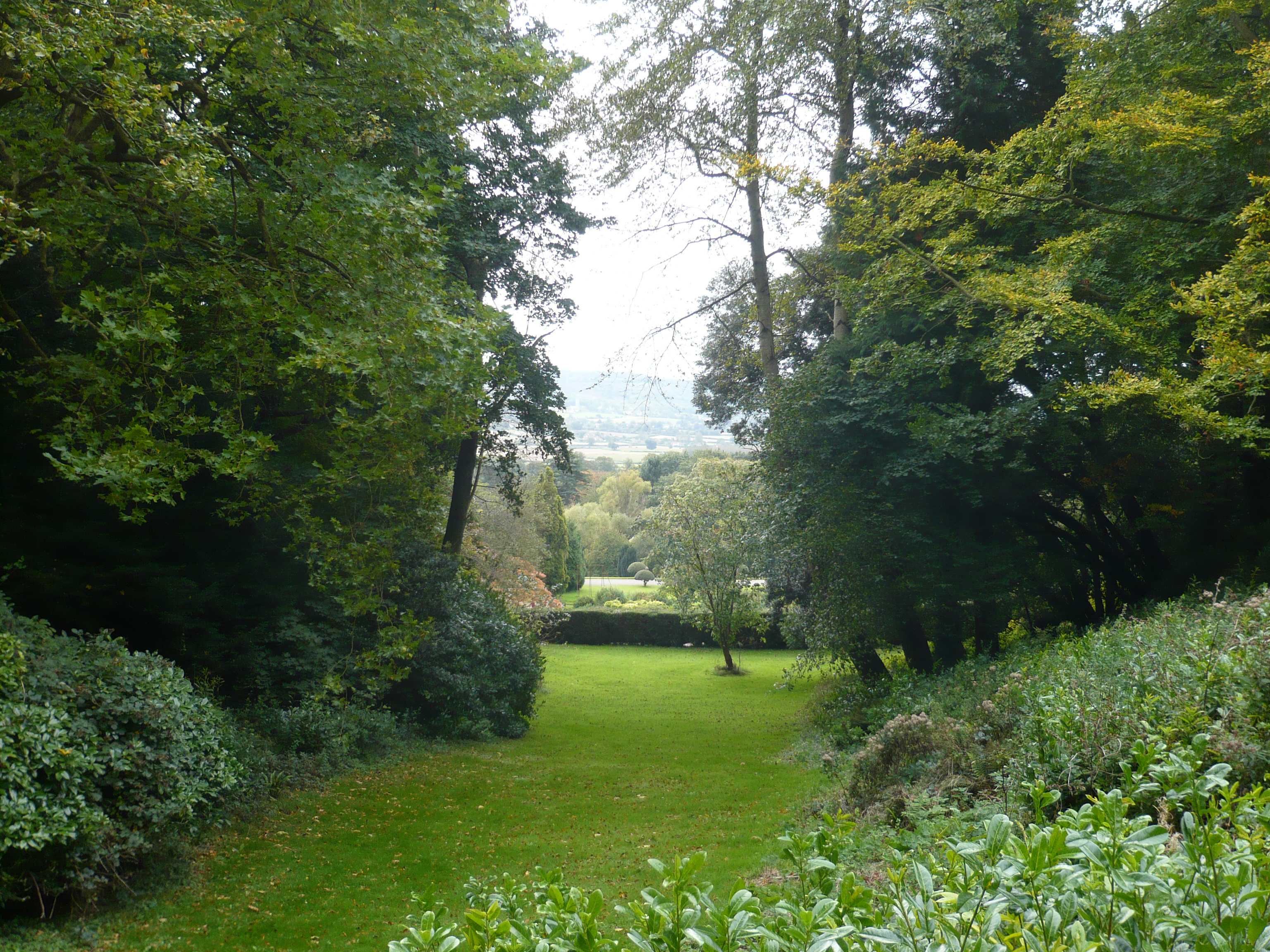
A misty morning on the grounds of Tyntesfield

A misty morning on the grounds of Tyntesfield

Money comes from the National Lottery, generous donations, memberships and the fees visitors pay.  Much of the work is done by dedicated volunteers.  Houses are staffed by kindly local people, standing patiently for hours in old rooms and gardens.  (I always think of Britain as the world headquarters for sensible shoes).  The Trust produces lovely, detailed and reasonably priced little guidebooks which they sell at each property.  They are temptingly slim and easy to stash in a suitcase.

Many of these properties have delightful tearooms.  Fancy a lunch of Stargazy Pie? Toad-in-the-Hole?  Bubble and Squeak?  Or maybe just a nice pot of tea for you, dear.  Perhaps a lovely warm Apple Crumble to go along with it?  The British love their Days Out in the countryside, and it’s a joy to join them.

If I had to choose my very favorite trip to dream of, it would be a very close contest between two:  Vienna in December, or the English countryside in the spring or fall.  Of course I’m blessed with an intrepid husband willing to drive “on the wrong side of the road” while sitting behind the wheel “on the wrong side of the car.”

The best travel bargain in Britain:  the Touring Pass from the National Trust.  It’s available for either 7 or 14 days, at prices ranging from $38 to a high of $90 for an entire family for 14 days. The pass comes with a wonderfully detailed book, including maps, directions, and opening hours.

NatTrustHandbook

Just looking at the maps, with treasures dotted all over England, makes me want to get out my own sensible shoes and travel.  For American visitors, there is also the related Royal Oak Foundation.  A year’s membership for a couple is $95.  It includes all entries to National Trust properties, plus a very nice magazine and various special events in the U.S., mostly it seems in New York.

Alas, I have other plans this year and won’t make it to England.  I guess I’ll have to revisit my favorite places using my photos and guidebooks.

Join me next time for more explorations into the art and history of Europe and the British Isles!

Downton Abbey: How Does Mr. Bates Rate?

One of the most interesting aspects of the show Downton Abbey is the way the servants have their own hierarchy that mirrors the strict hierarchy “above stairs.”  When the servants sit down to dinner, they sit according to their positions in the household, from Mr. Carson the butler right on down through the ranks to Daisy the scullery maid.
Every British tourist attraction sells little guidebooks published by the Pitkin company.  They run about 30 pages and are packed with information.  I buy one for every attraction I visit.  This one explains how a pre-war British country house worked.  (The First World War shook the system; the Second World War pretty much ended the system entirely).
Upstairs
The book lists some typical YEARLY salaries for household staff in the late 19th century:
Butler                          70 pounds  (Mr. Carson)
Master’s Valet             60 pounds (Mr. Bates)
Housekeeper              40 to 60 pounds  (Mrs. Hughes)
Lady’s Maid                50 pounds (devious Miss O’Brien)
Footman                      20-30 pounds (saintly William , dastardly Thomas)
Scullery Maid               5-10 pounds (Daisy)
At this same time, there were about 700 families in England who could support large country homes.  A rule of thumb was that an income of at least 1,000 pounds per year was required, or the income from at least 1,000 acres of land.
The master’s valet was especially important; his job was to make the master look impressive at all times.  Valets often received lavish gifts, including the master’s hand-me-down clothing which they could either wear or sell. Since room, board and uniforms were provided, a valet could save most or all of his money.
Many valets did very well for themselves. For example, the poet Lord Byron had a valet named James Brown.  In 1837, James Brown opened Brown’s Hotel with his savings.  The hotel is still one of the most elegant places to stay in London.
Afternoon tea, priced at around $60 per person, is still quite an occasion.
The price includes piano entertainment and an unlimited supply of little sandwiches, scones and cakes which are served graciously for as long as the customer wants to sit there basking in luxury.  Some years ago, I had tea there.  At the time, the waiters made a great show of clearing the tables by whisking the tablecloth OUT FROM UNDER the cups, plates, pots and tiered cake stand.  Do they still do it?  I guess I’ll have to return to find out.
As for Mr. Bates on Downton Abbey, I hope he is able to climb out of the hole he’s landed in.  I wish him a long happy life with his true love, Anna.
Join me next time for more explorations into the art and history of Europe, including the British Isles!

Native Americans at the Vatican

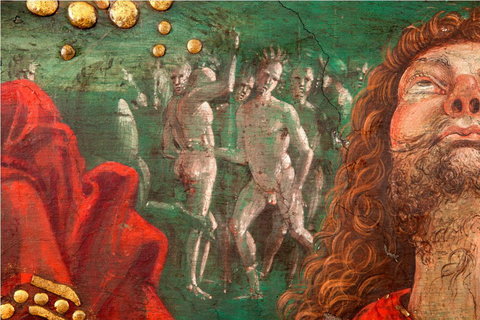
Remember the ditty, “In fourteen hundred and ninety-two, Columbus sailed the ocean blue?” Two years after Christopher Columbus’s  voyage, in the year 1494, the Renaissance artist Pinturicchio apparently added images of the Native Americans described by Columbus to a fresco in the Vatican.

Detail of fresco showing Native Americans

Detail of fresco showing Native Americans

News reports vary.  Either the images were more or less overlooked for the past 500 years, or they were uncovered in a recent cleaning of the fresco. The images are difficult to see.  They appear at the top of the open tomb.

Pinturicchio "Resurrection of Christ"

Pinturicchio “Resurrection of Christ”

The fresco, titled “Resurrection of Christ,” was commissioned for the rooms to be occupied by the newly-elected Pope Alexander VI.  This Pope was the former Spanish cardinal Rodrigo Borgia, so his rooms came to be called the “Borgia Apartments.” All the great powers in Europe at the time were much interested in the so-called “New World.” Of course, we now know that a big part of the interest in “the New World” was in exploiting the people and the riches to be found there.  But seeing this fresco gives us a little insight into the excitement in Europe over the new discoveries.

I first read about this discovery in The New York Times, http://artsbeat.blogs.nytimes.com/2013/05/06/early-images-of-american-indians-found-in-a-vatican-fresco/. I have to thank Kathy Schiffer, in her blog “Seasons of Grace,” for coming up with the full image of the fresco.  Her article is at http://www.patheos.com/blogs/kathyschiffer/2013/04/first-ever-painting-of-native-americans-discovered-in-the-vatican/.

The year before last, I was lucky enough to be in Rome just when the Vatican Museums were first open on Friday evenings from 7 to 11 pm.  All the daytime tourists leave, another long line forms, and at 7pm the doors open again.  The museums do fill up, of course, but things are much less crowded than during the day.  This program has been expanded; it now runs from May 3 to July 26, and again from September 6 to October 25.  I hope to be there again on a Friday night before too long!

Join me next time for more explorations in the art and history of Europe!

“Nice Fish” at Guthrie Theater

One of the best things about travel is making connections between things that seem unrelated.  For instance, last night I saw the play “Nice Fish” at the Guthrie Theater in Minneapolis and found myself thinking about Ludwig II of Bavaria. I’ll explain!

First, about the play: the wonderful actor Mark Rylance introduced large television audiences to the work of Duluth poet Louis Jenkins (who has been featured reading his prose poems on Garrison Keillor’s Prairie Home Companion, among other places). In 2008, while accepting his Tony award, Mr. Rylance did a hilarious deadpan recitation of a poem about the wearing of uniforms. You can watch the speech at http://www.youtube.com/watch?v=TU9iCgGDjRI.

Louis Jenkins emailed him, and soon the two men were collaborating on what eventually became the play “Nice Fish.”

NiceFishPosterIn the play, two men share an afternoon on a frozen Minnesota lake–a time-honored pastime in these parts.  The actors are Mark Rylance himself, on the right, and Jim Lichtscheidl on the left. Besides co-writing the play, Mr. Rylance also directed, along with his wife, Claire Van Kampen.

In the course of a long freezing afternoon, they encounter an insanely officious game warden. Then things turn surreal with the appearance of three figures from Germanic myth–sort of.   There’s an alluring young girl who pops out of a fishhouse in a bikini. She later changes into a festive prom-like party dress and teaches the lovestruck Ron to waltz.

Mark Rylance’s character can hardly believe his good fortune when she seems to fall in love with him, but she confides that Wayne, the owner of the fishhouse, is her sort-of boyfriend who’s gone off to fetch supplies.  When Wayne returns, roaring onto the ice on a vintage snowmobile, he summons his brother, Wainwright, who acts as his wingman.  Complications ensue.

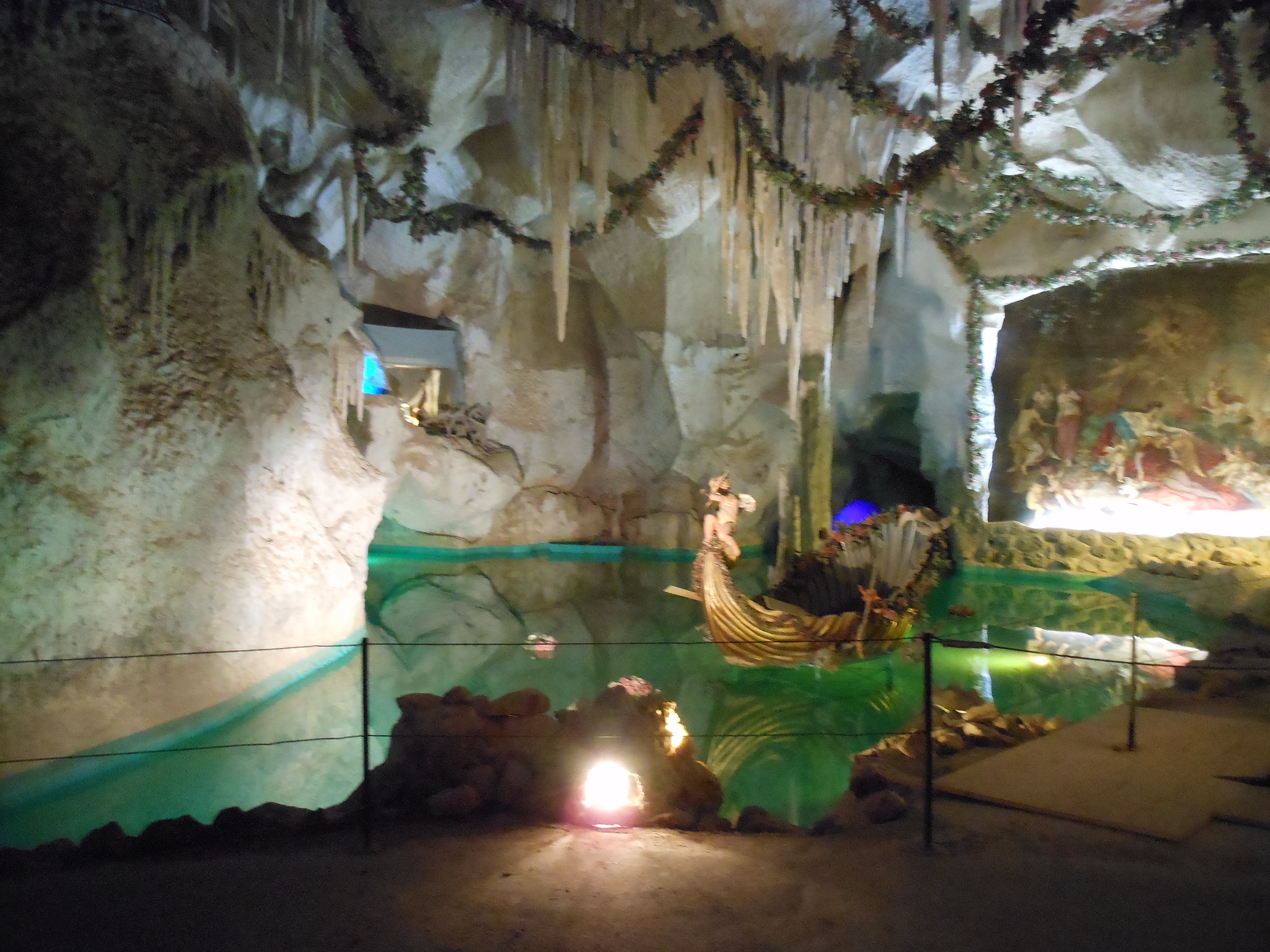
Mr. Rylance writes in the play’s program that he got the idea of introducing these characters while watching the opera Das Rheingold, by Richard Wagner.  Probably none of us would be watching Wagner operas if Ludwig II of Bavaria had not decided to be Richard Wagner’s patron.  I’ve written about Ludwig’s awe-inspiring grotto at Linderhof Castle, constructed as his personal theater for private performances of Wagner’s operas.

Ludwig's Grotto

Ludwig’s Grotto

Having arrived just before curtain time, I watched the entire play without reading the program notes.  So I didn’t know that Flo was a stand-in for Freya, the Norse goddess of eternal youth.  I didn’t know that Wayne and Wainwright were stand-ins for the giants who kidnapped Freya. (The plot of Das Rheingold, involving a magical ring, also provided some of the inspiration for J. R. R.  Tolkien’s The Hobbit and The Lord of the Rings). I doubt most of the audience around me cared much about the underlying myths, either.  The show was laugh-out-loud funny and thought-provoking to those of us who thought we were just watching Midwest eccentrics on a frozen lake.  (Yes, the supposedly staid Midwest has plenty of eccentrics–we all have relatives, don’t we?)

The play ends with a hilarious yet touching enactment of aging, death and the afterlife. It has had mixed reviews, including complaints that it is too long.  Personally, I would cheerfully watch Mark Rylance read blizzard school closings for the entire state of Minnesota.  Seeing what he can do as playwright and director is well worth my time any day.  I just might go see the show again before it closes!

Join me next time for more explorations into the art and history of Europe–with connections to modern life.

Ludwig’s Local Starbucks at Linderhof

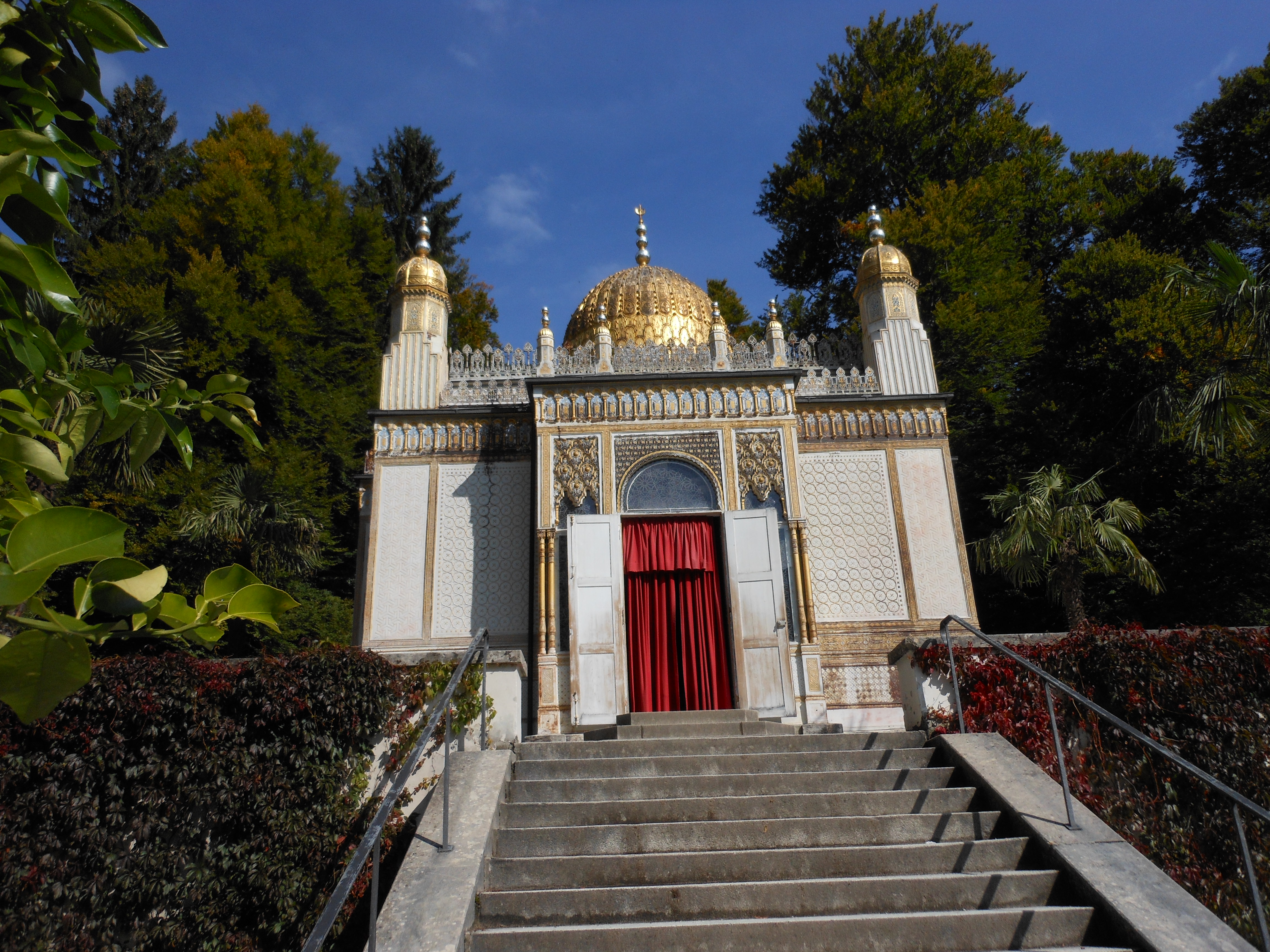
After the Siege of Vienna by the Ottomans was broken in 1683, the conquering army of Austrians found sacks of Turkish coffee left behind.  Immediately coffee became a popular drink, and coffeehouses sprang up.  Of course, Ludwig was not a sociable man, and he had no use for internet access.  So instead of heading to his local watering hole, he savored his morning coffee in his very own Moorish Kiosk on the grounds of Linderhof Palace.

Moroccan House at Linderhof

Moroccan House at Linderhof

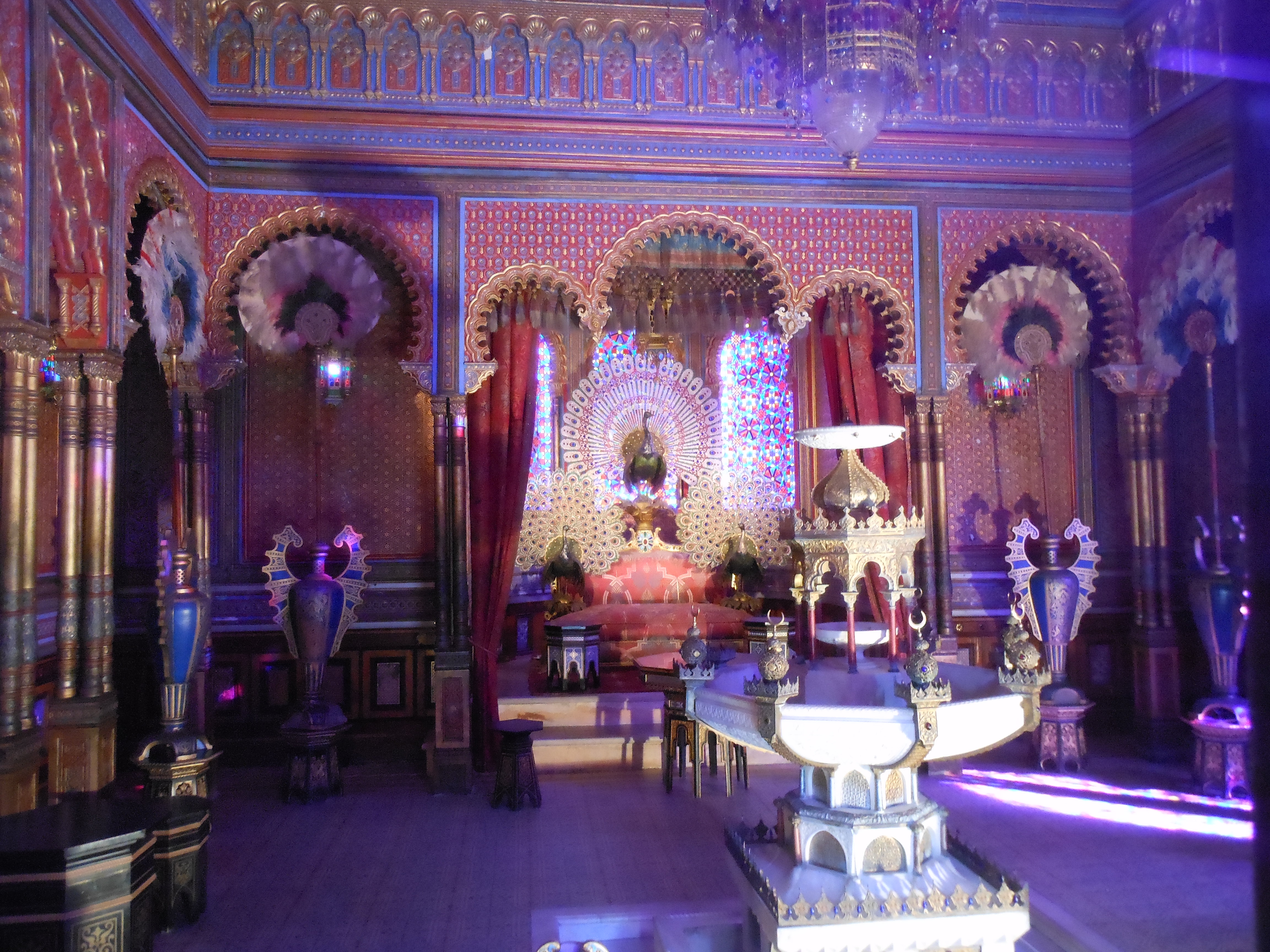
The structure was built for the International Exhibition in Vienna in Paris in 1867.  Ludwig wanted to buy it, but a railroad mogul beat him to the punch.  He had to wait until a little later, when the railroad went bankrupt. The interior is otherworldly, lit mostly by sunlight streaming through stained glass.

Moroccan House Interior

Moroccan House Interior

The most distinctive feature is the Peacock Throne.  Unfortunately, tourists are only allowed to peer into the doorway, so it’s hard to say whether the throne was built for comfort.

Ludwig was always dressed impeccably for any occasion.  History does not record what he wore for his jaunts to his favorite morning coffee spot, but I can use my imagination.

Join me next time for further exploration into quirky corners in the art and history of Europe!

Bears in Berlin

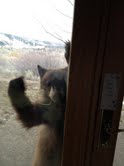
In the Rocky Mountains of northwest Colorado, where I live, spring means BEARS.  We scurry out to the curb with our trash practically when we see the garbage truck coming, and haul in the empty garbage cans as soon as the truck is past.  If we had birdfeeders out in the winter, we bring them in.  Still, sometimes the bears get a little too close, like this yearling cub trying to open my back door last week.

Notice the cub's claws!

Notice the cub’s claws!

His mother and brother (or sister) watched with great interest.  Maybe they could all have a feast!

BearMom3Bears

My door has a lever handle, and the cub knew how to push down on it.  When that didn’t work, he tried his already-powerful jaws.  All this was going on while I stood just inside the glass, hoping the deadbolt would hold. The note on the inside of my door says “Do not open this door!” I don’t want it left unlocked by accident.

My house seems to be located on an ancient game trail. Moose, elk, deer and bears parade past as if they owned the place–which, in a way, they do. Taking the wildlife officer’s advice, I have pots and pans ready to bang if bears come too close again.  These animals need to be kept wild if they are to survive.

Last spring at this time, I visited Berlin for the first time.  I saw bear statues everywhere, in bright colors and playful poses.

A bear appears on the city flag of Berlin, too.

Flag of Berlin

Flag of Berlin

No one seems to know when or why the bear became the symbol of Berlin.  There was an early ruler whose nickname was “The Bear.”  Or, more likely, the origin was a pun on the name of the city.  Sadly, though, there have been no bears in the entire country of Germany for almost 200 years.  Historically, wherever they appeared in Europe, they were exploited and abused. Farmers hunted them to extinction. In 2006, one of the 30 bears known to live in Austria wandered across the border into Germany. He was tracked for two weeks, then killed as a danger to humans.  Efforts were made to transplant bears into Austria in the 1990’s, but now they are extinct in that country too.

I feel blessed to live in a place where we try to coexist with the wildlife right outside our doors. I’ll do my part to help this magnificent creature live and thrive in the mountains!

Bad news: brown bears extinct in Austria

How Brunelleschi Gave Us Perspective

Filippo Brunelleschi, the genius who figured out how to build the spectacular octagonal dome of the Florence Cathedral, is often credited with inventing linear perspective around 1420.  Actually, his great rival Lorenzo Ghiberti would beg to differ.  So would the Arab mathemetician known as Alhazen, who lived around 965-1040.  A copy of Alhazen’s work on the subject, with notes by Ghiberti, is in the Vatican Library.  The ancient Greeks and Romans had the knowledge too, but it was lost in the Middle Ages.  So Brunelleschi’s work was really more of a rediscovery.

What exactly is linear perspective?  It is the technique of making an image in two dimensions–a flat surface–appear to be in three dimensions, with depth.  As a not-very-good, self-taught painter, I’m always looking for ways to make my paintings less bad.  Awhile ago, I bought a kit that promised to help me:

Linear Perspective Kit

Linear Perspective Kit

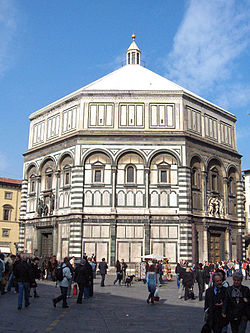
The kit consists of various frames and grids.  If I had the patience to actually work with the kit, I could create more realistic paintings by establishing a vanishing point, a horizon line, and accurate diagonals.  While writing about Filippo Brunelleschi, I realized that the illustration on the cover of my kit depicts the master’s famous demonstration of linear perspective.  The building shown on the cover is the Baptistery of Florence.

Florence Baptistery

Florence Baptistery

The hexagonal building stands directly across from the Florence Duomo. Brunelleschi stood in the doorway of the still-unfinished cathedral.  Using the rediscovered calculations and techniques of perspective, he painted a very accurate picture of the Baptistery.  (We could take a photo, but there were no cameras in his day). Then he poked a hole in the canvas and looked through the back of the canvas at a mirror.  When he quickly moved the mirror away, the viewer could see how accurate the painting was.  Very quickly, every Renaissance painter worth his salt began using the technique.  It was part of the new realism that swept the art world after centuries of art that was much more symbolic than realistic.

The Baptistery was constructed sometime between 1059 and 1128.  Right up into the 19th century, this was the place every Florentine Catholic was baptized. In about 1400, new doors were needed.  The city fathers held a competition for the plum job of creating bronze doors for this very important building.  Brunelleschi was 21 at the time; Ghiberti was barely 20.  The younger pup won.  Ghiberti ended up working on these doors, plus a subsequent set, for pretty much the rest of his life.  It took him 20 years to finish the first set of doors and 25 more years for the next set.

Brunelleschi was disappointed; this may have been one reason he turned his talents to architecture and design.  Personally, I think he was lucky he lost this competition. It enabled him to enter and win the one for the cathedral dome.  Both men became famous and had illustrious, well-paid careers.  But today, it is hard to fully appreciate Ghiberti’s work even when standing right in front of the doors.  We’ve lost our taste for intricate bronze reliefs.  Brunelleschi, on the other hand, got to spend 16 years on a complex project in the open air of Florence, while everyone in the city discussed and admired his work.  Today, every visitor can admire the Duomo from countless vantage points in and around the city.

The most famous image of Brunelleschi is a large statue that shows him gazing up at the crowning achievement of his life, the dome of the cathedral.

Photo by Richardfabi, released to public domain

Photo by Richardfabi, released to public domain

Leonardo da Vinci remarked, “Perspective is the rein and rudder of painting.”  Now, maybe I had better get that kit off the shelf and get to work painting.

Join me next time for more explorations into the art and history of Europe!

“In Santa Croce with no Baedecker”

I can’t leave A Room with a View without revisiting one of my favorite scenes from both the novel and the movie:  “In Santa Croce with no Baedeker.” Lucy Honeychurch finds herself unaccompanied in the grand church of Santa Croce. Even worse, she has no guidebook.  A Baedeker–the equivalent of a Rick Steves guide–would tell her what to see, and how to see it.  From the novel A Room with a View by E.M. Forster:

She walked about disdainfully, unwilling to be enthusiastic over monuments of uncertain authorship or date. There was no one even to tell her which, of all the sepulchral slabs that paved the nave and transepts, was the one that was really beautiful, the one that had been most praised by Mr. Ruskin.

Then the pernicious charm of Italy worked on her, and, instead of acquiring information, she began to be happy. 

But just when she’s beginning to enjoy herself, the dreaded Mr. Emerson and his handsome but impertinent son George appear. They were baffling enough at dinner the night before:

And Mr. Emerson insists on talking to her in a most alarming way:

I don’t require you to fall in love with my boy, but I do think you might try and understand him…. Make him realize that by the side of the everlasting Why there is a Yes!

Of course what Lucy needs is to learn to say “Yes!” herself.

Santa Croce is a Franciscan church, so it is no accident that E.M. Forster places his characters here.  The author wants his stuffy Victorian English characters to unwind in the warmth and charm of Italy.  St. Francis is the very warmest and friendliest of saints.  Mr. Forster’s characters can well use the directness, humility and freshness of the beloved saint.  So, of course, together they look at the glorious Giotto frescoes of the life and death of St. Francis:

In 2010, frescoes of Giotto were “rediscovered” under centuries of neglect and old paint.  As far as I can tell, they’re been left alone so far.  But there’s a BBC video showing them under ultraviolet light at http://news.bbc.co.uk/2/hi/europe/8556930.stm.

Surely we’re all a little like Lucy in Santa Croce:  instead of constantly acquiring information, we can just look around us and be happy.  And surely great art can help make us happy.

Join me next time for more explorations of the art and history of Europe, with some sidetracks into literature too!