Category Archives: History

Versailles: Crowded Splendor


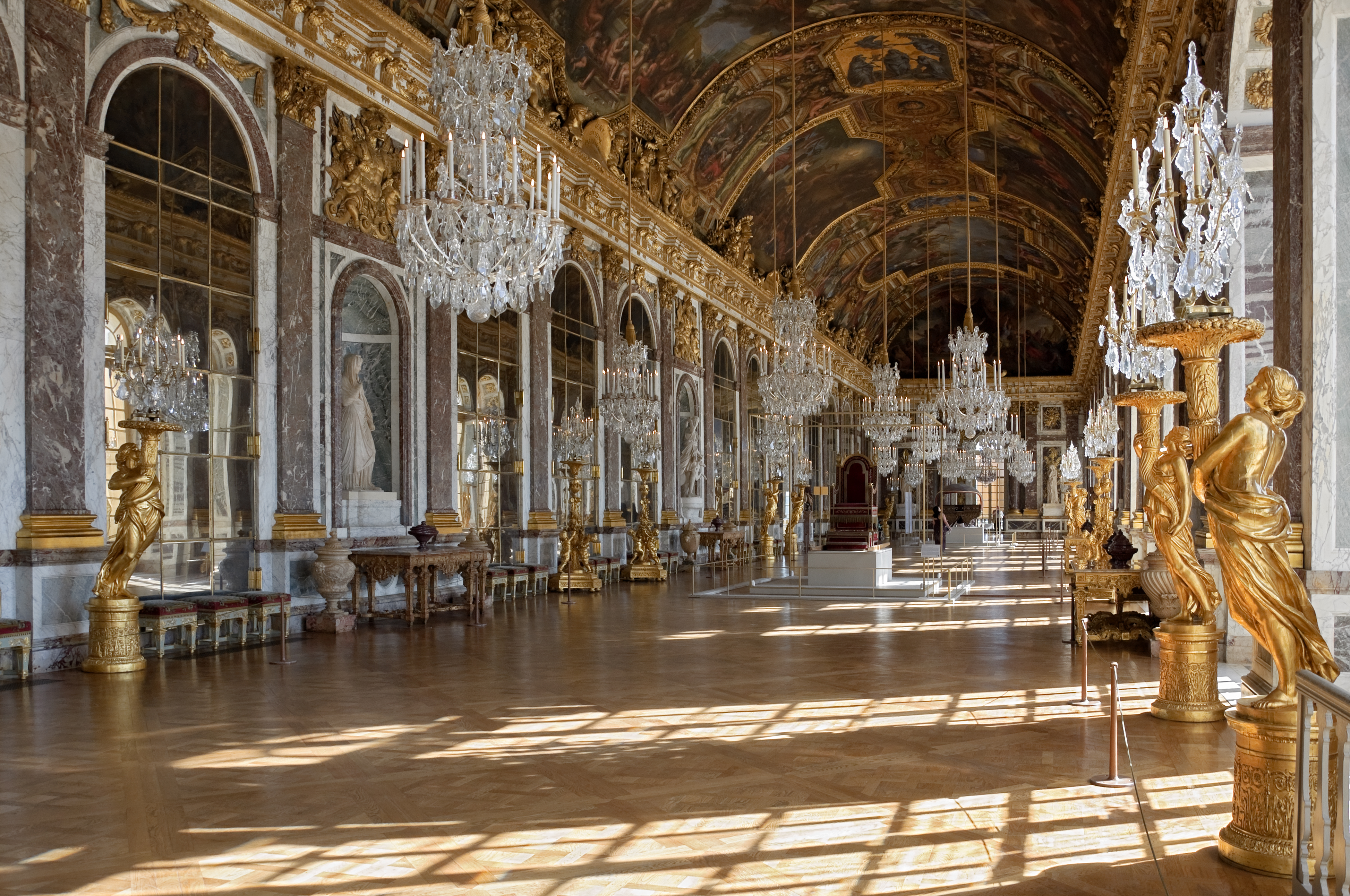
Galerie des Glaces, Myrabella, Creative Commons Attribution-Share Alike

Galerie des Glaces, Myrabella, Creative Commons Attribution-Share Alike

Why bother to stay overnight in the town of Versailles?   Most people do Versailles as a daytrip from nearby Paris. The picture above shows the best reason to spring for an overnight. It’s the Hall of Mirrors, built by Louis XIV in 1678 and crammed with people ever since. On one memorable day, after an overnight in Versailles, I managed to appear early at the entry with ticket already in hand. Success! I had arrived early enough to be THE VERY FIRST PERSON to walk the length of the glittering room. I was so awed that I didn’t take a picture.  The one above was taken by a person with more presence of mind.

HallOfMirrors2

This picture above was taken about 20 minutes later.  On busy summer days–which I would avoid– tourists shuffle along almost shoulder to shoulder. But once in my life, I had the place all to myself. I doubt that even the Sun King himself had that privilege, unless he managed to do it late at night after courtiers had turned in.
P1000474

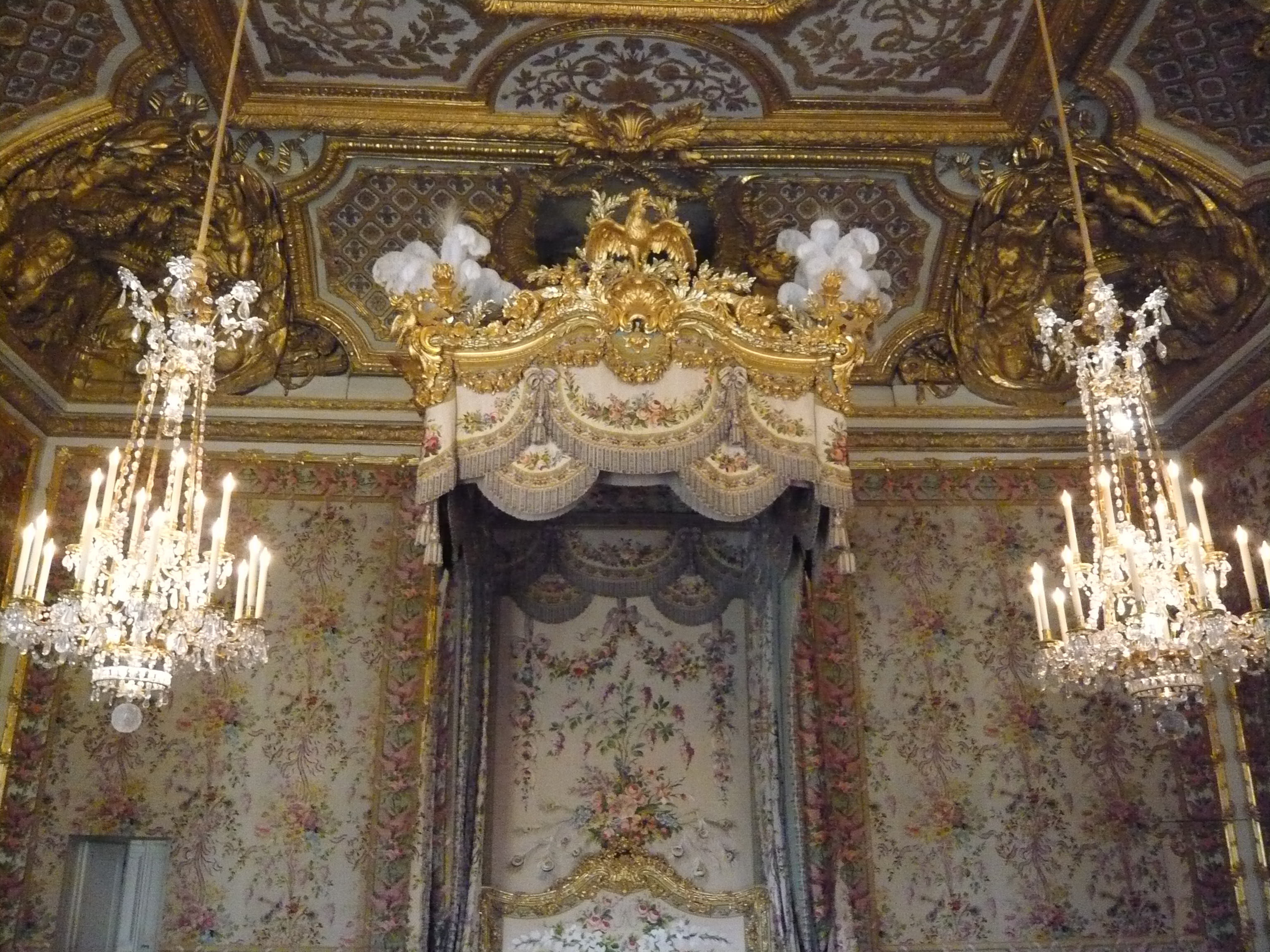
The King invented two ceremonies which bookended his day:  the Lever, when invited courtiers watched him get up, and the Coucher, when he was tucked in for the night under his grand canopy festooned with ostrich feathers. Like everything else Louis XIV did, these ceremonies inflated his ego and made people think they were lucky to even be in his presence. Trouble was, he made his bed and then he had to lie in it.  In actual practice, the King sometimes did get up way early to go hunting, but Louis XIV valued ceremony so much that he would return to bed in order to properly get up all over again.
Fountain

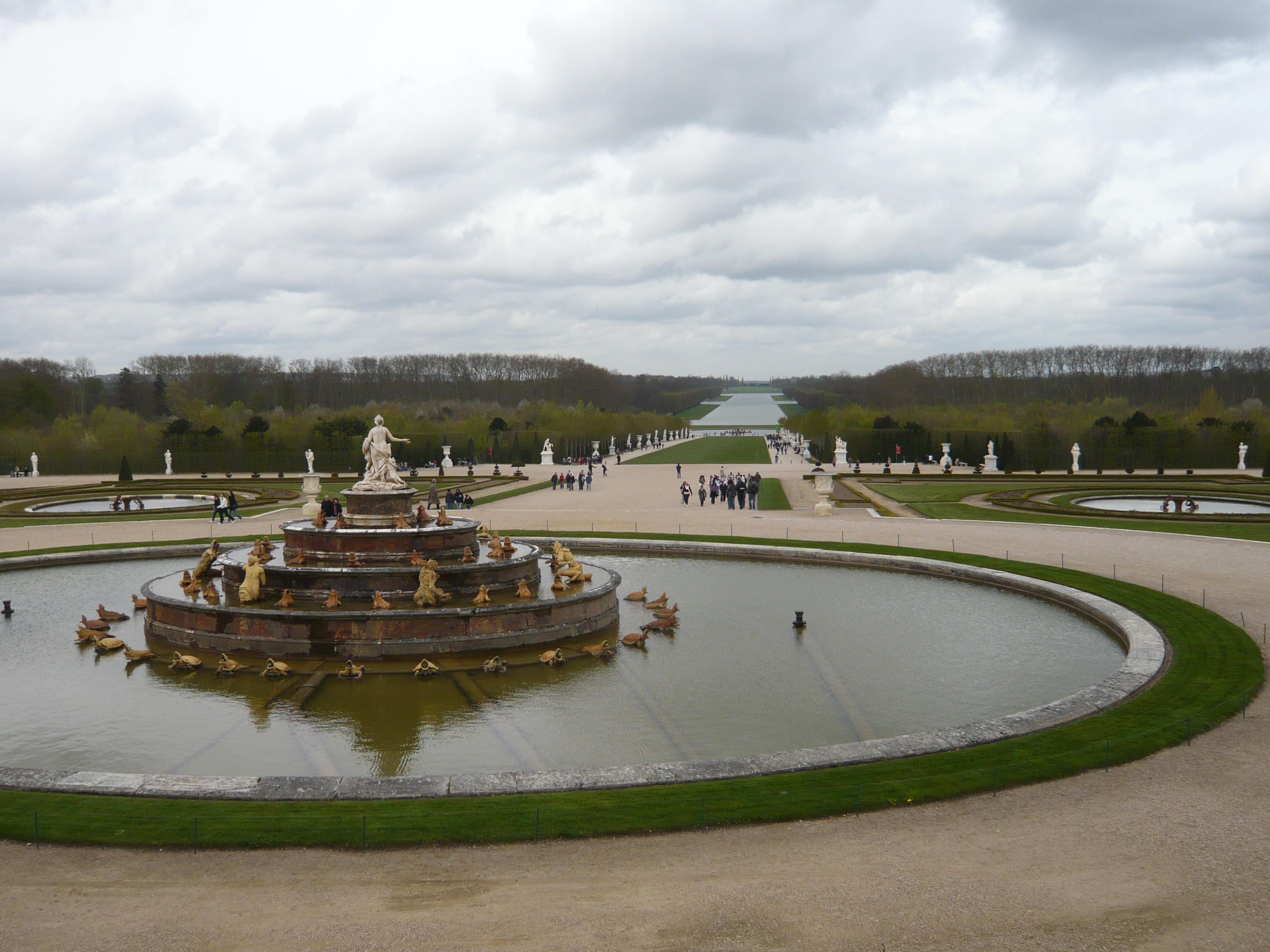
It’s hard to appreciate the overwhelming scale of the Palace of Versailles–and the Sun King wanted everyone to be overwhelmed.
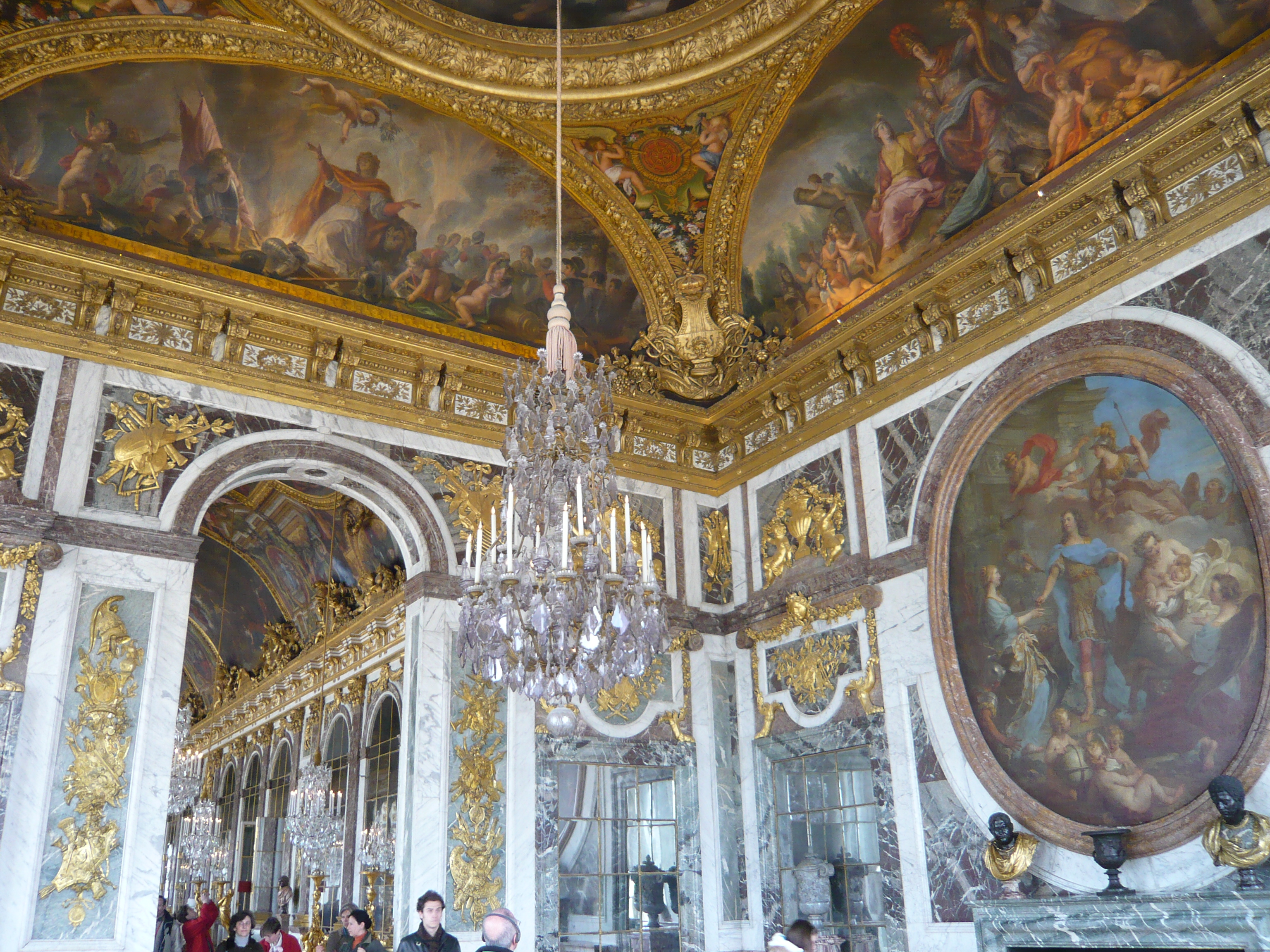
HallOfMirrorsCorner

I do better getting off to the side and lingering over some details, like this corner of the Hall of Mirrors.
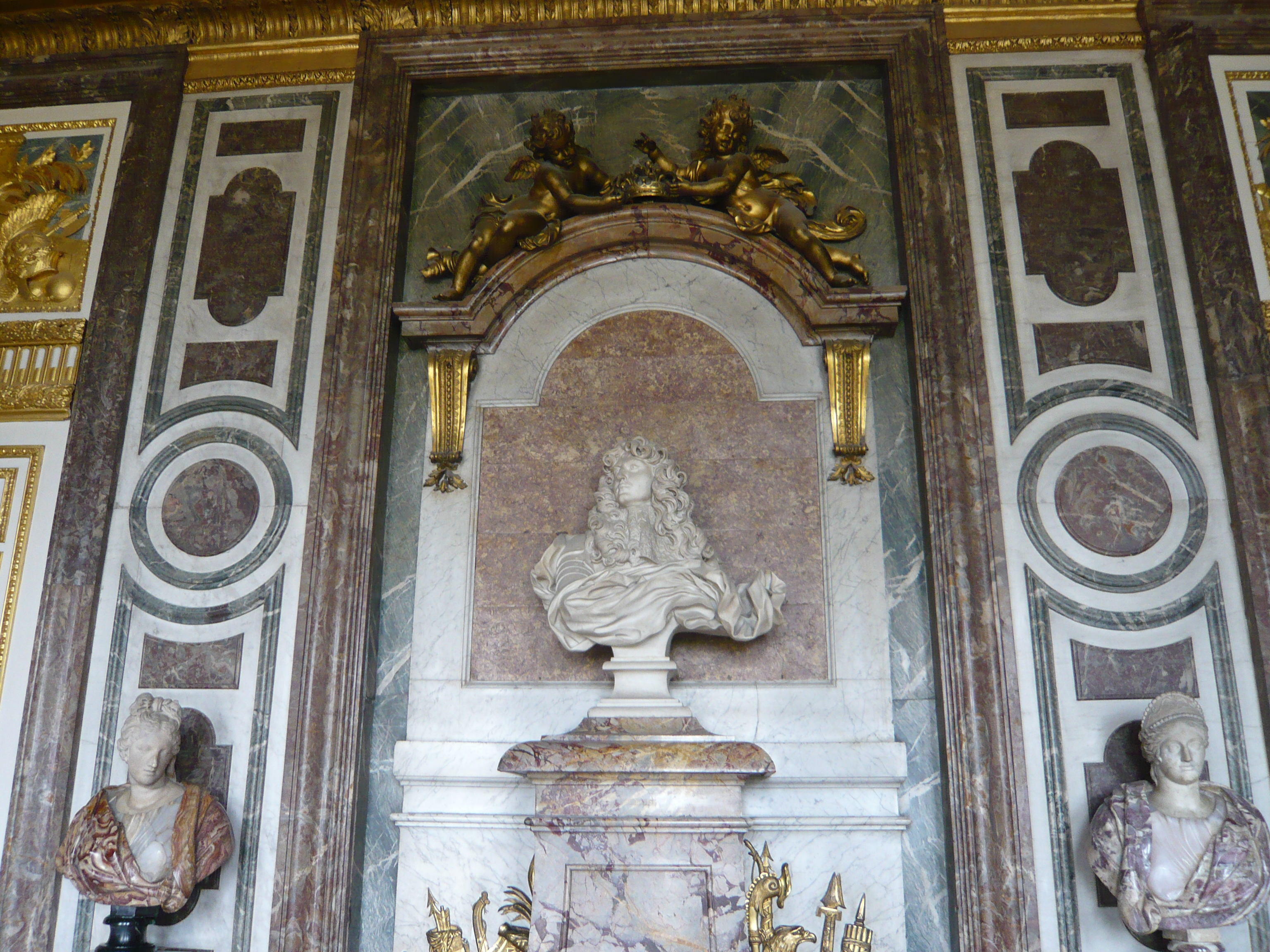
SunKing


Images of the Sun King are everywhere.  He could have invented the modern term “self-esteem.”  He famously remarked, “L’Etat, c’est moi,” meaning “The State, it is me.”  That worked out pretty well for him, but not so much for his offspring.

Louis XIV also once remarked, “Apres moi, le Deluge.” That loosely translates as, “After me, all hell breaks loose.”  He had that right.  His descendants managed to hold on to their riches and absolute monarchy for only two generations before the Revolution changed everything.

Join me next time for more explorations in the art and history of Europe!

Bob Marley and the Dutch Golden Age

url

What does Bob Marley, the legendary reggae musician who rose from grinding poverty in Jamaica, have to do with the over-the-top wealth of the great trading city of Amsterdam?  A lot, it turns out.  I just watched a fine documentary called Marley, streaming on Netflix. The film, directed by director Kevin Macdonald and released in 2012,  must be the definitive life story of the musician.  He somehow rose from extreme poverty to superstardom.  Bob Marley died of cancer at age 36, in 1981. But his music lives on, and the family he left behind continues what he started.

AmstOldShip

The National Maritime Museum in Amsterdam holds 500 years of the seafaring history of the city.  Last time I was in Amsterdam, in the fall of 2013, the city was celebrating the beginning of the canal system that allowed a great trading center to be built on hundreds of islands and swampy ground adjoining the North Sea.  Kids try sailors’ hammocks and pretend to eat in the officers’ mess. A restored ship docks outside in the harbor. Inside the museum, displays chronicle the glorious history of Dutch seafarers.

ShipHammock AmstShipTable

But there is a darker story, During my visit, the Maritime Museum hosted a stunning exhibit that frankly exposed the shameful secrets of the slave trade that contributed heavily to the city’s wealth.

AmstLadyLecture

On a video inside the exhibit, a lady abolitionist scolds those who profit from the slave trade. She looks quaint, but brave.  It took many years of determined efforts by people like her to put a stop to the slave trade.

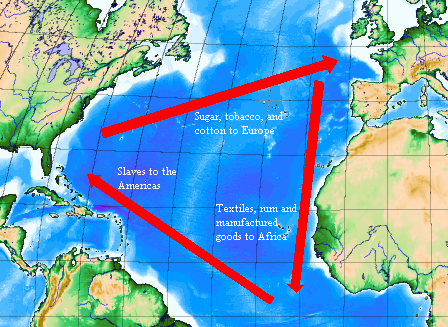
The profits that built the canal rings and the grand houses on Amsterdam’s canals came largely through trade in products from Dutch colonies–sugar, coffee, cacao, tobacco. Production of these lucrative products required slave labor.  The slaves were shipped from West Africa to the Dutch East and West Indies as part of the “triangular trade” that poured huge riches into Portugal, France, England and Holland.

Triangular Trade, Creative Commons GNU Free Documentation License

Triangular Trade, Creative Commons GNU Free Documentation License

Ships would pick up cargoes of slaves in Africa and deliver them to work on plantations in the Caribbean. From those islands, the ships would load up on products such as sugar, indigo, cotton, and coffee. In the ports of Liverpool, coastal France, Lisbon, and Amsterdam, the ships would in turn load up on manufactured goods like textiles, utensils, gunpowder, guns and alcohol.  These products, scarce in Africa, fetched high prices for merchants and shipowners. And another cycle began. The “Middle Passage,” between Africa and the Caribbean (and also the Americas) inflicted unimaginable misery on those captured and used as slaves.

Bob Marley’s ancestors arrived in Jamaica as slaves and remained there after slavery was finally abolished.  They were “free” to live in poverty. He grew up making music in his little hardscrabble town in the hills, using homemade instruments along with the odd guitar. Eventually he and his friends were able to parlay their musical talent into world fame, but he died young.

The Amsterdam exhibit appeared to be a momentous occasion in Dutch history.  The entrance was separated from the rest of the museum by heavy doors, and carried warnings that the exhibits were graphic.  Schoolchildren in somber groups were taking in the exhibit. There was very little of the running and jumping and joking that usually go along with kids on a mandatory school field trip.  The adults were equally serious.

AmstSlavePhotos

In Amsterdam, I visited some of the grand canal houses built by wealthy merchants and bankers. I strolled the beautiful, tranquil canals.  I marveled at the treasures of the Rijksmuseum.  It was good to also acknowledge some of the painful history behind the Dutch Golden Age.

Join me next time for more explorations in the art and history of Europe.


English: Modified version of en::Image:World map.png, which was created by John Monnpoly
Date 21 September 2005 (first version); 2007-05-26 (last version)
Source Modification made by SimonP. Transferred from en.wikipedia
Author SimonP at en.wikipedia
Permission
(Reusing this file)
CC-BY-SA-2.0; GFDL-WITH-DISCLAIMERS; Released under the GNU Free Documentation License.

Maria Christina: The Sister Who Got Everything

MariaChristinaWreck

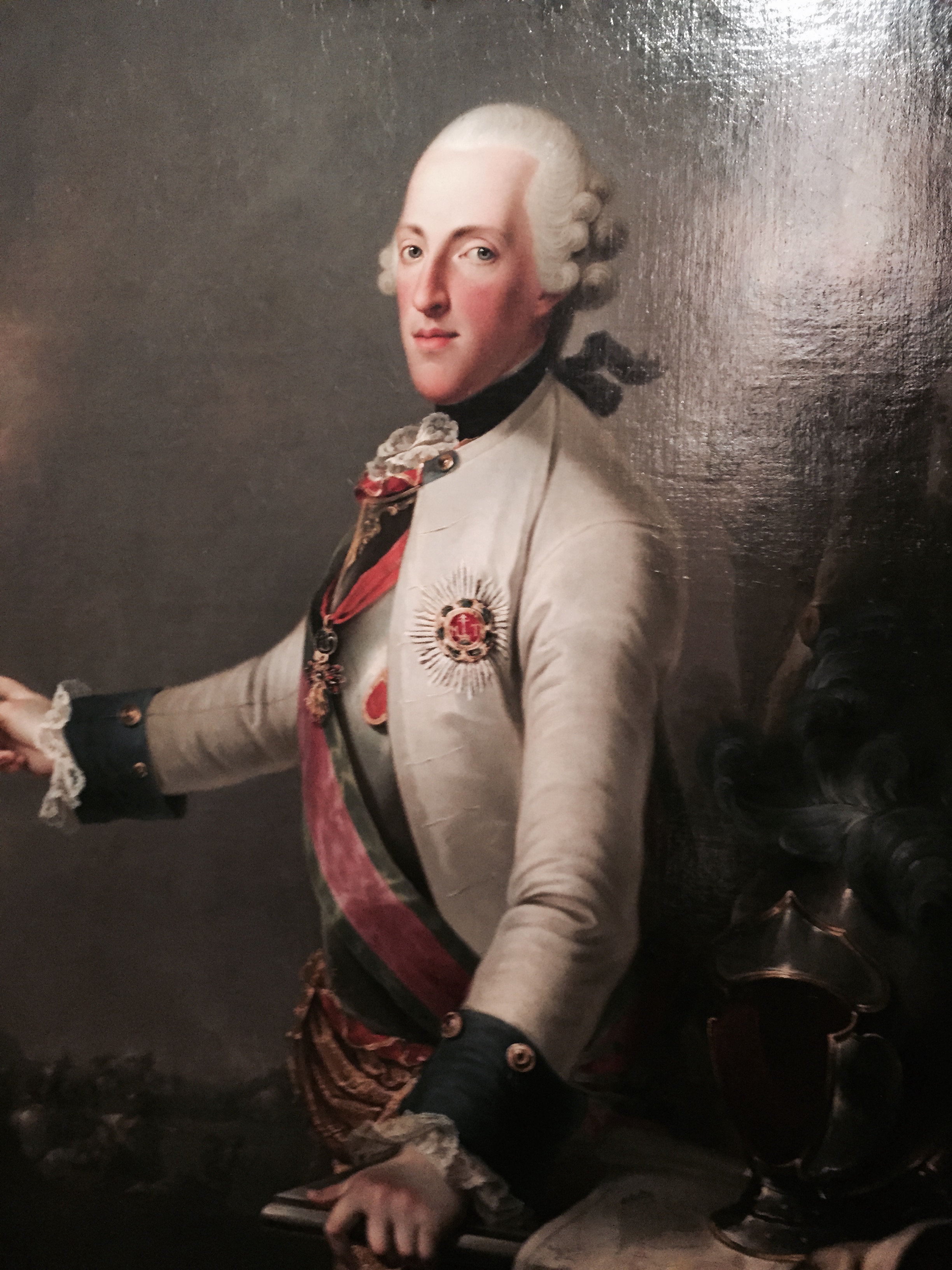
A few months ago in the Albertina Palace and Museum in Vienna, I came upon a small painting that showed the wreck of a carriage–an unusual subject for such grand surroundings. The caption explained that the wreck was an event in the life of the palace’s one-time occupants, Archduchess Maria Christina and her husband Albert of Saxony.  The couple became Duke and Duchess of Teschen and joint governors of the Austrian Netherlands on their marriage. They received an enormous dowry, too, from the bride’s famously parsimonious mother, Empress Maria Theresa.

Maria Christina

Maria Christina

Who were these fortunate people, and why was their carriage wreck such a big deal? Having a painting of a private misfortune, which the victims survived nicely, was the 18th century equivalent of a Facebook post about a fender-bender. And the 18th century was a time when almost no one had access to anything remotely like Facebook. The answer lies in family favoritism.

Empress Maria Theresa, who ruled the Austro-Hungarian Empire for 40 eventful years, produced 16 children.  It seems that she only liked one of them: Maria Christina, who happened to be born on Maria Theresa’s own birthday.  Every other sibling was used as a pawn in the empire’s political ambitions.  They were all packed off to strategic foreign marriages, preferably with either royal cousins or other monarchs who might be able to help the far-flung empire. The unluckiest sibling was Marie Antoinette, shipped off to France as a teenager to marry the doomed Louis XVI and lose her head.

Prince Albert

Prince Albert

But Maria Christina was allowed to marry the man she loved, Albert, a minor princeling with no wealth and no throne. Her doting mother kept Maria Christina close, in Vienna, and built her a magnificent palace right next door to the Hofburg, seat of Austrian royalty.

FullSizeRender

Maria Christina’s portrait in the Albertina Museum shows her posing (smugly, if you ask me) with her lapdog. In contrast, Marie Antoinette, on arrival all alone at the border of France, was forced to strip down and leave behind every article of Austrian clothing because she became the property of the French state. No one told her, until the last moment, that she also had to leave behind her beloved little dog.

Years later, Maria Christina paid her kid sister a visit in France. I completely understand Marie Antoinette’s reaction. I’ve read that Marie Antoinette retreated to her private mini-palace at Versailles, the Petit Trianon, and pointedly did not invite her big sister along.

Sibling rivalry? There we have it, on a grand scale.

Join me next time for more explorations in the art and history of Europe!

A Knight in Shining Armor—Wearing a Skirt

A couple of months ago in Vienna, I wandered into the Arms and Armour section of the Kunsthistorisches Museums–included with my museum pass, but not something that usually interests me much.

IMG_2936

But whoa!  What was up with this extremely scary suit of armor with a skirt? Were there actual women requiring feminine suits of armor? The waist seems small enough for a woman.  The helmet has a devilish look, male or female. Was this suit designed to get the enemy wondering exactly what he was up against?

The series Game of Thrones features a fearsome female knight, Brienne of Tarth.  Would she have worn something like this? On the show, she wears some skirt-like pads for swordfighting, but nothing like the getup above.

Brienne of Tarth, photo from LA Times article cited below

a Brienne of Tarth, photo from LA Times article cited below

I had trouble deciphering the German museum caption, and the photo I took of the caption didn’t turn out.  The next day, I thought I’d pop back into the museum to investigate further.  But the museum was closed. So I posted my mystery photo to one of the history Facebook groups I follow. Within minutes, people with a lot more knowledge than I had answers.

Armor like this dates from about the 1500s.  King Henry VIII of England had a set like it.  It was not made for a woman, but for a man planning to engage in ground combat. The skirt would protect his legs better than traditional pants-style armor.  Form-fitting armor needs joints that bend.  Joints mean there are gaps that a sword or axe or spear could penetrate. A strong skirt, covering the knees, might look unwieldy to us, but we might be glad enough to reach for one if we were faced with hand-to-hand combat.

The fluted design of the skirt was not just a fashion statement.  The folds made the armor plate stronger.  But it was still not strong enough to block musket fire, which was slowly taking over the battlefield.  Fancy suits of armor went out of vogue on the battlefield by the 1700s, although kings and princes sometimes  wore them into battle as marks of status, much as they sometimes wore battlefield crowns. This seems ill-advised to me–why make oneself an obvious target? Still, there are examples of elaborately decorated skirted suits designed to be worn on horseback.

IMG_2942

Anyway, skirted suits eventually became obsolete on the battlefield, but the nobility still wore them for jousting–an extreme sport for the rich in the Renaissance.  Hans Holbein the Younger, among other highly paid artists, designed armor for noblemen to show off in.

IMG_3038

Later in Vienna, I came upon this store window, in a lingerie shop.  Window display is an art.  I have to think the display designer, like many Viennese, was a regular visitor to the Kunsthistorisches.

http://herocomplex.latimes.com/tv/game-of-thrones-gwendoline-christie-on-brienne-of-tarths-beauty/#/0

Marie Antoinette: Women and Window Treatments

MarieAntKunst

The Kunsthistorisches Museum in Vienna has one of the most famous images of Marie Antoinette, painted by Elisabeth Vigee Lebrun in 1779. It was one of her most important paintings, and the artist herself made six copies of it. The young Queen had only reigned for five years; she still had about thirteen years of high living in store, before the Revolution and the Terror that cost her life.

It’s such a familiar image that I haven’t looked at it very carefully.  What struck me on a recent visit was that it’s mostly about fine silks.  All we really see of the queen is her face.  The rest is window dressing.

MarieAntDetail

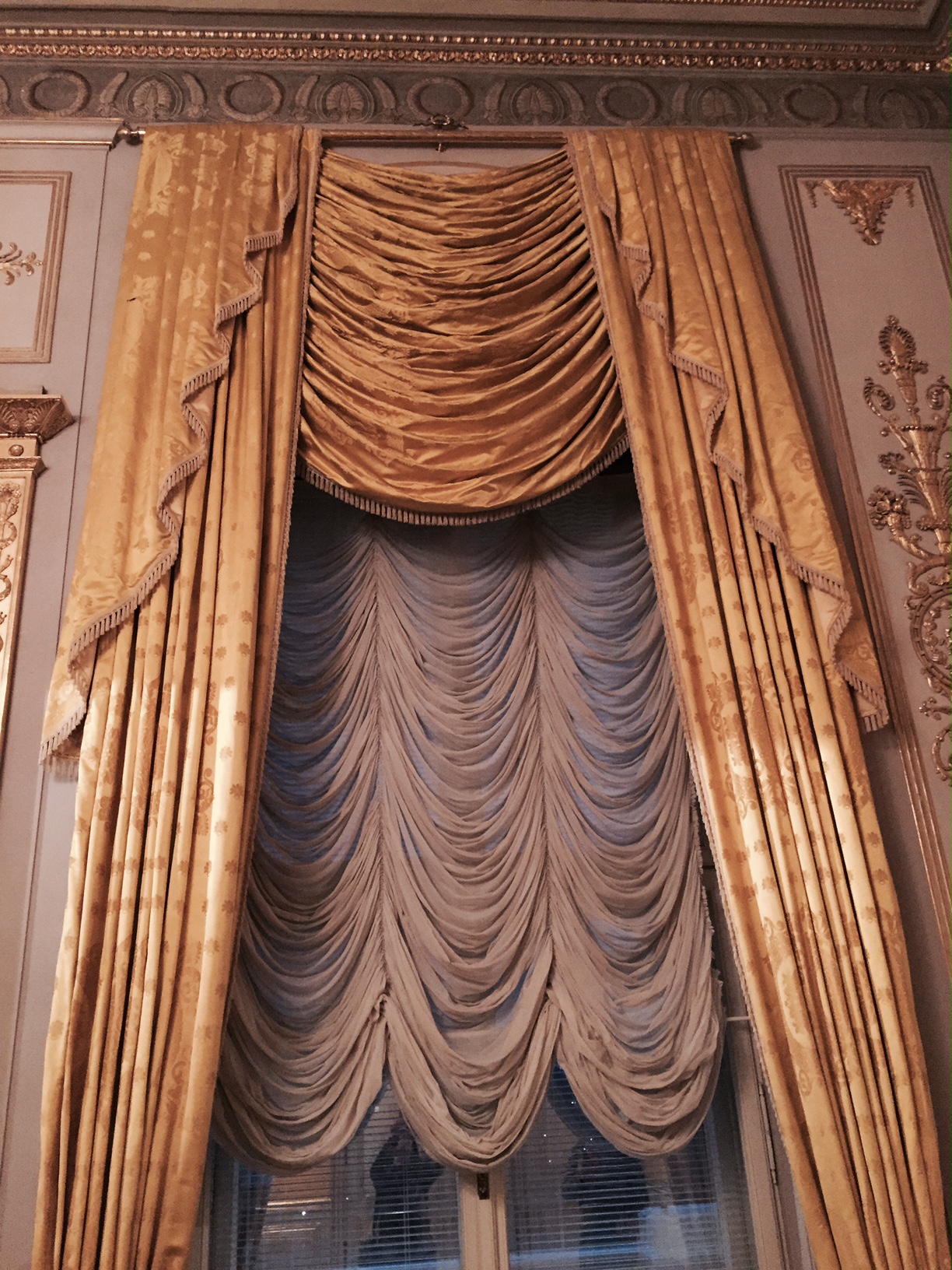
I got to thinking that her dress actually looks like a window treatment fit for a palace.

Curtains2

In a way, her entire life was a kind of window dressing.  She was married off as a teenager for the valuable political alliance between Austria and France.  She was expected to produce royal heirs, and in her spare time, to show off the wealth and power of the French monarchy.  No doubt it took at least a dozen ladies-in-waiting to get her into this dress.  No doubt she would much rather have been playing house in her farm on the grounds of Versailles, where she could dress as a milkmaid and tend her shampooed sheep.  But in sitting for this portrait, she was doing her duty.  Sadly, her duty did not work out well for her.

I went directly from the Kunsthistorisches to the Albertina Palace, where Marie Antoinette’s sister Marie Christine got to live out her life.  Marie Christine was the favorite child of the redoubtable Maria Theresa.  Of all the children, Marie Christine was the only one allowed to marry for love instead of political alliance. Life is not fair.

Curtains1

Anyway, the window treatments in the Albertina look exactly like Marie Antoinette’s portrait gown, if you ask me.

FullSizeRender (6)

How much of a person’s life, in history and in the present, is spent trying to strike an idealized pose?  How much of a life is window dressing?  It’s a question to ponder.

Join me next time for more explorations in the art and history of Europe!

The Tenth Mountain Division

IMG_2159

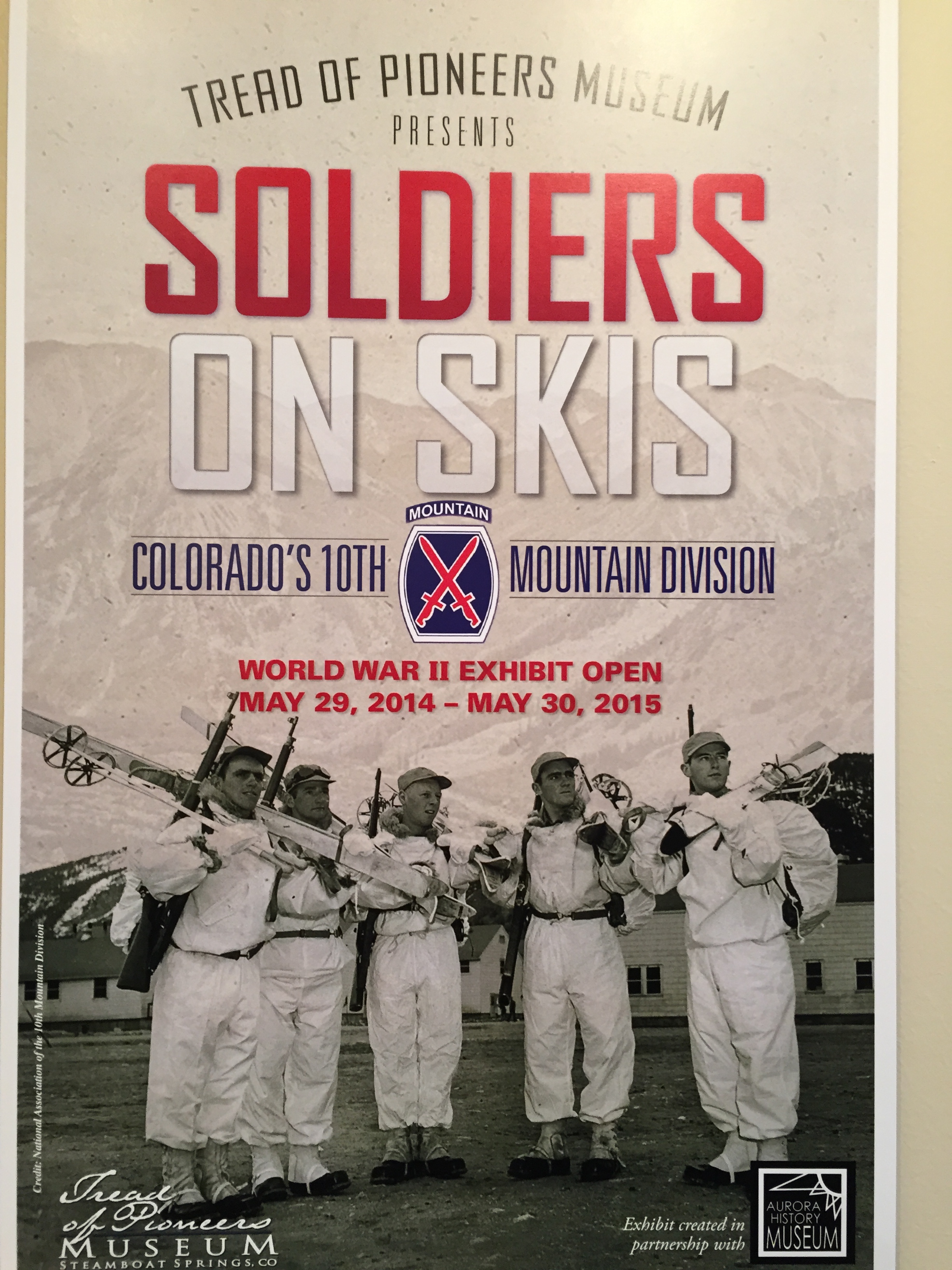
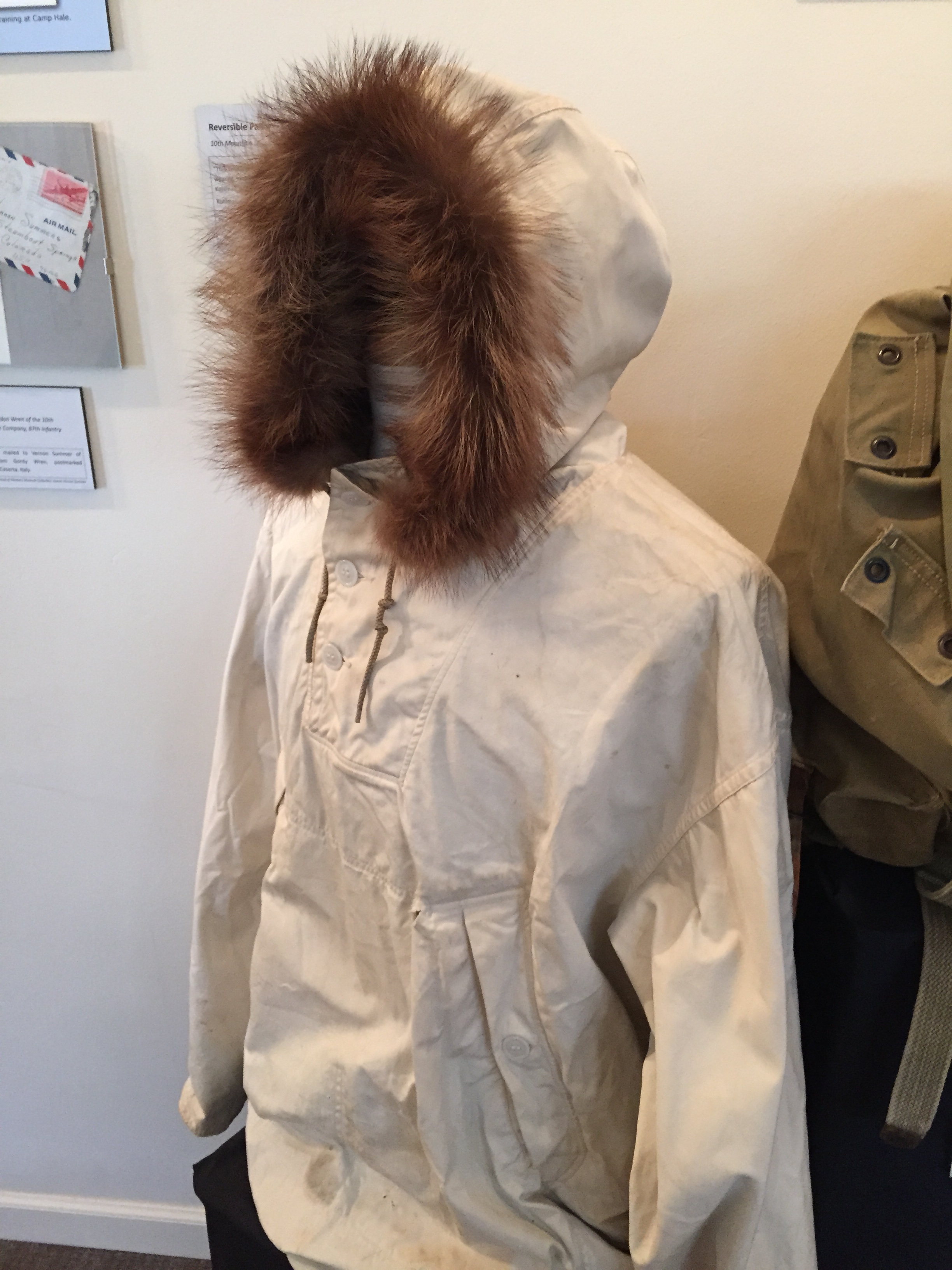
On this Veterans’ Day in the United States, I stopped by a local museum to see an exhibit honoring a special group of soldiers who served during World War II.  The Tread of Pioneers Museum in Steamboat Springs, Colorado is hosting a exhibit called “Soldiers on Skis.” A number of locals served as soldiers on skis.  They still hold reunions here.

Immediately after the attack on Pearl Harbor on December 7, 1941, military leaders realized that American soldiers would have to be combat-ready in all kinds of circumstances all over the world.  That included the treacherous mountain terrain of Europe and Asia–and, if it came to it, of the United States as well.  In 1939, Russian troops invading Finland had been held back by much smaller numbers of Finnish soldiers on skis.  The Finnish soldiers were able to use the rugged terrain of their home country to their advantage. United States military leaders took a lesson from the brave Finns. Soon Army suppliers were designing warm clothing and tents for mountaineering soldiers.

IMG_2167


Serious planning for mountain combat began. There were already a number of recreational ski mountains in the United States, along with some ski racers and ski patrol men. The Army began recruiting efforts with men already skilled on skis and in mountain terrain. They found no shortage of volunteers. The 10th Light Division (Alpine) was activated in July of 1943 and based in Camp Hale, in the heart of the Colorado Rockies. Among other training techniques, Army engineers actually built a glacier to mimic terrain the soldiers would soon see in Italy.  In 1944, what became known as the 10th Mountain Division shipped off to Italy.  They fought Axis troops in fierce and crucial battles in the Italian Apennine mountains near Bologna, Pisa and Lake Garda. (There’s an expert ski run called “Riva Ridge” in Vail, Colorado. I skied it for years without appreciating that it was named after a perilous ridge climbed by 10th Mountain Division soldiers on February 18, 1944, on their way to a vital attack that began on February 20).

Once the skiing soldiers had successfully helped to end German resistance Italy, they were to be shipped to Japan to fight in the mountains there.  However, they were not needed after the Japanese surrender. Since World War II, the 10th Mountain Division has been demobilized and reactivated several times.  To this day, the unit is light infantry, with special training and equipment to move in hard terrain.

IMG_2177

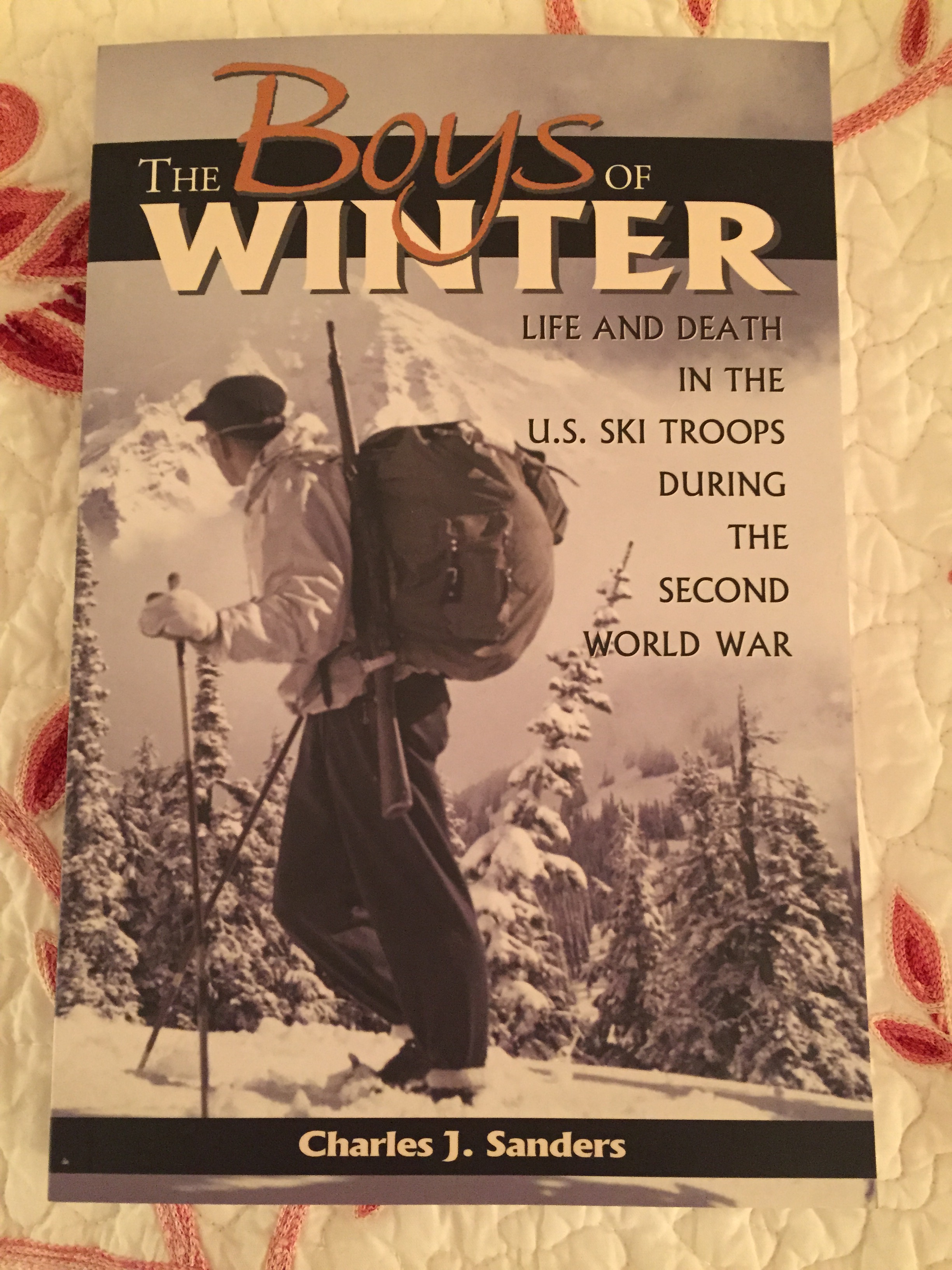
I bought a book at the museum. It is The Boys of Winter: Life and Death in U.S. Ski Troops During the Second World War. The author, Charles J. Sanders, particularly honors three of the many men who gave their lives fighting in the 10th Mountain Division.  Their names are Rudy Konieszny, Jacob Nunnemacher, and Ralph Bromaghin.  I’m going to read their stories with interest.

IMG_2176

Many of the great American ski areas were founded by skiing soldiers who returned home, sad at the loss of their friends but enthusiastic about sharing their love of the mountains and of skiing with a civilian population living in peace. Pete Seibert, an ex-soldier who became one of the founders of Vail Resort, no doubt had his fallen friends in mind whenever he set off down Riva Ridge.


What are Plus Fours Anyway?

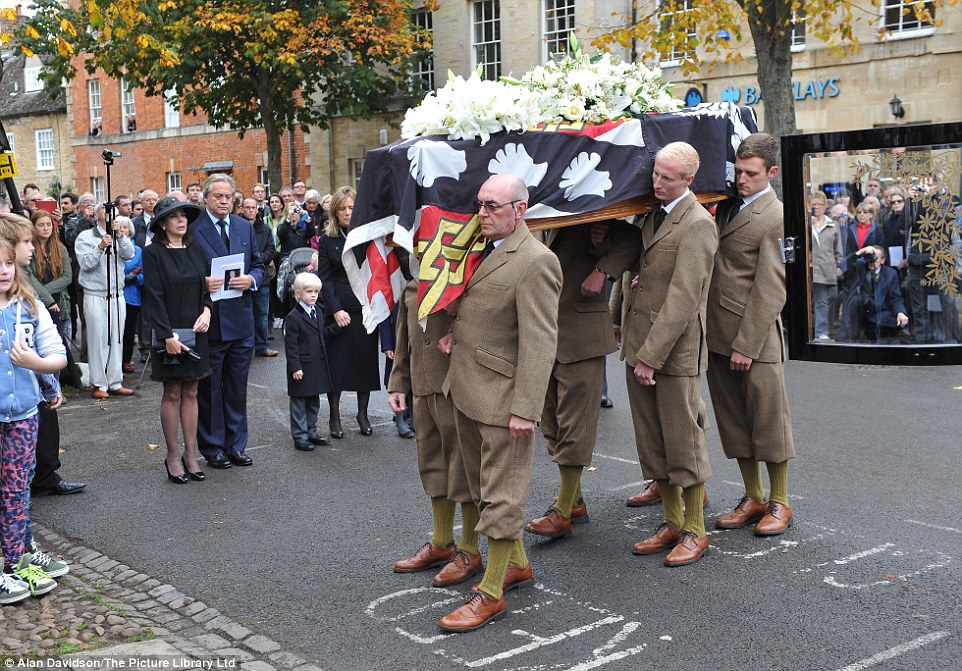
Photo from Daily Mail article cited below

Photo from Daily Mail article cited below

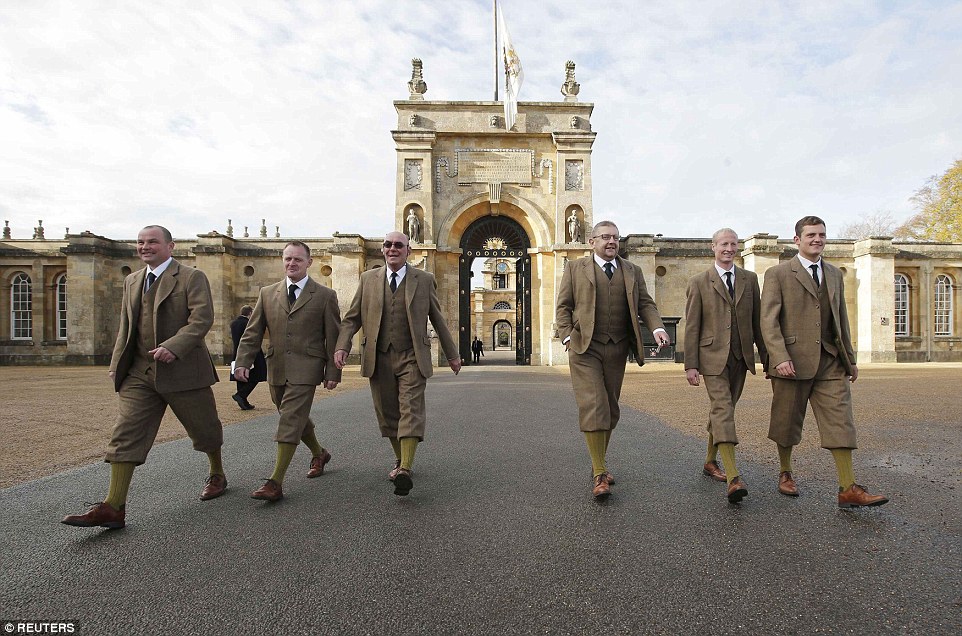
The media coverage of the late 11th Duke of Marlborough’s death made much of the fact that his pallbearers were Palace gamekeepers, or maybe groundskeepers, dressed in “traditional plus fours.”  I looked at the photos and all I saw was short pants worn with knee-high socks that seemed to slightly clash with the pants.  It turns out “plus fours” have a very specific definition: pants that are carefully tailored exactly four inches below the knee.They’ve been worn by British sportsmen since about 1860. The Duke himself very likely wore them when out hunting on his lands.

During his visit to America in 1924, the raffish Edward, Prince of Wales, famously wore plus fours. (He later briefly became Kind Edward VIII, until he famously abdicated in order to marry the divorced American socialite Wallis Simpson). His short pants gave him a sort of free-wheeling look that fit right in with the Roaring Twenties.  After Edward made his way back home across the pond, his stylish short pants caught on, especially with golfers and with anyone else who wanted to flout convention.  (I can well imagine F. Scott Fitzgerald sporting a pair).

I generally expect pallbearers to be close friends or relatives of the deceased.  It seems that having one’s groundskeepers perform the task must be a privilege and mark of very high status. After all, how many of us even have extensive grounds, let alone uniformed groundskeepers to tend them?  There’s also the implication that the Duke’s relatives are above any sort of menial task.

I’m reminded of the custom that shocked Consuelo Vanderbilt when she arrived as a young American bride at Blenheim, freshly married to the 9th Duke of Marlborough. A carriage met the newlyweds’ train in Woodstock.  Approaching Blenheim, men from the estate unhitched the horses and pulled the carriage through the grand palace gates. Things like that didn’t happen where Consuelo came from.

Photo from Daily Mail article cited below

Photo from Daily Mail article cited below

Anyway, the Duke’s employees seem a very happy lot.  When I was in Woodstock last month, all the palace employees I encountered seemed extremely cheerful–and that is not always the case with people who attend the high and mighty.  I think the late Duke was a hands-on sort of man, genuinely loved by many.

As an American, I don’t suppose I’ll ever fully understand the subtleties of the British class system.  I do appreciate certain little perks.  For example, the late Duke’s name was John George Vanderbilt Henry Spencer-Churchill.  But his title gave him the right to use a most elegant signature:  he simply signed his name “Marlborough.” Now that’s class.

http://www.dailymail.co.uk/news/article-2806349/Flag-half-mast-Blenheim-Palace-Mourners-line-route-funeral-cortege-11th-Duke-Marlborough-died-aged-88.html

High Victorian Splendor at Tyntesfield


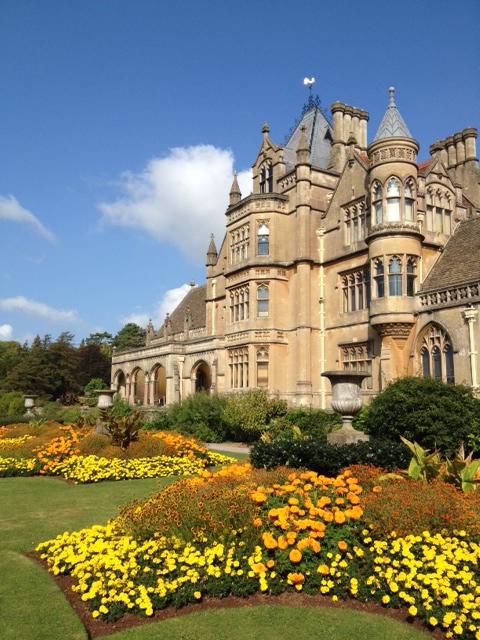
TyntFlowersOn my last trip to England, I made my second visit to Tyntesfield, the glorious Victorian country home rescued by the National Trust of Great Britain in 2002.  My first visit was just a couple of years after it opened to the public.  It is now one of my very favorite National Trust properties in all of Great Britain.

Succeeding generations of the Gibbs family lived in it since it was built.  As the family declined in numbers and in fortune, they simply closed up areas and lived in smaller and smaller parts of the mansion. The result is a time capsule. Tyntesfield and its entire contents were on the market by Sotheby’s when the National Trust managed to purchase it lock, stock and barrel. All the contents had already been tagged for separate auction.

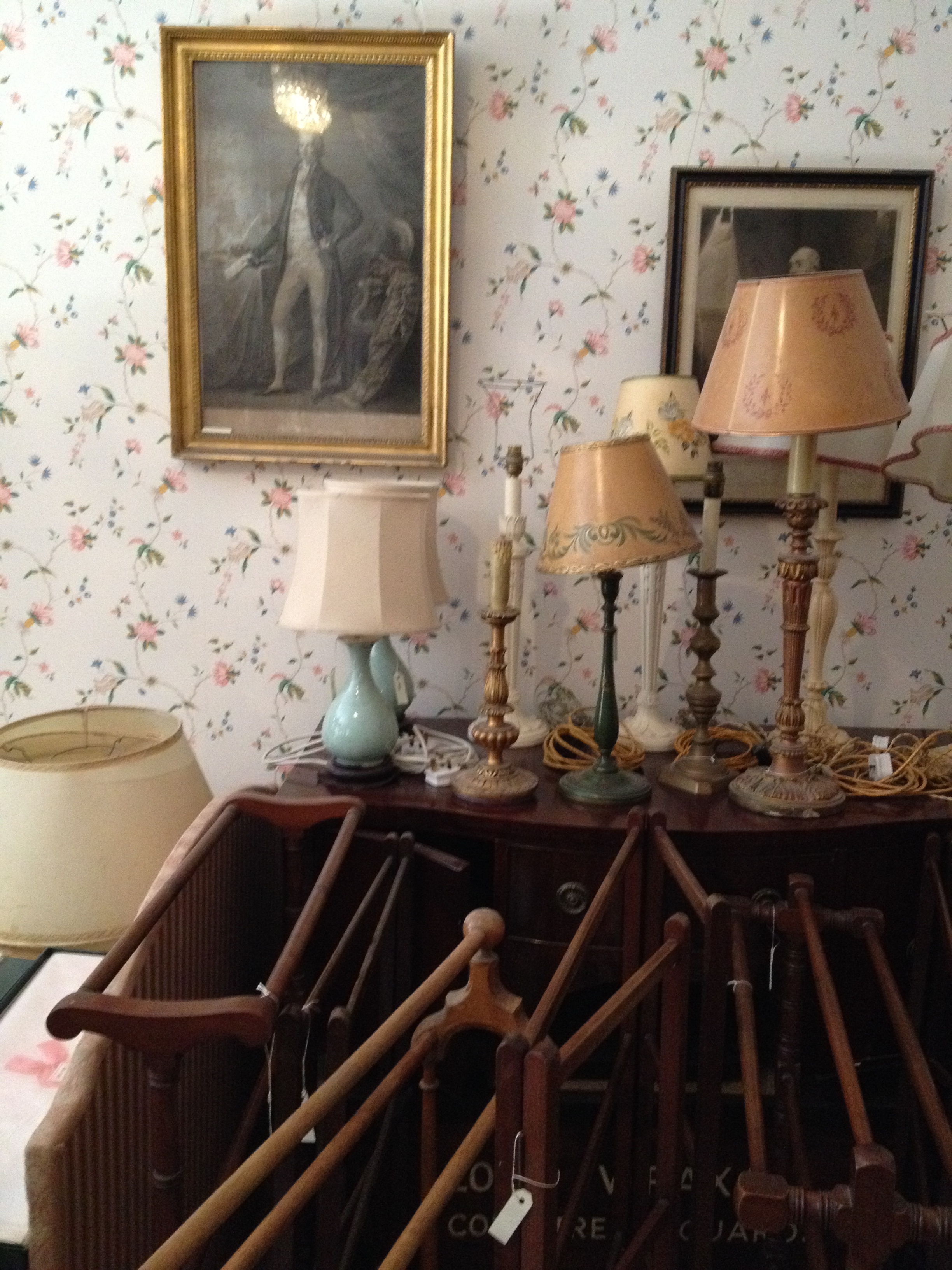
TyntesSotheby1 TyntesSotheby3

National Trust Curators have carefully catalogued, cleaned and replaced thousands of items into their original places in the gorgeous home.  They’ve left a few rooms as they found them with groups of housewares and furniture tagged and ready for the auction block.

By the time the 2nd Lord Wraxall, known as Richard, died in 2001, he was the only person living in the house.  The house had been hit by bombs several times during the Bristol Blitz of World War II, and had never been properly repaired. Birds and bats took up residence in whole wings of the house. Tyntesfield was the last High Victorian house available for purchase in all of England.

The market value was about 20 million pounds, or  about $31 million. In addition, double or triple the purchase amount was needed for repairs. Various gazillionaires were interested. (The press reported that Madonna, Kylie Minogue, and Andrew Lloyd Webber were looking).  But the National Trust of Britain, one of the two main preservation societies, managed to raise the purchase money within a period of 50 days.  (Controversy arose when a semi-secret deal with the National Lottery provided some of the money for this project that many considered “elitist”). The Trust took possession in July of 2002. This was the first new acquisition by the National Trust in many years, and the largest in its history.  Today, over 800 paid and volunteer staff work on the estate, 3 times the number at any other National Trust property.

Dining Room

Dining Room

Tyntesfield is a breathtakingly beautiful place to spend a day.

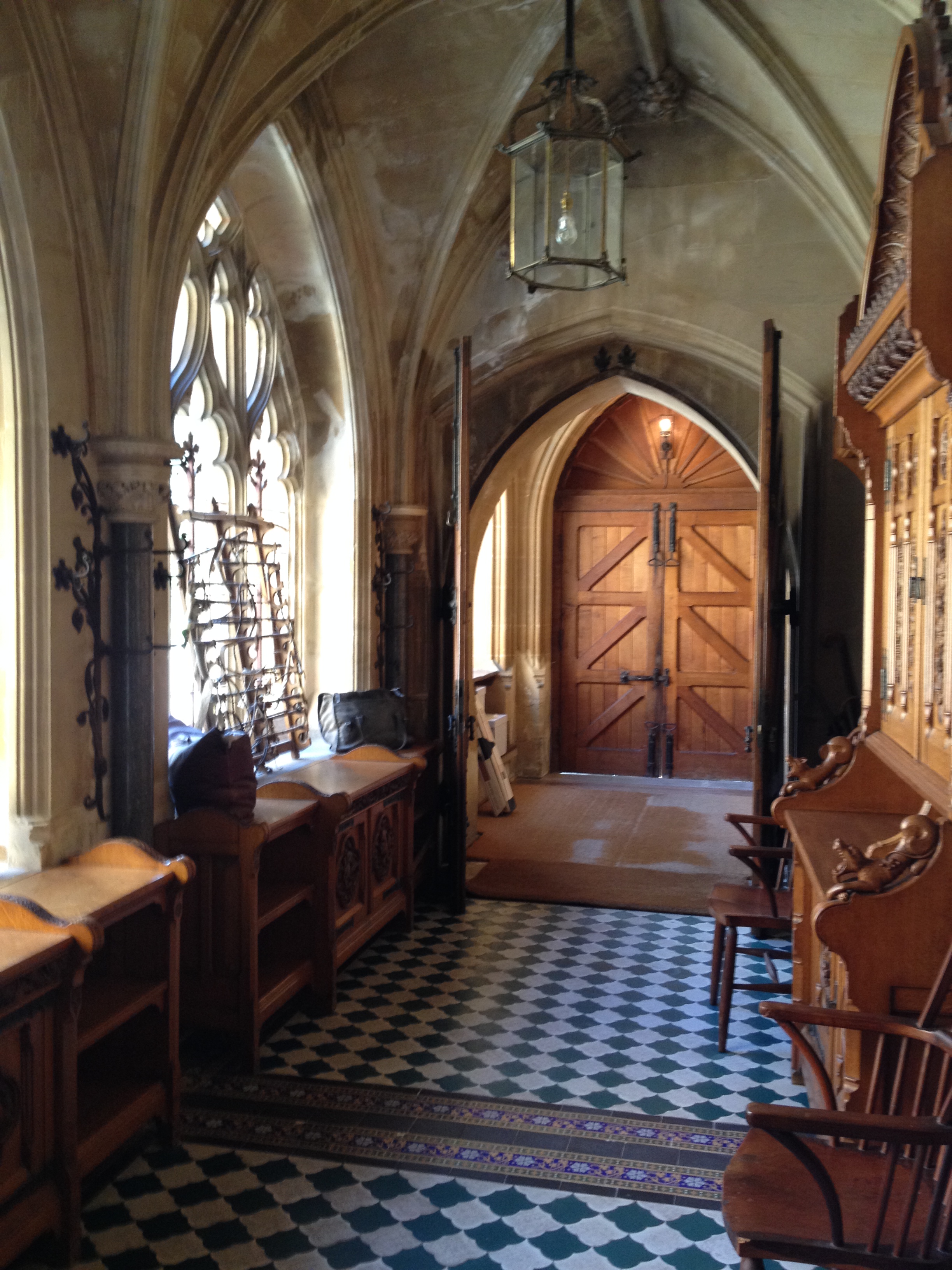
Entry Hall

Entry Hall

It is also a unique window into the glory days of the British Empire, when a businessman with no aristocratic background could amass a huge fortune and build a home to rival many royal palaces. I’ll be writing about how the Gibbs family managed to amass such a fortune.  The large family gathered with their servants for prayers twice a day, had their own private chapel, and funded churches and charities all over England.  However, their business and shipping interests were very likely tied up with the slave trade, a fact which must have caused this generous and devout family some feelings of remorse even as they spent their money.


Thinking About “Columbus Day”

images

Monday, October 13 is Columbus Day across the United States.  However, not everyone feels like celebrating the “discovery” of continents where well-developed civilizations already existed.  In Minneapolis, where I spend a lot of time, the City Council voted in April 2014 to substitute “Indigenous Peoples’ Day” for Columbus Day.

Thinking about controversies surrounding Christopher Columbus, I went back and watched a great film, The Mission. The British film was made in 1986 from a script by Robert Bold, directed by Roland Joffe. It won the Palme d’Or at Cannes and an Academy award for cinematography.  It’s a somewhat-fictionalized version of events that actually took place in the 1750s, in the mountains of Paraguay. The story is taken from the book “The Lost Cities of Paraguay” by Father C. J. McNaspy, S.J., who was also a consultant on the film. For me, the story dramatizes some of the heartbreaking conflicts between missionaries and politicians in the colonial period. Conflicts surrounding the exploitation of native lands and peoples continue in our time.

IronsFlute

The main character, Father Gabriel, is played by Jeremy Irons.  The character is based on a real-life Paraguayan Jesuit, Father Roque Gonzalez de Santa Cruz, who became a saint. After a priest in his charge is martyred by a Guarani tribe above a perilous waterfall, Father Gabriel climbs up the steep stone face carrying nothing but a flute.  Warriors surround him as he sits on a rock and plays.  It turns out they love music; they let him stay, and he develops a mission that helps them in material as well as spiritual ways. They are not exploited. Instead, they prosper.

The outside world arrives in the form of a mercenary soldier played by Robert de Niro. He has a lucrative sideline in the slave trade.  He sets a huge net as a trap in the jungle; soon he has a netful of tribe members, and he hauls them off like so many rabbits, to be sold into slavery. Soon afterward, he murders his brother in a jealous rage. Although he is acquitted, he experiences remorse for the first time in his life.  Father Gabriel, on a visit to the city, challenges the mercenary to atone for his sins and change his life.  As penance, the mercenary hauls his net, loaded with all his armor and possessions, tied to a rope and dragging behind him.  He climbs up to the mission above the falls, fully expecting to be shunned or even killed.  He is amazed and humbled when the tribe members forgive and welcome him; over time, he becomes a Jesuit himself. Liam Neeson is excellent as a young Jesuit, in one of his earliest roles.

The rest of the movie concerns further encroachments of the outside world.  Father Gabriel’s mission–and six others like it–are under the protection of Spain, which outlaws slavery.  In 1750, the Treaty of Madrid gives part of Paraguay to Portugal, which encourages slavery. Suddenly, the missions are ordered to close. The Church cannot risk allowing the Jesuits to violate the treaty; the Spanish could shut down their order entirely if they resist. Other religious orders could be barred from the colonies.

Father Gabriel and his Jesuits have to make agonizing choices.  A joint army from Portugal and Spain is ordered to clear out the missions in Portuguese territory. Should the missionaries abandon their mission and the Guarani people they have come to love?  Should they help the Guarani resist, using modern warfare techniques?  Should they resort to peaceful resistance? Would peaceful resistance have any chance? If not, should they sacrifice themselves by trying peaceful resistance anyway?

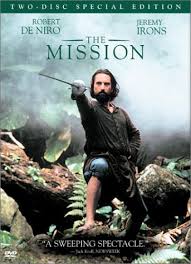
"The Mission" poster

“The Mission” poster

The film is available at Amazon. The story of the colonization of the “New World” is complex, The great colonial powers of England, Spain, France, and Portugal set out explicitly to exploit whatever they found in the “New World,” people and resources alike. But the members of the various religious orders set out for the colonies with a sincere desire to improve the lives of the people, however misguided their methods were at times.  They were able to do a lot of good that remains to this day. A film like “The Mission” invites us to share in the moral quandaries of times past, and to think about those of the modern world.

Join me next time for more explorations in the art and history of Europe!


John Ruskin

Brantwood, the home of English writer/critic/artist John Ruskin, is one of many enchanting sights in the Lake District of northern England. Ruskin bought this lakeshore home in 1872 and lived there for the rest of his life.  I can see why.

RuskinShore

The house and gardens are on the shore of beautiful Coniston Water.

RuskinBoats

The cafe is called the Jumping Jenny, after the boat Ruskin used to potter around the lake on.  His boat probably looked like one of these.

RuskinStudy

Ruskin’s study is crammed with evidence of his wide and varied interests and expertise:  in the natural world, scientific discoveries, literature, architecture, design, art, history, and any number of other fields.  He had advanced social views for his time, too.  One of his concerns was the plight of the worker in the industrial age.  He felt that modern manufacturing demanded that workers give up their most human qualities, to everyone’s detriment.

This quotation, on a placard in Ruskin’s study, caught my eye:  “You can teach a man to draw a straight line, and to cut one; to strike a curved line, and to carve it; and to copy and carve any number of given lines and forms, with admirable speed and precision, and you find his work is perfect of its kind; but if you ask  him to think about any of those forms, to consider if he cannot find any better in his own head, he stops; his execution becomes hesitating…But you have made a man of him for all that. He was only a machine before, an animated tool.”  The words are from Ruskins book “Stones of Venice.”

John Ruskin in 1863, photograph by William Downey, Public Domain

John Ruskin in 1863, photograph by William Downey, Public Domain

If I were given a chance to meet 10 people from the past, John Ruskin would be high on my list. And I’d make arrangements to meet him at his home in the Lake District!

Join me next time for more explorations in European history and art!