Category Archives: Historical Figures

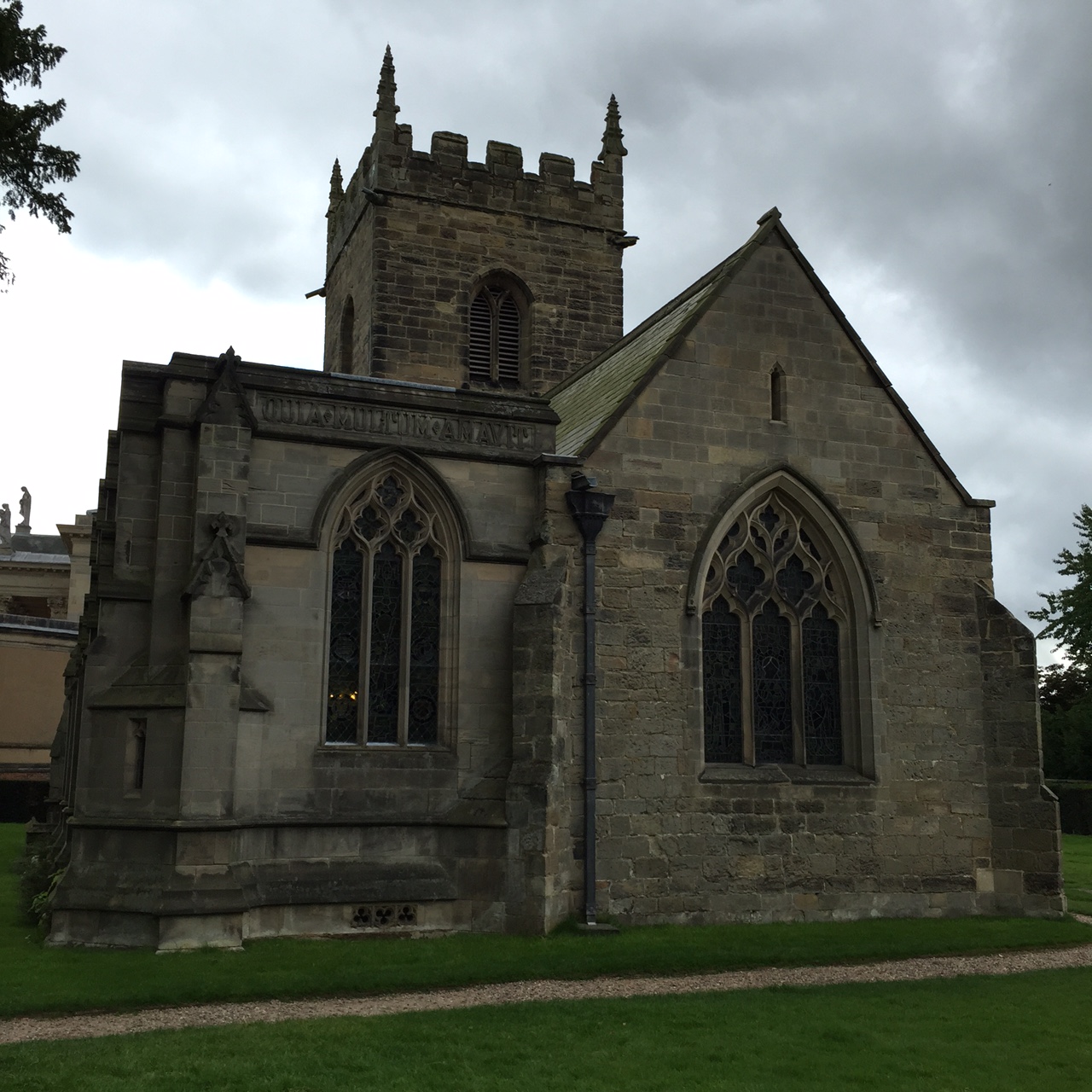
All Saints’ Church at Kedleston Hall

KedlestonHall

Kedleston Hall is the spectacular showplace home of the Curzon family, designed by Robert Adam, finished in 1765 and open to visitors before all the plaster was dry. The housekeeper led visitors (of the right sort, of course) on a tour through the state rooms. The point was to impress visitors with the wealth, power and taste of the family. Not everyone cared for the place, though. Dr. Johnson remarked, “It would do excellently for a town hall.” I have to agree.  Entering the lofty Marble Hall feels like entering a courthouse. Visitors stop in their tracks and speak in hushed voices.
AllSaintsKedleston

My favorite part of the estate is All Saints Church on the grounds outside. The church is an important historic site, cared for by a special organization separate from the National Trust, which manages the house.

CurzonMedieval

Curzon ancestors, dating all the way back to Norman times, were buried inside and in the churchyard. When Sir Nathaniel Curzon inherited the estate in 1758, he lost no time in razing the medieval village where his ancestors had lived quietly for centuries. But he kept the village church where they slept in their tombs.
AllSaintsPlaque

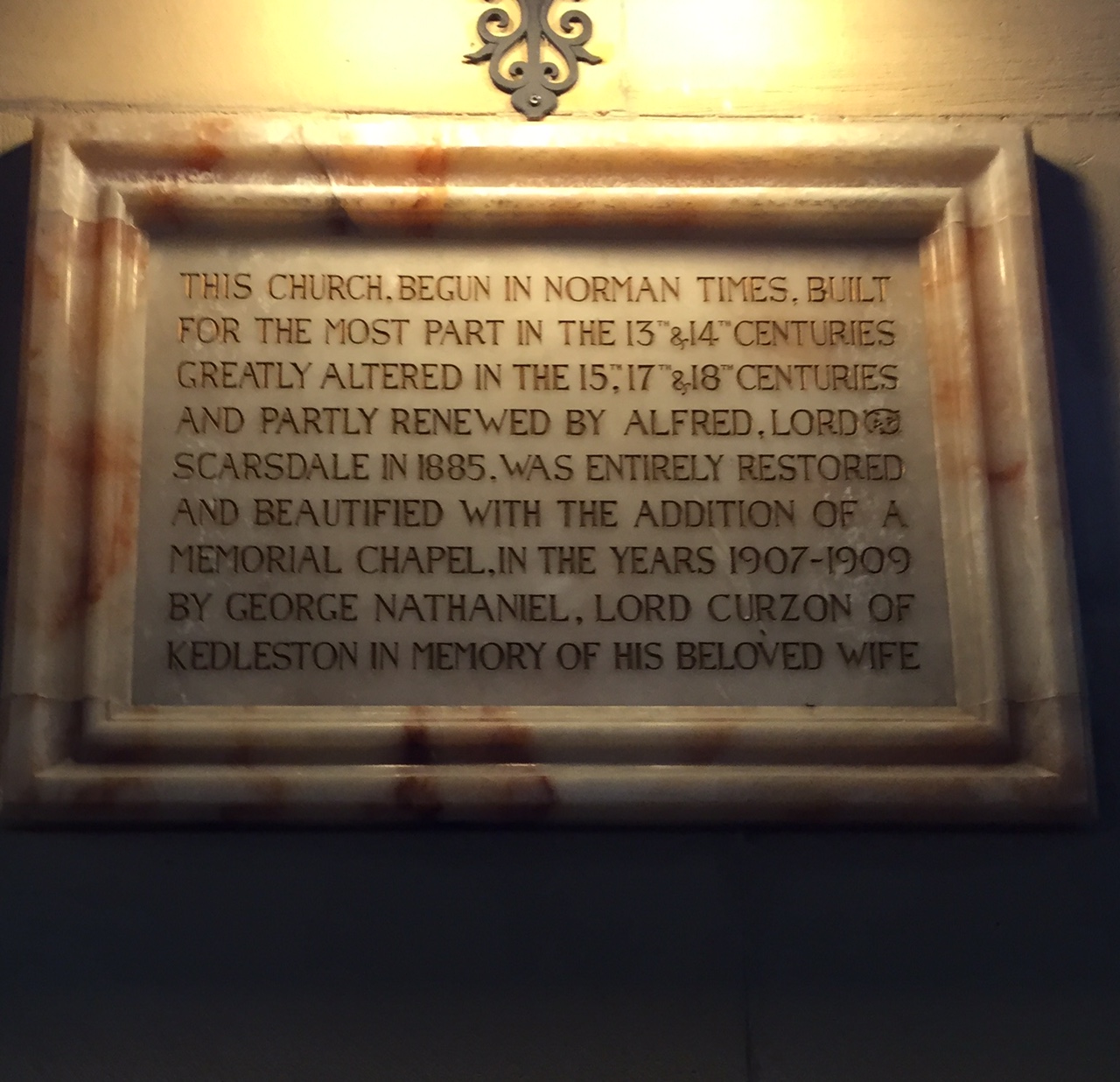
As the plaque above explains, various Curzons maintained and restored the church over the years.  But its pristine condition today is mostly because of a sad love story.
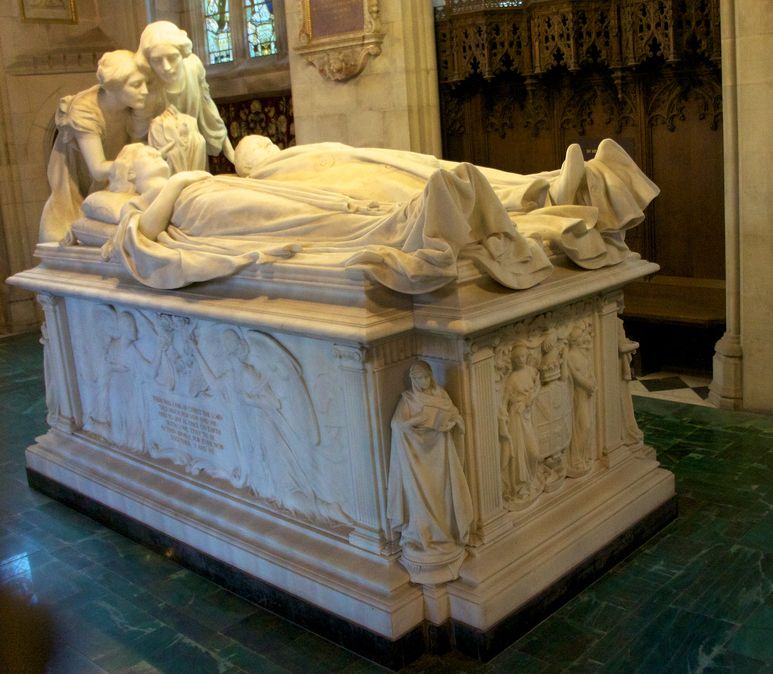
Photo by Chris Hoare, Creative Commons Attribution 2.0 Generic

Photo by Chris Hoare, Creative Commons Attribution 2.0 Generic

The photo above shows the exquisite marble memorial of Lord George and Lady Mary Curzon.  It was created between 1907 and 1913 by Bertram Mackennal. (Visitors can’t get the complete view above, because the side chapel is separated from the main church by a gate). This is one of the most beautiful and intriguing of all the many tombs I’ve seen in old churches. Who were these people?

MaryCurzon

Mary Leiter was a fabulously wealthy, cultivated and beautiful young woman from Chicago.  Her father was Levi Leiter, founder of Field and Leiter stores, which eventually became Marshall Fields. (Yes, Mary Leiter was an inspiration for Cora, the perfect wife of Lord Grantham on the TV show “Downton Abbey.”)  Mary Leiter married George Curzon in 1895. He very soon afterward became Viceroy of India, the highest title available to an Englishman, during the heyday of Victorian empire. Mary gave birth to three daughters, but failed to produce the all-important son. The years she spent in India were happy ones, but her health suffered and she died in 1906, aged only 36.

KedlestonSideChapel

Her husband immediately set to work memorializing her, even as he moved on to various mistresses and an eventual second wife. He never really recovered from his grief at losing Mary. So he built a neo-Gothic addition to the family church. The addition blends almost seamlessly with the original medieval church.   He commissioned the beautiful marble memorial. Mary was buried in the newly-created family vault underneath.  My understanding is that Lord Curzon had Mary’s effigy placed on the plinth as soon as the chapel was complete.  His own effigy was finished and kept in storage until he died.  Then it was placed next to his beloved Mary, and he took his place in the vault below.

Victorian technology allowed Lotrd Curzon to install a hidden elevator in the marble floor next to the memorial, so that coffins could be lowered into the vault at the push of a button.  The friendly church guide recalled the spooking of a lady in recent years. She walked into the church just as a workman rose slowly from underground, standing on the moving section of floor. The terrified lady fled.
FullSizeRender (12)

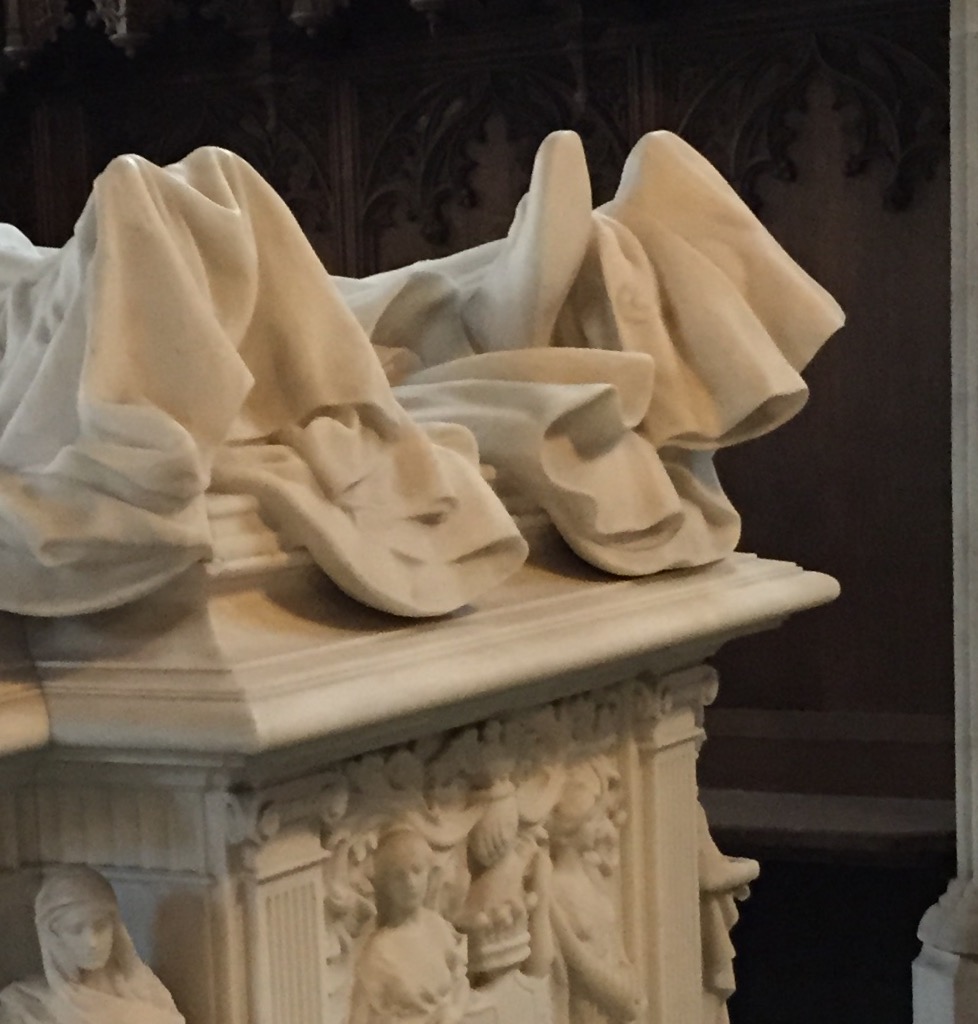
The guide pointed out that Lord Curzon’s right foot is uncovered, a Victorian convention indicating that the effigy was created while the person was still alive. Lord Curzon was a stickler for detail, and he expected the same from his family and everyone who worked for him.

MaryCrown

The sculpture depicts two angels hovering over the sleeping figures.  What are they holding? It’s the Crown of Life–a fairly obscure Biblical reference. The crown is wrapped in a veil. Why?  My thought is that nobody gets to see their heavenly reward until they actually receive it in the Great Beyond.

The sculpture stands serenely in its own side chapel, surrounded by nine stained glass windows depicting various Marys from the Bible and other sources. Impertinent questions come to mind. Considering that there are two people lying in state, why is there only one crown? Is the sleeping couple somehow supposed to share the crown, or is it meant for only one of them? If it is for one of them, would that be Mary? In some traditions, Mary the mother of Jesus became Queen of Heaven after her death. But this is an Anglican church, and as far as I know has no such tradition. Anyway, wouldn’t it be just a bit sacriligious to insinuate that one’s wife was destined to be Queen of Heaven? The guide had an information booklet, but there was very little explanation of the mysterious veiled crown. I would not use a vulgar term like “control freak” for Lord Curzon, but I half expected his ghost to tap me on the shoulder and set me straight about the crown. He did not suffer fools gladly.

Lord Curzon never found another person who could compare to his Mary, and by all accounts he often said so. How could any actual living person compete with a sainted ghost? After Mary’s death, Lord Curzon was soon battling his daughters for their shares of the money Mary had left. He ended up estranged from them. Toward the end of his life, he was also estranged from his second wife, Grace. All the same, according to the guide, Lord Curzon kindly reserved a space for her in the family vault. But Grace did not care to spend eternity directly underneath the effigies of her husband and his first wife, depicted in everlasting marital bliss. Instead she chose a burial plot for herself in the far corner of the churchyard.

Viceroy's Daughters
Every trip leads me to buy books which I may or may not find time to actually read. I’ve already devoured the book above, The Viceroy’s Daughters by Anne de Courcy. The Curzon family history, especially in the 20th century, is riveting.  The book is a window into British aristocratic life from Victorian times all the way through World War II.  I’ll be writing more about the glamorous Curzons.

Join me next time for more explorations in the art and history of Europe and the British Isles!

The Chapel at Tyntesfield

TynChapelExt

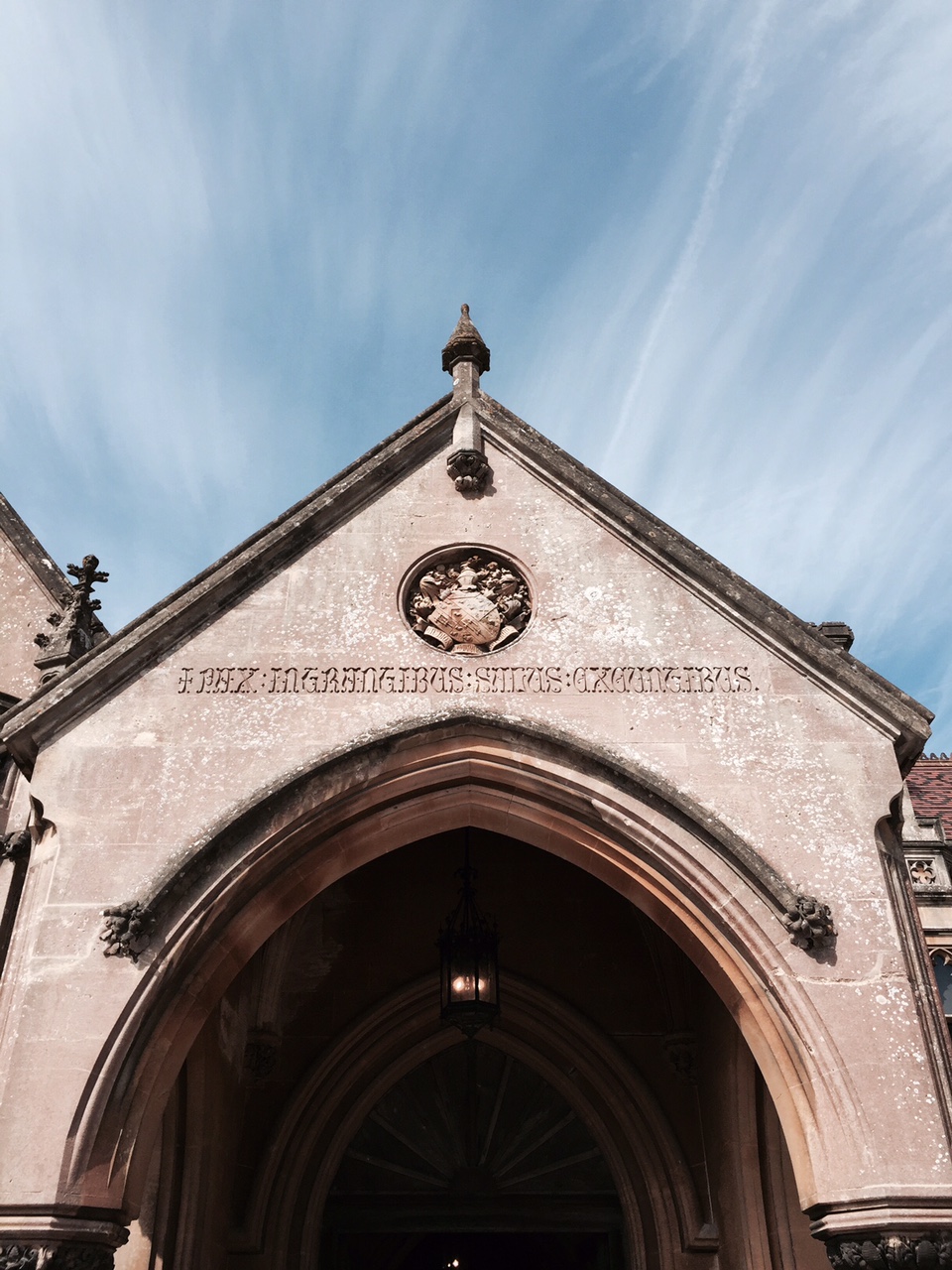
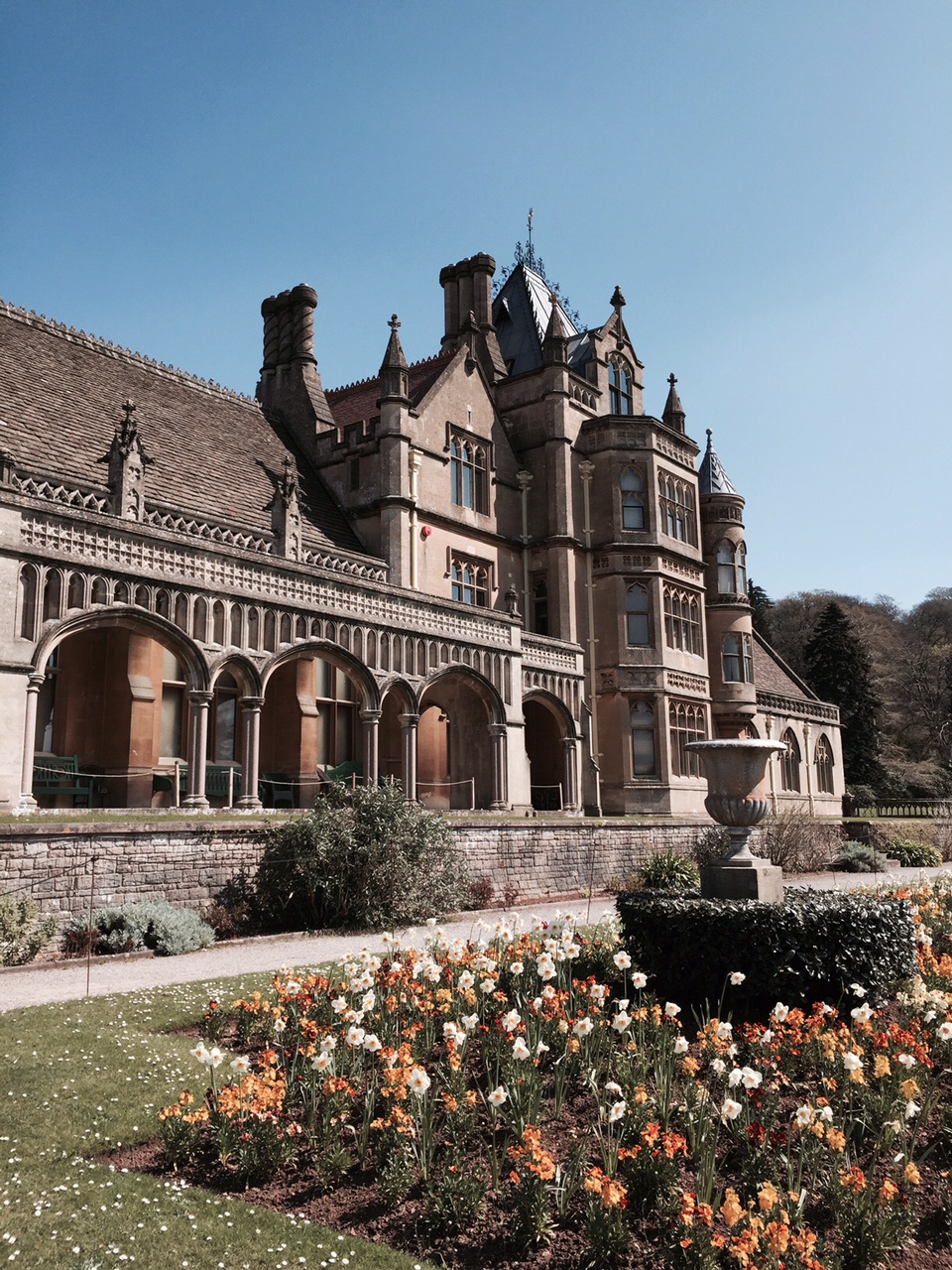
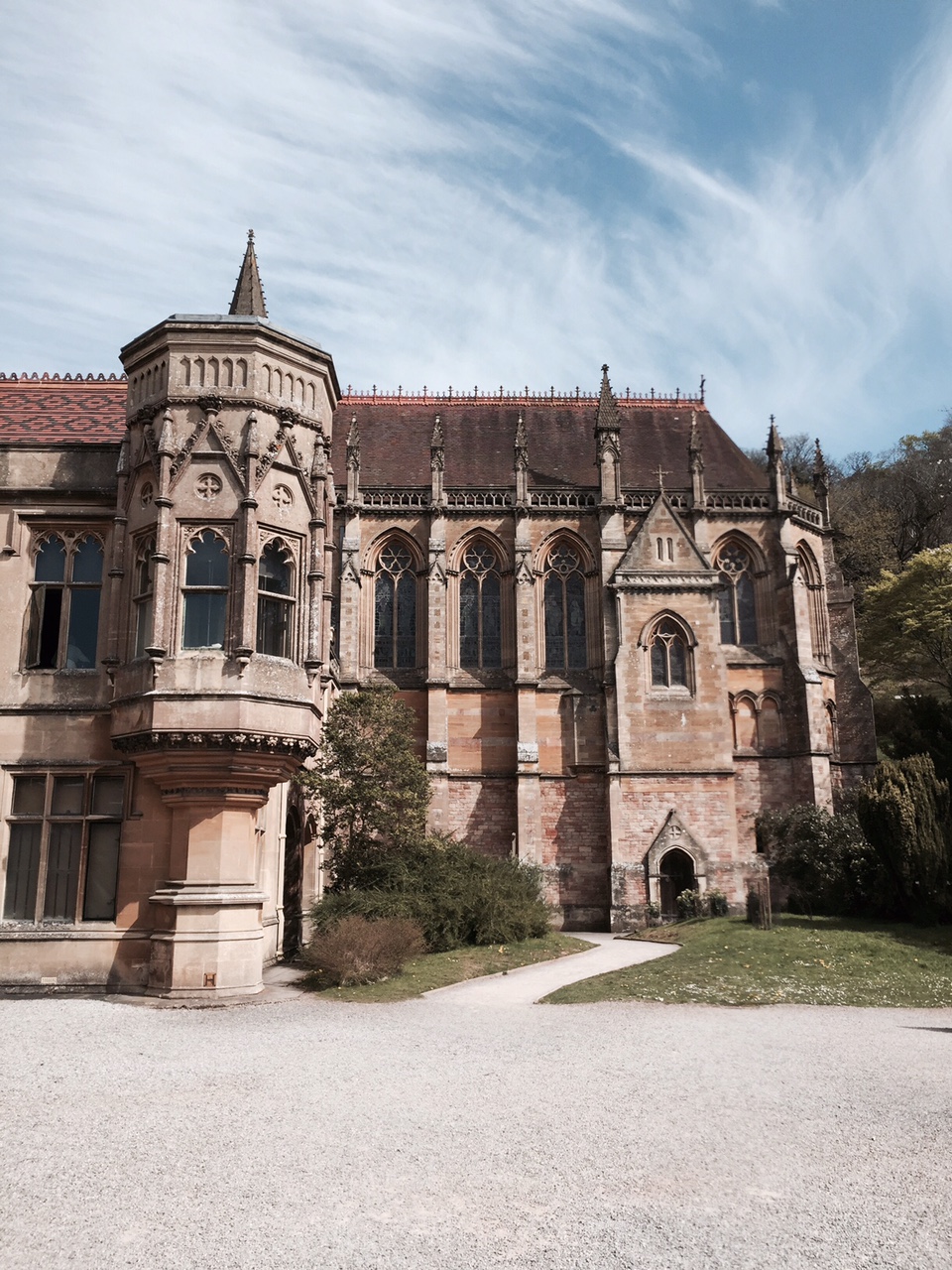
The chapel at Tyntesfield is a spectacularly beautiful reimagining of a French medieval church, Sainte-Chapelle in Paris. Tyntesfield is a Victorian neo-Gothic mansion built by the devout Gibbs family, commoners who rose to great wealth through banking, shipping, and bat and bird manure (more on that later).

FullSizeRender (9)

The chapel was the last big building project on the property, just outside Bristol, but it was in many ways the one most important to William Gibbs. It is also the first part of the house that the visitor sees on the walk from the parking lot and National Trust visitor center.  It’s a stunning first impression. Arthur Blomfield was the architect and builder.

FullSizeRender (8)

When the Gibbs family lived in their Victorian Gothic Revival mansion, the family, guests and servants alike attended prayers twice daily–first in the grand hall, and later in the chapel when it was finished. Beginning around 1842, William Gibbs made his fortune from a simple idea that grew and grew: he imported guano, the droppings of sea birds and bats, from Peru to North America.  Guano was highly prized as a fertilizer. William Gibbs became the richest non-aristocratic man in England. Tyntesfield had 106 total rooms, with 26 main bedrooms plus more rooms for the many servants. The square footage is about 40,000. And this was only their country home.  Most of the time they lived elsewhere, in equally grand digs.

FullSizeRender

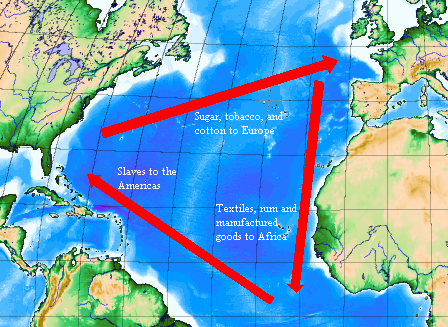
Naturally, people were envious of Gibbs’s success. An indelicate ditty in London ran, “Mr. Gibbs made his dibs, Selling the turds of foreign birds.” Actually, the selling of fertilizer led inexorably to profiting from the slave trade, a fact which the Gibbs family preferred not to dwell on.  Their shipping business, over time, became a part of the Triangular Trade that caused so much human misery. Ships constantly transported material goods and slaves between Europe, the Americas, and Africa.

Triangular Trade, Creative Commons GNU Free Documentation License

Triangular Trade, Creative Commons GNU Free Documentation License

The Gibbs family donated large amounts of their fortune to various charitable causes, and generously supported churches all over England. Naturally, they wanted their own church.  The chapel was built between 1872 and 1879, to a design by Arthur Bloomfield.

Sainte-Chapelle, interior, image from The Guardian article cited below

Sainte-Chapelle, interior, image from The Guardian article cited below

The inspiration was Sainte-Chapelle in Paris, pictured above. Sainte-Chapelle was built by the devout Louis IV in the 1240s. (He later became St. Louis, giving his name to the American city later still).

TynChapGlass

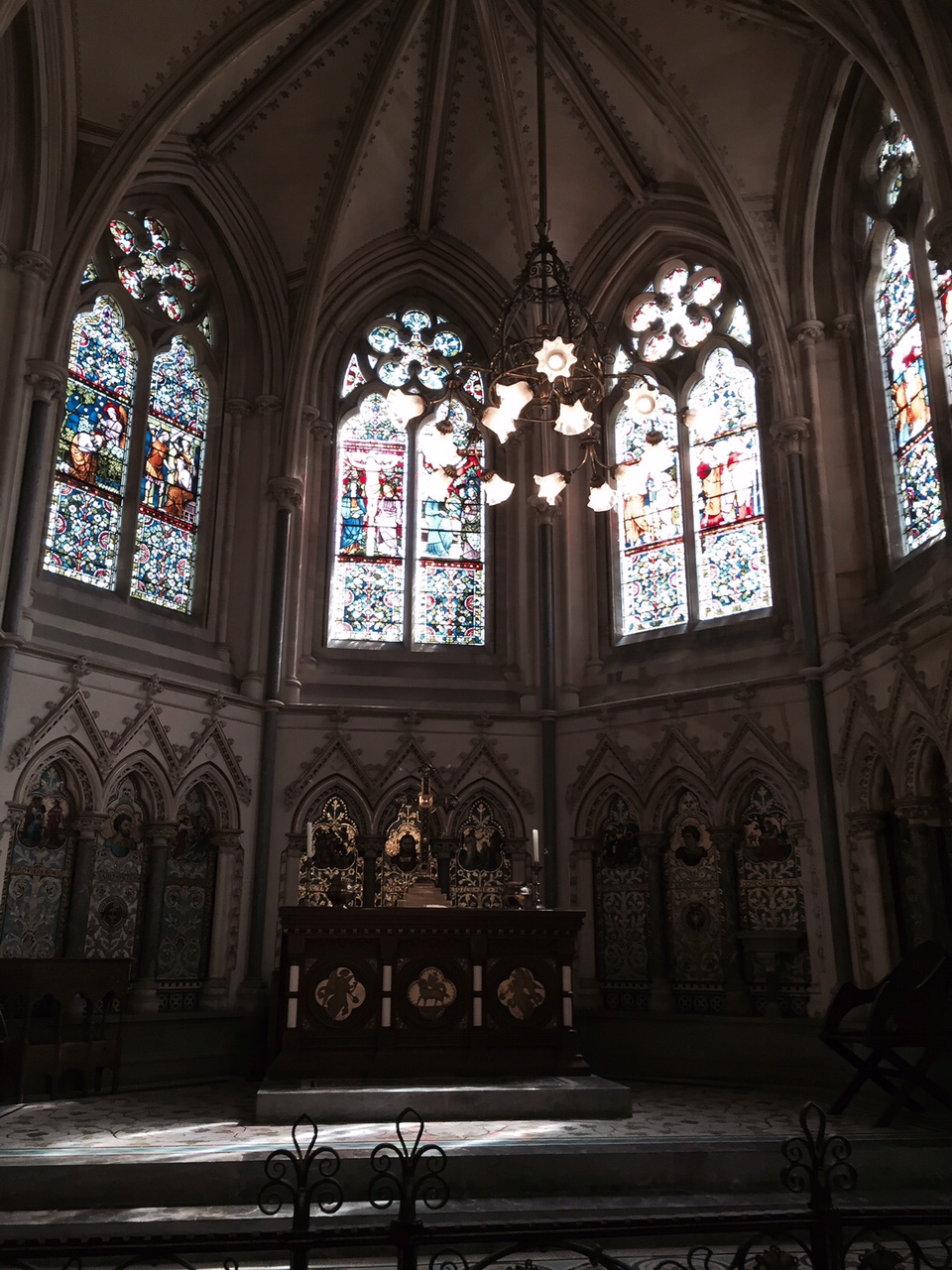
The stained glass at Tyntesfield is beautiful, if not as spectacular as the newly-restored glass at Sainte-Chapelle in Paris.

FullSizeRender

The stonework is lovely and evocative.

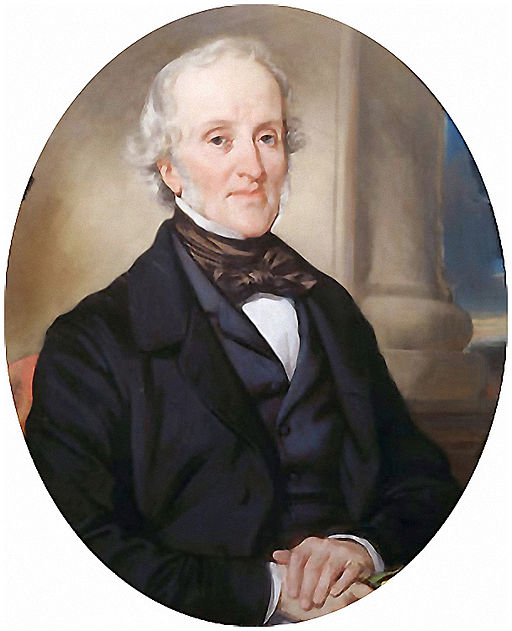
Portrait of William Gibbs by Eugene Deveria, circa 1850, Public Domain

Portrait of William Gibbs by Eugene Deveria, circa 1850, Public Domain

WIlliam Gibbs intended to follow the example of aristocratic families and create a family burial vault underneath the chapel for future generations. The vault exists, but it is empty. The Bishop of Bath and Wells, under pressure from local churches, refused to consecrate the chapel. The stated reason was that allowing a consecrated chapel on the grounds of Tyntesfield would detract from local churches. I can’t help thinking that “the powers that be” were also reluctant to upset the social applecart by allowing a family of common birth to put on airs. (Eventually, George Abraham Gibbs was “created” 1st Baron Wraxall in 1928, but family fortunes were already declining by that time).

The chapel at Tyntesfield is the last stop for visitors touring the beautiful mansion. It’s a lovely, light-filled, quiet place to contemplate history. William Gibbs was buried elsewhere, but a cross and inscription from the book of Proverbs memorialize his life: “The hoary head is a crown of glory, if it is found in the way of righteousness.” William Gibbs did his best to be both a businessman and a righteous man.  Early in his career, he and his brother Henry worked hard to completely repay the debts that earlier family members had run up.  The family business had gone bankrupt, and there was no obligation to pay. But they did anyway, every penny. It also appears that William Gibbs did his best to remove his shipping business from the slave trade once the terrible abuses were known.

I previously wrote about Tyntesfield and the Gibbs family at https://castlesandcoffeehouses.com/2014/10/22/high-victorian…at-tyntesfield/

https://castlesandcoffeehouses.com/2013/06/19/tyntesfield-vi…lendor-rescued/

Tyntesfield: Mr. Gibbs Made His Dibs

An article about the restoration of St. Chapelle in Paris is at http://www.theguardian.com/world/2015/may/20/sainte-chapelle-paris-stained-glass-window-restoration-completed

Join me next time for more explorations in the art and history of Europe and the British Isles!
Las Meninas: A Velazquez Masterpiece

Diego Velazquez, "Las Meninas," 1656-7, Public Domain, Prado Museum

Diego Velazquez, “Las Meninas,” 1656-7, Public Domain, Prado Museum

In around 1656-57, the great Spanish court painter Diego Velazquez was at the height of his powers, both as an artist and as a courtier.  King Philip IV appointed him not only to paint portraits of the royal family, but also to acquire and curate the royal art collection. Velazquez was more than a mere painter; he lived almost as a member of the royal family. Many people think Las Meninas is the greatest painting in all of Western art.

Pablo Picasso, "Las Meninas," image from Guggenheim website cited below

Pablo Picasso, “Las Meninas,” image from Guggenheim website cited below

In 1957, Pablo Picasso painted over 40 of his own versions of the painting. One of the greatest artists of modern times was carefully studying and paying tribute to a great artist of the past.

In the original painting, Velazquez did not have the red cross of the Order of Santiago emblazoned on his chest; he only received it three years later.  Philip IV ordered the cross to be added to the painting after the death of Velazquez. Legend has it that the King personally painted it.

The central figure is Princess Margarita Teresa, at the time the only living child of her parents, King Philip IV and his second wife Mariana of Austria. They’re in the background of the painting, possibly reflected in a strategically placed mirror. Also present are two ladies-in-waiting, two dwarves, a lady chaperone, a chamberlain, a bodyguard, and a friendly-looking mastiff.  And the artist himself is present, with brush and palette. The names of all the people are known, except the bodyguard.

Detail from "Las Meninas," Public Domain

Detail from “Las Meninas,” Public Domain

I’ll leave it to art historians to explicate what all Velazquez wanted to say in his magnum opus.  I’m drawn to the enchanting figure of little Margarita Teresa, age 5.  This was a golden moment in her short but seemingly happy life. The painting was almost destroyed by a fire in 1734.  Fortunately, it was rescued.  The left cheek of the princess was burned, but it was painstakingly restored.

The spectacular Velazquez exhibit at the Vienna Kunsthistorisches Museum last year had to make do with a reproduction of Las Meninas. The masterpiece is too precious for the Prado to lend out.

One of the pleasures of a major museum exhibit is a stop at the gift shop.  What souvenirs did the marketing people come up with? I thought they outdid themselves for the Velazquez exhibit.

b0621be3-02a5-45d1-948c-0c761a6a6c2e_0

Anyone for a t-shirt with the most fetching images from the great paintings? On the black cotton background, they show up almost as elegantly as the figures in Las Meninas.

bf1a76db-61b1-499e-a562-3a645ca4bafd_0

Or how about a set of salt and pepper shakers? The salt is the adorable Margarita Teresa.  The pepper is Diego Velazquez himself, complete with brush, palette and the cross of the Order of Santiago. I’m still kicking myself for not buying them.

An article about Picasso’s Las Meninas is at http://web.guggenheim.org/exhibitions/picasso/artworks/maids_of_honor

Join me next time for more explorations in the art and history of Europe!

St. Jerome and His Lion

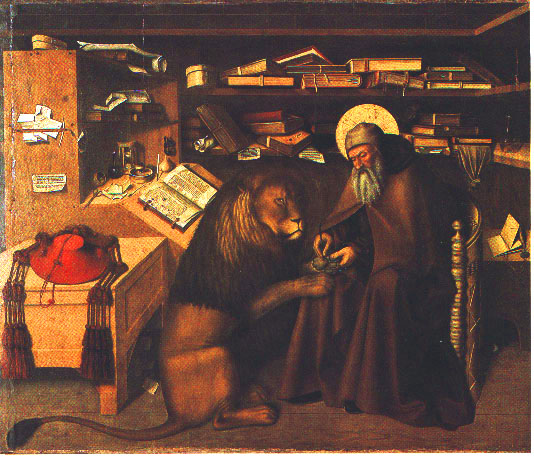
Niccolo Antonio Colantonio,

Niccolo Antonio Colantonio, “Jerome in his Study,” c. 1440-1470, Public Domain, National Museum of Capodimonte

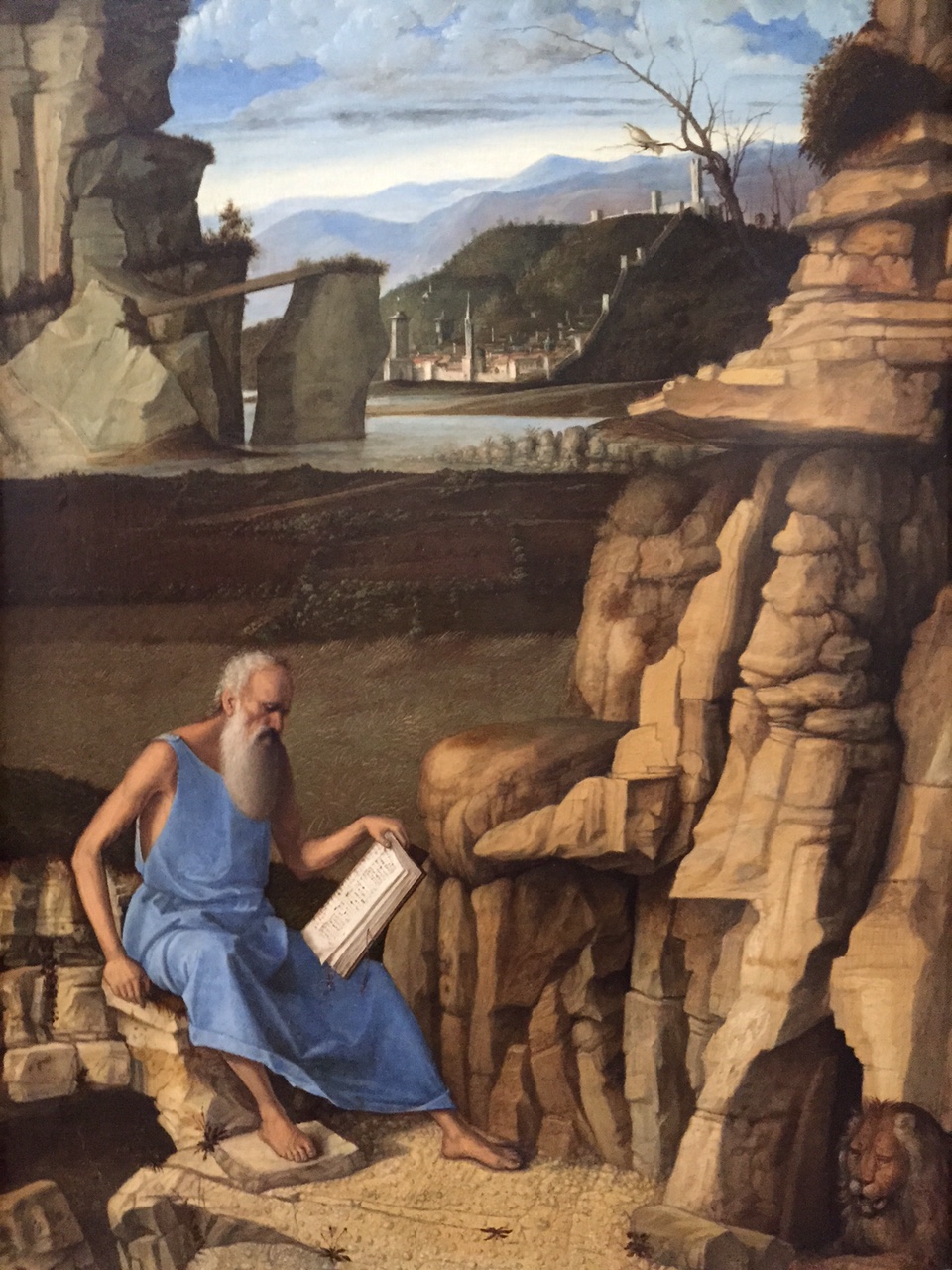
One of my favorite saints is Jerome, AKA Saint Hieronymous. Why? Because he befriended a lion in the wilderness–or at least so the legend goes. In the painting above, the lion has ventured into the saint’s dusty study with a thorn in his paw.  Jerome sets his book aside and carefully removes the thorn.  In other depictions, the saint comes across the lion, writhing in pain, out in the wilds. Either way, the legend is that from the moment Jerome extracted the thorn, the lion never left his side.

Jerome was born around the year 347 A.D.  He lived mostly in what is now Croatia.  A scholarly fellow, he became one of the earliest Doctors of the Church, before titles like “Cardinal” existed.  One of his main accomplishments was translating the Bible into Latin, from its original Aramaic and Greek.

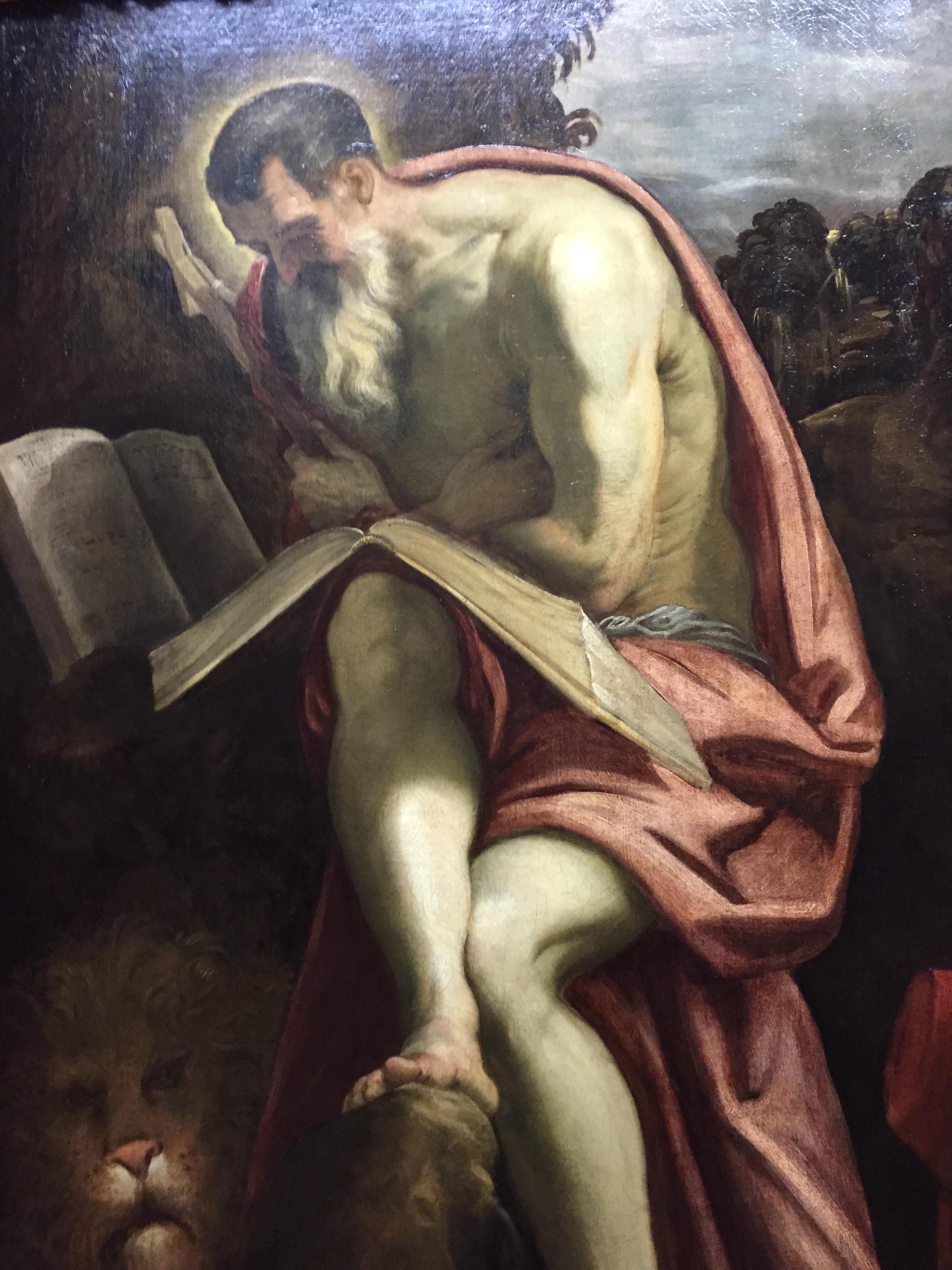
Jacopo Tintoretto,

Jacopo Tintoretto, “St. Jerome,” c. 1570, Public Domain, Vienna Kunsthistorisches Museum

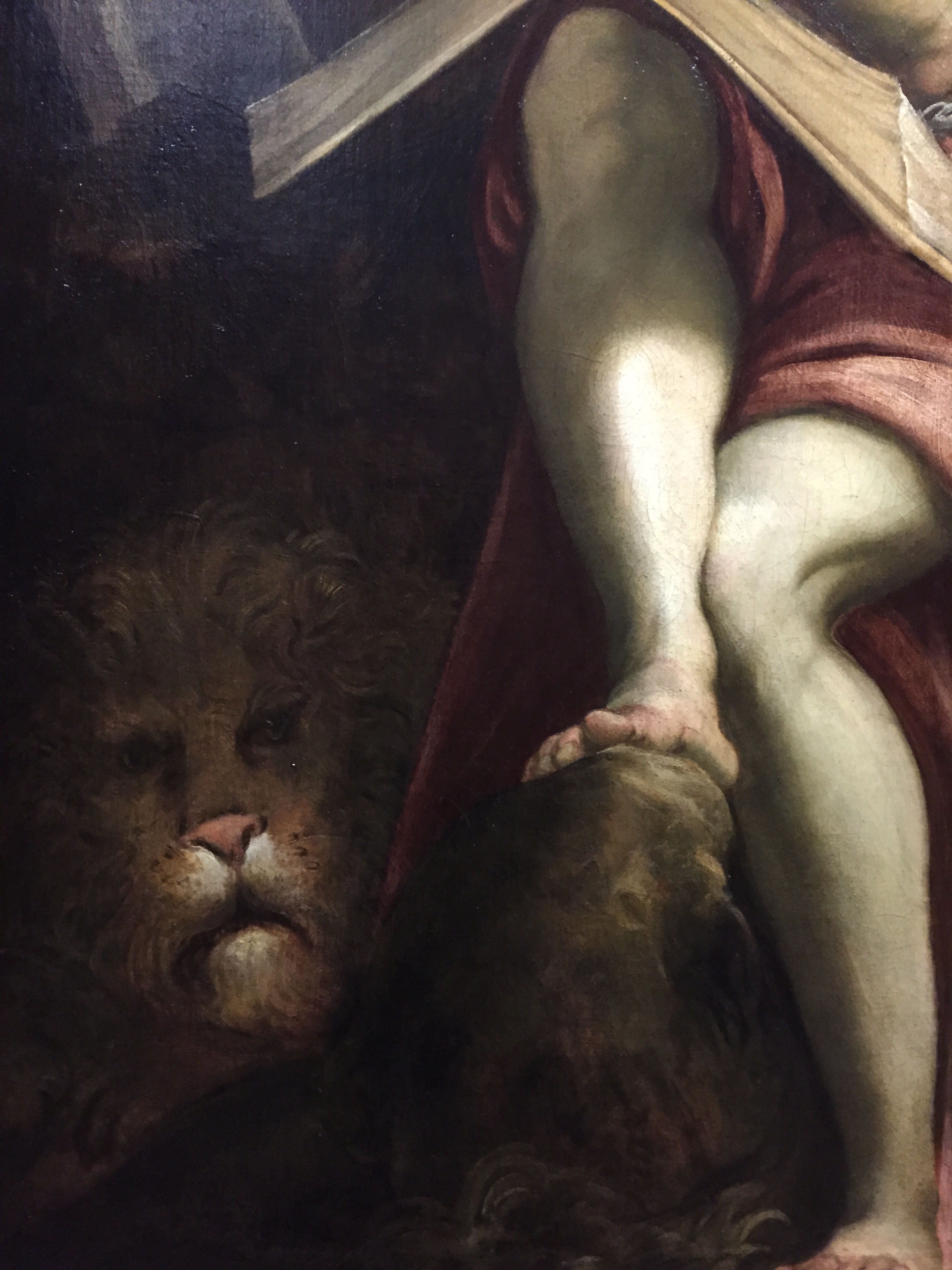
In paintings, the lion often lurks under a table or in a dark corner.

IMG_3174

I took the two photos just above in the Kunsthistorisches Museum in Vienna. I love the legend, and whenever I’m in an art museum I’m on the lookout for images of Jerome and his lion. They have been painted countless times.

IMG_3495

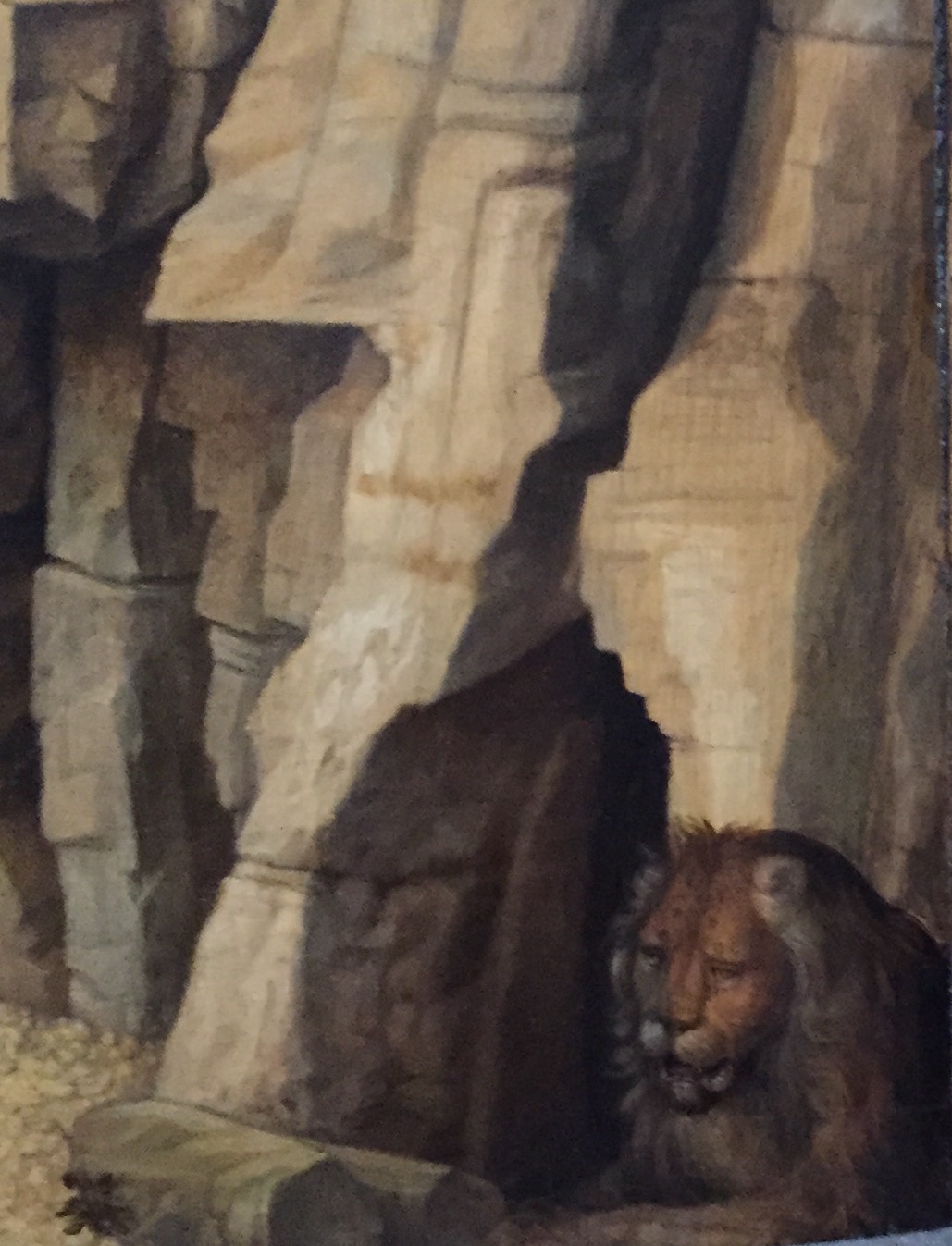
Whenever I spot Jerome and his lion, I move in for a closeup.

Workshop of David Gerard, Saint Jerome in a Landscape, about 1501, my photo taken in National Gallery, London

Workshop of David Gerard, Saint Jerome in a Landscape, about 1501, my photo taken in National Gallery, London

To me, Jerome’s friendship with his lion is part of his concern for the whole creation.

Antonello da Messina,

Antonello da Messina, “Saint Jerome in His Study,” about 1475, my photo taken in National Gallery, London

Sometimes the lion is not underfoot, but he’s always close by.
FullSizeRender (3)

The faithful lion is always present.  In the painting of Jerome in the large study above, he’s patrolling the perimeter. No matter what, the lion always had Jerome’s back.

Giovanni Bellini, Saint Jerome Reading in a Landscape, circa 1480-5, my photo taken in National Gallery, London

Giovanni Bellini, Saint Jerome Reading in a Landscape, circa 1480-5, my photo taken in National Gallery, London

If the lion’s face is shown, he always has a friendly, grateful, loyal face–much like a shy family dog. He tends to look a little wary–who is about to disturb his friend Jerome?

FullSizeRender (2)

Are these paintings just sentimental portrayals of a serious saint who should be remembered for much more than a story that may not have happened at all?  The subject is the medieval and Renaissance equivalent of sharing cute animal videos online.

On a busy day, a couple of minutes spent watching photogenic animals feels to me like a guilty pleasure. What am I accomplishing by watching a gorilla rock a kitten to sleep or a sheepdog rescue a teacup pig from drowning?  Well, I’m not getting a thing done, but I’m pausing in a busy day to learn compassion from animals. Like those videos, the images of St. Jerome and his lion give us an appreciation of our bond with the animals who share our world. The animals mostly treat each other and our world better than we humans do. If I were St. Jerome, I wouldn’t mind being remembered as an animal lover as well as a high-powered scholar.

Join me next time for more explorations in the art and history of Europe!

Margarita Teresa: A Cheerful Infanta

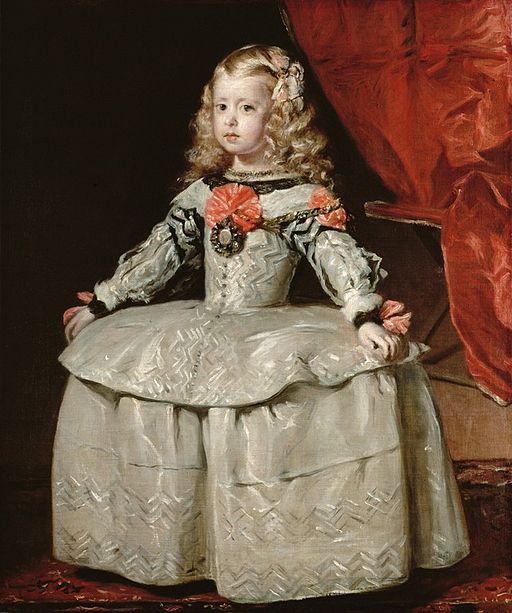
Diego Velazquez,

Diego Velazquez, “Portrait of the Infanta Maria Teresa of Spain,” 1652, Public Domain

It’s just as well we can’t see into the future.  The series of Velazquez portraits of Spain’s Infanta Margarita Teresa are some of the most charming images of childhood ever recorded. Her life was happy, but far too short. Margarita Teresa was born in 1651, daughter of King Philip IV of Spain and his second wife Mariana of Austria.

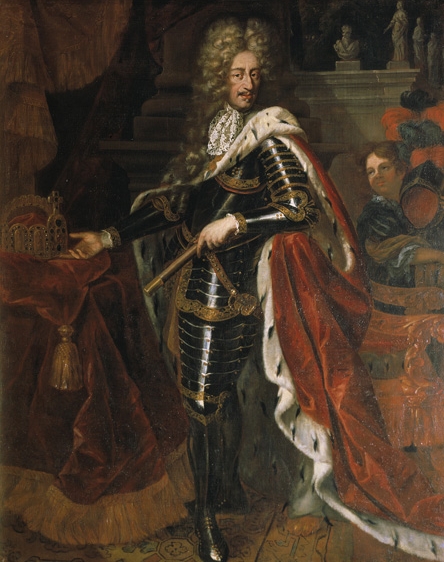
On the birth of a royal child, the Habsburgs immediately began looking for ways to cement the dynasty.  This usually involved intermarriage.  Most of us would not consider our uncle AND our first cousin as what we used to call “dating material,” but Margarita had no choice in the matter. As a baby, she was betrothed to Leopold I, Holy Roman Emperor. He was both her maternal uncle and her paternal cousin. (In my family, holidays like Thanksgiving are tense enough, what with all the unaccustomed family togetherness.  I can only imagine  trying to get through a festive meal of turkey and cranberries with the Habsburgs. At the very least, I think there would be snarky comments.  There could be a food fight).

"Portrait of Leopold I, Holy Roman Emperor," unknown artist, late 17th century, Public Domain

“Portrait of Leopold I, Holy Roman Emperor,” unknown artist, late 17th century, Public Domain

Leopold, 11 years older, was more than happy with his prospective bride.  To sweeten the pot, her father had made sure that she remained in the Spanish line of succession and would pass on her rights to any descendants.

Leopold naturally wanted to follow the progress of his bride as she grew up, and the Spanish court had the great painter Diego Velazquez at the ready.  He supplied enchanting portraits of the child as she grew. The portraits were sent straight to Leopold in Vienna.  The Kunsthistorisches Museum still has them. The portrait at the beginning of this article, showing the child at age 2, was the first. The child still had her fair baby hair, fluffy and unstyled.

Diego Velazquez,

Diego Velazquez, “La Infanta Margarita Teresa,” 1653-56, Public Domain

Velazquez painted Margarita Teresa again a couple of years later. She was lovely and serene. She looks a little shy, but she was clearly accustomed to wearing a grand gown and being admired.

Diego Velazquez,

Diego Velazquez, “Infanta Margarita Teresa in a Blue Dress,” 1659, Public Domain

One of the most famous depictions, above, showed Margarita Teresa at age 8, wearing a blue dress. She looks older than her age, and more than a little apprehensive.  She must have begun to understand her daunting obligations and her rapidly-approaching future by this time.

Jan

Jan Thomas, “Infanta Margarita Teresa,” 1667, Public Domain, Vienna Kunsthistorisches Museum

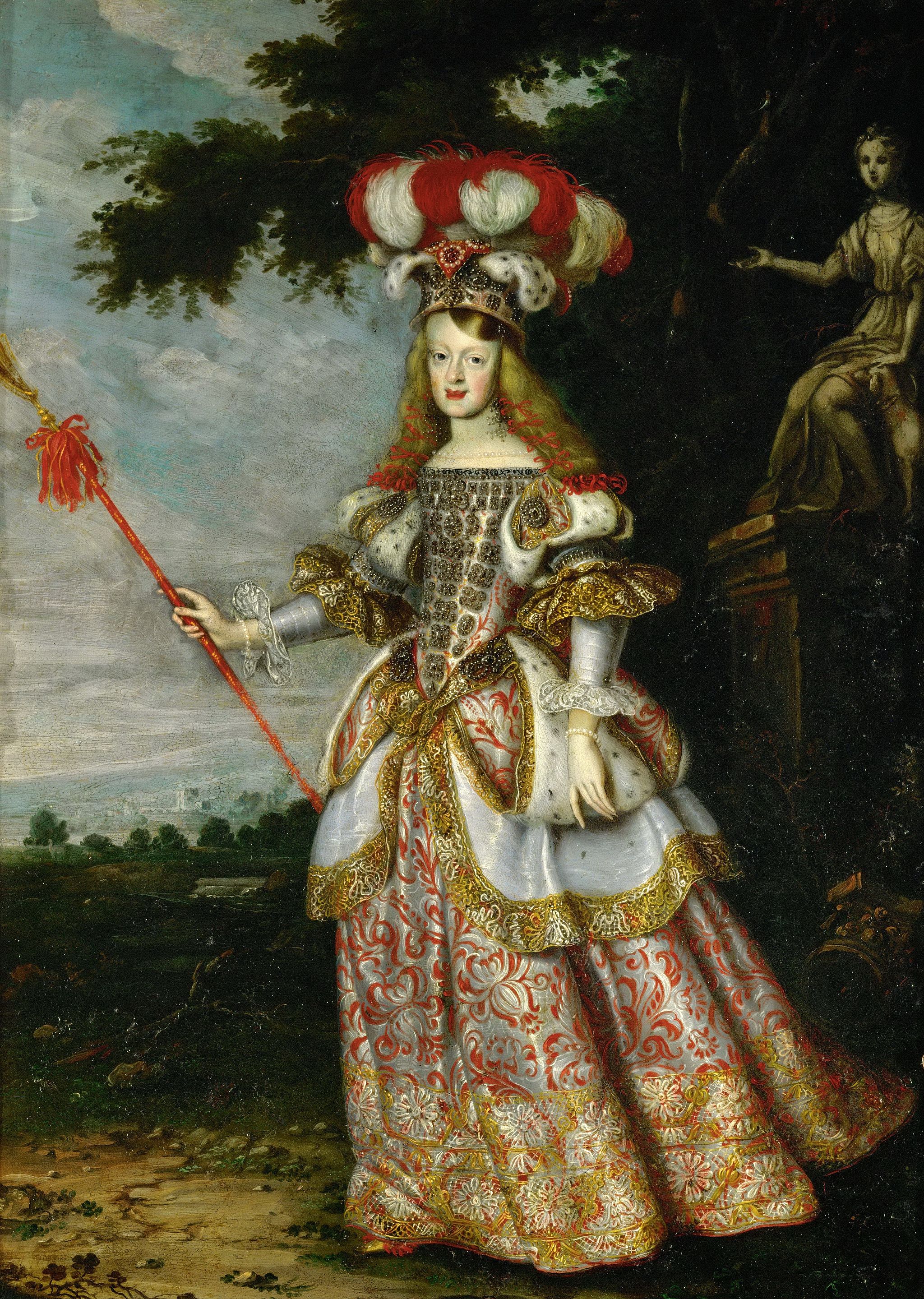
At age 15, just after the death of her father, Margarita Teresa went off to her destiny in Vienna. A German painter, Jan Thomas, painted her portrait in 1667, when she was 16. To me, she looks stiff and unhappy. Her towering headdress overpowers her slight frame, on which so much depended for her family’s royal succession. She looks thin and pale, too.  And why is there a statue in the background, looking over her shoulder and raising a hand as if to ask what she’s up to? The Viennese court was famous for its rigid protocols.  I imagine Margarita Teresa rarely had a moment to herself. Yet, in spite of the age difference, she and Leopold reportedly had a happy marriage.

Of course the teenager immediately began her child-bearing duties. Margarita Teresa had four living children, plus a number of miscarriages in her young life. Only one child survived, Maria Antonia of Austria. But the years of constant pregnancy had taken a toll.  Sadly, Margarita Teresa died at age 21.  Never having seen her native Spain again, she was buried in the Imperial Crypt in Vienna.

I wrote about Margarita Teresa’s ill-fated brothers, Balthasar Charles and Felipe Prospero, in two previous posts:

https://castlesandcoffeehouses.com/2015/07/27/velazquez-in-vienna/

https://castlesandcoffeehouses.com/2015/07/28/prince-felipe-…-a-sad-infante/

An article about the family church in Vienna, where Margarita Teresa was married at age 15, is at https://castlesandcoffeehouses.com/2014/12/01/habsburgs-hatc…and-dispatched/ (“Habsburgs Hatched, Matched and Dispatched”)

Join me next time for more explorations in the art and history of Europe!

Velazquez in Vienna: Prince Balthasar Charles

DSCN9263

Last winter the Vienna Kunsthistorisches Museum had a wonderful exhibit of paintings by the Spanish master, Diego Velazquez. Many of them were from the museum’s stellar collection by the artist, but some, like the portrait used for the banners, were borrowed.

The December week I spent in Vienna it rained all day, every day. Sometimes, it is true, the rain was only a gentle mist.  But I never saw a single moment without some kind of wetness falling from the gray sky.

ViennaRain

Snow in Vienna is beautiful and romantic.  Rain? Not so much. Still, there is more than enough to do indoors in culture-rich Vienna. I always say that I don’t travel to Europe for the weather.

Diego Velazquez,

Diego Velazquez, “Self Portrait,” 1640, Public Domain

Diego Velazquez, considered by many to be the greatest of all European painters, was an honored guest at the Kunsthistorisches Museum. I had a yearly museum pass, so I ducked into the Kunst almost every day. I was often dripping wet, but each time I stashed my raincoat and revisited the Velazquez exhibit, I forgot all about being chilled and damp. I felt as though I had been to sunny Spain for awhile. The museum owns a number of the works of Velazquez, because of the close family ties (inbreeding, actually) between the Habsburgs and Spanish royalty.

The young boy in the portrait below was (literally) the poster child for the exhibit. Who was this boy?

Diego Velazquez,

Diego Velazquez, “Equestrian Portrait of Prince Balthasar Charles,” 1634-35, Public Domain, Prado Museum

The child posed confidently on a galloping horse was Prince Balthasar Charles, Prince of Asturias. He was the long-awaited male heir to the Spanish throne, the only son of King Philip IV and his first wife, Elisabeth of Spain. The Prince was born to great fanfare in 1629.

The boy appears to be at most eight or ten years old in his portrait, but that didn’t stop his parents from having him painted brandishing the baton of a Field Marshal.  He was born to lead, educated to lead, and expected to lead. King Philip IV faced challenges to the continuing rule of his family.  He needed this heir desperately. The hopes of his family and his country rested on this little boy’s shoulders. Sadly, Prince Balthasar Charles died at the age of 17 from smallpox.

Eugène Charpentier,

Eugène Charpentier,
” Jean-Baptiste, comte Jourdan, maréchal de France,” mid-19th century, Public Domain

Monarchies all over Europe awarded batons to important military officers, royal or merely aristocratic.  I imagine a Marshal wielding his baton the way Moses wielded the rod he used to lead the people of Israel.  Possibly the Biblical story is even one of the origins of the marshal’s baton. In most European armies, Field Marshal was the highest military rank, above even a General.  Usually it was awarded only to a person who was already a General, and only after extraordinary achievement, like winning an important battle. But the marshal’s baton in this portrait was purely wishful thinking.

Prince Balthasar Charles never had his chance at glory on the battlefield. His family waited eleven long years for another male heir.  My next post will tell the story of that Spanish royal child, subject of one of my very favorite Velazquez masterpieces.

Join me next time for more explorations in the art and history of Europe!

A Royal Christening at Sandringham

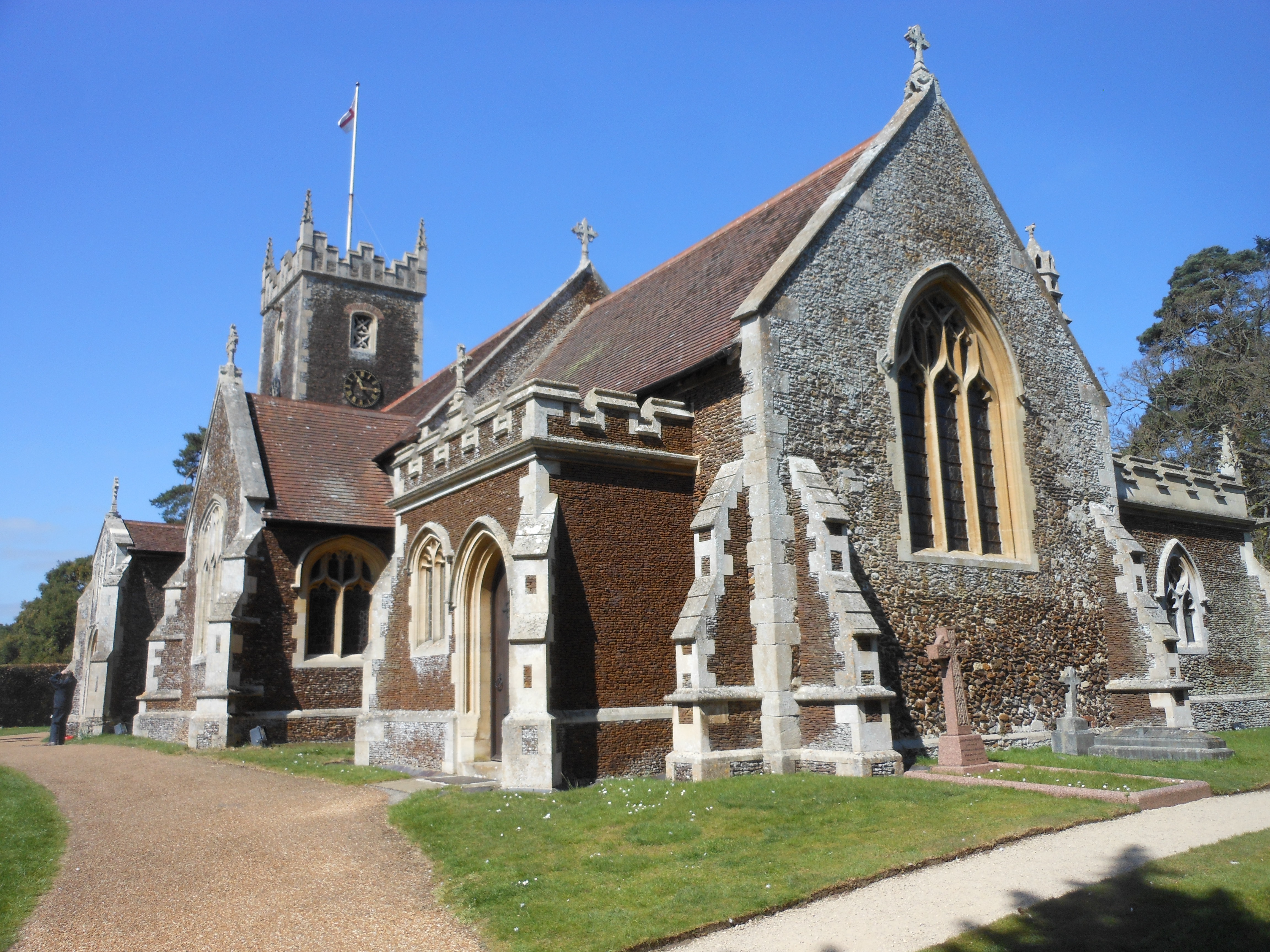
DSCN7017In April I visited Sandringham, the private country home of the royal family, and was especially keen to have a look at the local parish church, where Princess Charlotte was christened yesterday.  News media reported that royal well-wishers were invited to stand in the “paddock” where folks stand every Christmas to watch the royals go in and out of church.  What’s a paddock?  It’s just a field where horses normally stand around and eat grass.  Yes, the old stone parish church is in an unassuming location with fields all around, just a short walk from the grand house. From the outside, the Church of St. Mary Magdalene looks exactly like countless other English country churches. Inside, it is the most beautiful country church I’ve ever seen–not surprising, what with the royal connection.

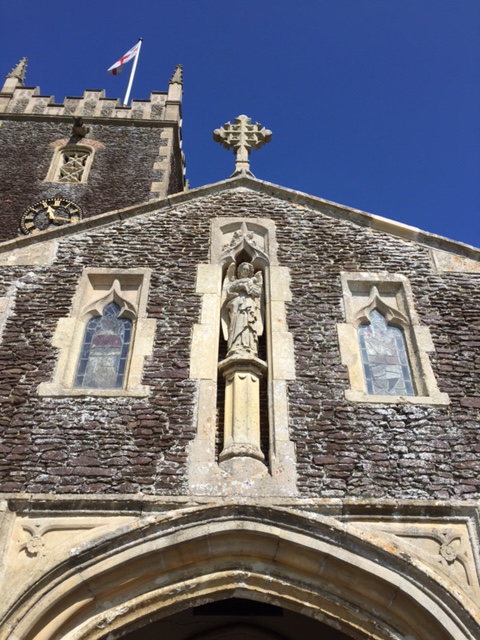
2015-04-23 11.16.47-2An angel holding a baby stands, appropriately, just above the entrance.

2015-04-23 11.19.51More angels minister to people inside, like this carved wooden one offering communion to a parishioner.

2015-04-23 11.20.49The church seems an especially joyful place of worship.  Sunlight streams in through stained glass.

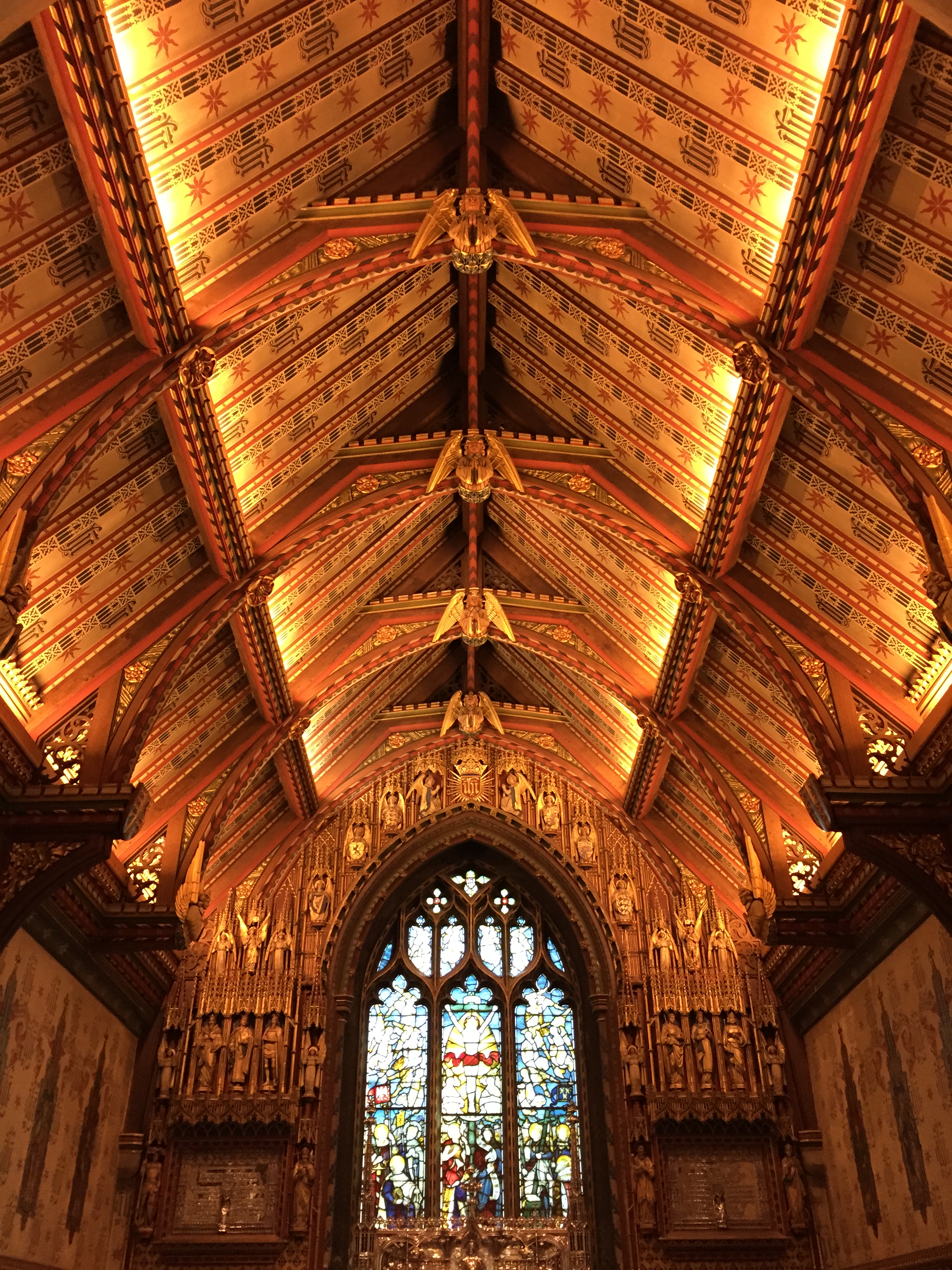
2015-04-23 11.19.21The painted ceiling is especially beautiful and colorful. I think the church in its present form dates mostly from Victorian times.

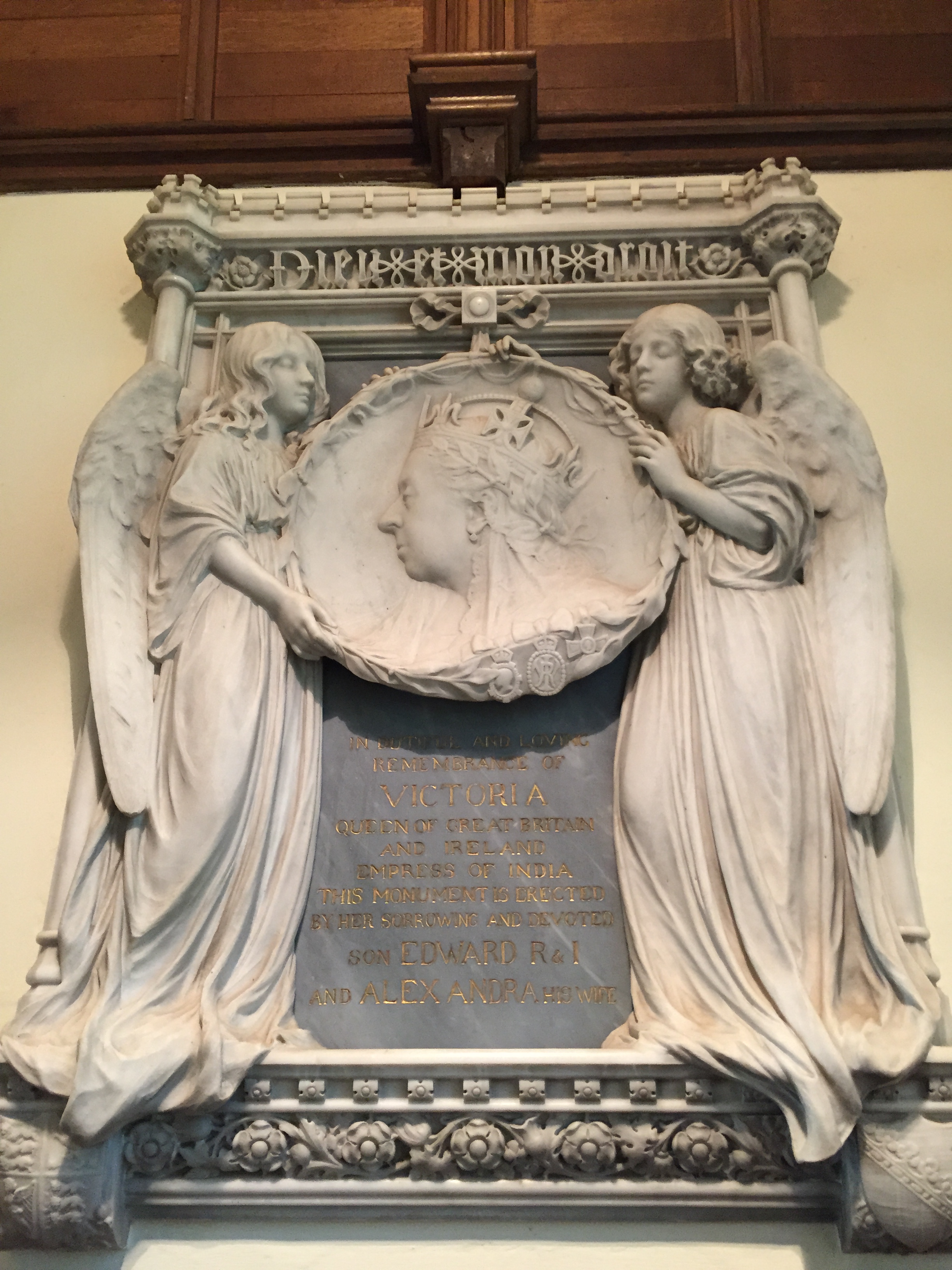
2015-04-23 11.26.07No one seems to be buried in the church, but the walls contain exquisite memorials to various royals.  My favorite is the one of a pair of angels tenderly supporting a silhouette of Queen Victoria. I’m sure she was present in spirit to watch over the newest generation of her descendants. Did they behave themselves? That’s always the big question, as Victoria knew well from the trials of raising her own very large family.

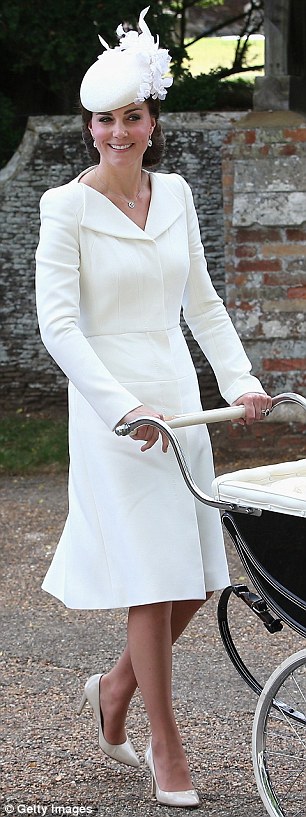
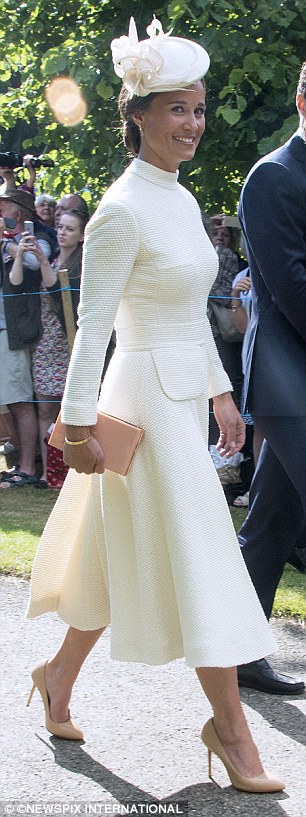
KatePippaNews media have breathlessly reported on supposed sibling rivalry at the christening:  Pippa Middelton is accused of trying to upstage her sister Duchess Kate by wearing essentially the same outfit, and possibly wearing it better.  I reserve judgment. If there are any soap-opera goings-on among the current young royals, I prefer not to know about them. Anyway, good luck upstaging Kate.  This is the woman who left the hospital and waved to crowds the very day she gave birth in April, wearing a pretty dress, perfect hair and HIGH HEELS.  I would not care to try competing with Duchess Kate. The images of the sisters are from the Daily Mail article cited below.

2015-04-23 11.25.37Not having been one of the 25 or so people invited to the christening, I’m not sure there was a sermon or homily.  But if there was, it was delivered from this beautiful silver Victorian pulpit. Best wishes to the new Princess!
http://www.dailymail.co.uk/femail/article-3150898/Did-Pippa-Middleton-try-upstage-Kate-Middleton-Etiquette-expert-William-Hanson-Aunt-Middleton-s-matching-christening-outfit-avoided.html

Previous posts about Sandringham are at https://castlesandcoffeehouses.com/2015/05/07/sandringham/

and https://castlesandcoffeehouses.com/2015/04/30/the-queens-chu…at-

Diane de Poitiers vs. Catherine de Medici

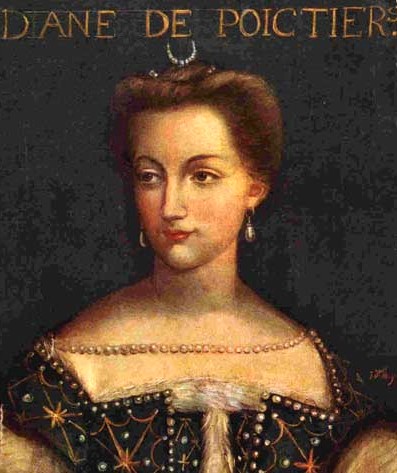
Diane de Poitiers, unknown artist, Public Domain

Diane de Poitiers, unknown artist, Public Domain

When Diane de Poitiers arrived at Chenonceau in 1547, things were going her way. At around age 35, she was already a widow left wealthy when her much older husband conveniently died and left her a fortune. She moved easily in court circles and soon became the mistress of the 16-year-old King Henri II, who gave her Chenonceau as a residence.  Diane loved Chenonceau. She was the undisputed occupant, but it took her a number of years to persuade the King to give it to her outright. In the meantime, she called in the best architects and builders. Money was no problem. First off, she greatly expanded the beautiful pleasure gardens.

Photo by Luke van Grieben, 2006, Creative Commons Attribution Share Alike 3.0

Photo by Luke van Grieben, 2006, Creative Commons Attribution Share Alike 3.0

The gardens were just gardens like many others, but Diane had a truly brilliant idea: she expanded her living space by building an arched bridge, with rooms, that crossed the River Cher. Later additions, some by Diane and some by others, expanded on that idea and created the chateau we see today.

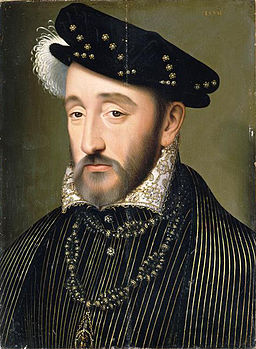
Henri II, after Francois Clouet, Public Domain

Henri II, after Francois Clouet, Public Domain

I think Henri looks very suave in this portrait. Where have I seen that sly, knowing look?  Of course!
Connery

The very worldly James Bond, played by Sean Connery, had the same expression. Just saying. Anyway, Henri certainly knew what he liked, and as King he had the wherewithal to get it. Diane de Poitiers was famous as one of the most beautiful and accomplished women of her age, and the King depended on her advice throughout his life. She had rivals; naturally the King took other mistresses, but she was his closest and most trusted companion throughout his life.  She became the most powerful woman in France.

Catherine-de-medici (1)

This did not sit well with Catherine de Medici, Henri’s wife and the mother of his three sons who became subsequent kings. (She also had several daughters). The stern portrait above was painted when Catherine was still a comparatively young wife. Once she became a widow, she draped herself in black at all times and looked even more forbidding. I would not care to tangle with her.

Lady in Bath, Diane de Poitiers, Francois Clouet, c. 1555, Public Domain

Lady in Bath, Diane de Poitiers, Francois Clouet, c. 1555, Public Domain

Henri lavished favors and property on Diane de Poitiers.  She was clearly quite the babe, as well as being smart and witty. She retained her beauty all through her long life, too.

During his lifetime, Henri expected his dutiful wife Catherine to stay at home and keep quiet. She really had no choice while he was alive. But things changed suddenly.

Desmond Llewelyn as

Desmond Llewelyn as “Q,” 1983, Towpilot, Creative Commons Attribution Share Alike

Since I’ve brought up James Bond, I can’t resist:  what Henri needed was a guy like “Q,” who in the movies patiently explained weapons and prudent tactics to an impatient James Bond. Maybe nobody like “Q” had Henri’s back. In 1559, when he was just 40, poor Henri got knocked in the head in a jousting accident.  His wound became infected and he died 10 days later. His heir the Dauphin was a sickly young son, age 15. The Dauphin was already married to Mary Queen of Scots. But he died 18 months later and Mary Queen of Scots was sent back to Scotland, never becoming Mary Queen of France. The two remaining sons were not good King material, but they were all that Catherine as Regent had to work with. Of course she was not allowed to become Queen in her own right. It was quite an accomplishment to even keep her sons on the throne.

Things went from bad to worse. France was torn apart by civil and religious struggle all through Catherine’s life.  Although she made valiant efforts to govern the country, she made a lot of mistakes and her weak sons were not much help. The French Wars of Religion continued, causing massive carnage as Protestants and Catholics fought each other bitterly.

Chenonceau3

Catherine’s life was not easy.  But there was great consolation in one thing: once Henri was in the ground, she lost no time in booting her chief rival, Diane de Poitiers, out of Chenonceau. Catherine took over the place, made extensive additions, threw spectacular parties, and relished her time there. Who wouldn’t?

Chaumont

Chaumont

As a consolation prize, Catherine grudgingly gave Diane another chateau, Chaumont. It’s a very nice place–I’d cheerfully live there. But it’s high above a river, not draped like an exquisite necklace right across a river. Diane had plenty of other properties, too.  She lived in comfort for the rest of her life. But she must have missed her glory days at Chenonceau.

Join me next time for more explorations in the art and history of Europe!

Ludwig at Linderhof

"King Ludwig II of Bavaria," Ferdinand Piloty, 1865, Public Domain

“King Ludwig II of Bavaria,” Ferdinand Piloty, 1865, Public Domain

“Mad” King Ludwig II of Bavaria was found dead in Lake Starnberg on June 13, 1886. He was 40 years old. The cause of death is still mysterious, but his death was convenient for a lot of people in Bavaria, where he had pretty much given up on the day-to-day business of governing. Government of Bavaria ground to a halt while Ludwig spent all his money (mostly his own personal fortune) on increasingly theatrical castles and palaces. He had been declared insane the previous day and was in some kind of royal “protective” custody.

After a couple of misses, I was finally able to visit Linderhof Palace, King Ludwig II’s favorite home, at a time when the grotto was open.  I was anxious to see it, especially after watching Luchino Visconti’s very fine film Ludwig, about the life and mysterious death of the notorious Bavarian king.

LudwigPoster

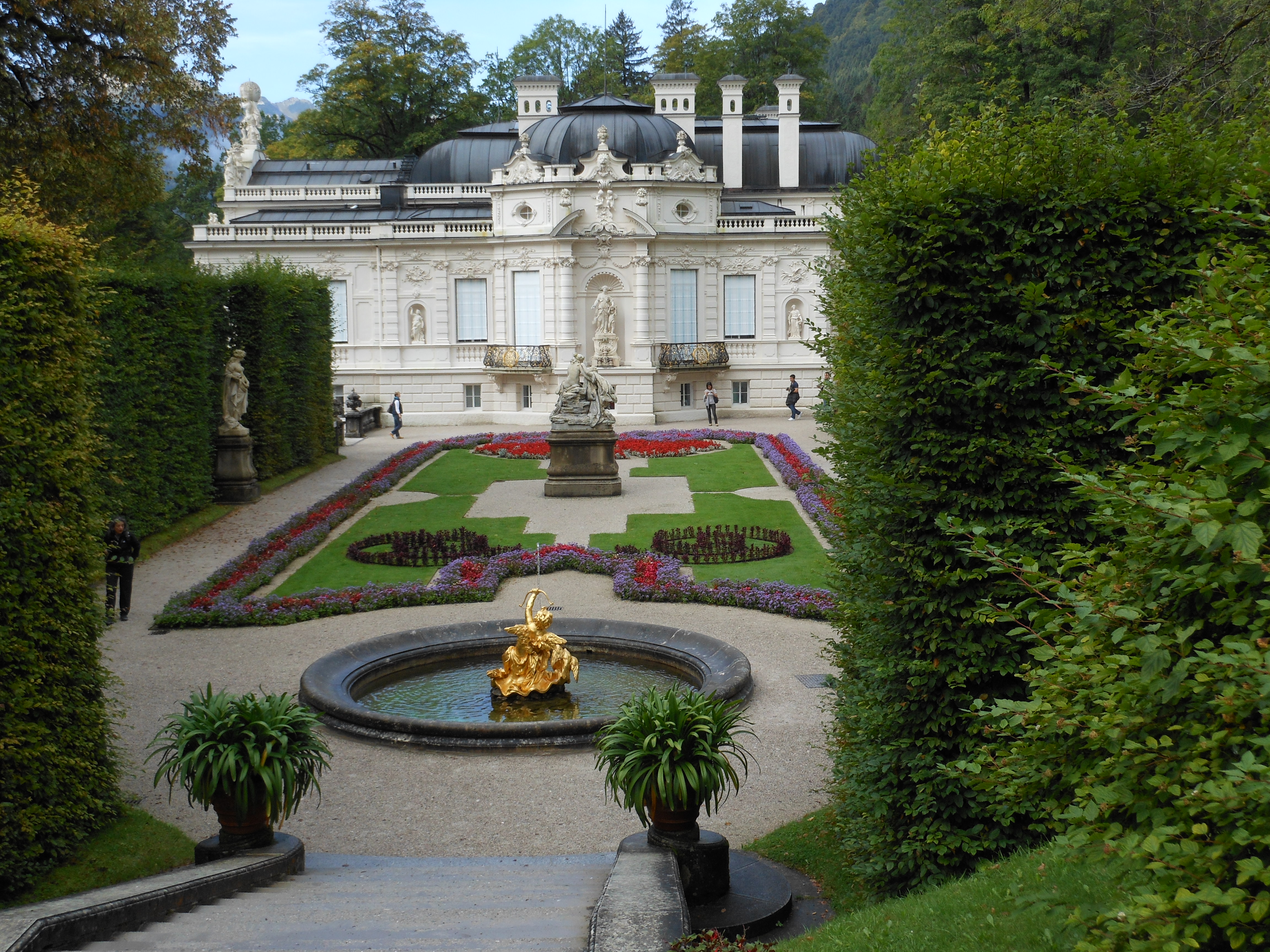
Ludwig built Linderhof as his own personal getaway.  In fact, it was the ultimate bachelor pad.  But he enjoyed the place in solitary splendor; he rarely if ever had visitors.  He built a special music room for his favorite composer, Richard Wagner, but Wagner never saw it. The grounds are breathtaking, and because the palace is quite small, each room looks out onto a beautiful manicured view with pristine mountains in the background.

Linderhof Palace

Linderhof Palace

In Visconti’s 1972 film Ludwig, the king is played by Visconti’s real-life romantic partner and muse, Helmut Berger.

LudwigBed1

The film shows Ludwig lounging around in his grand surroundings with hand-picked servants and a handsome young actor. Filming took place in the palace, so watching it is like having a tour personally conducted by the very strange and romantic Ludwig himself. His bedroom (intentionally) recalls the bedroom of King Louis XIV of France. This is a one-man palace; there are no guest rooms.  The help stayed in outbuildings, invisible to the king until they were needed.

It is hard to say how accurate the life story is.  But it is certain that Ludwig was an eccentric and  dreamy romantic.  His people loved him, but he was not much of a king when it was time to hang the ermine in the closet and get some work done.

One of Ludwig’s very few friends was his cousin, the Austrian Empress Elisabeth, nicknamed Sisi. She was famously married to the Emperor when she was only 15, and spent the rest of her life wanting out.  She is played by Romy Schneider (who also played Sisi in the very silly but entertaining semi-fictional series of Sissi movies).

The grotto was built up the hill behind the castle.  The entrance looks like a fort a very ambitious child might build.

GrottoEntry

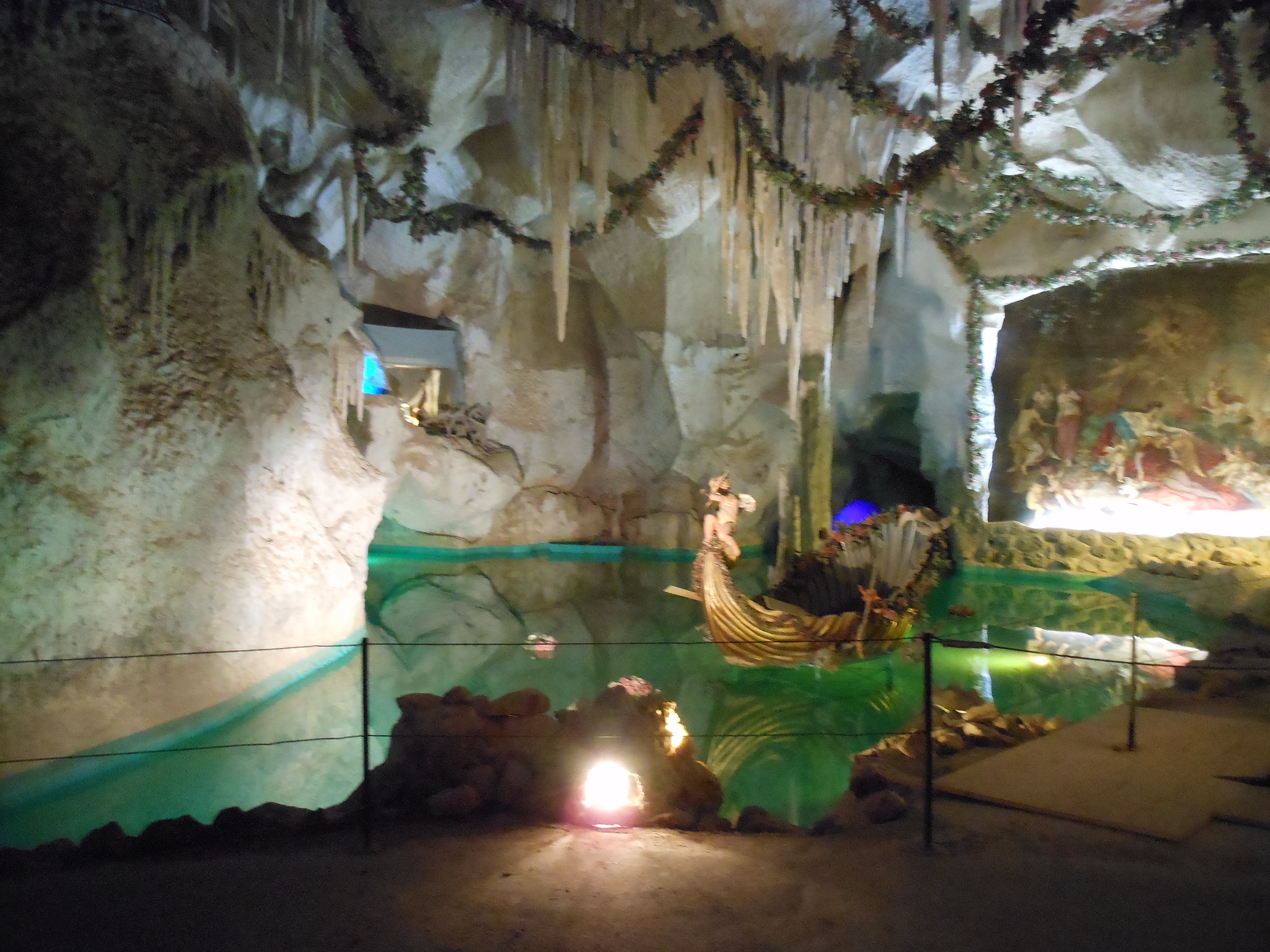
But the grotto itself is as jaw-droppingly weird and beautiful as it was in Ludwig’s day.  He had Wagner’s operas performed inside for his own personal pleasure.  The water was heated, so that he could swim in it if he tired of being rowed around in his gilded shell boat.  And the lighting could change colors depending on his mood, or the mood of the opera scene.

Ludwig's Grotto

Ludwig’s Grotto

The grotto is still festooned with the floral swags that Visconti’s movie crew put up.  The film has a fantastic scene where an Austrian actor is taken into the grotto to meet Ludwig, who wants him to recite dramatic speeches 24/7.  Helmut Berger, as Ludwig, floats out of the gloom in his shell boat, wearing a dark overcoat and a black Homburg–with an enormous diamond brooch pinned to the side. He fixes the actor with an imperious, piercing stare. The actor tries hard to be Ludwig’s New Best Friend, but the friendship ends badly and Ludwig is alone again.

Nearby Neuschwanstein and Hohenschwangau Castles are justly famous, but they are overrun with tourists.  Armed with a Bavarian Castles Pass, I actually went to Linderhof twice during my last trip.  One day it was rainy, the next it was sunny.  I can’t say I had the place to myself, but there was time and space enough to ponder the mysterious life of Ludwig.

Join me next time for more explorations in the art and history of Europe!

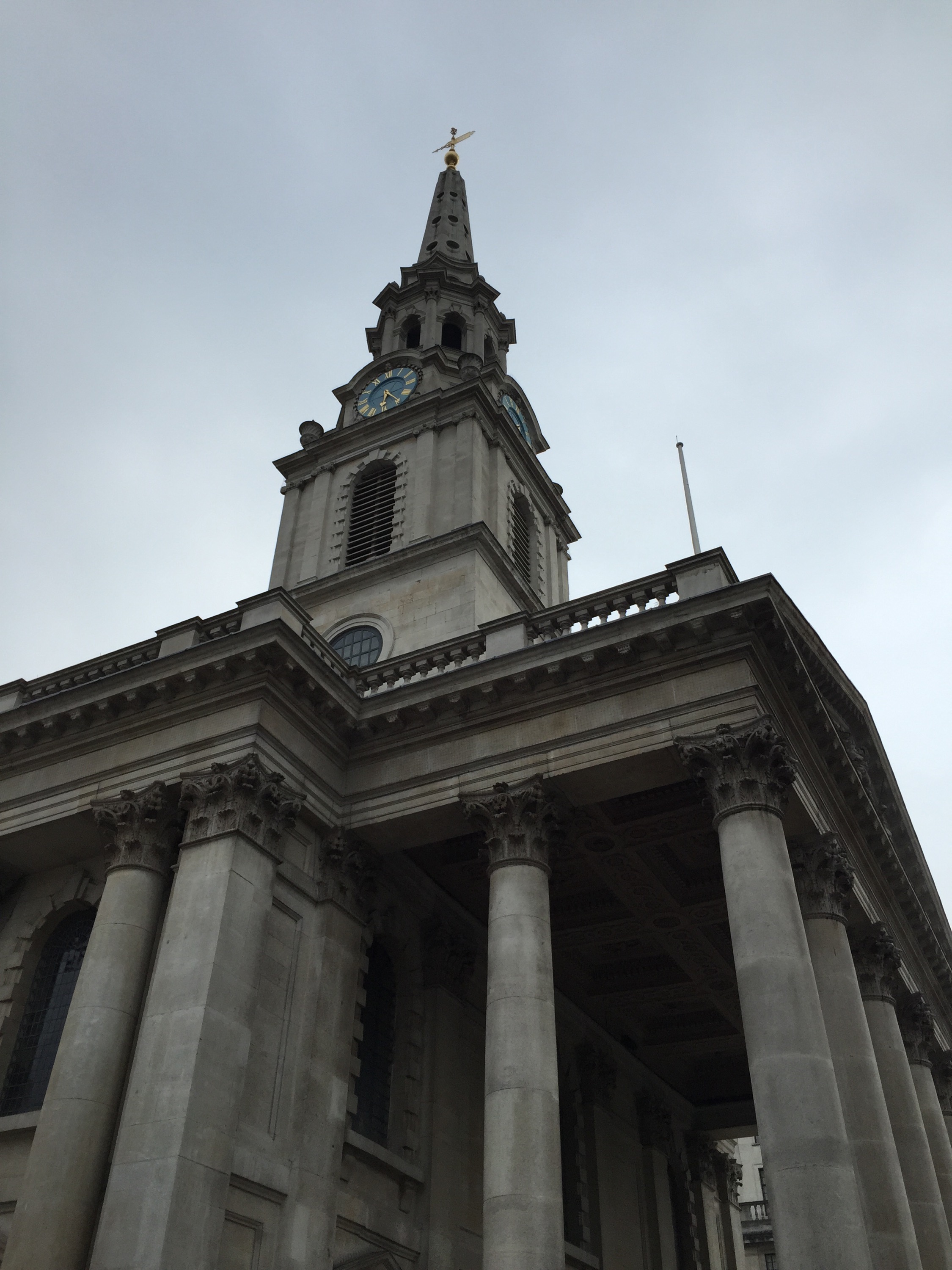
St. Martin-in-the-Fields


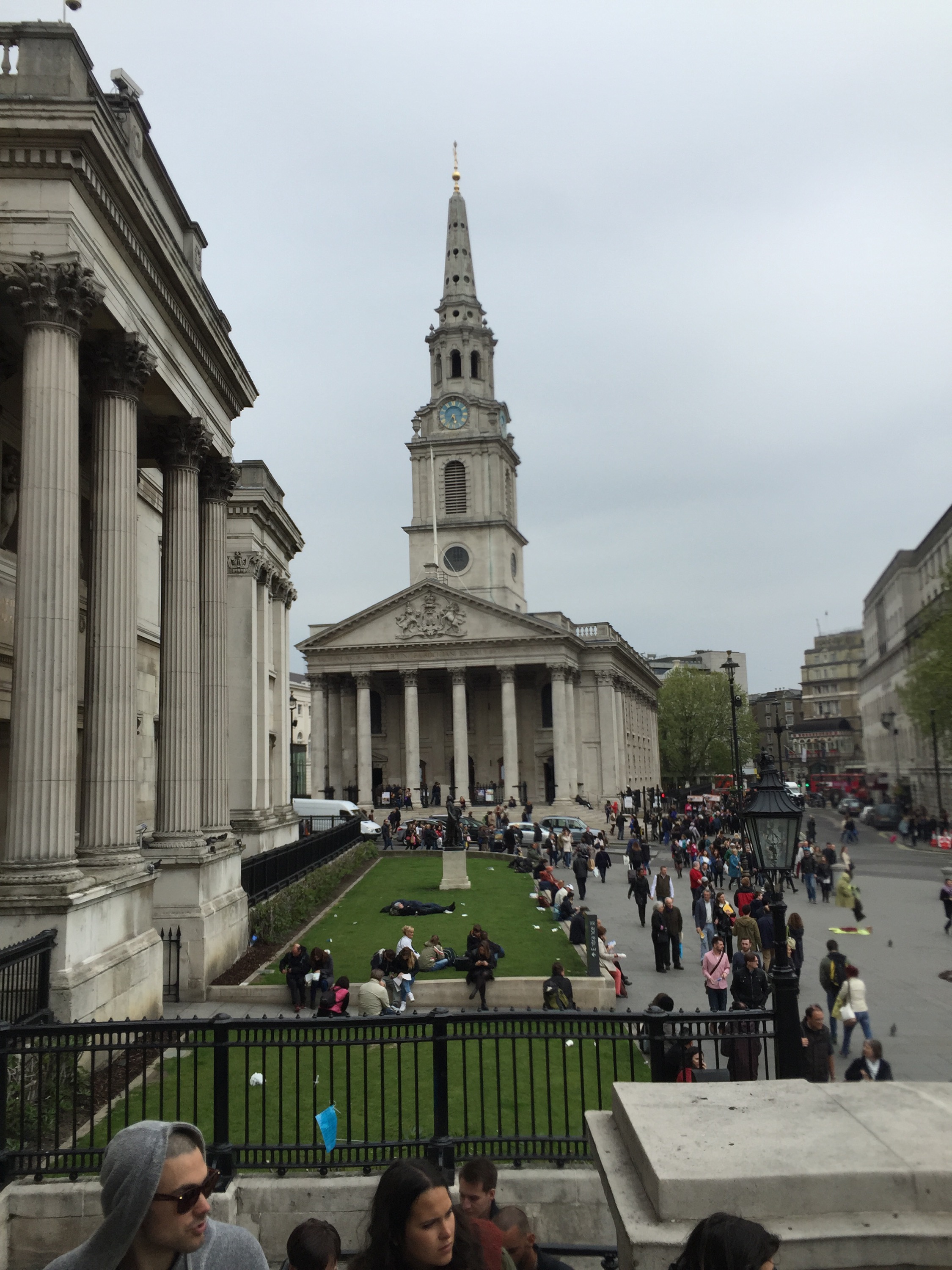
IMG_3643

After spending a few hours in London’s National Gallery, I’ve had enough of appreciating great art. I’m more than ready to stagger down the steps into Trafalgar Square, navigate through the crowds, cross the street, and disappear down the well-worn steps into the ancient crypt of St. Martin-in-the-Fields Church. The church was once literally “in the fields,” far outside the center of London. Now it’s at the epicenter. The day before I visited was May Day, when tens of thousands of demonstrators converged on the square. (In most of Europe, May Day is similar to Labor Day in the United States. In Europe, people march in support of working people on this day). On any day, though, Trafalgar is full of people.

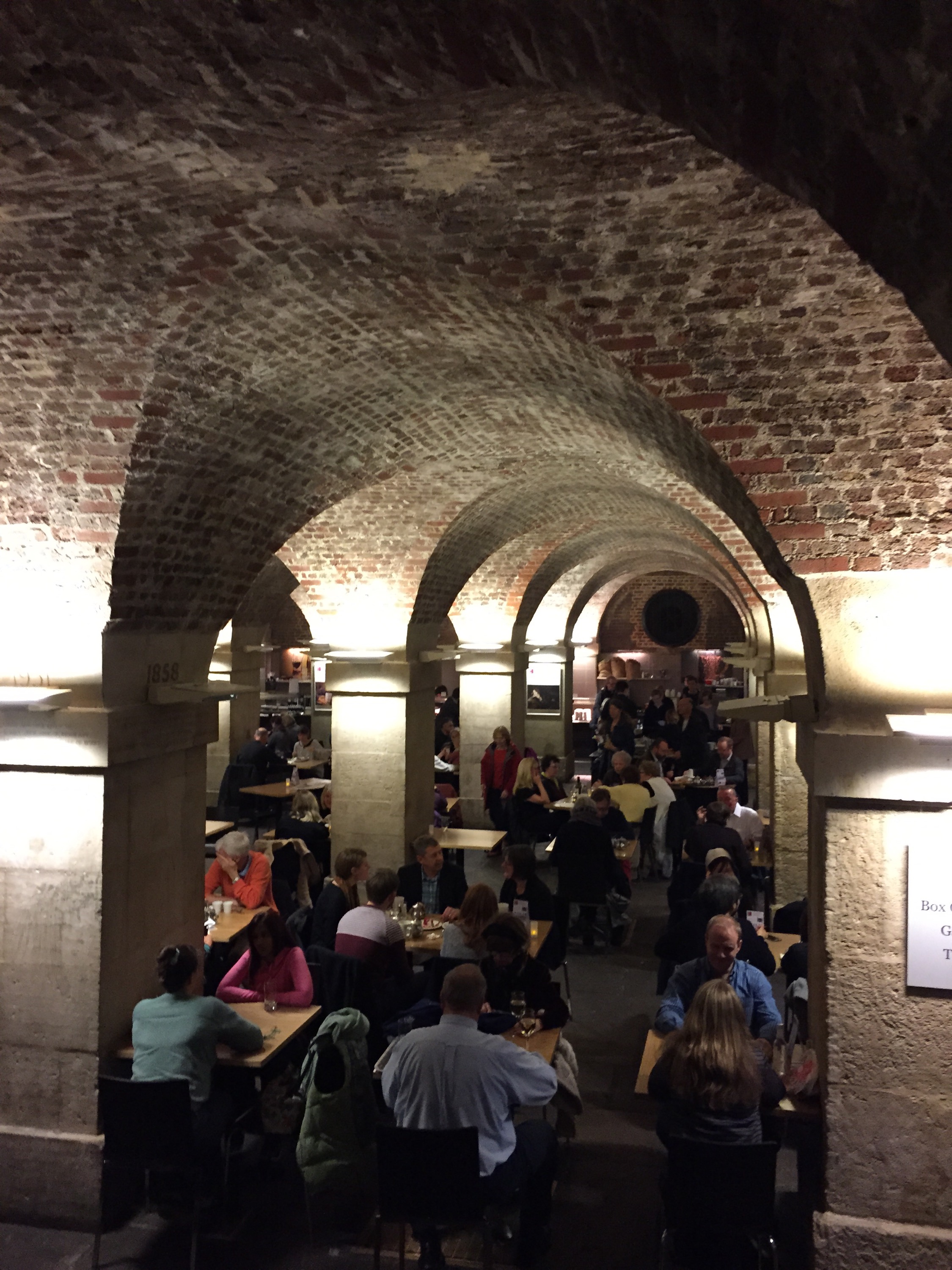
IMG_3648

The centuries-old crypt underneath the church has been turned into a cheerful cafeteria and venue for jazz concerts.

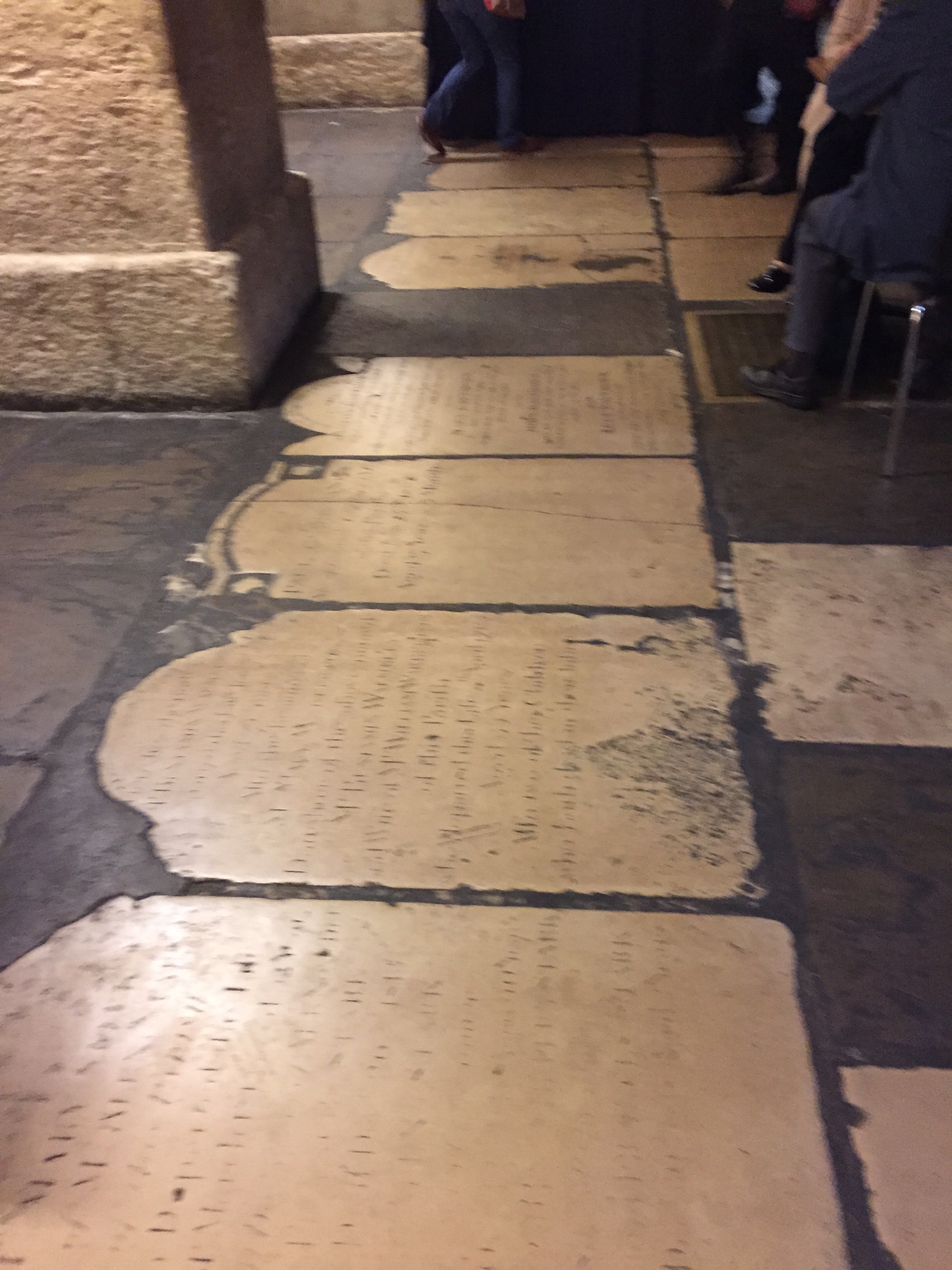
IMG_3657
Are we walking on top of very old tombs? I don’t think so. I think these are grave markers from centuries past, when the church still had a churchyard around it. I think that tombs once in the crypt were moved elsewhere during one of the many rebuildings of the church over the centuries. Of course, like many British churches, the site of this one dates back to Roman times–or very likely even pre-Roman pagan times. So there’s no telling what is deep underground. If there are spirits of the departed, I think they enjoy the company.

IMG_3666
The food is cooked onsite, inexpensive, healthy and delicious.

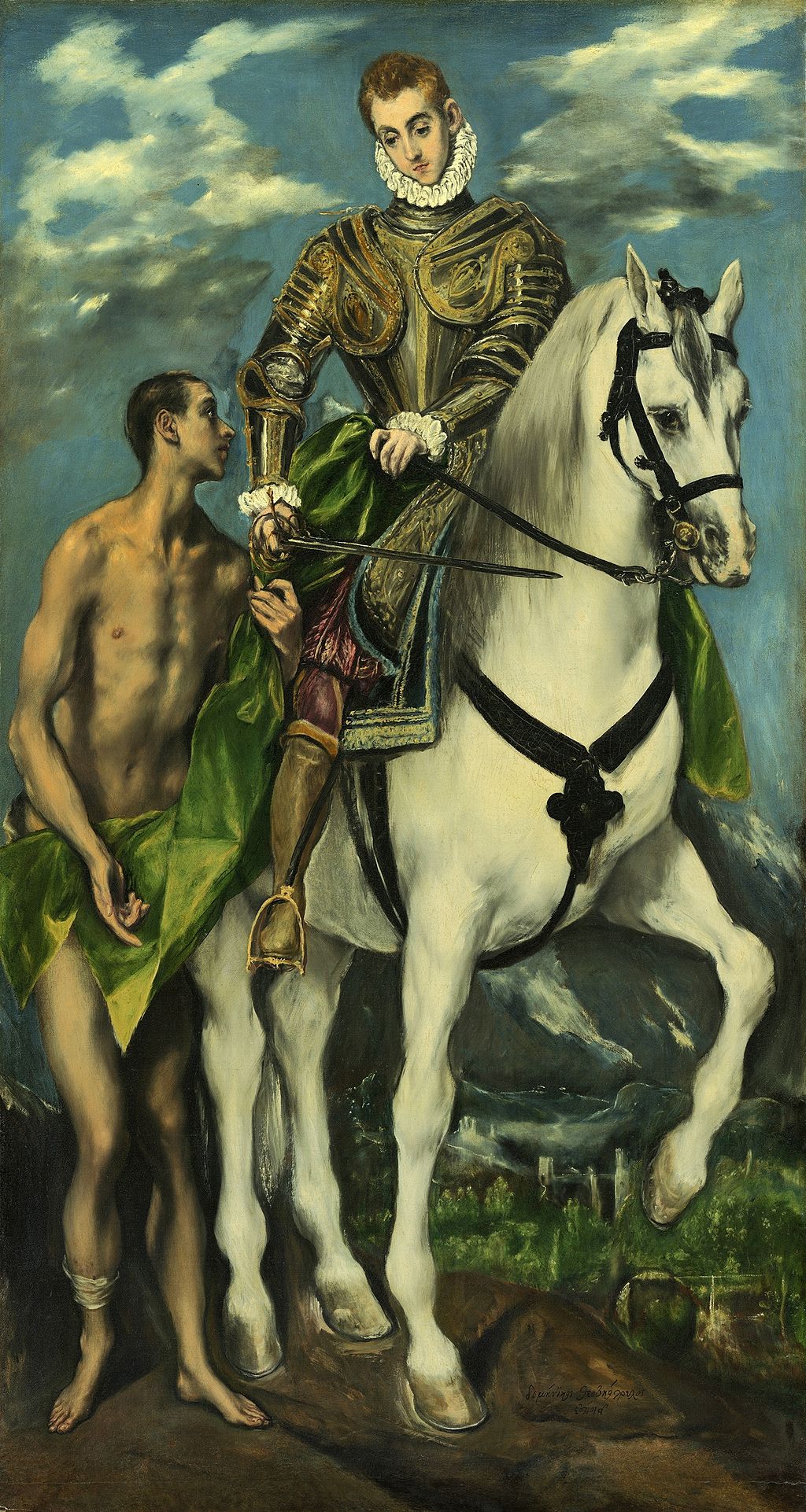
El Greco, St. Martin and the Beggar, circa 1597, Public Domain

El Greco, St. Martin and the Beggar, circa 1597, Public Domain

Who was St. Martin of Tours? He was a 4th-century Roman soldier who became one of the first conscientious objectors when he decided not to fight. He offered to go to the front lines unarmed, but fortunately the enemy sued for peace and he was allowed to leave the army. He eventually became Bishop of Tours, a post he accepted reluctantly because he preferred to serve the poor directly. He was well known enough in his day to have a biographer who followed him around and wrote about him, so it is pretty well documented that he once impulsively cut his warm military cloak in half and gave it to a near-naked vagrant in the dead of winter. Legend has it that the next morning the cloak was made whole again. The rest of his life was devoted to serving the poor and outcast, and that is the mission of St. Martin-in-the-Fields today. The church’s cafe and its many concerts support its work with the poorest of the poor in London.

IMG_3695

I’m happy to contribute to the work of this famous church by joining the lively crowd in the once-silent crypt. Join me next time for more explorations in the art and history of Europe and the British Isles!