Category Archives: Art

Eugene, the Painter Prince of Sweden

Prinz Eugen, Duke of Narke, 1910, painting by Anders Zorn, Public Domain

Prinz Eugen, Duke of Narke, 1910, painting by Anders Zorn, Public Domain

If I were born royal, I’d for sure want to be a younger child.  It looks to me like Prince Harry has a lot more freedom than the more direct heir to the throne, Prince William.  In Sweden, Prince Eugene was the fortunate younger son of the royal family in the late 19th century.

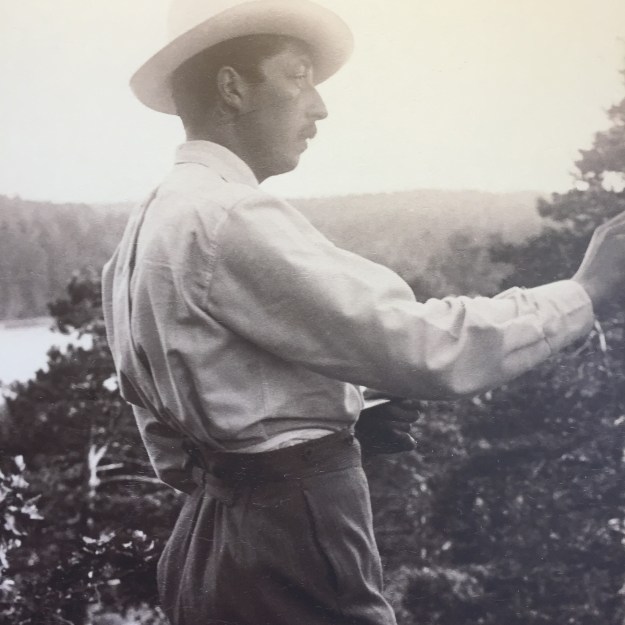
Eugene was born in 1865 in Drottningholm Palace, on a beautiful island about an hour by boat from Stockholm.  It’s still the home of the Swedish royal family, and makes for a dreamy visit. Eugene was fourth in line to the throne, so he was pretty much free to do as he liked. Nobody expected him to marry and produce an heir, although he did cheerfully carry out many royal duties.

img_2849

What Eugene wanted was to paint and to hobnob with artists and writers. He found the perfect spot for his home on the island of Djurgarden, with views over the water of the Stockholm skyline. He studied painting seriously, in Stockholm, Olso and Paris.

img_3557

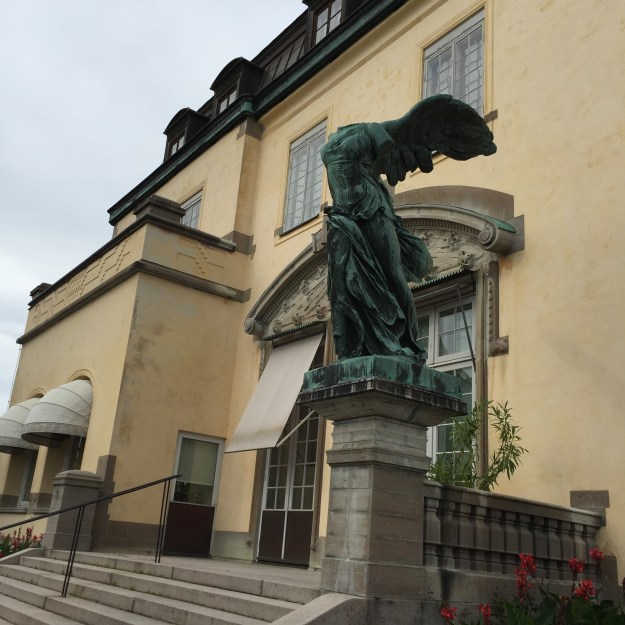
Today, his beloved home, Waldemarsudde, is an enchanting museum with the rooms left as they were at his death in 1947.

img_3410

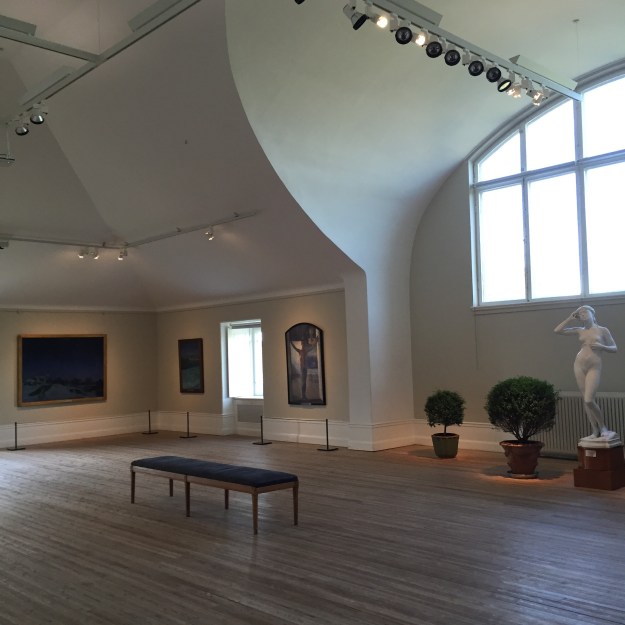
His top-floor studio space is a gallery with rotating exhibits, some by artists the Prince patronized during his long life.

In his studio and on his peaceful grounds, Eugene contentedly painted the Swedish and Norwegian landscapes he loved. The painting just above is a beloved country home where he spent time.

img_2962

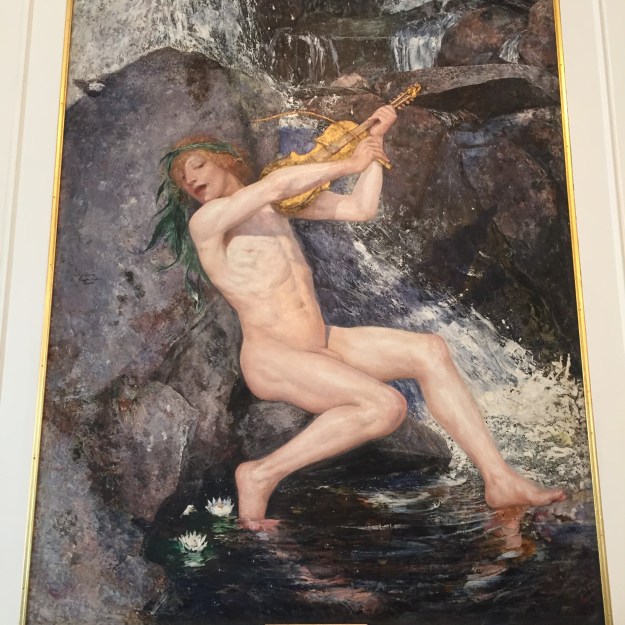
Eugene decorated his home with the work of other artists who were his friends. He considered “The Water Sprite” by Ernst Josephson, 1884, to be one of his best acquisitions.  Josephson did three versions of this painting of a character from Swedish folklore. Eugene offered it to the Academy in Stockholm, but they considered it too daring to accept.  It seems the problem was not so much the nudity as the style.  Josephson was breaking away from the time-honored traditions of Realism and Naturalism.  He was getting into the movement that later became known as Symbolism. Eugene was more than happy to keep the painting, which dominates his salon.

img_3150

Inside Waldemarsudde, Eugene studied, read, and entertained his friends–most of them artists, and many of them partisans of the then-radical ideas of the 1880s. Although he was named the Duke of Narke at his birth, Eugene much preferred artists to royalty.

img_3571

Having seen Drottningholm Palace, the Royal Palace in Stockholm, and Waldemarsudde, I’m with Eugene.  The palaces are showplaces, gilded, confining, and a little dreary. Waldemarsudde is a light-filled home.  I’d choose the artist’s life over the Royal Prince’s any day.


Join me next time for more explorations in the art and history of Europe!

St. Jerome and His Lion: More Sightings

IMG_4931

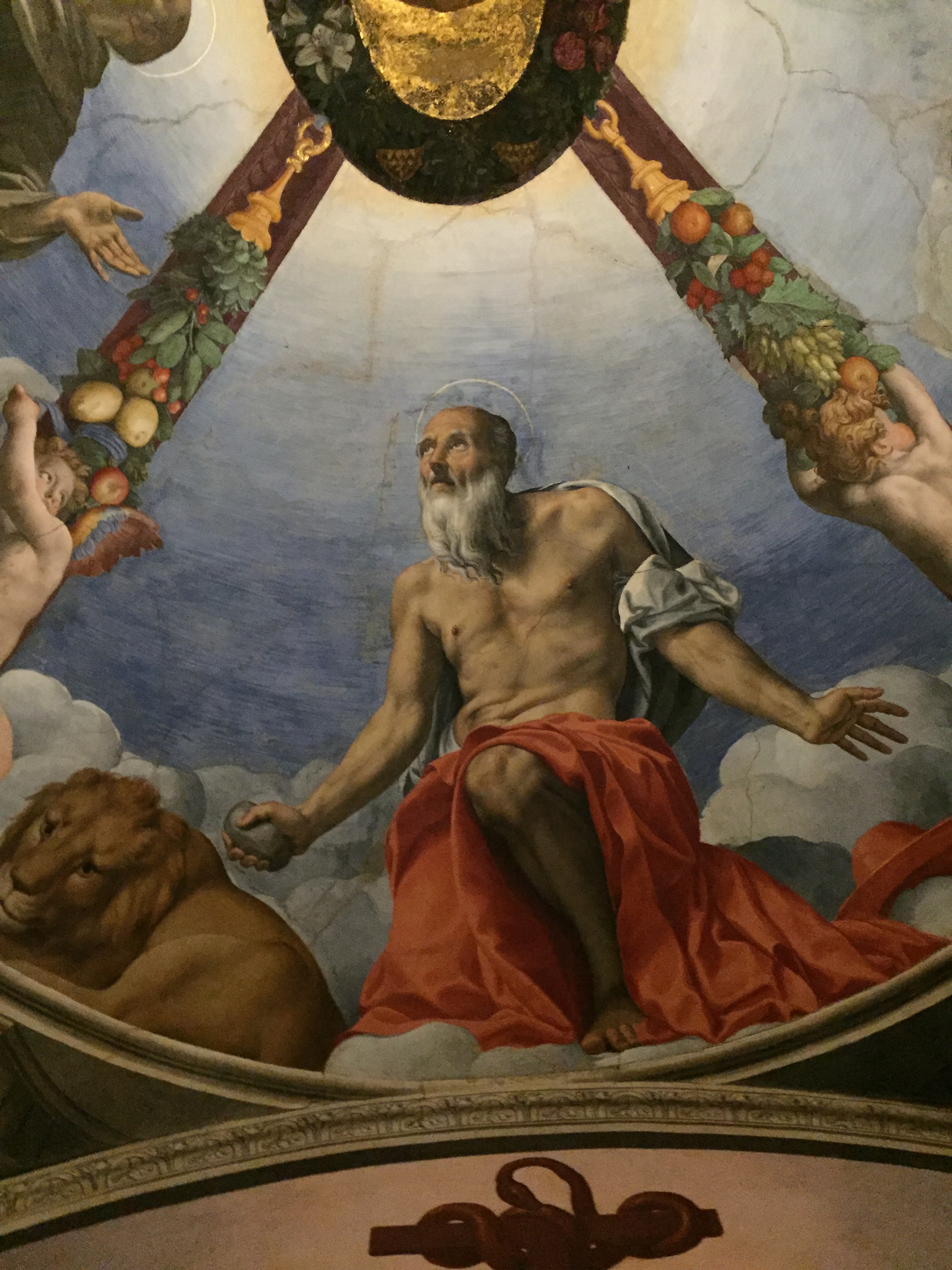
I’m always on the lookout for images of St. Jerome and his lion. Legend has it that when the saint retreated to the wilderness to study and pray, he came upon a lion with a thorn in its paw.  St. Jerome didn’t run or climb a tree.  He stopped and removed the thorn. From that day forward, the grateful lion stayed by his side. The fresco above is from a ceiling in the Palazzo Vecchio in Florence. Agnolo di Cosimo, known as Bronzino, painted it between 1540 and 1565.

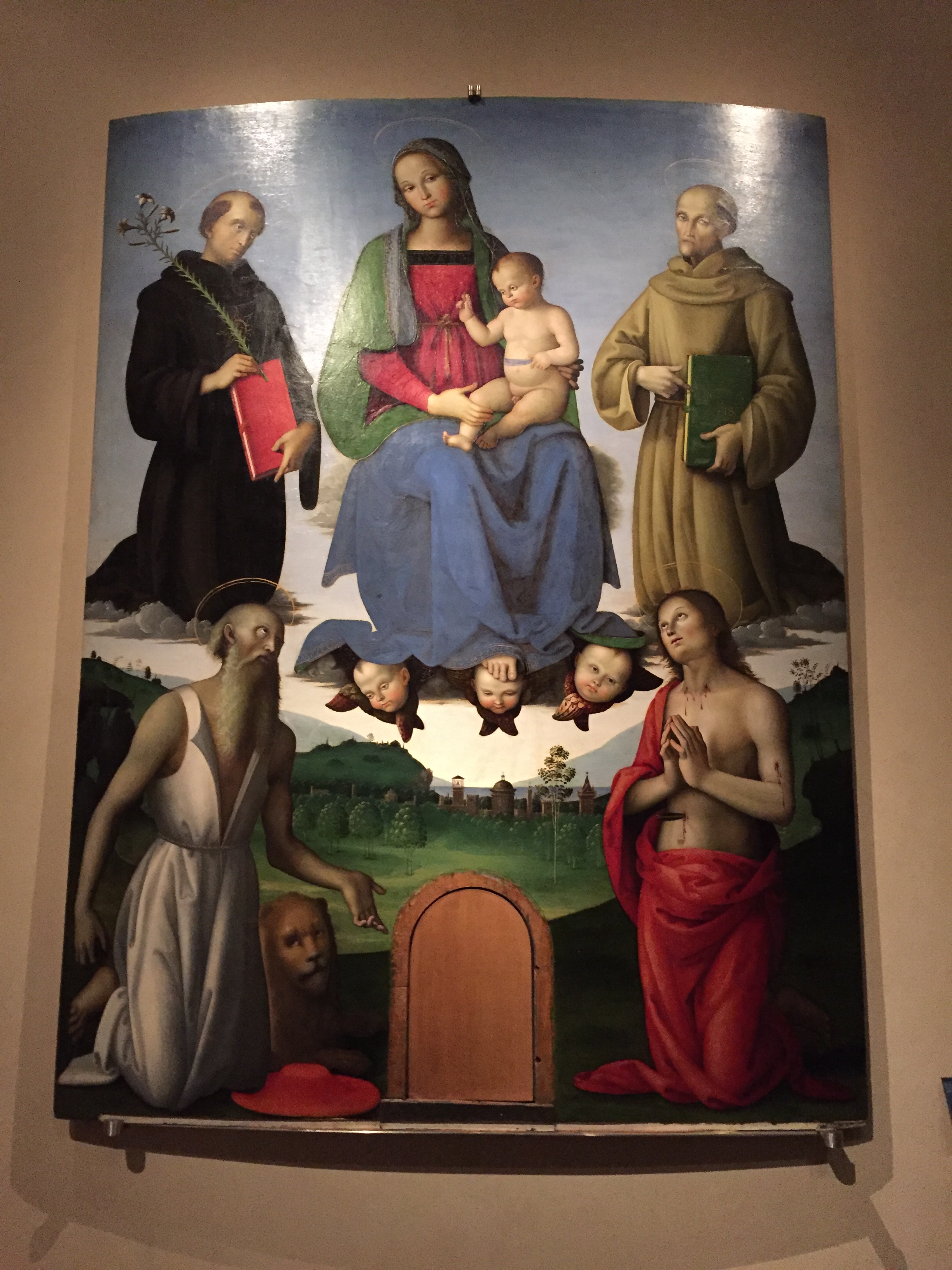
Pala Tezi, Pietro di Cristoforo Vannucci, known as Il Perugino, 1500

Pala Tezi, Pietro di Cristoforo Vannucci, known as Il Perugino, 1500

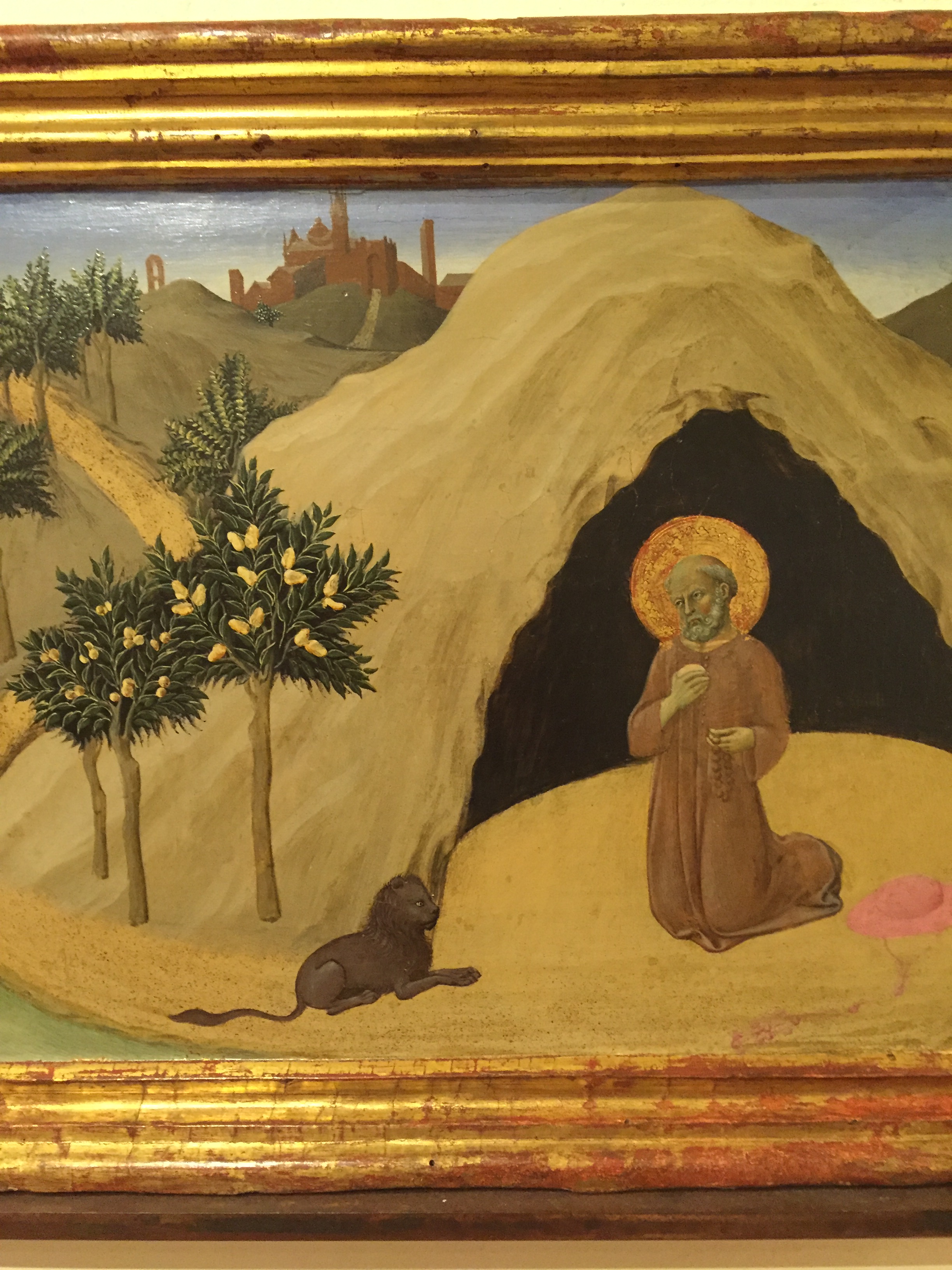
A more primitive, but still endearing, lion is in the painting above, from the Galleria Nazionale of Umbria in the town of Perugia.

Detail from Il Perugino painting above

Detail from Il Perugino painting above

The artist painted the lion and the saint sitting peacefully together in a simple landscape, in front of the cave that Jerome may have lived in.

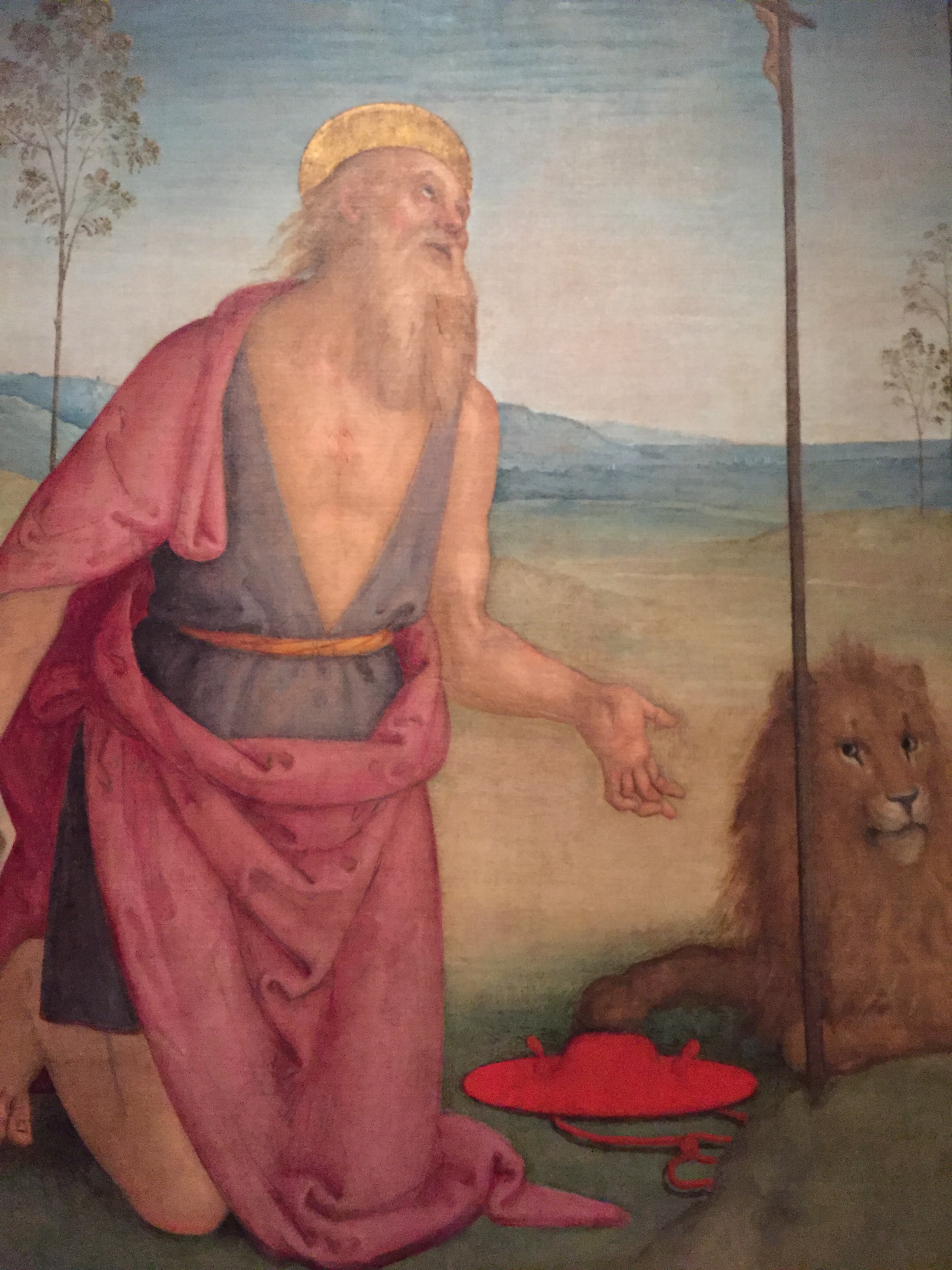
San Girolamo Penitente, Il Perugino, 1512

San Girolamo Penitente, Il Perugino, 1512

Another painting by Perugino shows the saint in contemplation of the Virgin and child, accompanied by other saints.  In humble adoration, he’s set his cardinal’s red hat on the ground–and who is lurking beside him?

San Girolamo Penitente, Il Perugino, 1512

San Girolamo Penitente, Il Perugino, 1512

In turn, Jerome’s faithful lion gazes adoringly at him.  Isn’t this what we all love to have our pets do?

Detail from Il Perugino painting above

Detail from Il Perugino painting above

The lion’s face is distinctly human.  How many of us humanize our pets? It’s an ancient impulse.

St. Jerome, Pintoricchio, around 1495

St. Jerome, Pintoricchio, around 1495

The same museum in Perugia has another painting of the saint in the same pose–also with his cardinal’s red hat set humbly on the ground. It’s by Bernardino di Betto, known as il Pintoricchio.

The friendly lion is guarding the hat–and St. Jerome.  Who wouldn’t like to have a tame lion riding shotgun all the way through life? Jerome’s lion always had his back.

In medieval times, retreating to the wilderness to meditate was a radical action. Jerome would not have been the first man eaten by a lion in the wilderness. At a time when nature was frightening, St. Jerome was revered for being at one with nature. In our times, retreating to the wilderness still has its risks, but it’s becoming more and more an expensive luxury. Our wildernesses are shrinking and human over-development is routing wild animals from their age-old homes.

1B2632B5-0CCB-42CB-AE4C-EDBC95B95B2B

I treasure any wildlife sightings, like this fox right outside my window.  And I’ll keep looking for glimpses of St. Jerome and his lion.

My previous post about St. Jerome and his lion is at

https://castlesandcoffeehouses.com/2015/08/06/st-jerome-and-his-lion/

Join me next time for more explorations in the art and history of Europe and the British Isles!

Happy International Cat Day!

60D3B527-DCDB-4E0E-9835-D1EE417C57B1

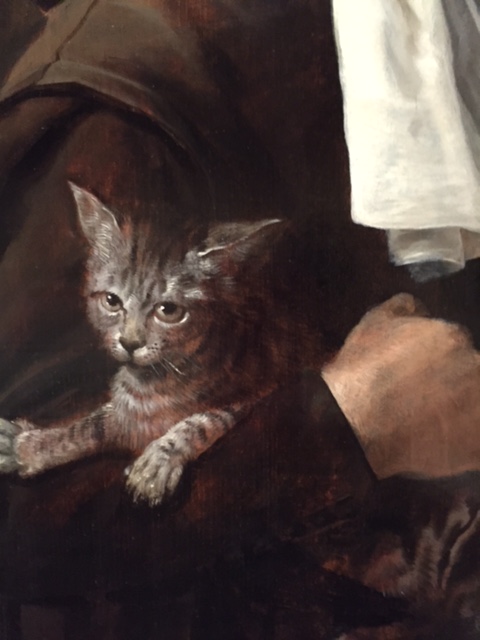
Do cats deserve a day of their very own in the international calendar? Of course they do. A couple of years ago, wandering art museums in Amsterdam and Haarlem, I wrote about the many dogs that appear in Dutch paintings.  I mused that for me, the dogs served as a window into long-ago times and places.  Cats are the same. It’s hard to identify with people wearing heavy black robe-like garments relieved only by starched white ruffs and collars. But  these same people had pets they loved.  The cat above, looking out at the world from the safety of her person’s lap, has the same smug look as any cat of mine. I can understand people who appreciate their feline friends enough to immortalize them in art.

5A866DE9-6454-4482-8B8A-B37736EF81E0

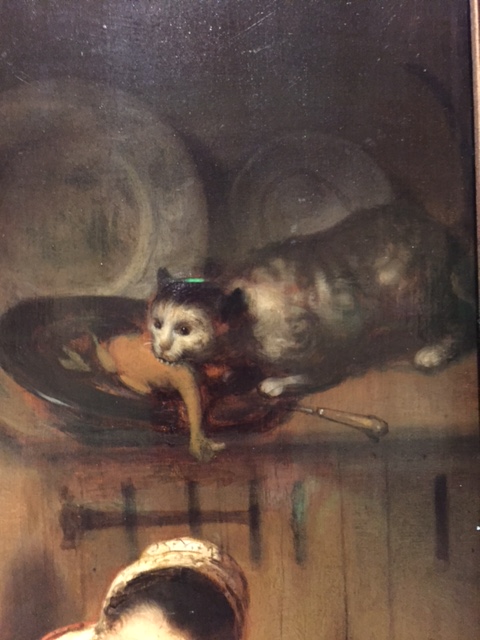
Cats in Dutch paintings are often up to no good.  The one above is about to make off with a plucked bird while the unsuspecting housewife is looking the other way.

00AD08E3-4B61-4426-9900-DCC3DB1E71D8

Cats often gaze longingly at the food artfully arranged in Dutch still life paintings, and they add some “life” to still lifes that consist mainly of dead animals ready to be consumed.

DA817445-8CF4-4AE2-BCCB-1CD306FED0ED

Children have always liked cats.  This ceramic pet, complete with a bib and abandaged leg, sits in the now-quiet nursery at Wightwick Manor, a wonderful Arts and Crafts home in England. He looks a little anxious. I have a feeling his broken ear and broken paw happened when he got tossed across the nursery in some long-ago game.

648F459B-2829-4CEC-9A55-736FD549E1CC

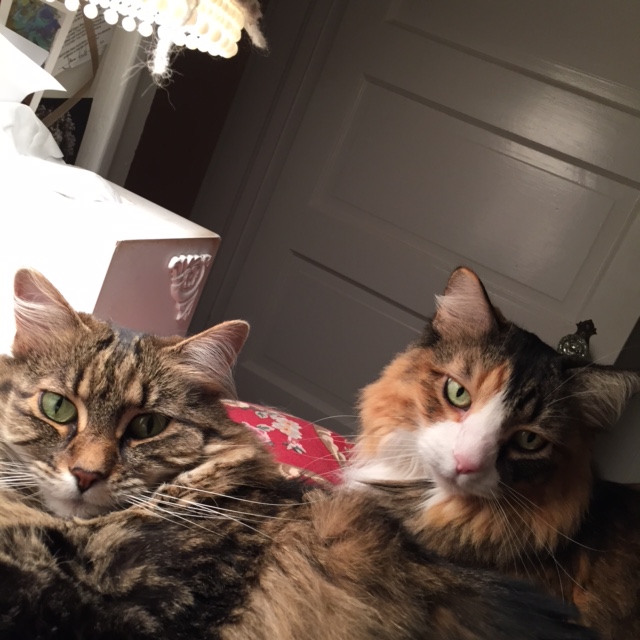
I have a soft spot for all cats, but especially for the calico and tabby  varieties. They remind me of the pair that patiently wait for me at home.

B84912A3-B784-4384-9232-83664DB88EC6

Of course I’m always on the lookout for friendly cats on my travels. This handsome fellow was in York, England.

CB007BF4-DDF8-4F4A-8F26-64A698F1FF1D

What about big cats? I love them too.  The fierce creature above is on an exterior wall of the very grand Pitti Palace in Florence.

6E00C57C-58E9-40B7-BBBD-934557E53E56

Chatsworth House in England has a pair of regal lions who lord it over the Sculpture Gallery. I think part of our fascination with big cats is that we feel we understand them just a bit, especially if we live with their small domesticated relatives. Our pet cats give us a little insight into both long-ago places and wild places on this earth.

In my post “Dogs in Dutch Art,” I quoted a striking poem by David Graham:  “The Dogs in Dutch Paintings.”  A couple of months ago I received a lovely comment from the poet, who had just happened upon my post.  The main reason I keep posting is to remember where I’ve been, what I’ve seen, and what I was thinking at the time.  That must be part of what motivates a poet, too.

Posts about dogs in art are at  https://castlesandcoffeehouses.com/2013/10/01/dogs-in-dutch-art/ ‎and https://castlesandcoffeehouses.com/2013/10/03/more-dogs-in-dutch-art/

Join me next time for more explorations in the art and history of Europe and the British Isles!

St. Eustace in Canterbury Cathedral

img_7293

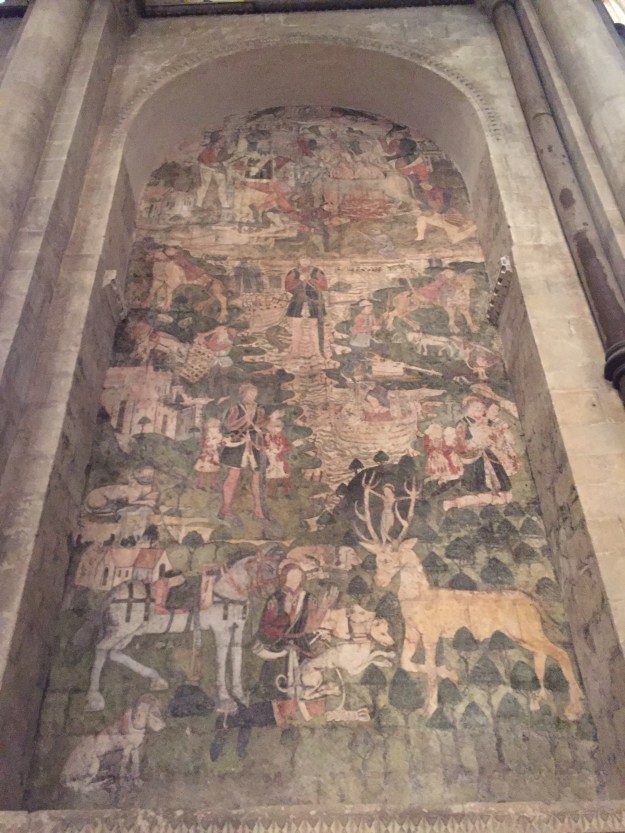
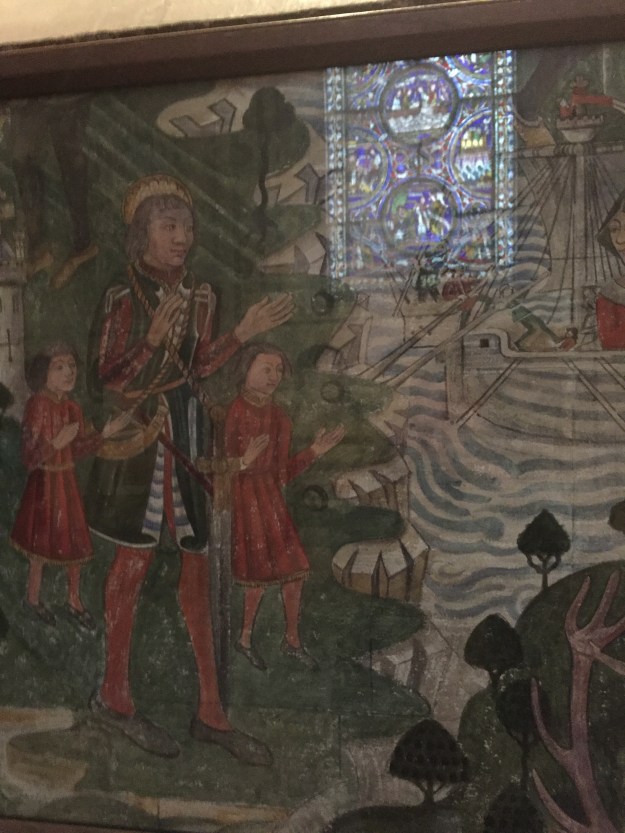
Among the many treasures at Canterbury Cathedral, one of my favorites on my visit this week  was this large large wall painting, done in about 1480. It’s the legend of St. Eustace, who lived a colorful if harrowing life. He might possibly have been a known historical character, a Roman general named Placidus, in the 2nd century A.D.

img_7332

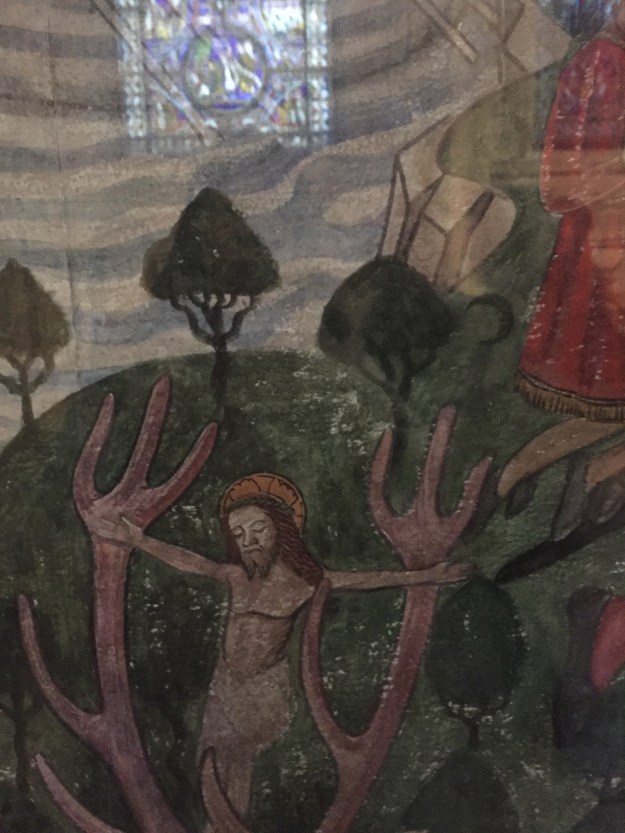
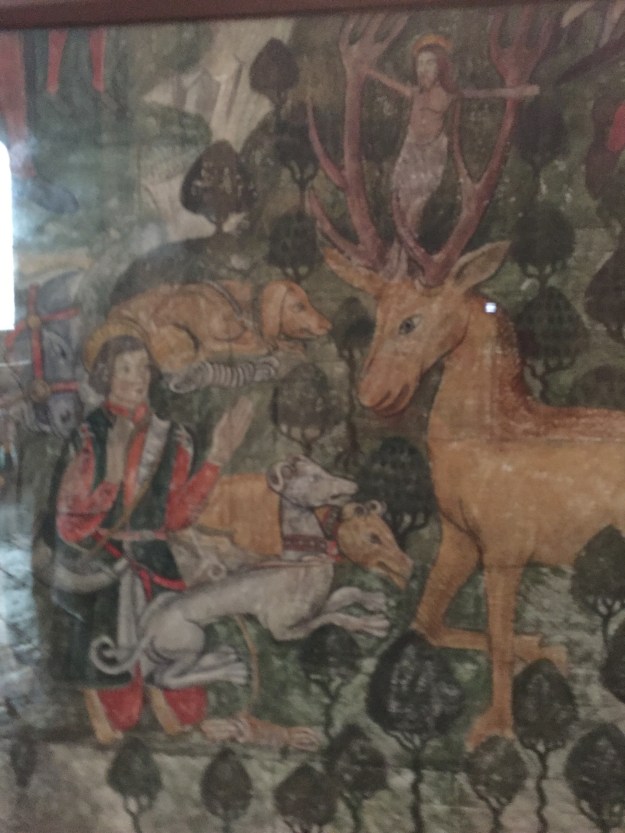
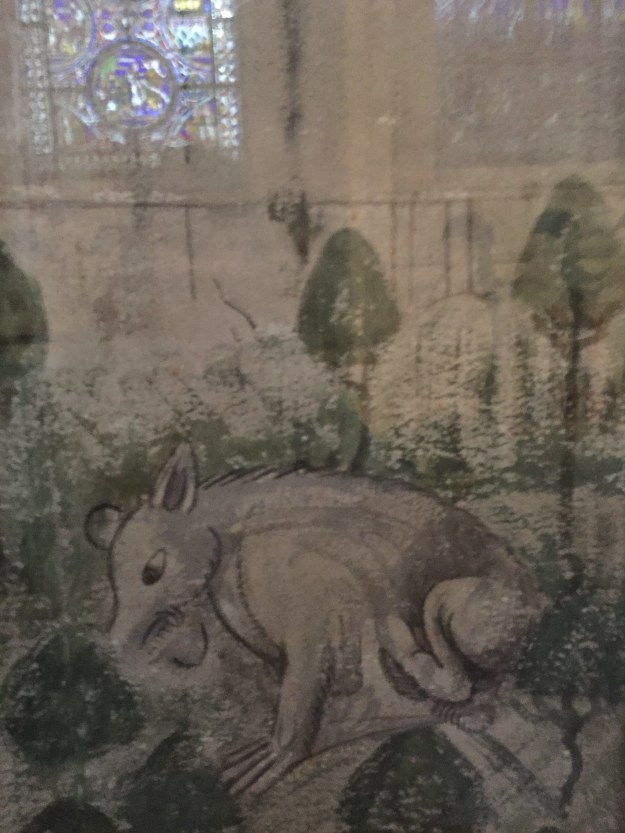
The legend goes that Placidus was out hunting one day when he had a vision of Christ  in the antlers of a stag.  He immediately converted to Christianity and changed his name to Eustace.

img_7302

It’s hard to see the images that go high up the stone wall of the catheral.  But there’s a horizontal copy nearby.  Photos of it are not great because it’s covered by glass, but the reflections of the stained glass windows are sort of a bonus. I loved the images, especially the animals like the smiling stag and the hunting dogs above.

img_7322

The legend goes that Eustace’s troubles began right away.  His faith was tested by various calamities.

img_7327

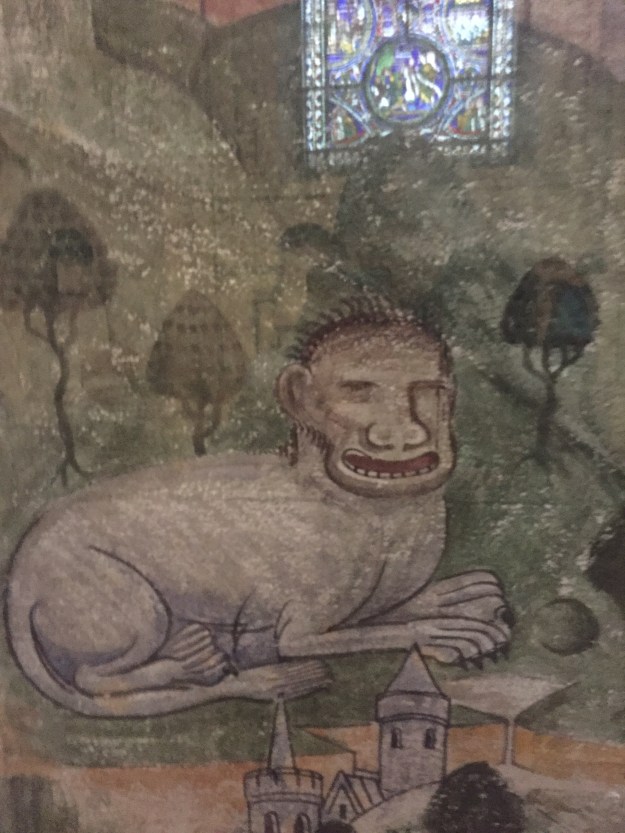
I was admiring the lion image. Personality plus! Then I read that the lion was grinning because he had just eaten Eustace’s son.

img_7335

The wolf, looking all innocent? He had eaten the other son. But the legend goes that Eustace endured his hardships and kept his faith.

The painter of the Canterbury mural subscribed to a disputed end of Eustace’s story: the very upper part of the mural shows Eustace, his wife and his remaining children being roasted alive by order of the Emperor Hadrian. Eustace had refused to make a pagan sacrifice. Then they were all beatified, so there was still a happy ending of sorts. However, the martyrdom and even the historical existence of the saint are in doubt. I love the painting, regardless of the source. Bravo to the anonymous painter, back through the centuries!

To me, the charm of the mural is in the medieval images of people in nature, learning lessons from animals. The painter told the story with gusto and some humor.

Join me next time for more explorations in the art and history of Europe and the British Isles!


Happy Tax Day in the USA

 In the whole history of the world, has anyone ever enjoyed paying taxes?  Probably not. In London’s National Gallery, I came upon these two fellows, obviously no friends of the artist.  The painting is from the workshop of Marinus van Reymerswale, most likely from the 1540s. The caption explains that it was probably painted as a satire on covetousness.

At the time, government authorities imposed taxes on items such as wine, beer and fish.  The serious-looking gentleman on the left is apparently writing out a tax list. Once the tax rate was set, private individuals were entrusted with actually collecting the money from taxpayers.  An unscrupulous tax-gatherer could obviously take advantage of this system. The man on the right, with his grasping fingers and face contorted by greed, looks more than ready to grab more than his fair share of whatever he collects. 

Do tax collectors deserve any sympathy? The painting below, a 1599-1600 masterpiece of Michelangelo Merisi da Caravaggio, depicts the moment that Jesus Christ called the tax collector Levi to walk away from his lucrative profession and follow Jesus as a disciple.  He became the disciple we know as Matthew.

4096px-The_Calling_of_Saint_Matthew-Caravaggo_(1599-1600)

The Calling of St. Matthew, Caravaggio, 1599-1600, Public Domain

So who is St. Matthew in the painting? Opinions vary.  I’ve always thought it was the bearded man, pointing to himself as though to ask, “Who, me?” But I recently read that some experts think Matthew is the young man slumped over at the end of the table, trying to avoid the summons to a life of poverty and hardship. It could not have been an easy choice.

April 15 is the day that Americans have to submit their income tax forms to the government.  We all would like to believe the tax system we live under is fair, uncorrupted and just. Let’s hope so, and as we send off our tax returns, let’s hope that every hard-earned penny is spent wisely.

Poor Old Joseph

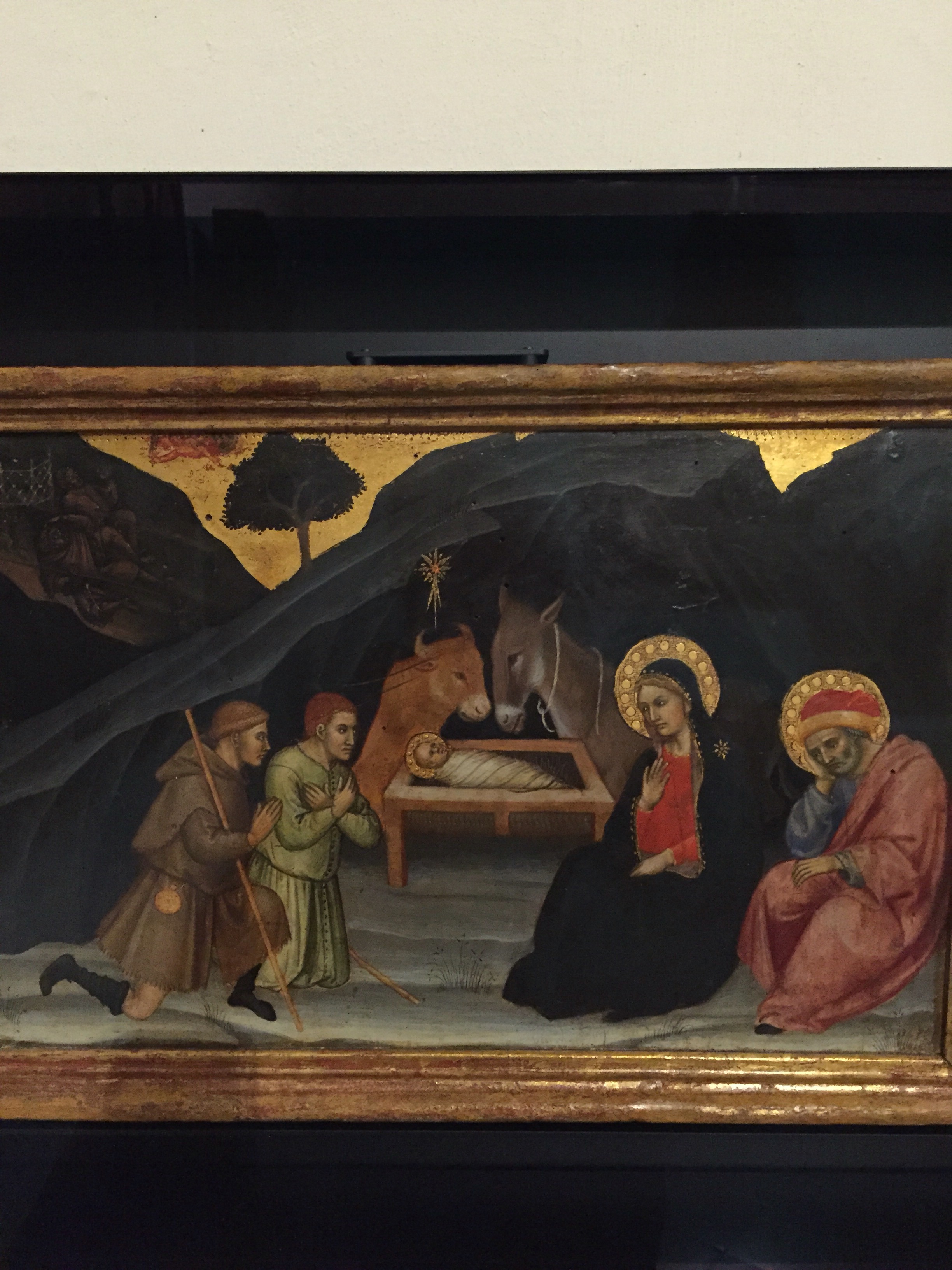
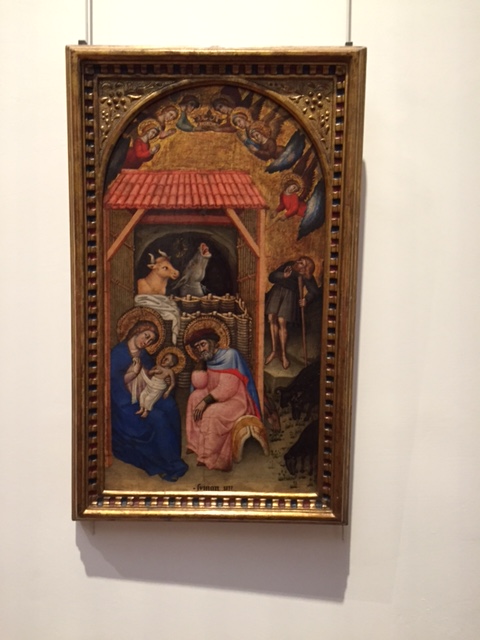
Wandering in the Pinacoteca in Siena, Italy, I started feeling sorry for Joseph, the often-neglected member of the Holy Family. It seems that in the 14th and 15th centuries, at least in Italy, there was a tradition that Joseph was an exhausted old man. His wife Mary is always shown as a pretty young woman, but poor Joseph  in these paintings looks tired and put-upon.


Taddeo di Bartolo, Adoration of the Shepherds, Siena 1362-1422

img_3840

Joseph disappears in the Gospels after the episode where Jesus stays behind in the Temple after a family visit, and his worried parents have to search for him. In the serene Nativity scene above, are we to think of Joseph as the only one who foresaw the troubles ahead?

Here’s another worn-out Joseph:

Matteo di Giovanni, Adoration of the Shepherds, Siena, 1433-1495

img_3850

The Biblical story tells us that the Holy Family soon became a family of refugees fleeing persecution, traveling to Egypt to avoid the wrath of King Herod. Was Joseph resting up for the journey ahead?

And another image:


Pietro di Dominico, Adoration of the Shepherds with St. Paul, Siena, 1457-1502

img_3856

Here, the Three Kings are just arriving in the background. In the story, Joseph has already traveled far with a pregnant wife, and now he has an infant as well, and faces more trudging down a dirt road. Is Joseph thinking, “Enough with the gold, frankincense and myrhh.  How about a tent, a baby backpack and some down sleeping bags?”

In the painting below, Joseph has his walking stick at the ready.

img_3922
Giaccomo Pacchiarotti, Adoration of the Shepherds, Siena, 1474-1540

img_3926

In all the joy of the holidays, I’d like to remember those who are refugees, or old, or tired, or discouraged.  I’d like to remember those who stay in the background and do the heavy lifting. I’d like to remember those who are in over their heads for one reason or another. I’d like to remember those who stick around to clean up after everyone else has celebrated and headed home. I don’t know the theology that informed these paintings, but I have a lot of sympathy for Joseph.

IMG_4201

Simone di Filippo, Nativity, circa 1380, Bologna

img_1975

In my favorite fresco, a humble anonymous work I wrote about a few days ago, Joseph looks aged, but cheerful and downright sprightly.  That’s my wish for all of us. My post about this delightful fresco is at https://castlesandcoffeehouses.com/2015/12/21/a-medieval-dan…-for-christmas/

Join me next time for more explorations in the art and history of Europe!

A Medieval Dancing Dog for Christmas


An unknown artist created this enchanting image of a shepherd playing a sort of bagpipe for his dancing dog between 1370 and 1390. It’s from a lunette–a semicircular fresco, divided into two parts–that once decorated the Monastery of Santa Giuliana in Umbria. Today, what is left of the lunette is in the Galleria Nazionale dell’Umbria in Perugia, Italy.

RFresco
The shepherd and his dog occupy the far right-hand side of the nativity scene above. Why is this simple scene so special?  I love it for the way the ordinary mortals–and the animals–are as important as the Holy Family.

DogCattle

The musical shepherd, his dancing dog, and the cattle on the right-hand side of the lunette (the semi-circular scene)  are hanging out casually on the hillside, unaware of what’s going on in the stable.


I love the lifelike sheep, with their thick winter coats.


The shepherds stand on a flowery hillside, nudging each other in amazement at what’s happening in the sky above them–no doubt there were once angels.


The left-hand side of the lunette does show the missing angels, hovering over what looks like a typical Italian hill town much like Assisi or Perugia. A lucky cow and a donkey are special guests–or rather, they are hosting special guests in their humble stable.


All the elements of the Biblical story are here, in their simplest form. Gathered around the swaddled baby, we have musical angels, friendly cattle, and a proud mom and dad.


 St. Francis of Assisi, very near to Perugia, created the first three-dimensional manger scenes, in order to make the Christmas story seem more real to those he preached to. In early December when I visited , preparations were underway for a manger scene outside the Basilica in Assisi.

Francis is beloved for many reasons, but especially for his love for the working poor and the homeless.  Francis was all about radical humility. He was in demand in the palaces of the great, but he was determined to spend his time with the poorest of the poor.

Great artists like Giotto created wonderfully colorful frescoes illustrating the saint’s life for the Basilica that was immediately begun after his death in Assisi. A new pictorial language developed around the humble life of St. Francis, emphasizing his love for humanity, the joy possible in the most ordinary of lives, and the goodness of the natural world. The challenge was to honor the saint’s life without unduly glorifying him. The frescoes above were part of this artistic and spiritual movement. No doubt the anonymous artist who created these frescoes for a little monastery had seen the work of Giotto in the Basilica.  Although St. Francis is not the subject of the almost-primitive lunette I liked so much, his influence shines through in the simple everyday images.


I spent several happy hours soaking up the great art in this underappreciated museum. But I circled back several times to the damaged but charming fresco of the Nativity with the dancing dog.

All Saints’ Church at Kedleston Hall

KedlestonHall

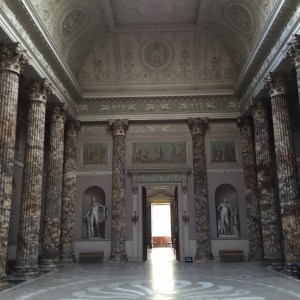
Kedleston Hall is the spectacular showplace home of the Curzon family, designed by Robert Adam, finished in 1765 and open to visitors before all the plaster was dry. The housekeeper led visitors (of the right sort, of course) on a tour through the state rooms. The point was to impress visitors with the wealth, power and taste of the family. Not everyone cared for the place, though. Dr. Johnson remarked, “It would do excellently for a town hall.” I have to agree.  Entering the lofty Marble Hall feels like entering a courthouse. Visitors stop in their tracks and speak in hushed voices.
AllSaintsKedleston

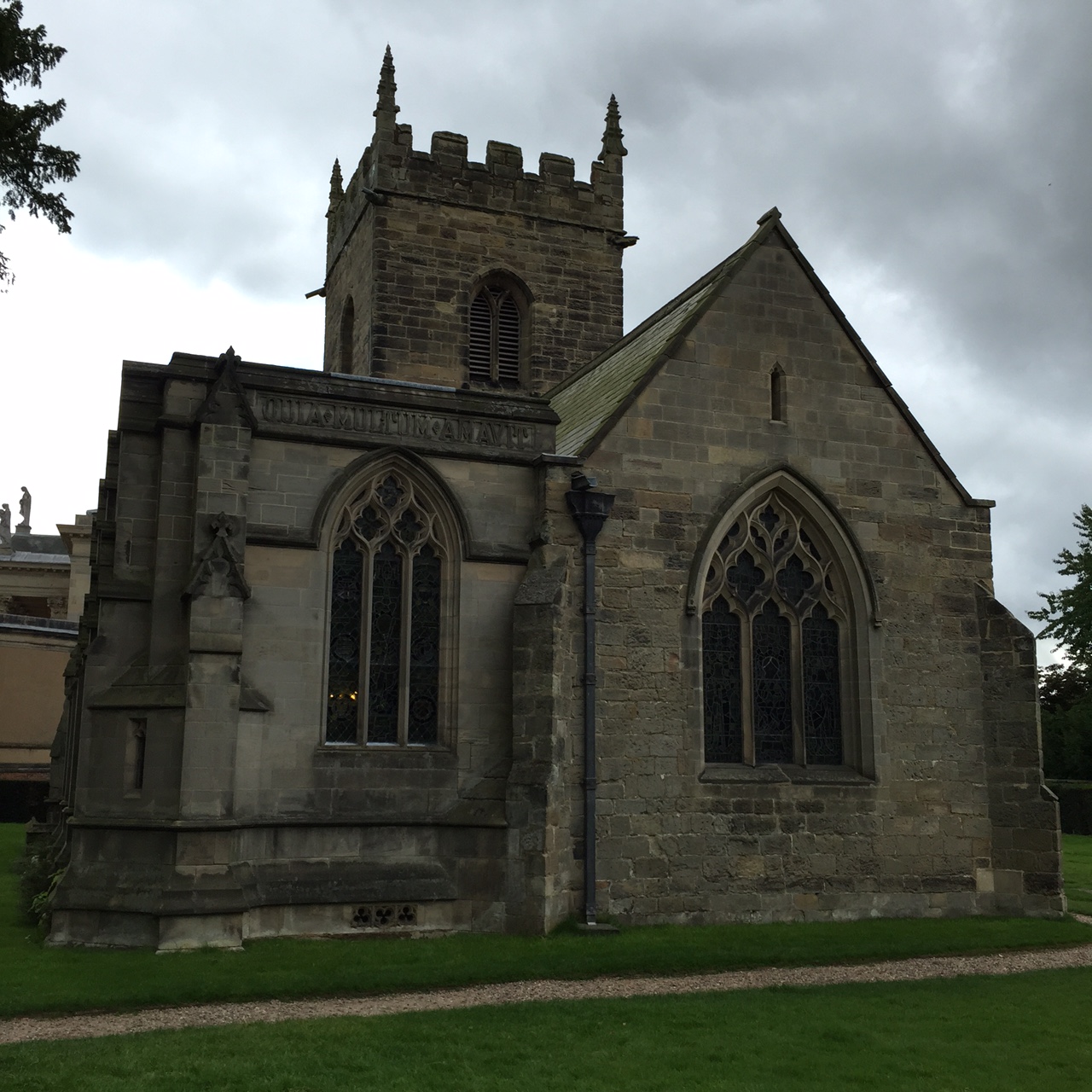
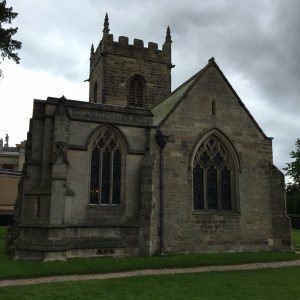
My favorite part of the estate is All Saints Church on the grounds outside. The church is an important historic site, cared for by a special organization separate from the National Trust, which manages the house.

CurzonMedieval

Curzon ancestors, dating all the way back to Norman times, were buried inside and in the churchyard. When Sir Nathaniel Curzon inherited the estate in 1758, he lost no time in razing the medieval village where his ancestors had lived quietly for centuries. But he kept the village church where they slept in their tombs.

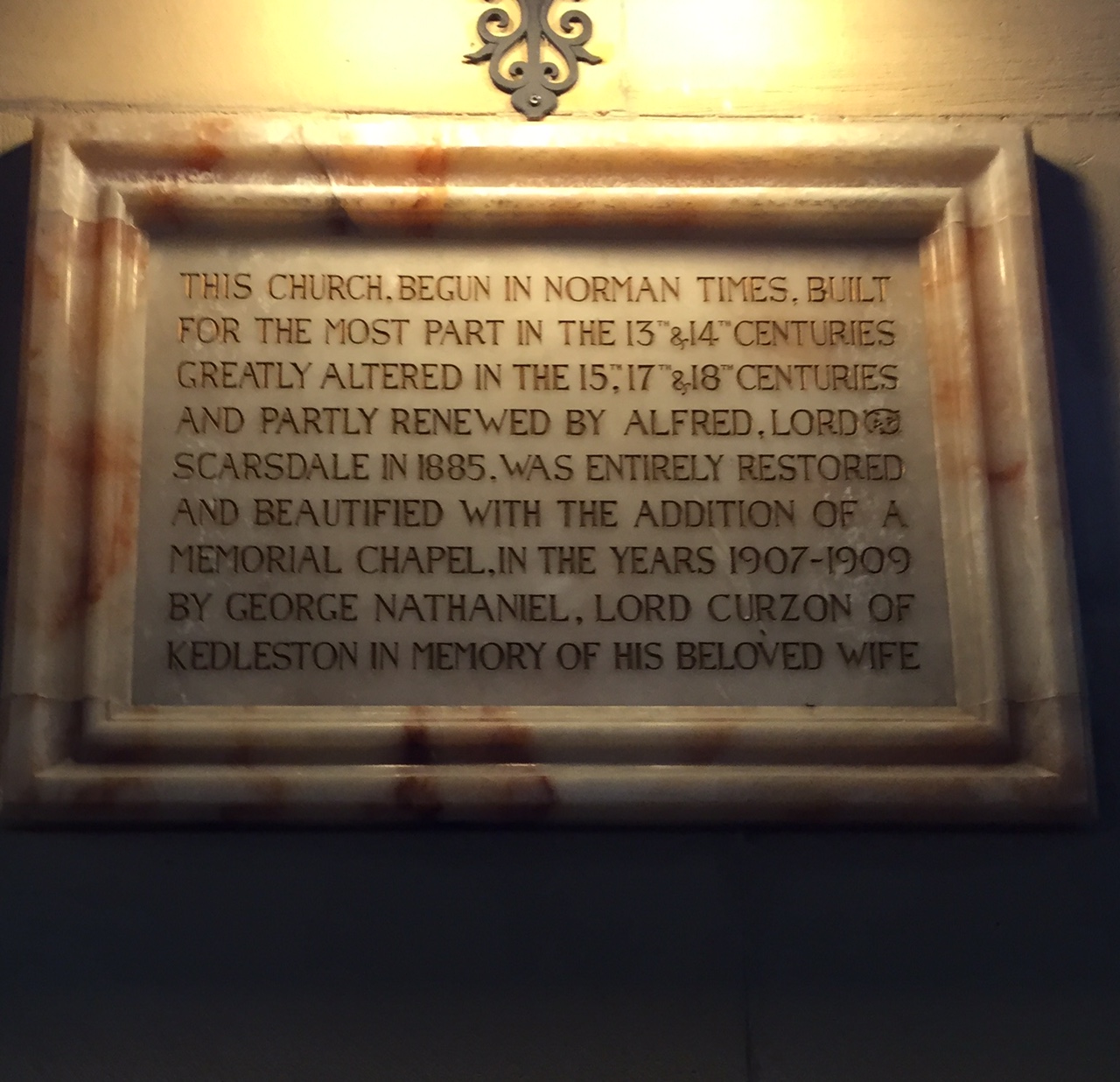
AllSaintsPlaque

As the plaque above explains, various Curzons maintained and restored the church over the years.  But its pristine condition today is mostly because of a sad love story.
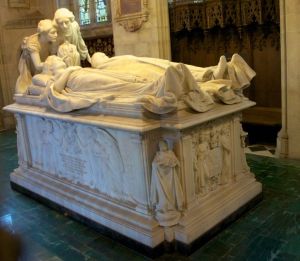
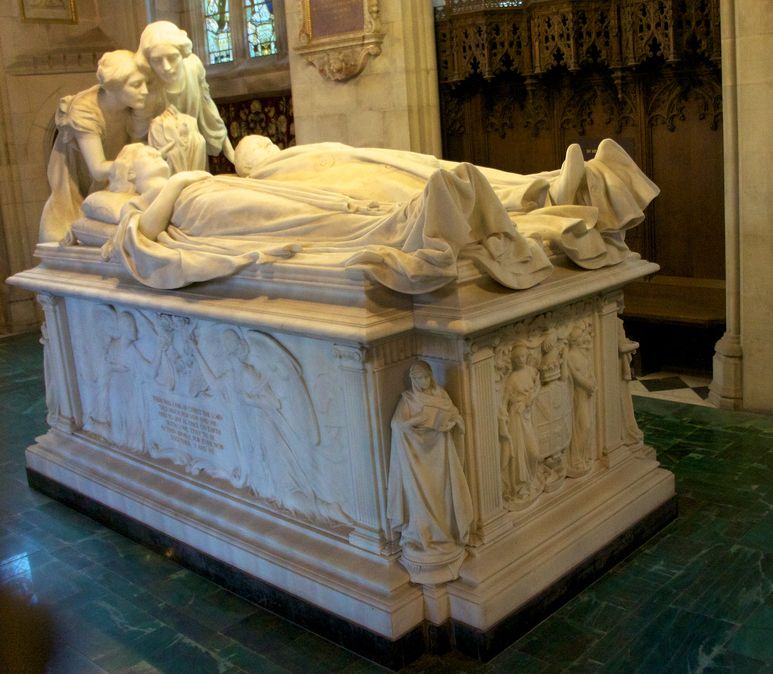
Photo by Chris Hoare, Creative Commons Attribution 2.0 Generic

Photo by Chris Hoare, Creative Commons Attribution 2.0 Generic

The photo above shows the exquisite marble memorial of Lord George and Lady Mary Curzon.  It was created between 1907 and 1913 by Bertram Mackennal. (Visitors can’t get the complete view above, because the side chapel is separated from the main church by a gate). This is one of the most beautiful and intriguing of all the many tombs I’ve seen in old churches. Who were these people?

MaryCurzon

Mary Leiter was a fabulously wealthy, cultivated and beautiful young woman from Chicago.  Her father was Levi Leiter, founder of Field and Leiter stores, which eventually became Marshall Fields. (Yes, Mary Leiter was an inspiration for Cora, the perfect wife of Lord Grantham on the TV show “Downton Abbey.”)  Mary Leiter married George Curzon in 1895. He very soon afterward became Viceroy of India, the highest title available to an Englishman, during the heyday of Victorian empire. Mary gave birth to three daughters, but failed to produce the all-important son. The years she spent in India were happy ones, but her health suffered and she died in 1906, aged only 36.

KedlestonSideChapel

Her husband immediately set to work memorializing her, even as he moved on to various mistresses and an eventual second wife. He never really recovered from his grief at losing Mary. So he built a neo-Gothic addition to the family church. The addition blends almost seamlessly with the original medieval church.   He commissioned the beautiful marble memorial. Mary was buried in the newly-created family vault underneath.  My understanding is that Lord Curzon had Mary’s effigy placed on the plinth as soon as the chapel was complete.  His own effigy was finished and kept in storage until he died.  Then it was placed next to his beloved Mary, and he took his place in the vault below.

Victorian technology allowed Lotrd Curzon to install a hidden elevator in the marble floor next to the memorial, so that coffins could be lowered into the vault at the push of a button.  The friendly church guide recalled the spooking of a lady in recent years. She walked into the church just as a workman rose slowly from underground, standing on the moving section of floor. The terrified lady fled.

FullSizeRender (12)

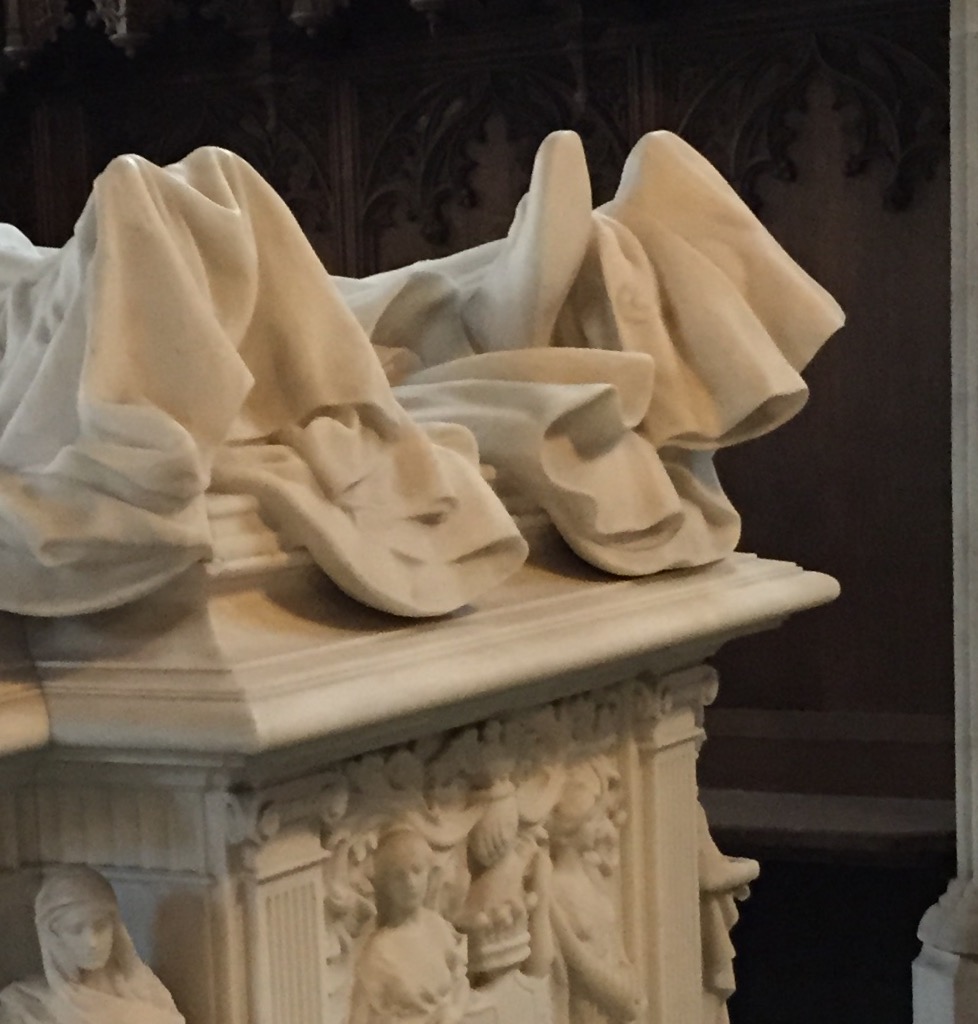
The guide pointed out that Lord Curzon’s right foot is uncovered, a Victorian convention indicating that the effigy was created while the person was still alive. Lord Curzon was a stickler for detail, and he expected the same from his family and everyone who worked for him.

MaryCrown

The sculpture depicts two angels hovering over the sleeping figures.  What are they holding? It’s the Crown of Life–a fairly obscure Biblical reference. The crown is wrapped in a veil. Why?  My thought is that nobody gets to see their heavenly reward until they actually receive it in the Great Beyond.

The sculpture stands serenely in its own side chapel, surrounded by nine stained glass windows depicting various Marys from the Bible and other sources. Impertinent questions come to mind. Considering that there are two people lying in state, why is there only one crown? Is the sleeping couple somehow supposed to share the crown, or is it meant for only one of them? If it is for one of them, would that be Mary? In some traditions, Mary the mother of Jesus became Queen of Heaven after her death. But this is an Anglican church, and as far as I know has no such tradition. Anyway, wouldn’t it be just a bit sacriligious to insinuate that one’s wife was destined to be Queen of Heaven? The guide had an information booklet, but there was very little explanation of the mysterious veiled crown. I would not use a vulgar term like “control freak” for Lord Curzon, but I half expected his ghost to tap me on the shoulder and set me straight about the crown. He did not suffer fools gladly.

Lord Curzon never found another person who could compare to his Mary, and by all accounts he often said so. How could any actual living person compete with a sainted ghost? After Mary’s death, Lord Curzon was soon battling his daughters for their shares of the money Mary had left. He ended up estranged from them. Toward the end of his life, he was also estranged from his second wife, Grace. All the same, according to the guide, Lord Curzon kindly reserved a space for her in the family vault. But Grace did not care to spend eternity directly underneath the effigies of her husband and his first wife, depicted in everlasting marital bliss. Instead she chose a burial plot for herself in the far corner of the churchyard.

Viceroy's Daughters
Every trip leads me to buy books which I may or may not find time to actually read. I’ve already devoured the book above, The Viceroy’s Daughters by Anne de Courcy. The Curzon family history, especially in the 20th century, is riveting.  The book is a window into British aristocratic life from Victorian times all the way through World War II.  I’ll be writing more about the glamorous Curzons.

Join me next time for more explorations in the art and history of Europe and the British Isles!

Norwich: Refugees in the Cathedral

IMG_8299

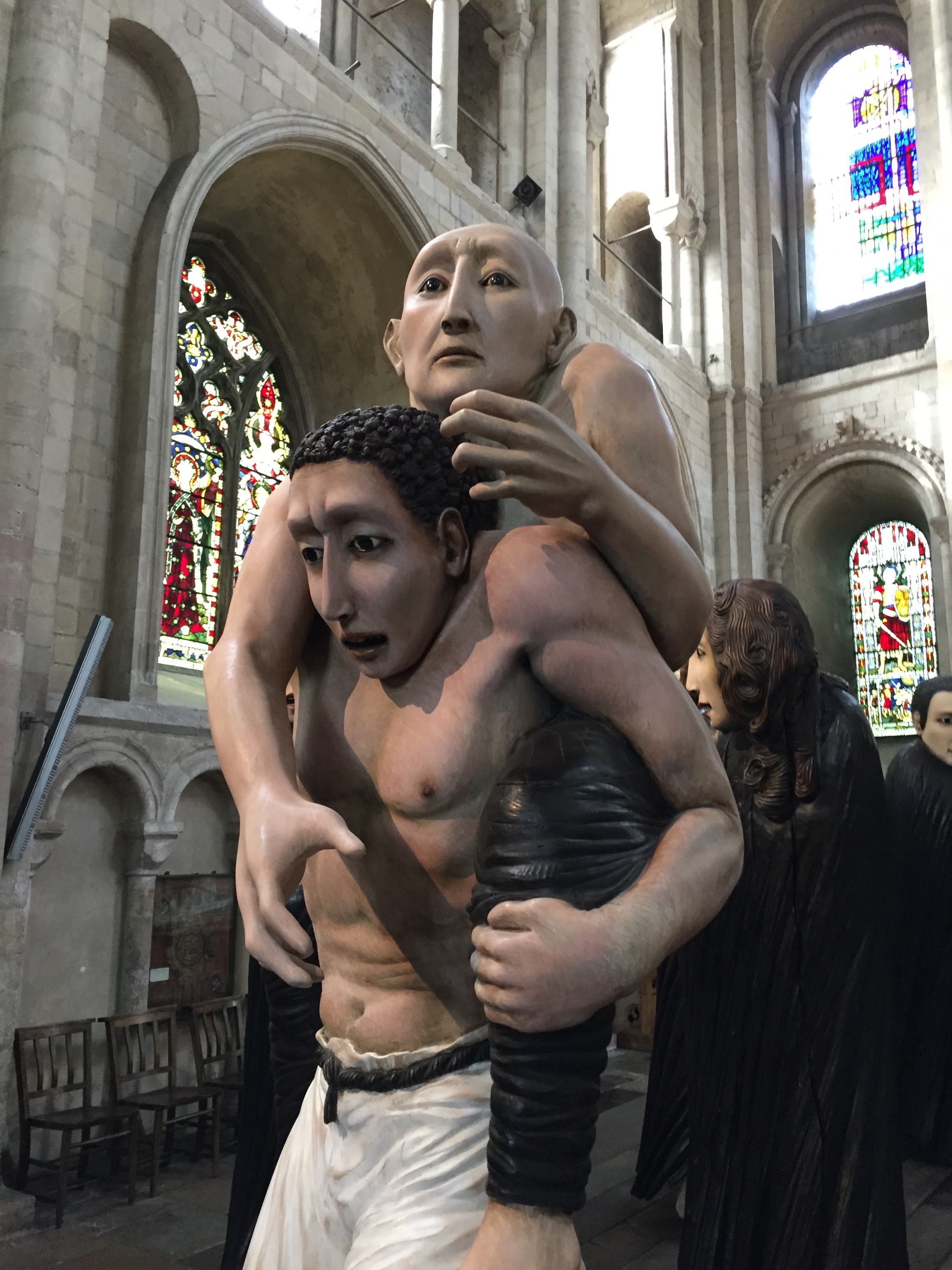
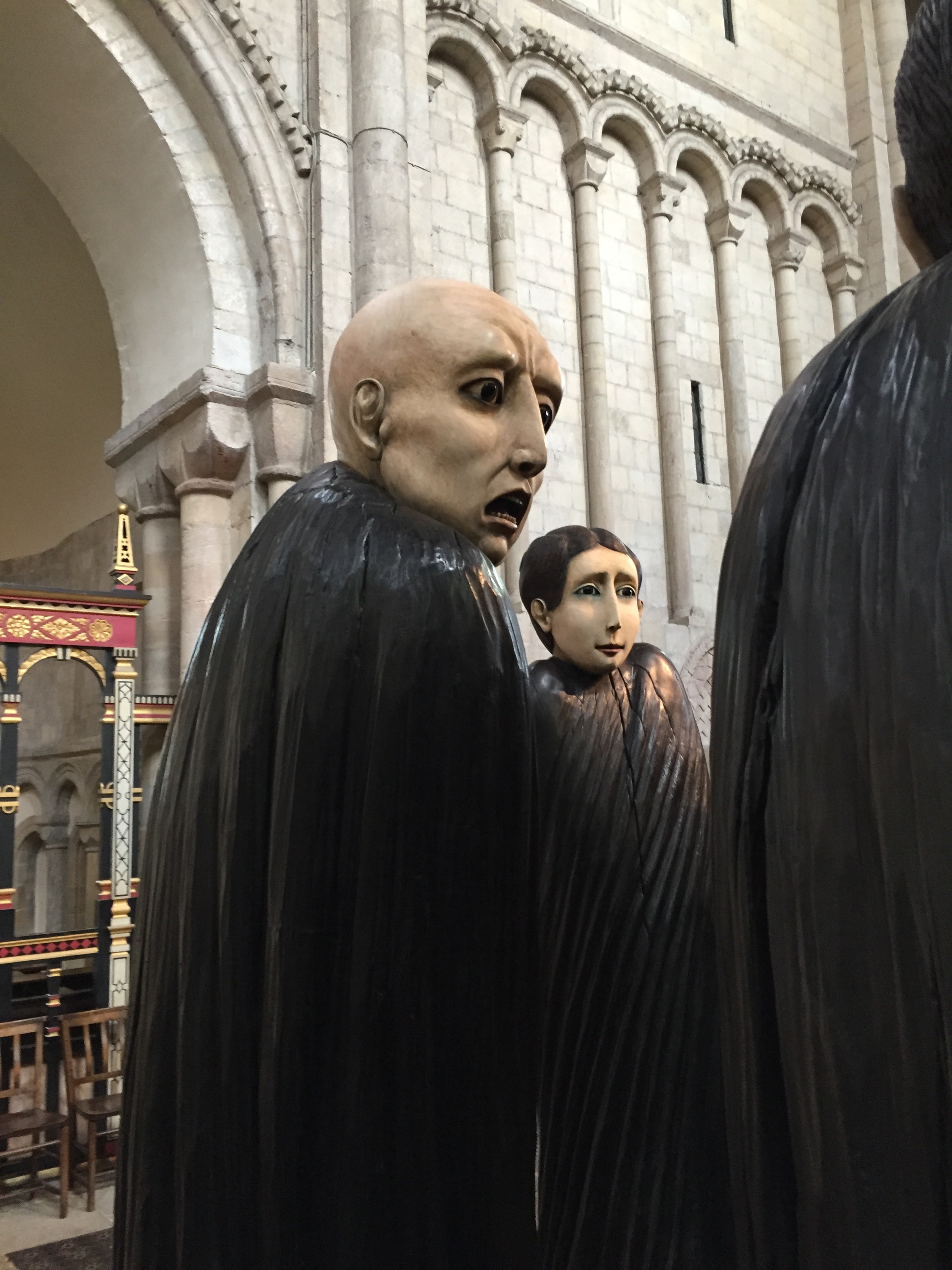
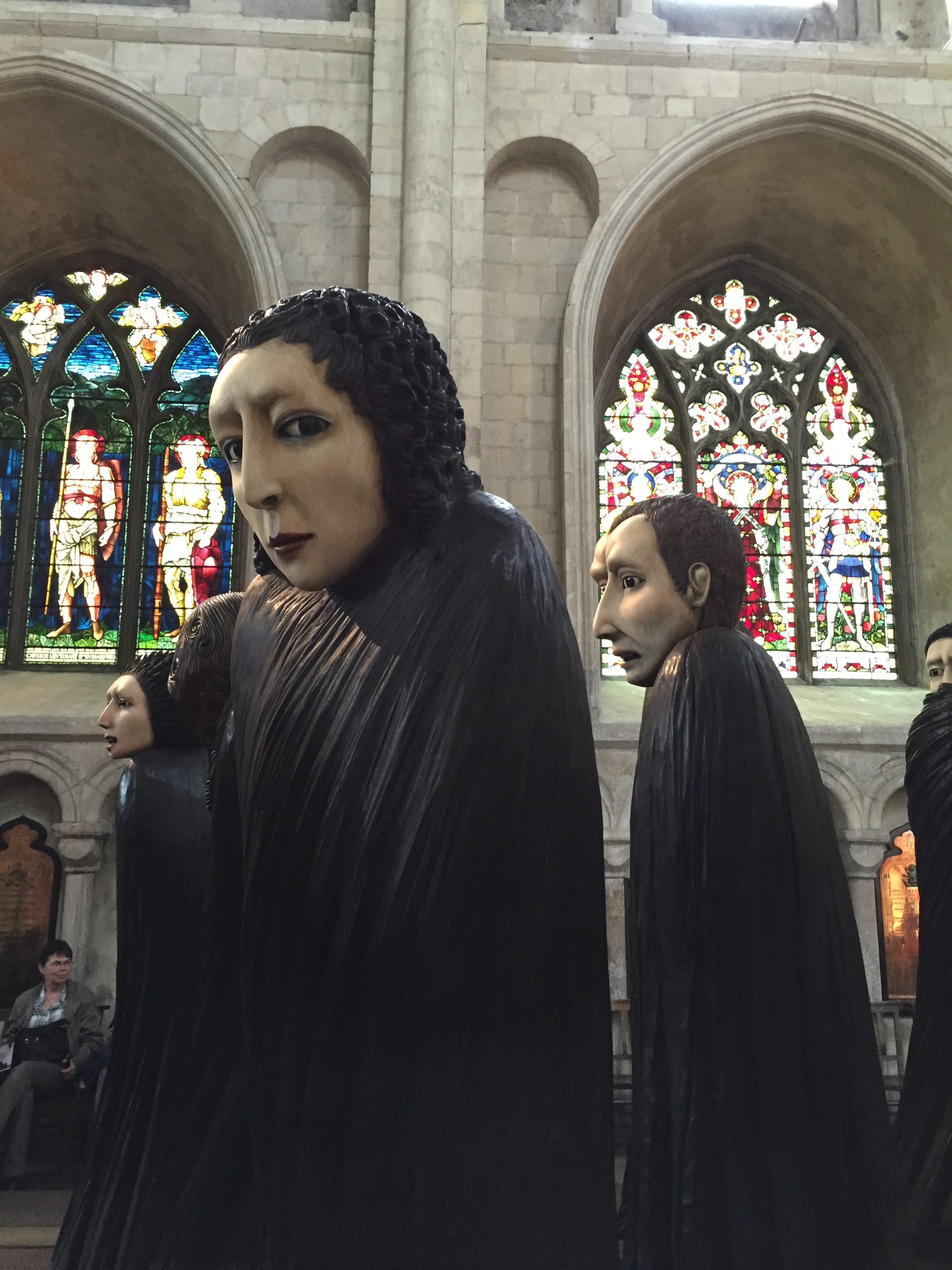
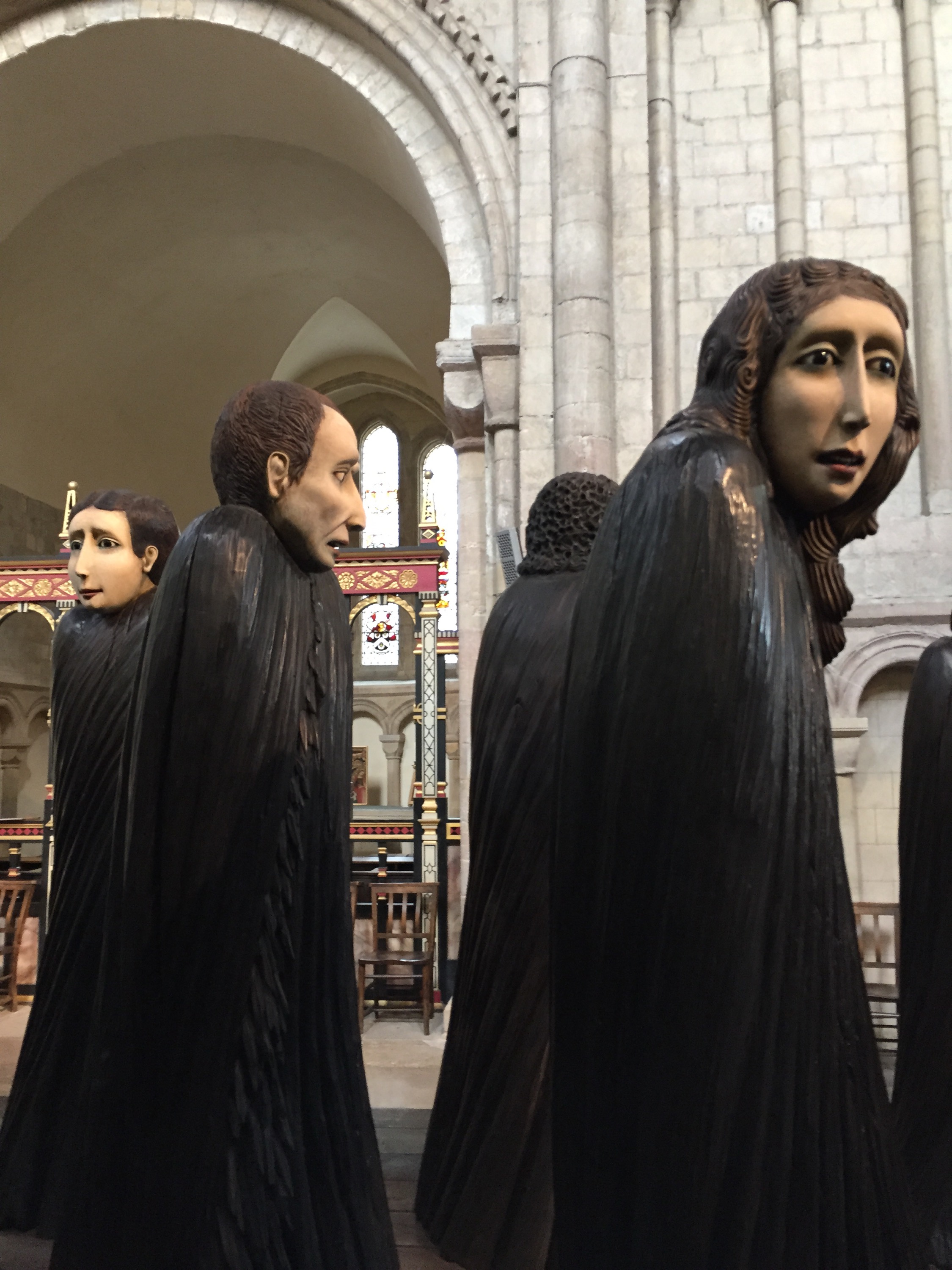
In the middle of the biggest and most heartbreaking refugee crisis in Europe since World War II, I came face to face with larger-than-life refugees in the middle of beautiful Norwich Cathedral in England. Ana Maria Pacheco, a sculptor from Brazil, had her ten-figure group on exhibit in the North Transept.  The installation is called Shadows of the Wanderer. It was created in 2008.  But it is especially powerful today, when people are dying every day in a desperate flight away from violence and grinding poverty in their home countries. The nations of Europe are struggling to come to terms with the vast number of refugees arriving on their shores and at their train stations. All over Europe and Britain, while governments dither, ordinary people get on with the business of helping their fellow human beings.  They collect diapers, food, water bottles, blankets and tents, and they simply appear where they are needed.

The lead figure in the sculpture group is a young man carrying his elderly father on his back. Father and son are carved from the same huge block of wood. The son literally cannot leave his father behind; his father is part of him, and he is part of his father. The origin of this stunning work of art was the story of Aeneas, who carried his aged father Anchises from the ruins of battle at Troy.  The son is about to step off the exhibit plinth and join us, the viewers.

How will we react to these desperate people? All the figures are larger than we are, about 7 or 8 feet tall. The situation they depict is bigger than we are, too.

IMG_8288

The remaining figures show possible reactions: Shock, dismay, disapproval, indifference.

IMG_8291

Will we look around, wondering who is going to get this problem out of our sight?

IMG_8276

Will we look the other way, complacent as we go about our regular business?

The draped figures following the desperate father and son have their arms and hands hidden.  If the father and son fell backward, would anyone catch them? Will no one reach out a helping hand?  These are the questions that ordinary people are asking their leaders right now.  Each one of us could become a refugee for reasons beyond our control.  The current crisis is a test of our humanity.

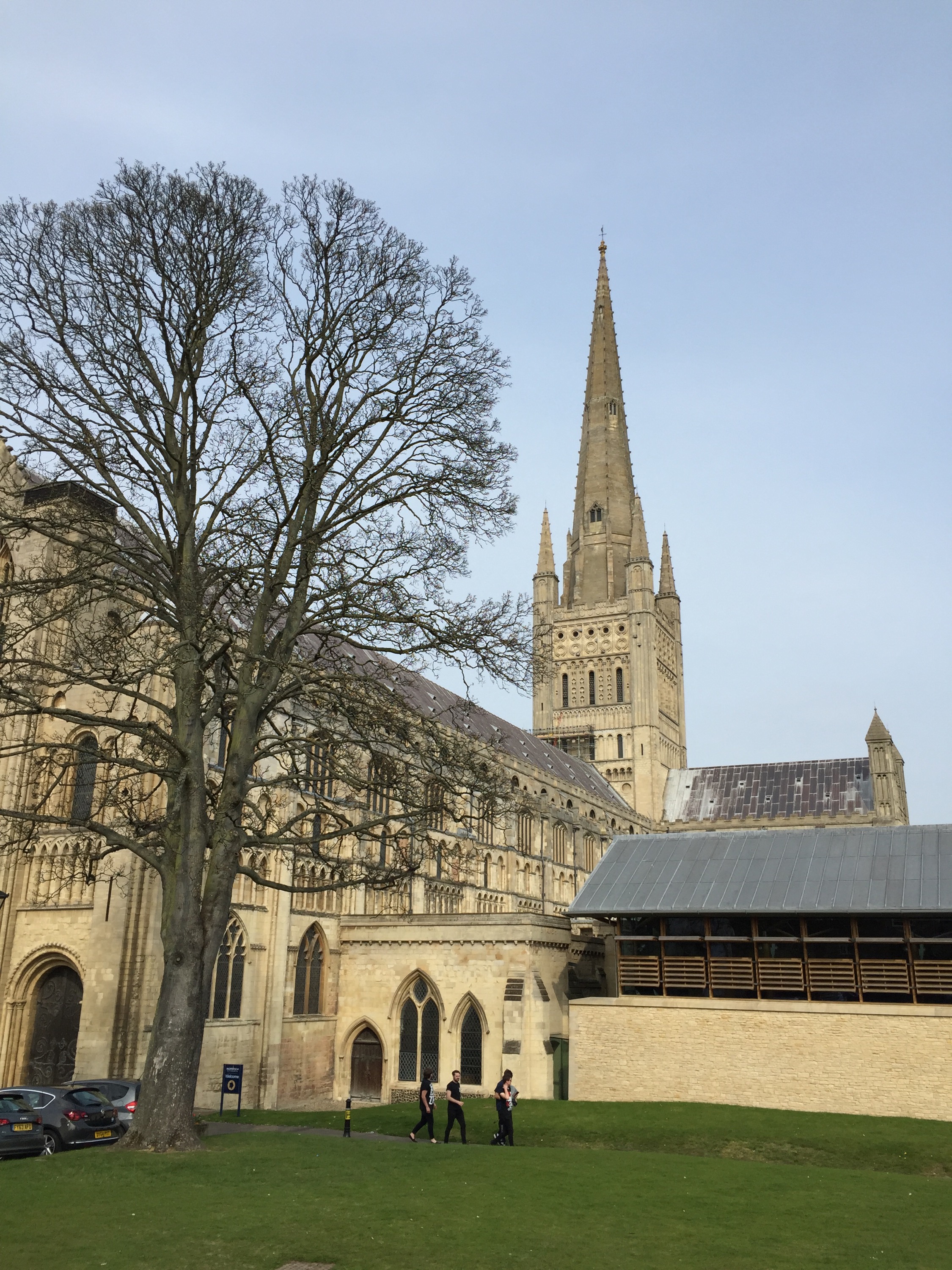
Norwich has one of the most welcoming cathedrals I’ve ever seen.  Many great cathedrals charge admission, often as much as $15 or $20.  At Norwich, visitors are greeted by volunteers asking what they are most interested in seeing.  I’m sure donations are gratefully accepted, but I arrived late in the day and didn’t realize until after I’d left that I never saw a place to donate. The business of Norwich Cathedral is to welcome and to minister to its visitors.


When I arrived, a lovely young volunteer asked about my interests, then described this special exhibit. She offered to lead me directly to the North Transept so I wouldn’t miss this powerful work of art in my limited time.  I am grateful to her.

Join me next time for more explorations into the ever-fascinating and ever-challenging history and art of Europe and the British Isles.

Las Meninas: A Velazquez Masterpiece

Diego Velazquez, "Las Meninas," 1656-7, Public Domain, Prado Museum

Diego Velazquez, “Las Meninas,” 1656-7, Public Domain, Prado Museum

In around 1656-57, the great Spanish court painter Diego Velazquez was at the height of his powers, both as an artist and as a courtier.  King Philip IV appointed him not only to paint portraits of the royal family, but also to acquire and curate the royal art collection. Velazquez was more than a mere painter; he lived almost as a member of the royal family. Many people think Las Meninas is the greatest painting in all of Western art.

Pablo Picasso, "Las Meninas," image from Guggenheim website cited below

Pablo Picasso, “Las Meninas,” image from Guggenheim website cited below

In 1957, Pablo Picasso painted over 40 of his own versions of the painting. One of the greatest artists of modern times was carefully studying and paying tribute to a great artist of the past.

In the original painting, Velazquez did not have the red cross of the Order of Santiago emblazoned on his chest; he only received it three years later.  Philip IV ordered the cross to be added to the painting after the death of Velazquez. Legend has it that the King personally painted it.

The central figure is Princess Margarita Teresa, at the time the only living child of her parents, King Philip IV and his second wife Mariana of Austria. They’re in the background of the painting, possibly reflected in a strategically placed mirror. Also present are two ladies-in-waiting, two dwarves, a lady chaperone, a chamberlain, a bodyguard, and a friendly-looking mastiff.  And the artist himself is present, with brush and palette. The names of all the people are known, except the bodyguard.

Detail from "Las Meninas," Public Domain

Detail from “Las Meninas,” Public Domain

I’ll leave it to art historians to explicate what all Velazquez wanted to say in his magnum opus.  I’m drawn to the enchanting figure of little Margarita Teresa, age 5.  This was a golden moment in her short but seemingly happy life. The painting was almost destroyed by a fire in 1734.  Fortunately, it was rescued.  The left cheek of the princess was burned, but it was painstakingly restored.

The spectacular Velazquez exhibit at the Vienna Kunsthistorisches Museum last year had to make do with a reproduction of Las Meninas. The masterpiece is too precious for the Prado to lend out.

One of the pleasures of a major museum exhibit is a stop at the gift shop.  What souvenirs did the marketing people come up with? I thought they outdid themselves for the Velazquez exhibit.

b0621be3-02a5-45d1-948c-0c761a6a6c2e_0

Anyone for a t-shirt with the most fetching images from the great paintings? On the black cotton background, they show up almost as elegantly as the figures in Las Meninas.

bf1a76db-61b1-499e-a562-3a645ca4bafd_0

Or how about a set of salt and pepper shakers? The salt is the adorable Margarita Teresa.  The pepper is Diego Velazquez himself, complete with brush, palette and the cross of the Order of Santiago. I’m still kicking myself for not buying them.

An article about Picasso’s Las Meninas is at http://web.guggenheim.org/exhibitions/picasso/artworks/maids_of_honor

Join me next time for more explorations in the art and history of Europe!