Category Archives: Art

A Perfect Winter Day

Wikimedia Commons, Public Domain

Wikimedia Commons, Public Domain

Some regular visitors to the Vienna Kunsthistorisches Museum head straight to a particular painting.  Austria subsidizes yearly passes for museum visitors, so many–some say a majority- of Viennese would not think of being without a yearly ticket and popping in to visit favorite works of art on their daily rounds.  A particular favorite is “Hunters in the Snow,” painted in 1565 by Pieter Breugel the Elder. Some people consider it the most beautiful and intriguing painting in the world.  It doesn’t draw the crowds of the Mona Lisa in the Louvre, but there are always a few admirers standing before this painting, transfixed.

hunters1

Last time I visited the Kunsthistorisches, I lingered in the glorious roomful of Breugels.  A woman was absorbed in painting a perfect copy “Hunters in the Snow”.  I envied her: she was spending untold hours lost in the vision of a great artist who captured a winter day almost 500 years ago.

hunters2

Breugel was a Flemish artist, but this is not a landscape from the Low Countries.  He was known to have traveled to Italy, and he very likely passed through the Austrian Alps on his way.  This is definitely an alpine landscape, which would have seemed exotic and particularly beautiful to the folks back home.

I spent awhile looking over this artist’s shoulder.  What better way to spend a winter afternoon than in the company of Pieter Breugel the Elder, gazing at a landscape that he brought home as a perfect memory of his travels?

I am home from my own travels, back in the mountains of Colorado, having my own perfect winter days playing in the 16 feet of snow we have received so far this winter.  But I can imagine a different kind of winter’s day, spent sharing brushstrokes with a great artist.  What painting would I choose? What kind of permission would I need? Could I fit my paints and brushes into my carryon? It’s another travel dream.

Treewell

Join me next time for more explorations in the art and history of Europe!

A Kinder, Gentler Church: Strasbourg Cathedral

TowerToCeiling

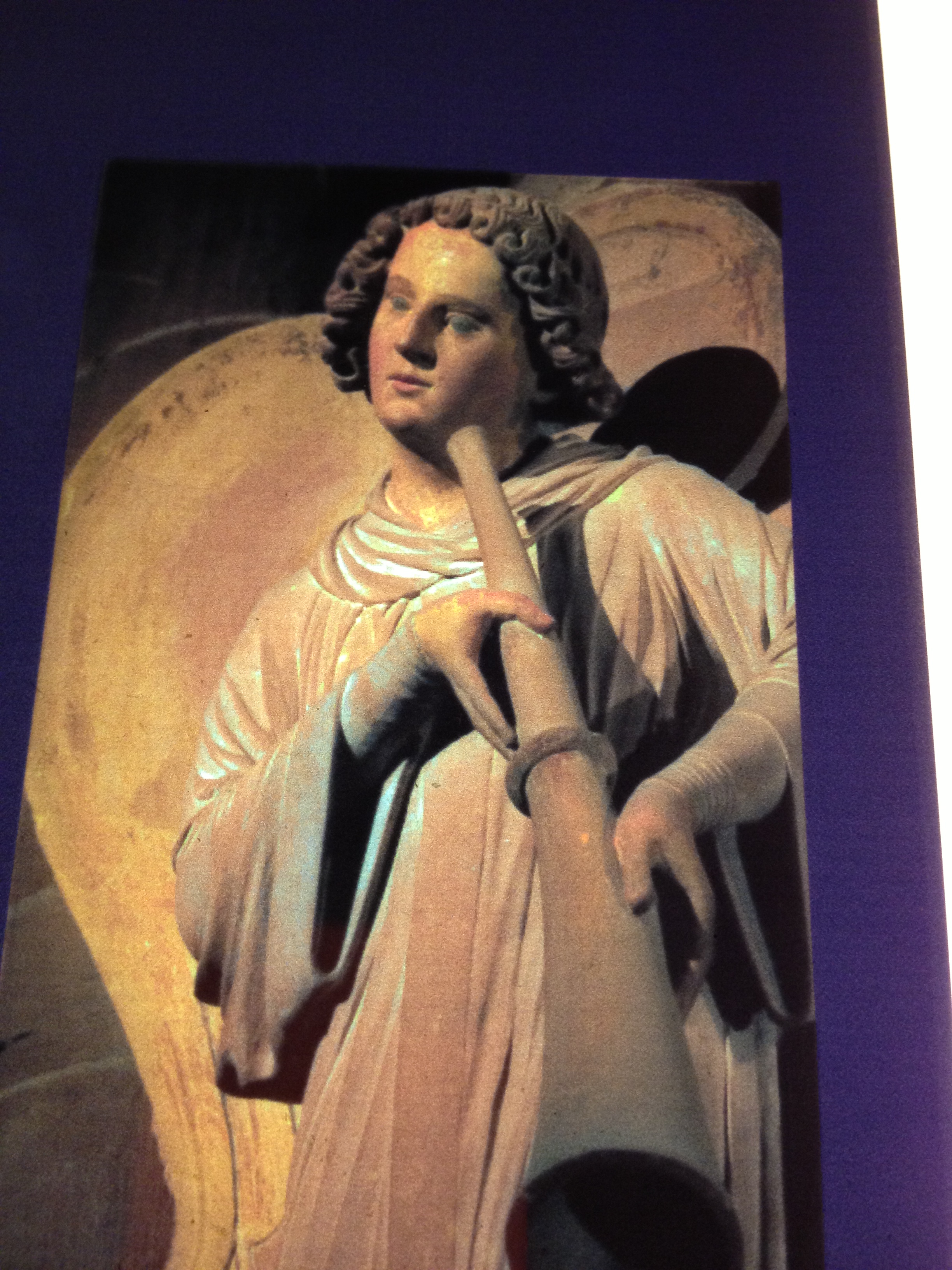
Among the many wonders of Strasbourg Cathedral is the Tower of Angels.  The breathtakingly beautiful column reaches from the cathedral floor all the way to the vaulted Gothic ceiling.  It was sculpted between 1225 and 1230, early in the 400-year span of time it took to build the cathedral. The subject of the column is really the Last Judgment, but it has a startling twist on the usually-dire subject.

BeautifulAngel

The four Evangelists appear on the lowest level, with angels above them, then the dead rising, then finally Christ.  My criticism of the column as a teaching tool for the faithful is that it’s hard to see the pinnacle, the figure of Christ, and get the point. But helpful placards provide close-ups and explain, in several languages, what is going on.

Christ

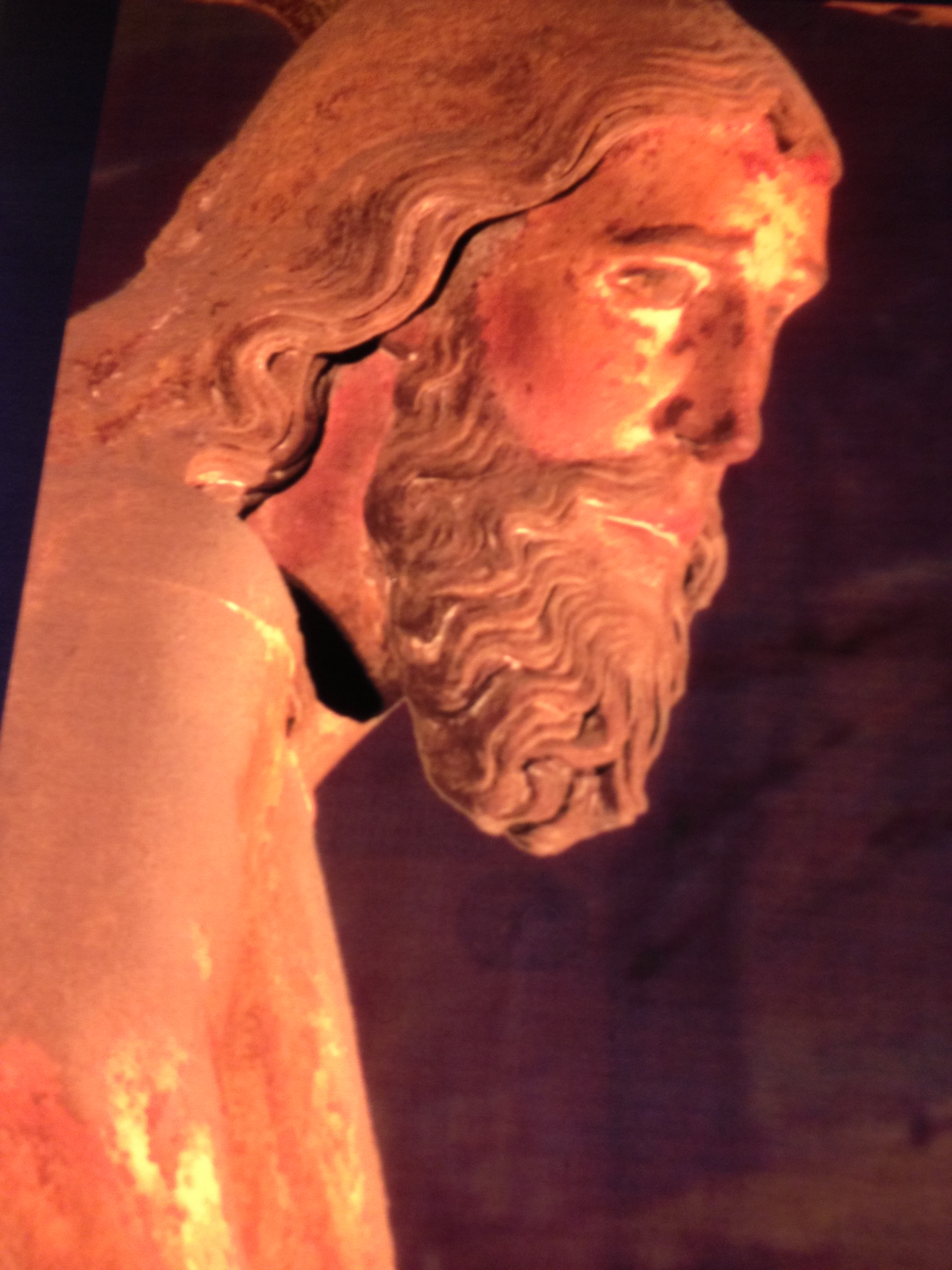
The Christ figure at the top is not sitting in splendor on a grand throne.  He is not giving anyone a thumbs-up or thumbs-down. Instead, this Christ bestows a gentle welcoming smile on everyone. This is a humble figure, a figure of loving understanding and compassion for the always-messy human condition.

I thought of the tower and its message this morning as I read the bold new statement by Pope Francis concerning the future of the Catholic Church.  Full disclosure:  I am not now and never have been a Catholic.  I visit cathedrals and churches for their art, traditions and history. Wherever I’m living, I attend whatever Protestant church seems the most socially active, inclusive and forward-thinking. But like many non-Catholics, I’m impressed by the current Pope. (Actually, he had me as soon as he decided to wear regular shoes instead of red Papal slippers.  Then when he chose to live among regular priests instead of in the much-fancier Papal Apartments, I decided he was worth a listen anytime).

In his latest statement, cited in the article below, the Pope said, “I prefer a Church which is bruised, hurting and dirty because it has been out on the streets.”  He has consistently shaken things up by insisting that the church should boldly reach out into the world with love,  compassion and creativity.  His vision is that the church is a place of refuge for all, not a place of harsh judgment. This is not a new idea, of course.  But it’s one that can certainly use a new champion.

StrasCathedral

In September, I found the French city of Strasbourg so lovely that I’m planning a side trip there, on my way home from Vienna in December. Strasbourg is just two miles across the border between Germany and France.   I’ve scheduled a day and a night there. I’ll wander through the Christmas markets, which have been held at the base of the cathedral since medieval times. And I’ll spend time contemplating the season inside this most warm and welcoming of cathedrals.

Join me next time for more explorations into the art and history of Europe!

Viennese Coffee with a Dash of History

Hawelska2,11-12

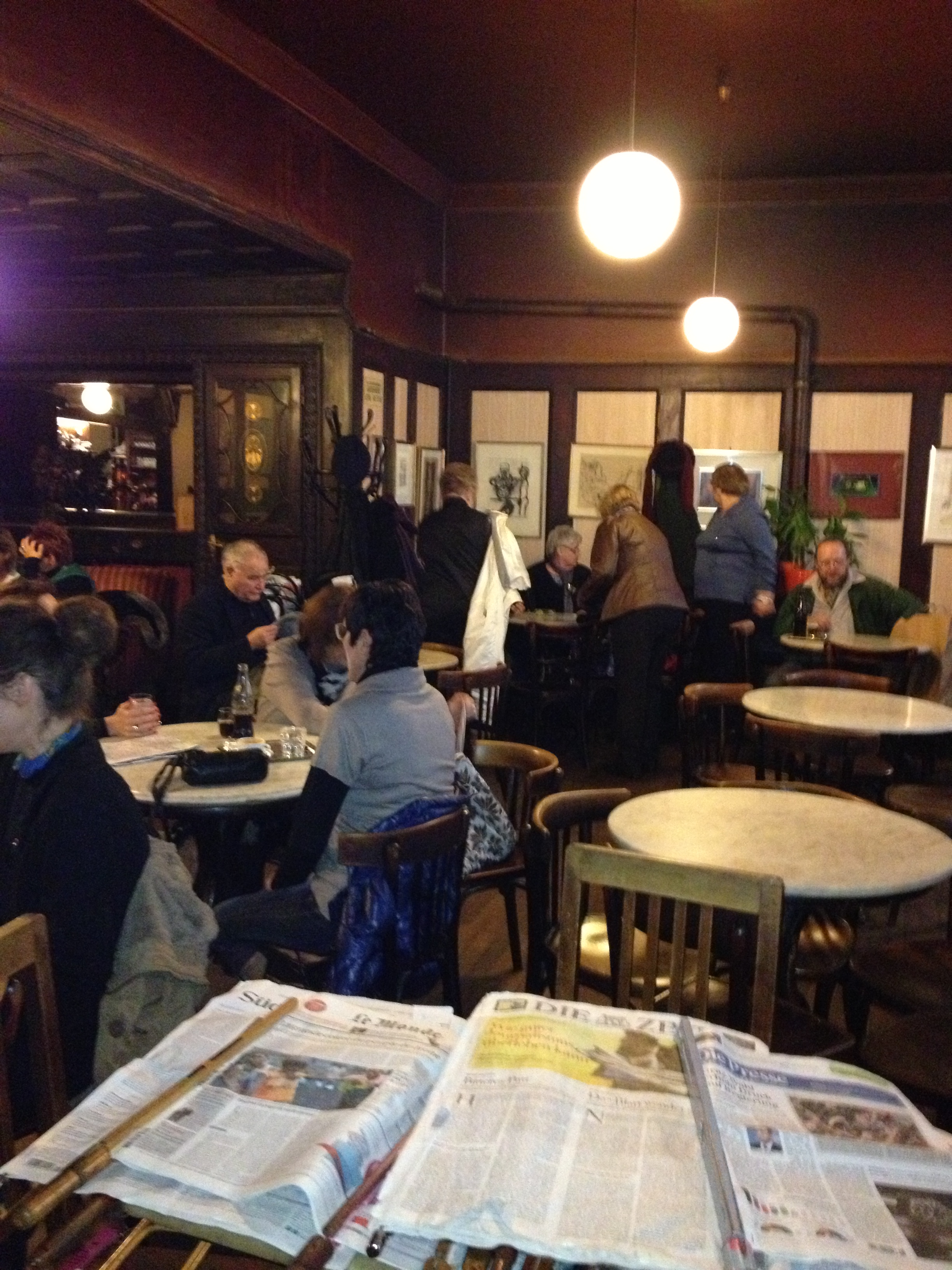
Cafe Hawelka is a dimly lit old-school coffeehouse in the heart of Vienna.  Now as in decades past, a cup of coffee entitles the buyer to sit all day with one of the many newspapers neatly arranged on racks. The cafe first opened in 1938, just before World War II broke out.  Its founder, Leopold Hawelska, had to close when he was drafted into Hitler’s army.  He survived the deadly fighting on the Russian front and returned to reopen the place in 1945.  Fortunately the building still stood.  In impoverished postwar Vienna, the cafe was one of the few places that had heat.  Poor people were welcome to come in for a free glass of water, to warm up.  Some sat there for hours.  Princely folk, like the Liechtensteins, also hung out there, hawking artwork and valuables they had managed to hide from the Nazis.

Later, the place became a sort of living room for artists and writers.  Some artists paid with paintings, which still hang on the smoke-stained walls. (I think the place is non-smoking now, as most Austrian restaurants are in recent years).

Mr. Hawelska and his wife Josefine were benevolent presences for decades, watching over generations of artists, writers, students, and tourists.  She baked the specialty, Buchteln: a yeast bun with plum filling.  It is still served there today. The preferred accompaniment is a melange, or what Starbucks has taught us to call a cappuccino.

PlumDumpling11-12

Josefine Hawelska died at age 91, in 2005.  Leopold Hawelska lived to 100, still frequently occupying his usual seat at the cafe almost to the end.  Their descendants continue the tradition.

Leopold Hawelska, photo by Lili Strauss, in article cited below

Leopold Hawelska, photo by Lili Strauss, in article cited below

In Vienna, as in other cities, Starbucks locations are filled at all hours.  I’m sure the free Wifi attracts customers.  Still, historic coffeehouses like Cafe Hawelka endure.  I hope to spend some quality time in them, trying to read German-language papers and soaking up the atmosphere of history.

An article from The Guardian, about the Hawelka family and cafe, appears at http://www.google.com/search?client=safari&rls=en&q=Leopold+Hawelka+the+guardian&ie=UTF-8&oe=UTF-8.

The Perfect Austrian Sweater

Embroidery

Wandering through the Folk Art Museum of Innsbruck, Austria last year, I admired pieces of embroidery, lace, weaving and other needle arts.  It occurred to me that I own a precious piece of folk art myself:  a handknit sweater I bought about 35 years ago. In a tiny shop in one of the ski towns, maybe Kitzbuhel, a lady in the traditional dirndl skirt, fitted bodice and puff-sleeved blouse patiently pulled every sweater in my size off the neat shelves behind her.  She spread a rainbow array of handknit sweaters across the worn wooden counter.  Things have changed since then, but in those days most shops, at least in small towns, served customers personally; there was no such thing as browsing through the racks. Fine handknits should never be hung on hangers anyway. I probably spent at least an hour in the shop, trying on and debating the merits of each sweater before me.  It appeared that each garment in the entire shop was one-of-a-kind.

In my wretchedly rudimentary German, I asked whether the sweaters spread before me were all really handknit.  The saleslady had trouble understanding me.  I mimicked hand-knitting motions.  Another customer helpfully translated for me. The saleslady looked incredulous–and maybe a little insulted–that I would ask such a question.  Yes, of course every sweater in the shop was knitted by hand.

BlueSweater

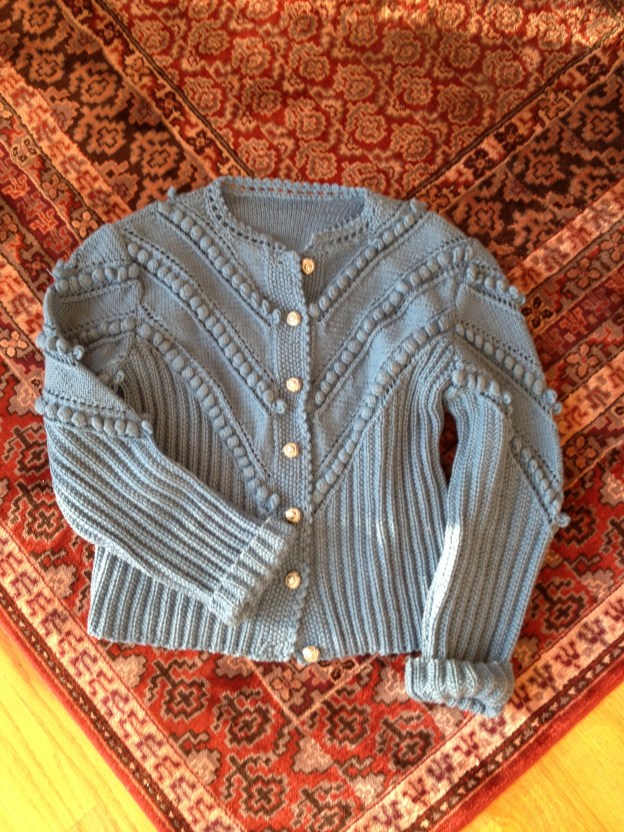
I chose a worsted wool sweater, in a color I thought of as bluejay blue, with popcorn stitches and silver buttons.  It was slim-fitting, with vertical ribbing around the midriff and down the sleeves.  It looked great with jeans. Over the years, it’s become one of my prized possessions; whenever I wear it, people ask where I found it. Some can’t resist touching the popcorn stitches, still springy after all these years.

Knitting was a cottage industry in those days, before women in large numbers began to join the workforce outside the home. In country towns in the mountains of Tirol and Bavaria, it was fairly common to see women knitting, crocheting, or embroidering while sitting on their front porches, watching over children in a park, or riding a tram.  Many women seemed to work without thinking or even looking at their work.  They made it look easy. Later, when I tried to learn to knit, I realized how difficult it is–and how time-consuming. A simple scarf, knit with huge needles and loose stitches, is my limit.

Now I wish I had bought more than one sweater that day.  My blue one still looks as new as the day I bought it.  It never sags or stretches.  It never gets pills on the sleeves. It never fades.  It is always warm, but not too warm. It still fits perfectly, and it still looks great with jeans. Handknit sweaters are prohibitively expensive now, if they can be found at all. Still, every time I’m lucky enough to be in Austria or Germany, I’m looking for another perfect sweater.  Of course, if I do find another one, I may not be able to afford it.

SweaterShop11-12

Still, I can always hope.  A year ago, on a side street just as I was leaving Vienna, I spied a tiny shop that looked promising. Who knows, maybe I’ll find just the thing there next week!

Winter as a Child, Again

It is just over a year since I started my blog.  I decided to revisit my very first post, written when I was getting ready to travel to Vienna for the Christmas markets, the concerts and the museums–and of course the apple strudel.  Now I’m lucky enough to be leaving again for Vienna, one of my very favorite places.  Here’s to discovering new places and revisiting old ones!  A year ago, I wrote:

Travel is not just about being there.  Travel is about memory and anticipation.  As I pack my one small suitcase for Vienna in November, I am full of memories of past trips and high hopes for this one.

Lady Caroline Scott as Winter; image from Commons Wikimedia

Last year, the Vienna Kunsthistorisches Museum had a special exhibit:  “Winter Tales.”  Paintings, sculpture and artifacts from all over the world were gathered in a glorious celebration of winter.  My very favorite piece was this portrait of a child with a fur-and-velvet muff and a scruffy little dog impatient for her to play:  “Lady Caroline Scott as Winter,” by Sir Joshua Reynolds.  Winter is so often personified as Death, or as a creaky old man.  Here, though, winter is a child full of hope and wonder.  She gazes out at us from the barren winter grounds of her British home, her face as fresh as the day she was painted in 1776 at the age of two or three.

This is not a glamorous society portrait.  It is only about 57 x 45 inches (just the right size to place over my fireplace, if I could afford such a thing!)  I can imagine the artist Sir Joshua Reynolds, age 51 at the time, encountering Lady Caroline in the bare winter grounds of her home.  Anyone would be captivated by her rosy-cheeked face and direct gaze.  I can see Sir Joshua dashing off a sketch and finishing the portrait back in his studio.  It would have made a nice break from painting his more demanding adult subjects, who proudly posed with the emblems of their wealth and power:  swords, globes, weighty books, jewels and fine silks.

The British Peerage tells us that Lady Caroline was the daughter of the 3rd Duke of Buccleuch. She married the 6th Marquess of Queensberry (slightly lower in rank than a Duke, but who’s keeping score?) She had 6 surviving children and lived to the age of 80.  So she was an exact contemporary of Jane Austen, although Jane died at age 41.  I’d like to think Lady Caroline read Jane’s books.

Lady Caroline was a privileged child.  As she grew up, no doubt she learned that many children were cold and dirty and hungry.  Her rank would come with some responsibilities to take care of the less fortunate.  She lived through the American Revolution, the Terror in France, and the Napoleonic Wars.  And we all know that even for the most privileged, life holds heartbreak and disappointment.  But on this wintry day, all that is in the future.  In this perfect moment, Lady Carolin stands on her sturdy little legs, happy to be walking about in the wide world.

Vienna is an enchanting city in any season, but my favorite time there is winter.  The Christmas season begins in late November, an ideal time for crowd-free travel.  I do not have a fur muff or a scruffy little dog, but I am setting off for Vienna with all the anticipation of a child at Christmas.

Veterans’ Day

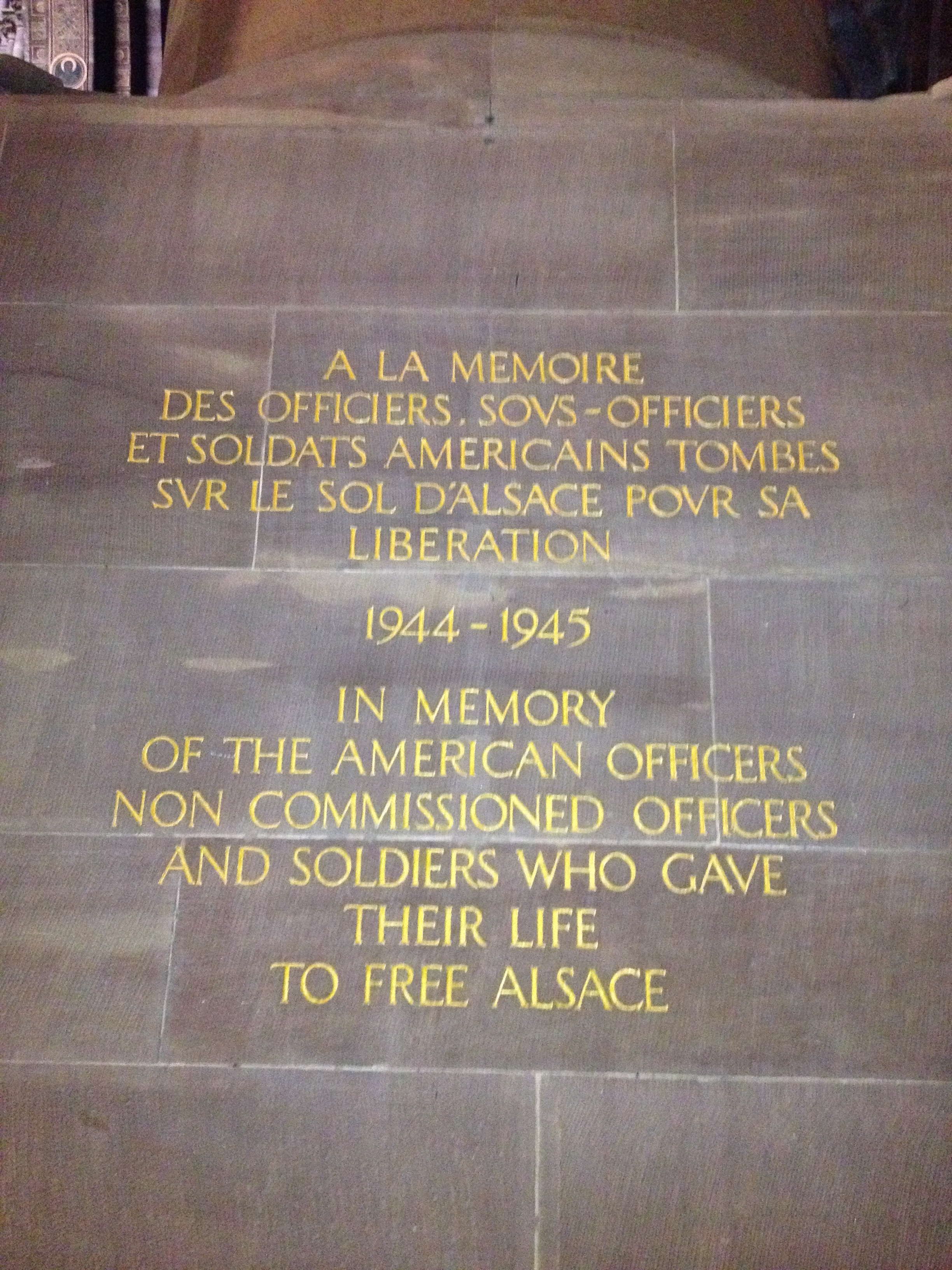
When I visited Strasbourg Cathedral a couple of months ago, I was touched to see a memorial to American soldiers who had helped to liberate Alsace and its capital, Strasbourg, from Nazi control.

AmerMemorial

Strasbourg is just across the Rhine from Germany, and had been in dispute between the Germans and the French ever since the Franco-Prussian War of 1870-71.  I know next to nothing about that war, but I do know that Strasbourg had great symbolic importance for the Free French, led by Charles de Gaulle from exile in England.  He insisted that only French soldiers should liberate Strasbourg, and so it was.  Strasbourg and its Cathedral had enough symbolic importance that Hitler himself had visited in 1940.  Hitler declared that he intended the Cathedral to be a place of sanctuary for the German people, or possibly a memorial to the Unknown Soldier. But in the closing days of the war, while the Allies moved across France from Normandy toward Germany, French forces were assigned to recapture Strasbourg and above all to liberate the beloved Cathedral.  Liberation took place on November 22, 1944.

The day we celebrate as Veterans’ Day is known as Remembrance Day or Armistice Day in many countries.  It actually marks the end of World War I, which everyone hoped would be “the war to end all wars.”  Sadly, it was not.  But the guns of World War I fell silent at the 11th hour of the 11th day of the 11th month of 1918. The next year, the day was designated to honor veterans of all wars.

BulletsStrasCath

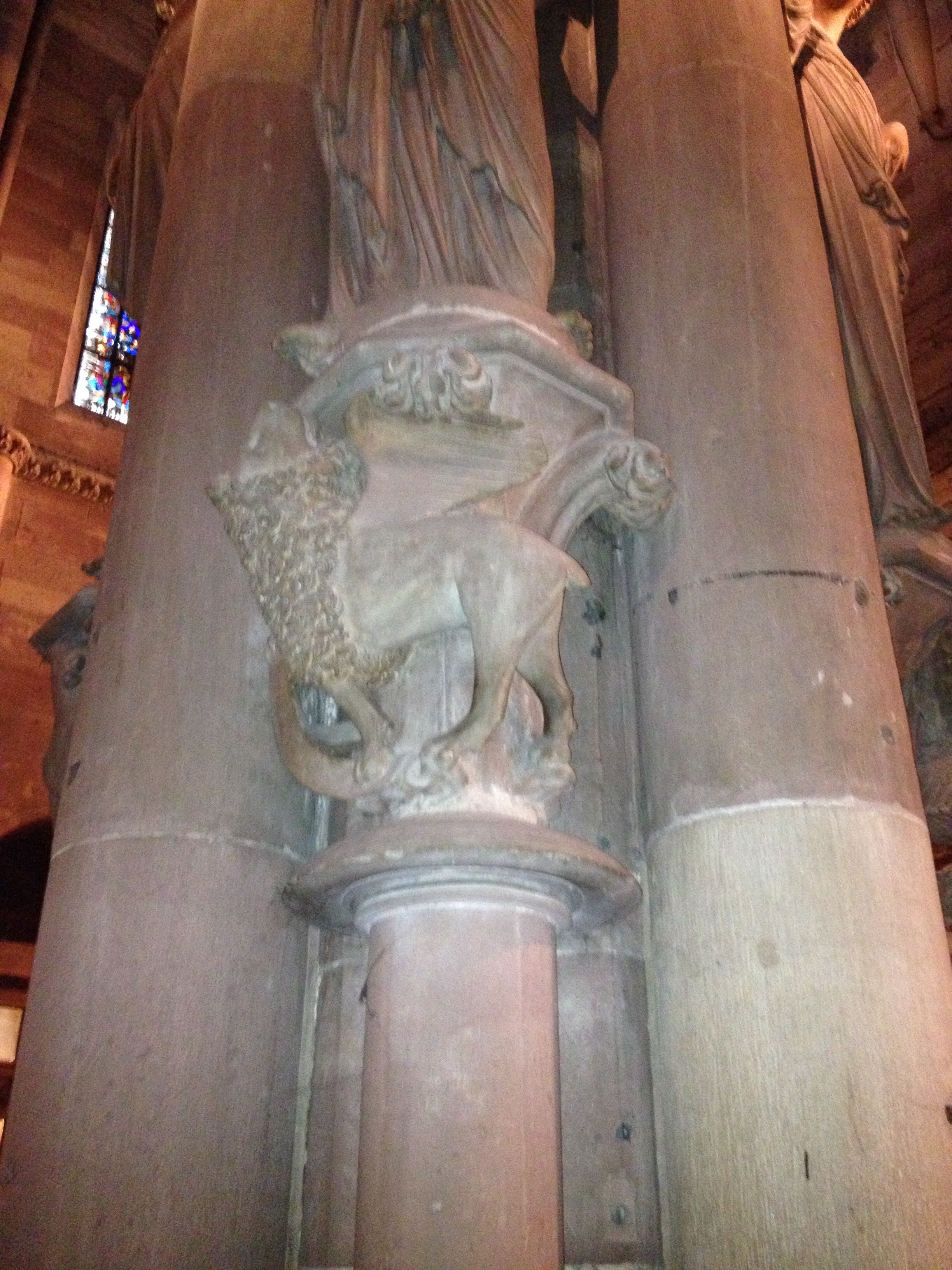
In the Cathedral, columns are still pocked with bullet holes.  Was there actually a battle inside?  I don’t know.  The fighting was certainly fierce.  But possibly the damage was more from the bombs that hit the Cathedral in August of 1944.

Yesterday in church, veterans were asked to stand and be recognized.  In our congregation, there were about a dozen veterans, all white-haired.  Then members were asked to call out the names of veterans they wanted to remember.  Names were spoken from all corners of the church.  Some of the voices were young and strong.  Some were old and quavering.  The people named could have filled the place by themselves. All those named had served their country with honor.

We might not all agree on the wisdom of sending American troops to the many places across the globe where they have been deployed.  But we can agree that we all owe a debt of gratitude to those who are willing to serve their country. I think we can spare some sympathy for the men and women of other countries who have been drawn into war, too. Service people are committed to dangers other than war, too. As I write, I’m sure that American service people are among those rushing to provide aid after the catastrophic typhoon that just hit the Phillippines.

Join me next time for more explorations into the art and history of Europe.

Picasso’s Soft Spot?

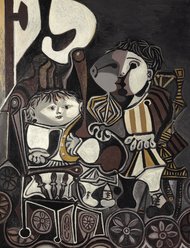
In the rarefied world of Christie auctions, price is always what makes news.  At a recent auction, sales were disappointing except for the price fetched for a Picasso painting from 1950, “Claude and Paloma.”  It sold for $28.1 million, much more than predicted.  I can see why.  I’d have bought it myself. To paraphrase Ferris Bueller’s thoughts about buying a Ferrari, “If you have the means, I recommend it.”

Photo from NYT article cited below

Photo from NYT article cited below

The painting depicts Pablo Picasso’s two youngest children.  What strikes me is the depiction of the baby, Claude.  In the midst of all kinds of sophisticated design elements, in a sort of cubist composition, the baby’s face stands out as almost a traditional portrait.  Could it be that the great man just melted when looking at the little child’s face?  This portrait seems a pure depiction of childhood innocence.  Maybe the artist was looking back at his own lost innocence,   when he first discovered his own talent and had no idea where it would lead him.  In 1950, Picasso had just lived through the horrors of the Second World War, which he spent in occupied Paris.  The Nazis did not allow him to exhibit, considering him degenerate.  The end of the war was a new beginning of artistic freedom.  A baby is always a new beginning, too.

The article about the Christie auction, by Carol Vogel, is at http://www.nytimes.com/2013/11/05/arts/despite-picassos-bidding-is-sluggish-at-christies.html?_r=0


Kids and Their Costumes

ChildMilitia

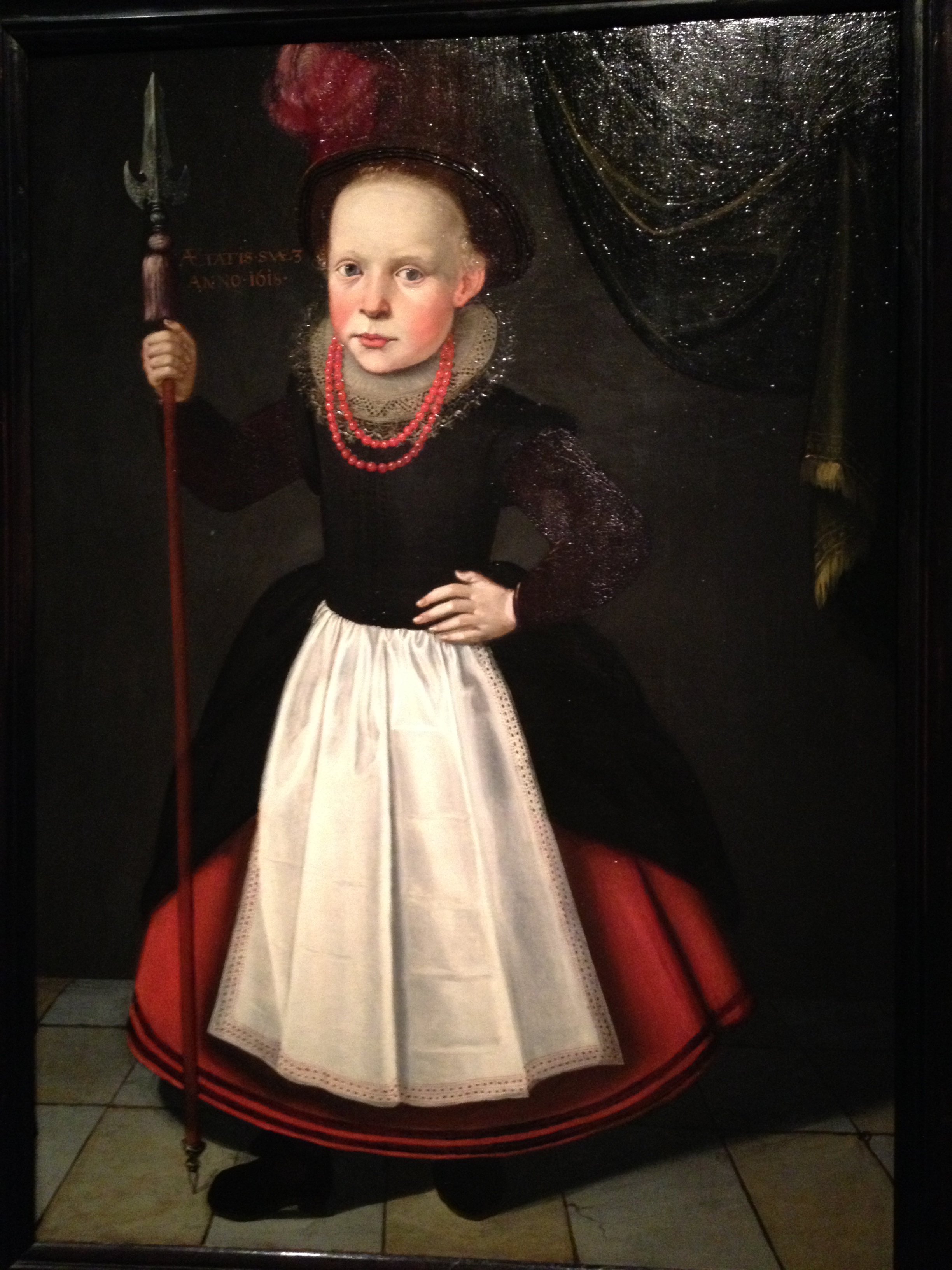
Last month in the Amsterdam History Museum, I admired this touching portrait of a solemn little boy dressed up as a militia officer, complete with a pike in his hand.  This child was no doubt a member of a wealthy family in the Netherlands of the 1600s.  The city militia of the time was not so much a military or police organization as an exclusive club for the elite.  This child’s family hoped he would grow up to be a civic leader.  At that time, children were generally portrayed as miniature adults. Still, parents must have had the same feelings present-day parents have.

images

This portrait reminded me of the costumes present-day children wear, for Halloween and for everyday play. The firefighter’s costume above is for sale at http://www.rakuten.com/prod/kids-baby-halloween-costume-firefighter-fireman/211550071.html?sellerid=23844739. I saw kids trick-or-treating in similar costumes last week.

We all want our children to grow up to be useful members of society.  I’m sure that parents in the 1600s, like present-day parents, watched each stage of their childrens’ development with a mixture of pride and apprehension.  Then as now, parents must have wished they could prolong childhood for their little ones.

Join me next time for more explorations in the art and history of Europe!
My Own Woman in Blue

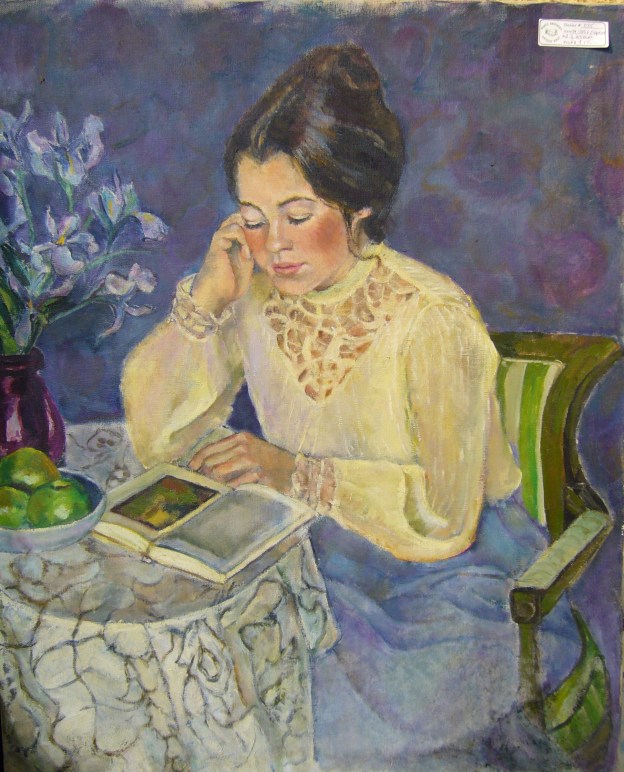
LadyCroppedMy last post was about Vermeer’s exquisite “Woman in Blue Reading a Letter,” which I saw last month in Amsterdam’s Rijksmuseum. I bought a much more humble painting for my own wall, in an antique shop in Santa Monica.  Like many old forgotten oil paintings, this one leaned against a wall with others stacked against it; in fact, there was a dent in the canvas, which smoothed out once I rescued it and brought it home.  There was some water damage along the bottom edge.  Still, the colors were brilliant. It’s one of my very favorite pieces. It’s about 2 by 3 feet, much larger than Vermeer’s. I don’t know who the artist was. But the subject speaks to me:  a woman seated in a lovely, peaceful room, absorbed in her book.

For many centuries, all over the world, women were discouraged from reading.  In places in our contemporary world, reading is still discouraged or even forbidden to women.  A woman reading is a woman not cooking, cleaning, weaving or tending a garden.  Worse yet, a woman reading might get uppity ideas about her place in the world.  Who knows what might come of a woman quietly reading, all by herself?

A British writer, Belinda Jack, has written a book titled The Woman Reader. In it, she explores the history of women reading, in much the same way Virginia Woolf explored the history of women writing in her book A Room of One’s Own.  In many ways, a woman reading a book is creating her own private room, her own space within whatever world she lives in. This interior space, created anew with each new book opened, is really a window onto the wider world outside. We can experience absolutely any time or place, real or imagined, when we pick up a book. We can learn new skills and new ways of looking at life.  We can learn from those who have gone before us.

I was fortunate in having parents who especially encouraged me to read, took me to the library, and gave me the quiet time to develop a lifelong love of books. I wish that good fortune for all children, especially girls.

Book cover from Amazon

Book cover from Amazon

A review of Belinda Jack’s book, by Hermione Lee, is at http://www.theguardian.com/books/2012/jul/05/woman-reader-belinda-jack-review.

Woman in Blue


Vermeer's "Woman in Blue Reading a Letter," Rijksmuseum website

Vermeer’s “Woman in Blue Reading a Letter,” Rijksmuseum website

One of the masterpieces in Amsterdam’s Rijksmuseum is Johannes Vermeer’s “Woman in Blue Reading a Letter.”  In the newly-renovated museum, there are now four exquisite Vermeers all in a row.  In his entire life the master Vermeer only produced only a total of about 34 paintings.  He never became rich or particularly famous.  He ran an inn and acted as an art dealer to make money, not to mention having 15 children, of whom 11 lived beyond infancy. The wonder is that he had any time or energy at all to paint.  He lived in the small town of Delft for his entire 43 years, from 1632 to 1675.  A local patron bought most of his paintings, so his name never spread much beyond Delft until long after his death.

Today, crowds gather in front of Vermeer’s small, jewel-like paintings.  They reward close study. In this painting and in others, Vermeer splurged on expensive blue pigments, lapis lazuli or natural ultramarine. This particular painting was just recently restored, unlocking the glorious blue and the luminous light.   Almost all of of Vermeer’s paintings were small domestic scenes, recording humble lives in humble homes. Through the centuries, the beauty of everyday life shines through in them.

Join me next time for more explorations in the art and history of Europe!