More Dogs in Dutch Art

DogLookUpWhat do we really value about our dogs? Blind adoration is the most important thing, if we dog lovers are honest.  Sure, we’d like to see obedience, intelligence, cute tricks, and barking only when fire breaks out or someone is actually breaking into the house.  But that look of pure unconditional love trumps everything else. I imagine that even rich merchants in the Dutch Golden Age had their moments of doubt and insecurity, moments when they needed that adoring upward gaze.

As I wandered the art galleries of Amsterdam, I snapped photos of dogs. They were everywhere, in the Rijksmuseum and in the Amsterdam Museum (which is really the history museum, but the word “history” was recently removed, apparently because it was thought to scare some people away).

iPhone9-23-13 394

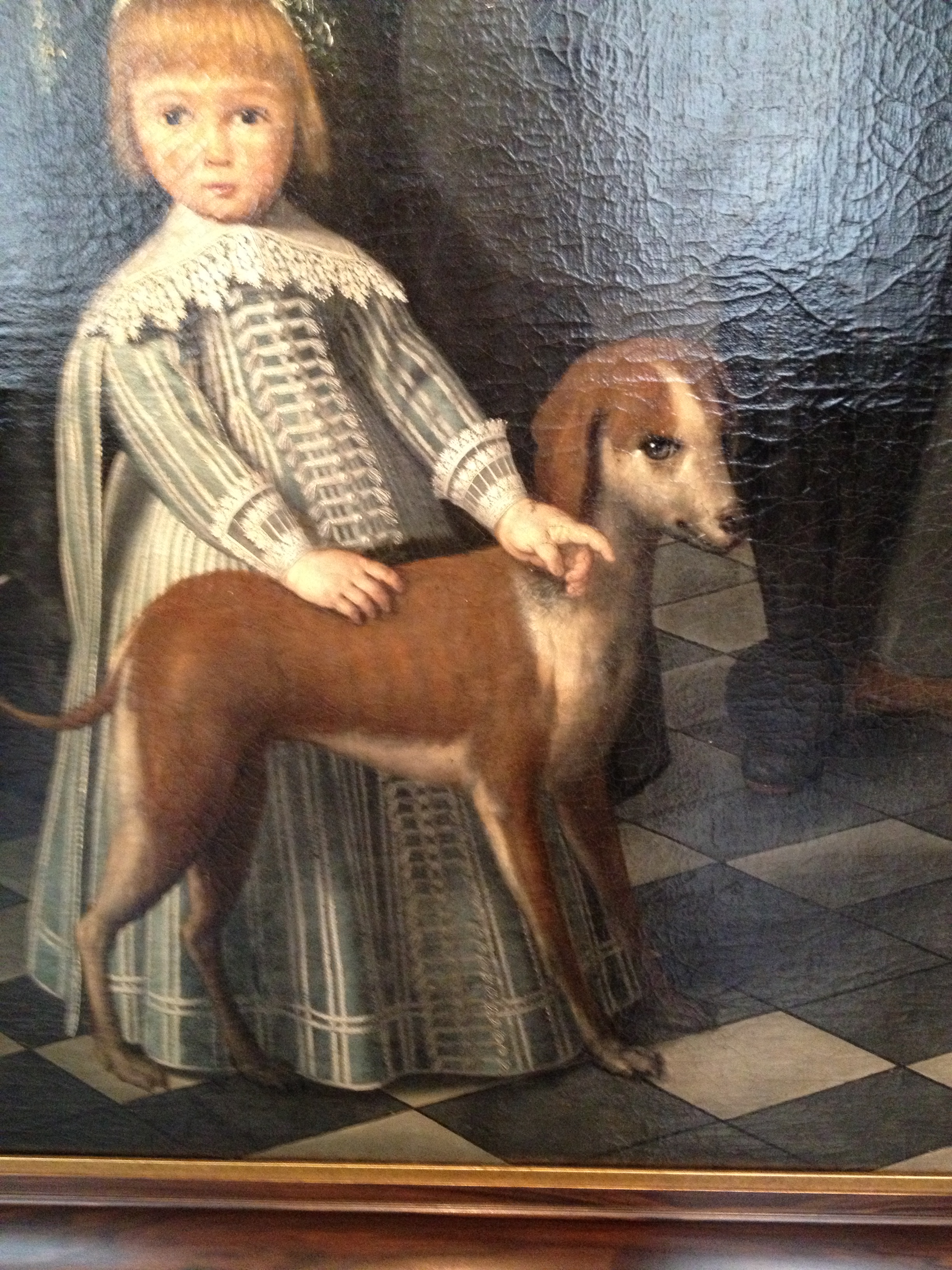
Somehow, the dogs featured in paintings serve to make the people depicted seem more real, more like us.
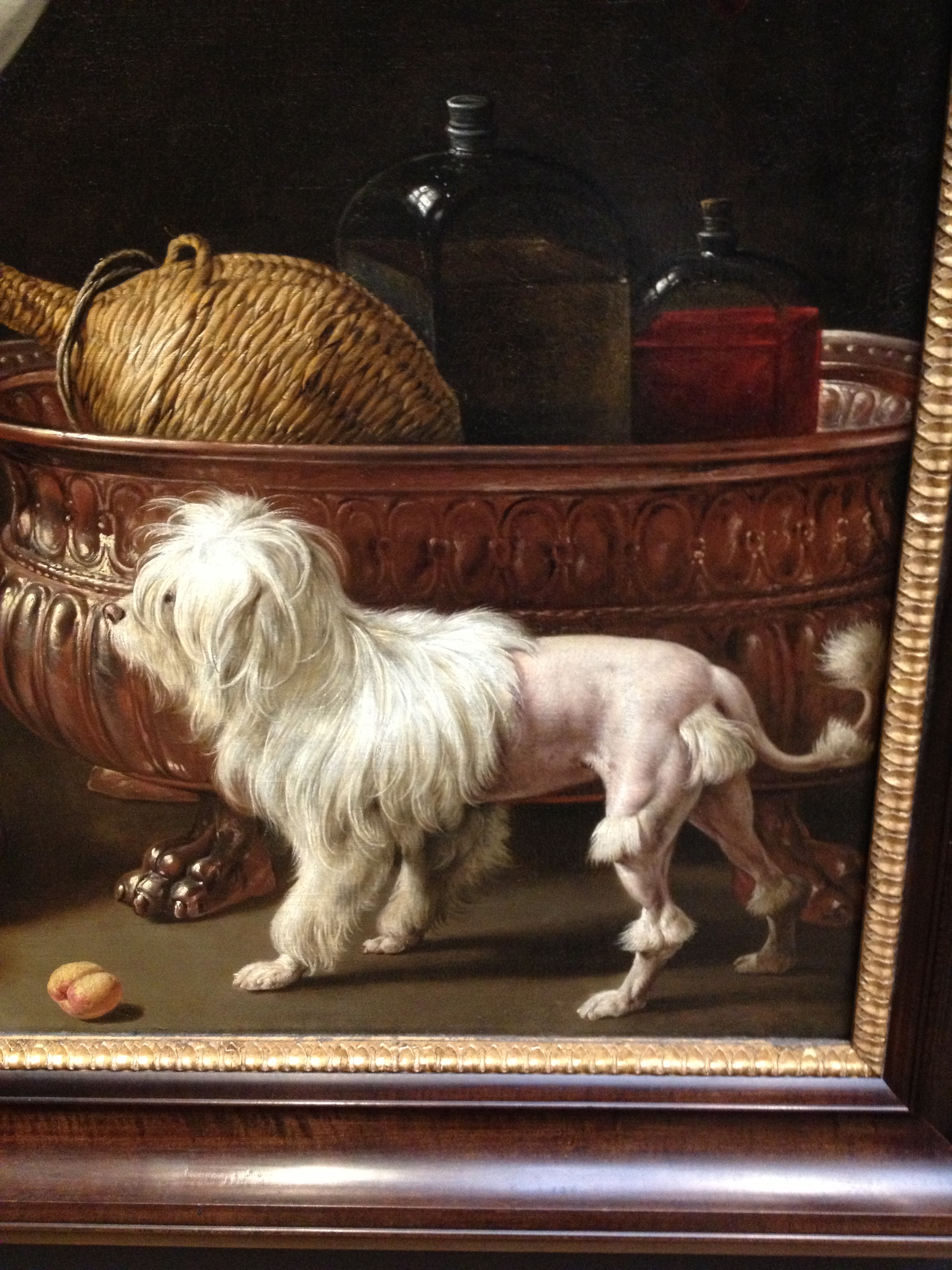
iPhone9-23-13 363Each animal is an individual character, as lovingly painted as any man, woman or child.

iPhone9-23-13 239


Each long-ago dog had a name, a favorite place to sleep, a way of looking happy or sad.

iPhone9-23-13 238

We might have trouble imagining the lives of humans from past centuries, but we have no trouble recognizing these dogs. And that adoring upward look still speaks to us, centuries after dog and master are gone. For me, the loving relationship between people and their pets is a kind of window into the past.

iPhone9-23-13 237

Join me next time for more explorations in the art and history of Europe!
Dogs in Dutch Art

iPhone9-23-13 240

Dogs are everywhere in Dutch museums.  As I wandered through the art galleries of Amsterdam, I wondered why dogs appear in so many paintings, especially those dating from the Golden Age.  All though the 1600s, the Dutch Republic was pretty much on top of the world.  Merchants and seamen traded all over the world, bringing in boatloads of money.  A wealthy middle class rose up. There was still a market for religious and historical art, but above all this new wealthy class  wanted portraits and depictions of their everyday lives of luxury.  Rembrandt, Vermeer, Frans Hals and many other artists were happy to oblige. My guess is that man’s best friend was just part of the good life.

I came across a wonderful poem by David Graham:

The Dogs in Dutch Paintings

How shall I not love them, snoozing

right through the Annunciation?  They inhabit

the outskirts of every importance, sprawl

dead center in each oblivious household.

They’re digging at fleas or snapping at scraps,

dozing with noble abandon while a boy

bells their tails.  Often they present their rumps

in the foreground of some martyrdom.

What Christ could lean so unconcernedly

against a table leg, the feast above continuing?

Could the Virgin in her joy match this grace

as a hound sagely ponders an upturned turtle?

No scholar at his huge book will capture

my eye so well as the skinny haunches,

the frazzled tails and serene optimism

of the least of these mutts, curled

in the corners of the world’s dazzlement.

The poet’s website is at davidgraham.lifeyo.com.

I’m counting my discovery of this poet as one of the world’s dazzlements!

Like Father, Like Son? Not So Much.

BickerKid

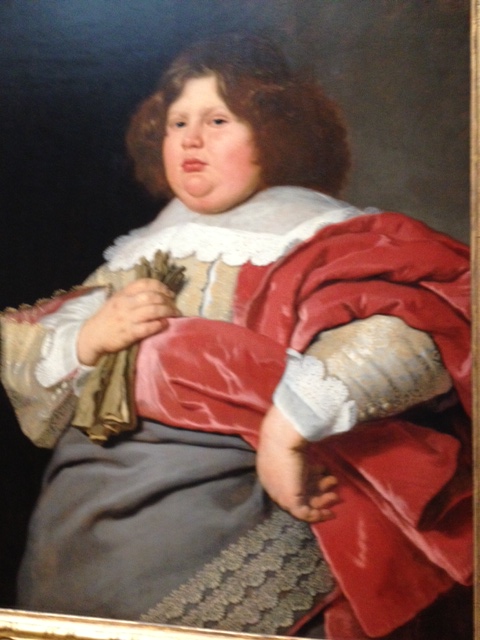
In Amsterdam’s Rijksmuseum, I noticed a lot of people pausing in front of a particular portrait, depicting a fat young man named Gerard Andriesz Bicker in 1639.  Dressed in fine silks, velvet and lace, he looks particularly satisfied with himself.  If Gerard had posted this portrait on match.com, I suppose he would have expected a lot of takers.  People in the museum pause, read the caption, and then move to the adjoining portrait, of young Gerard’s father.

BickerDad

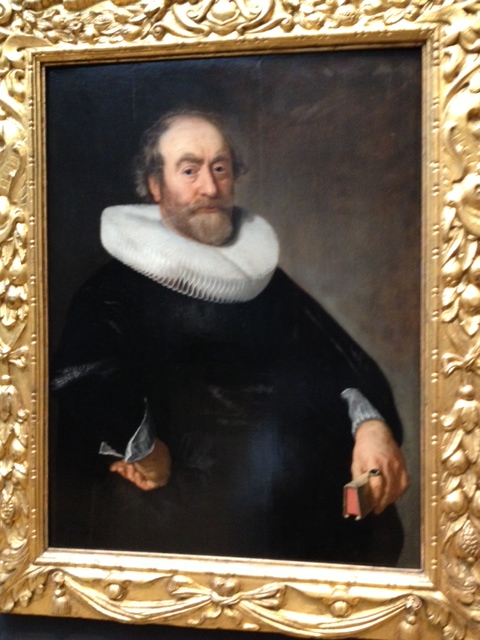
The father, Andries, was the mayor of Amsterdam at the time.  He appears as a stern, hardworking burgher, dressed in severe black.  He wears the stiffly starched and pleated collar so popular among the elite at the time.  These collars took about 18 yards of fabric to make and had to be painstakingly hand-pleated.  They held a person’s head high and made it impossible to lean back and relax.  One can only imagine what opinion Andries had of his spoiled-looking son.  The son’s caption notes dryly that young Gerard did not attain offices as high as those of his father.  No kidding.

Both portraits were painted by Bartholomeus van der Heist, 1613-1670.  He was Rembrandt’s chief rival in the contest to get the most lucrative portrait painting jobs among Amsterdam’s rich and famous. Apparently young Gerard was pleased with his portrait.  His father must have been pleased enough with both portraits, too.  After all, he paid for them.

Join me next time as I explore the art and history of Europe!

To Dance in France

Arriving in Strasbourg, France on a Sunday evening, I came upon a group of people gathered to dance in the moonlight in the plaza between the cathedral and the palace of the bishops.  It looked like a weekly gathering of friends, mostly young but some old. The setting could not have been more elegant.

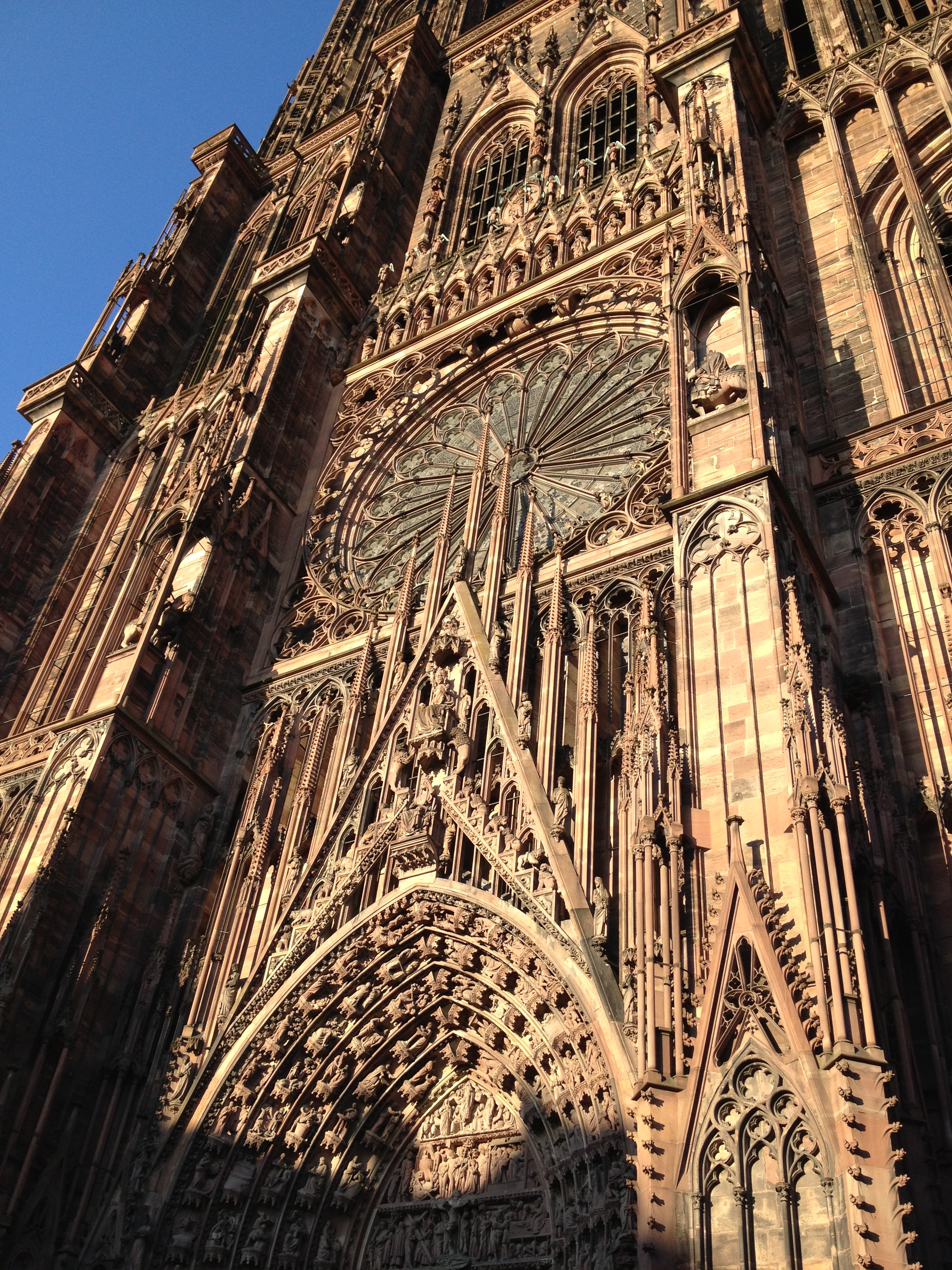
The magnificent Gothic cathedral took about 400 years to build.  It was completed in 1439. During the French Revolution, it became a Temple of Reason.  HItler visited in 1940, after his armies steamrollered across the French border. He wanted the landmark cathedral to become a “refuge for the German peoples.” The city of Strasbourg was only returned to France after Germany’s defeat.

StrasCathedral2

The Baroque Palais Rohan was built between 1731-1742.  It was once occupied by Hapsburg bishops under the Holy Roman Empire.  At one time Napoleon Bonaparte took over and remodeled parts of it to his own taste.  Actually, it is hard to find a corner in Europe where Napoleon did not make some kind of mark.

Dancers

Through centuries of political changes, the local people have carried on their own cherished traditions no matter who ruled them.  Dancing is one such tradition.  Before each dance that I watched, a pair of young women conferred with a flutist and a violinist.  Then they all began a tune, blending in sweet harmony.  Couples stepped, promenaded and twirled around the musicians.  The dances were graceful, but fairly simple and repetitive.  I imagine they’ve been performed at weddings and village festivals for generations.

Maybe because dancing was so important Strasbourg, it once got out of hand.  In 1518, there was a Dancing Plague.  Several hundred people were victims of a kind of mass hysteria which caused them to dance nonstop for weeks.  Most if not all of them finally died of heart attacks or exhaustion.

The dancers I watched on a clear fall evening looked happy and healthy.  Long may they dance!

You Know You’re in France When…

DSCN8668Driving across the Rhine River from Germany into France, I noticed an immediate change:  the cornfields have wide strips of flowers planted between the road and the neat line where the orderly rows of cornstalks begin.  Germany has its own beauty, but to me, these flower beds are quintessentially French. Of course French farmers would consider it worthwhile to give up twenty or thirty feet of perfectly good corn-growing soil in order to have purple, pink and white flowers swaying in the breeze.

Strasbourg is in Alsace, the most German area of France.  Of course this lovely and productive land has been hotly contested over the centuries, between France and Germany.  The outcome of the Second World War decided the issue once and for all.

Most of the rest of this trip will be in southern Germany, with forays into Austria and maybe Switzerland.  But I’m glad to have had a couple of days just across the border in la belle France, land of impractical beauty for its own sake.

Rembrandt’s House in Amsterdam

Rembrandt van Rijn’s house in Amsterdam is on the tourist circuit, and well worth a stop. The building is the original one where the artist lived and work, but the interior has been reconstructed to accommodate visitors. An adjoining building has further displays.

The nearby Rijksmuseum has some of Rembrandt’s greatest hits in paintings, but the house has a treasure trove of his etchings.  During high season, I understand the etching process is demonstrated. The artist spent a good deal of time and effort becoming a fantastically skilled master of etching–an art form a little harder to appreciate than the big colorful paintings such as the one we know as “The Night Watch.”  Like other Rembrandt canvases, that famous work draws big crowds over at the newly-refurbished Rijksmuseum.

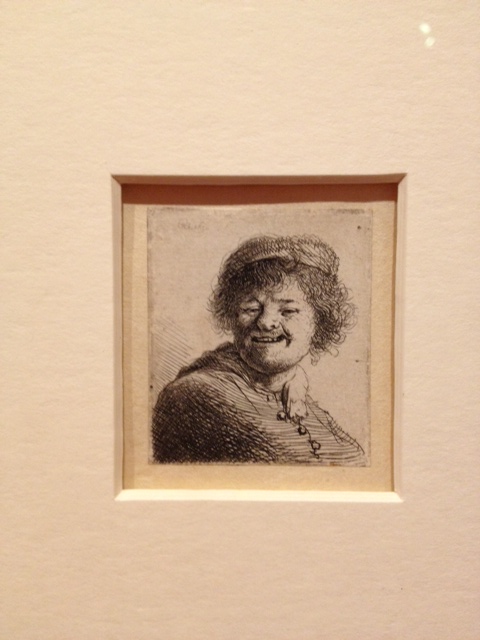
In his many drawings and etchings, Rembrandt developed his skill with characterization and especially with light and shadow.  He used himself as a subject over and over, often to study emotion and facial expression.

RembrandtLaugh

In this example, he shows himself laughing.

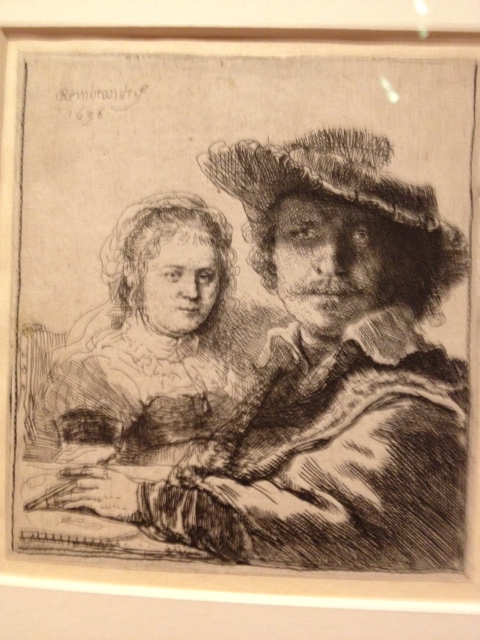
RembrandtSaskia

He used his wife Saskia as a frequent model, too.  Here she is shown with the artist himself in a double portrait.

RembrandtPaint

The house recreates the studio where Rembrandt worked.  It has wonderful large windows with northern light.  Here he mixed his paints and produced his masterpieces.  For his portrait work, Biblical subjects, and historical paintings, he needed a lot of props.  He had rooms full of interesting objects gathered from all over the world.

RembrandtStuff

Sadly, the artist fell upon hard financial times for reasons I don’t really understand.  He continued to draw, paint, and teach many students to the end of his life, but the big lucrative commissions dried up. Finally he went bankrupt and had to move to a smaller rented house. He was forced to sell the house for which he had paid a fortune in his heyday.  To recreate the place, curators had only to refer to the detailed list of every single one of Rembrandt’s possessions. I’m sure they would be able to place most of these objects in Rembrandt’s many paintings.  More casual visitors to the house can get a vivid idea of a great artist’s working methods, and a new appreciation for the art of etching.

Join me next time as I continue on a journey with new discoveries in the art and history of Europe!


Oscar in Amsterdam


Oscar

At the Anne Frank House, I came upon an unexpected sight: an actual Oscar statuette in a glass case near the exit. I never expected to get within inches of one. The story is that the American actress Shelley Winters fulfilled a promise when she brought it to Amsterdam. She met Otto Frank on the set of the movie The Diary of Anne Frank. Miss Winters was playing the part of one of the hidden people, Mrs. Van Pels, in the movie. She told Mr. Frank that if she won an Oscar, she would bring it to the Anne Frank House and leave it there. He gently answered that would be a difficult thing for her to do. She replied that she would keep it for a little while, then bring it to Amsterdam. That is exactly what she did.

Shelley


Artists, including actors, movie-makers and writers, do not just entertain us. They show us images and tell us stories that help us to make sense of the chaotic world around us. That is what young Anne Frank did as she developed, all alone, as a writer. The tour of her house ends with a short video that brings many visitors to tears. Anne’s father, Otto, explains that although he had a very good relationship with his daughter, he did not know the depth of her feelings or the extent of her understanding of human nature until he read her diary after her death. He ends by saying that he thinks parents never truly know their children. Sadly, his opportunity to know his beloved daughter better was cut short. But her honest account of her deepest feelings continues to enrich us all.


Dress


At another museum I visited, I came across a dress that the young Anne could have worn: a dress with the hated yellow star required of all Jews under Nazi occupation. I found the experience of staying so close to Anne’s hiding place profoundly moving. I hope I never forget.


Picasso’s Lady in a Fish Hat

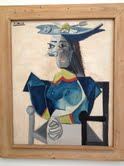
Fish Hat

At the very end of two days of looking at great art in Amsterdam, I came across a Pablo Picasso painting that made me laugh: “Seated Woman Wearing a Hat in the Shape of a Fish.”  The painting is in Amsterdam’s modern art museum, the Stedelijk. The date is 1942, midway through the Second World War.  I had to look up the artist’s whereabouts during this time.  As it happened, he stayed in Paris during the entire Nazi occupation.  Naturally, the Gestapo regarded him as subversive–and he certainly was, though not in any way the Nazis could understand. He did not bother to exhibit his work at this time, but he never stopped creating.

According to one account, one day Gestapo officers were in his studio harassing him, as they often did.  They spotted his great antiwar painting, “Guernica,”  which depicts the terrible suffering inflicted by German bombers on a town full of innocent victims during the Spanish Civil War.  A Gestapo officer pointed at the painting, which was not yet acknowledged as one of the most powerful antiwar images ever made, and asked Picasso, “Did you do this?”  “No,” Picasso reportedly replied. “You did.”

So what about this woman with a fish on her head? Could it be a spoof on military headgear?  Or a joke about pompous officials in general? Was Picasso poking fun at some acquaintance?  Was he making fun of women’s frivolous fashions during wartime?  I don’t know. Maybe the painting  means nothing at all–maybe that is the point. Maybe it is just meant to provoke a smile. In even the darkest times, we need artists who are able to show us that there is more to life than the grim reality that sometimes surrounds us.

Anne Frank in Amsterdam

Anne

How to get the most from an Amsterdam Museum Pass:  see everything!  The pass covers all the major sights, and Amsterdam is a great city for walking.  So we spent the entire day on our feet.  Today will be more of the same.  It’s especially nice to be able to pop in and out of the more exhausting sights, like the newly-restored Rijksmuseum and the Van Gogh Museum.

We are staying just down the canal from the Anne Frank House, so we pass the ever-present long lines several times a day.  Last night, returning home at about 8:30 pm, we did a double take:  no line, and the house is open until 9:00 pm!  We flashed our Museum Passes and we were in.

Since we last visited, some years ago, a modern annex to the Annex has been added to accommodate the crowds.  The claustrophobic hidden rooms, reached by ladder-like stairs, are untouched since the end of World War II.  But now there is space for thought-provoking multimedia displays.

The center of the exhibit, as always, is the little red-checked diary under glass.  Now there is also space to display some of the many loose pages Anne wrote once she had filled up the little book.  She wrote short stories, ideas for novels, and copied out favorite passages from other writers.  Toward the end of the war, Dutch authorities advised residents to keep diaries in order to preserve memories of that terrible time.  Anne took the advice very seriously.  She began copying and revising what she had written, planning to publish a novel called “The Secret Annex.”  What was actually published after her death was the pure unvarnished truth:  the experience of an ordinary but talented young girl forced to grow toward adulthood in extraordinary circumstances.

I had forgotten that the Annex was in the shadow of the Westerkerk, the magnificent church whose carillon bells played every day all through the war.  Anne heard them daily for over two years.  They reminded her that a whole world still existed outside her cramped hidden home. During the war, that world was unimaginably treacherous. The four helpers who made it possible for the eight people in hiding had to venture into that world every day for supplies, each transaction putting their own lives at risk.

I always think the exit door of a memorial exhibit like the Anne Frank House should have a mirror.  We each need to ask ourselves, what would we have done?