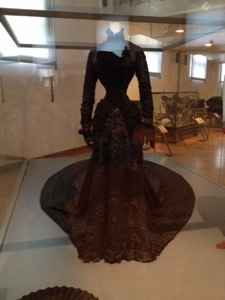
I’ve heard the term “wasp waist,” but never really understood it until I came upon an unaltered dress that once belonged to the Empress Elisabeth, known as “Sisi” in Austria. She was a celebrated beauty, married at 16 to her cousin the Emperor Franz Joseph. She pretty much invented anorexia in her age, dieting obsessively and exercising for hours every day. Even after dutifully giving birth to four children, including the required male heir, her waist measured 20 inches for her entire life. Amazingly, her waist was actually had a larger diameter front to back than side to side. I can only guess how it must have felt to be corseted into this dress.
A Pretty Good Crown
This is the crown of the Holy Roman Empire, which historians agree was not really holy or Roman, plus the “empire” part at the time was mostly wishful thinking. But it’s pretty impressive all the same. It was made in about the year 960. The cross denotes the holy part, the arch from front to back recalls the helmets worn by those great soldiers the Romans, and the panels all around denote parts of the empire.
The crown was apparently good enough for Charlemagne, who had himself painted in it in about 1460.
Vienna in December
The streets of the old city center are enchanting, especially at this season. The tall column, liberally coated in gold, was built in the late 1600s in gratitude for the ending of a bad episode of plague, before everyone in the entire city died. It’s a riot of triumphant angels, with the Emperor Leopold front and center. The plague is long forgotten but the column takes its place in the exuberant life of Vienna.
Sisi in Vienna
Miles of Memories
The title is from today’s post in one of my favorite blogs, allthingsfulfilling.com. Sue Batton Leonard is the writer. She really does write about anything and everything that brings joy and fulfillment: art, film, books, nature, travel, and above all people. She seeks out interesting folks and tells their stories. Right now, she’s about to publish a story of her own, a memoir about her family and her happy but challenged childhood in Baltimore. I’ve read the manuscript and it is a lovely story about how hardships like life-threatening health problems sometimes bring the most amazing surprises and blessings into the life of a family.
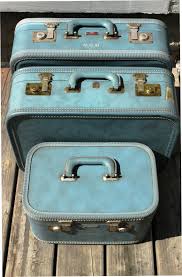
Today’s post begins with a photo of her family’s luggage in the 1950s, all ready for a road trip. The post describes her family’s history of taking off together on long road trips along the East Coast from their home in Baltimore. Sue’s parents believed in the value of travel. In the days before everyone had a smartphone or personal game device, road trips were especially long. When children started fighting in the back seat of the station wagon, Sue’s mother decreed that it was time to sing, and sing they did.
Like Sue, I wish everyone happy and safe travels on this Thanksgiving holiday!
Visit Sue’s always-interesting and inspiring blog athttp://allthingsfulfilling.com/2013/11/27/miles-of-memories/
A Kinder, Gentler Church: Strasbourg Cathedral
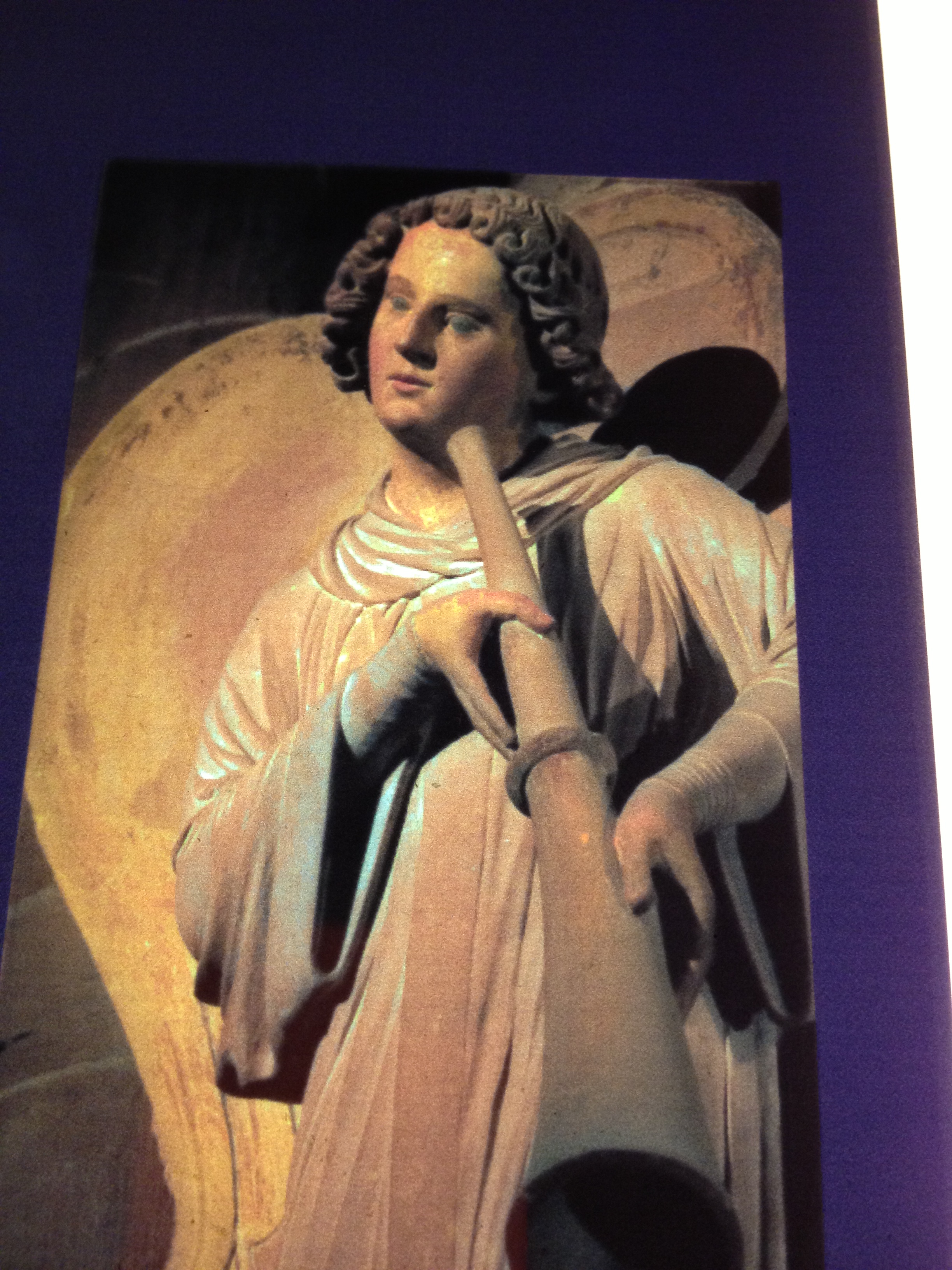
Among the many wonders of Strasbourg Cathedral is the Tower of Angels. The breathtakingly beautiful column reaches from the cathedral floor all the way to the vaulted Gothic ceiling. It was sculpted between 1225 and 1230, early in the 400-year span of time it took to build the cathedral. The subject of the column is really the Last Judgment, but it has a startling twist on the usually-dire subject.
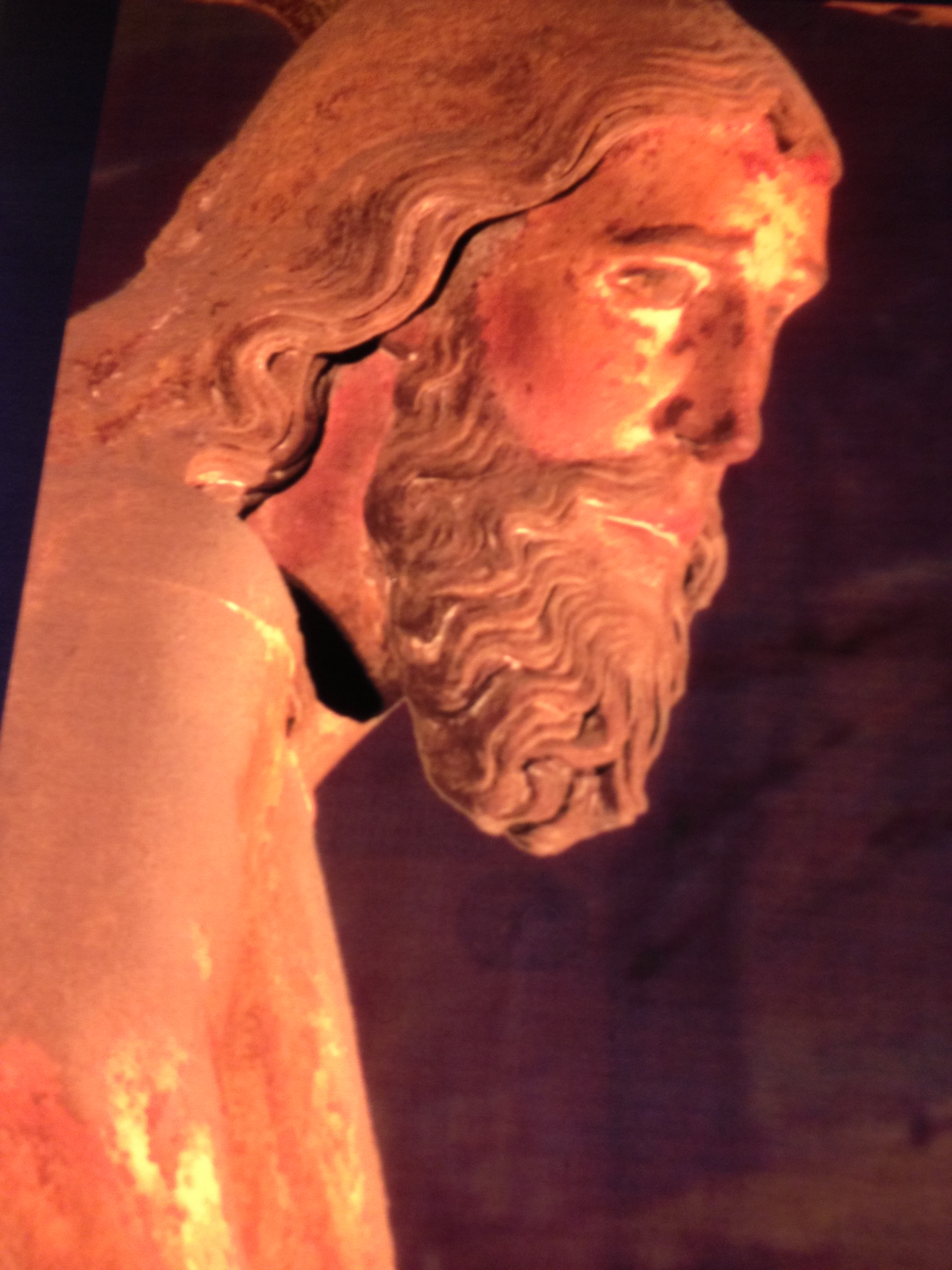
The four Evangelists appear on the lowest level, with angels above them, then the dead rising, then finally Christ. My criticism of the column as a teaching tool for the faithful is that it’s hard to see the pinnacle, the figure of Christ, and get the point. But helpful placards provide close-ups and explain, in several languages, what is going on.
The Christ figure at the top is not sitting in splendor on a grand throne. He is not giving anyone a thumbs-up or thumbs-down. Instead, this Christ bestows a gentle welcoming smile on everyone. This is a humble figure, a figure of loving understanding and compassion for the always-messy human condition.
I thought of the tower and its message this morning as I read the bold new statement by Pope Francis concerning the future of the Catholic Church. Full disclosure: I am not now and never have been a Catholic. I visit cathedrals and churches for their art, traditions and history. Wherever I’m living, I attend whatever Protestant church seems the most socially active, inclusive and forward-thinking. But like many non-Catholics, I’m impressed by the current Pope. (Actually, he had me as soon as he decided to wear regular shoes instead of red Papal slippers. Then when he chose to live among regular priests instead of in the much-fancier Papal Apartments, I decided he was worth a listen anytime).
In his latest statement, cited in the article below, the Pope said, “I prefer a Church which is bruised, hurting and dirty because it has been out on the streets.” He has consistently shaken things up by insisting that the church should boldly reach out into the world with love, compassion and creativity. His vision is that the church is a place of refuge for all, not a place of harsh judgment. This is not a new idea, of course. But it’s one that can certainly use a new champion.
In September, I found the French city of Strasbourg so lovely that I’m planning a side trip there, on my way home from Vienna in December. Strasbourg is just two miles across the border between Germany and France. I’ve scheduled a day and a night there. I’ll wander through the Christmas markets, which have been held at the base of the cathedral since medieval times. And I’ll spend time contemplating the season inside this most warm and welcoming of cathedrals.
Join me next time for more explorations into the art and history of Europe!
Viennese Coffee with a Dash of History
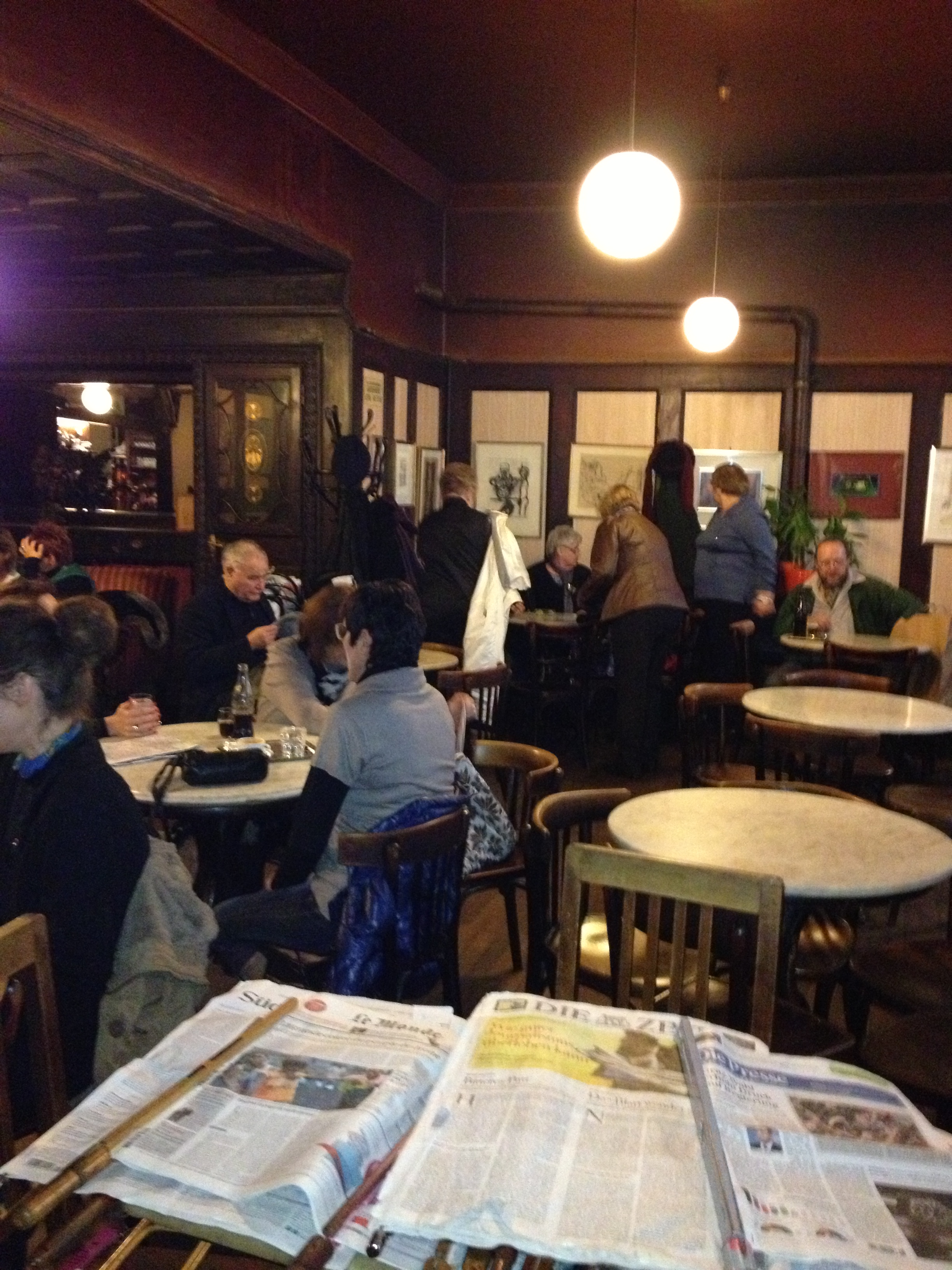
Cafe Hawelka is a dimly lit old-school coffeehouse in the heart of Vienna. Now as in decades past, a cup of coffee entitles the buyer to sit all day with one of the many newspapers neatly arranged on racks. The cafe first opened in 1938, just before World War II broke out. Its founder, Leopold Hawelska, had to close when he was drafted into Hitler’s army. He survived the deadly fighting on the Russian front and returned to reopen the place in 1945. Fortunately the building still stood. In impoverished postwar Vienna, the cafe was one of the few places that had heat. Poor people were welcome to come in for a free glass of water, to warm up. Some sat there for hours. Princely folk, like the Liechtensteins, also hung out there, hawking artwork and valuables they had managed to hide from the Nazis.
Later, the place became a sort of living room for artists and writers. Some artists paid with paintings, which still hang on the smoke-stained walls. (I think the place is non-smoking now, as most Austrian restaurants are in recent years).
Mr. Hawelska and his wife Josefine were benevolent presences for decades, watching over generations of artists, writers, students, and tourists. She baked the specialty, Buchteln: a yeast bun with plum filling. It is still served there today. The preferred accompaniment is a melange, or what Starbucks has taught us to call a cappuccino.
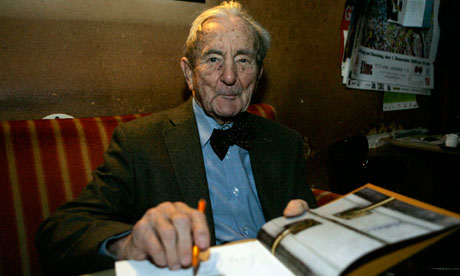
Josefine Hawelska died at age 91, in 2005. Leopold Hawelska lived to 100, still frequently occupying his usual seat at the cafe almost to the end. Their descendants continue the tradition.
In Vienna, as in other cities, Starbucks locations are filled at all hours. I’m sure the free Wifi attracts customers. Still, historic coffeehouses like Cafe Hawelka endure. I hope to spend some quality time in them, trying to read German-language papers and soaking up the atmosphere of history.
An article from The Guardian, about the Hawelka family and cafe, appears at http://www.google.com/search?client=safari&rls=en&q=Leopold+Hawelka+the+guardian&ie=UTF-8&oe=UTF-8.
The Perfect Austrian Sweater
Wandering through the Folk Art Museum of Innsbruck, Austria last year, I admired pieces of embroidery, lace, weaving and other needle arts. It occurred to me that I own a precious piece of folk art myself: a handknit sweater I bought about 35 years ago. In a tiny shop in one of the ski towns, maybe Kitzbuhel, a lady in the traditional dirndl skirt, fitted bodice and puff-sleeved blouse patiently pulled every sweater in my size off the neat shelves behind her. She spread a rainbow array of handknit sweaters across the worn wooden counter. Things have changed since then, but in those days most shops, at least in small towns, served customers personally; there was no such thing as browsing through the racks. Fine handknits should never be hung on hangers anyway. I probably spent at least an hour in the shop, trying on and debating the merits of each sweater before me. It appeared that each garment in the entire shop was one-of-a-kind.
In my wretchedly rudimentary German, I asked whether the sweaters spread before me were all really handknit. The saleslady had trouble understanding me. I mimicked hand-knitting motions. Another customer helpfully translated for me. The saleslady looked incredulous–and maybe a little insulted–that I would ask such a question. Yes, of course every sweater in the shop was knitted by hand.
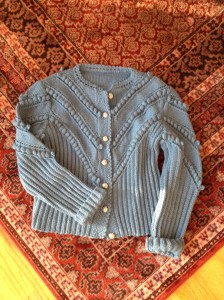
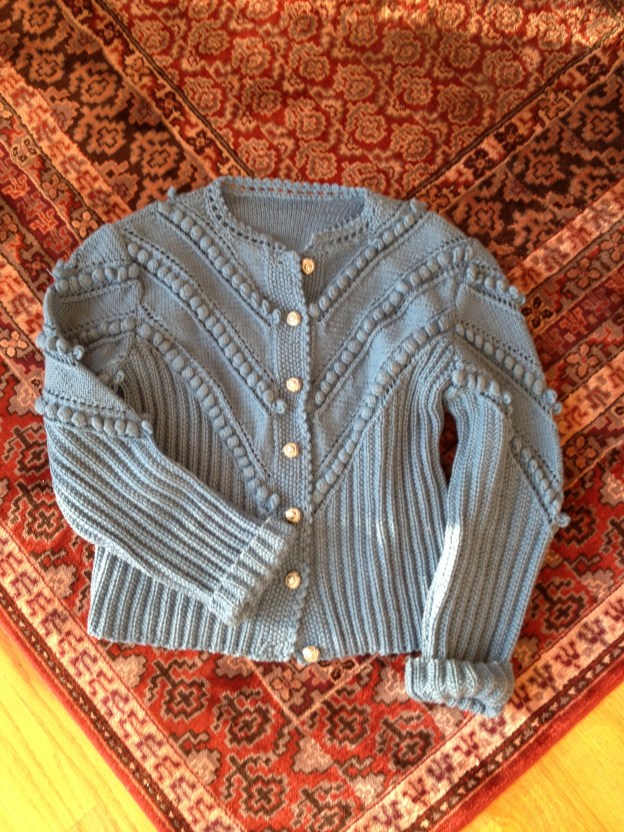
I chose a worsted wool sweater, in a color I thought of as bluejay blue, with popcorn stitches and silver buttons. It was slim-fitting, with vertical ribbing around the midriff and down the sleeves. It looked great with jeans. Over the years, it’s become one of my prized possessions; whenever I wear it, people ask where I found it. Some can’t resist touching the popcorn stitches, still springy after all these years.
Knitting was a cottage industry in those days, before women in large numbers began to join the workforce outside the home. In country towns in the mountains of Tirol and Bavaria, it was fairly common to see women knitting, crocheting, or embroidering while sitting on their front porches, watching over children in a park, or riding a tram. Many women seemed to work without thinking or even looking at their work. They made it look easy. Later, when I tried to learn to knit, I realized how difficult it is–and how time-consuming. A simple scarf, knit with huge needles and loose stitches, is my limit.
Now I wish I had bought more than one sweater that day. My blue one still looks as new as the day I bought it. It never sags or stretches. It never gets pills on the sleeves. It never fades. It is always warm, but not too warm. It still fits perfectly, and it still looks great with jeans. Handknit sweaters are prohibitively expensive now, if they can be found at all. Still, every time I’m lucky enough to be in Austria or Germany, I’m looking for another perfect sweater. Of course, if I do find another one, I may not be able to afford it.
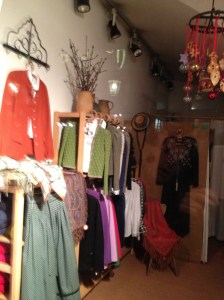
Still, I can always hope. A year ago, on a side street just as I was leaving Vienna, I spied a tiny shop that looked promising. Who knows, maybe I’ll find just the thing there next week!
Winter as a Child, Again
It is just over a year since I started my blog. I decided to revisit my very first post, written when I was getting ready to travel to Vienna for the Christmas markets, the concerts and the museums–and of course the apple strudel. Now I’m lucky enough to be leaving again for Vienna, one of my very favorite places. Here’s to discovering new places and revisiting old ones! A year ago, I wrote:
Travel is not just about being there. Travel is about memory and anticipation. As I pack my one small suitcase for Vienna in November, I am full of memories of past trips and high hopes for this one.
Last year, the Vienna Kunsthistorisches Museum had a special exhibit: “Winter Tales.” Paintings, sculpture and artifacts from all over the world were gathered in a glorious celebration of winter. My very favorite piece was this portrait of a child with a fur-and-velvet muff and a scruffy little dog impatient for her to play: “Lady Caroline Scott as Winter,” by Sir Joshua Reynolds. Winter is so often personified as Death, or as a creaky old man. Here, though, winter is a child full of hope and wonder. She gazes out at us from the barren winter grounds of her British home, her face as fresh as the day she was painted in 1776 at the age of two or three.
This is not a glamorous society portrait. It is only about 57 x 45 inches (just the right size to place over my fireplace, if I could afford such a thing!) I can imagine the artist Sir Joshua Reynolds, age 51 at the time, encountering Lady Caroline in the bare winter grounds of her home. Anyone would be captivated by her rosy-cheeked face and direct gaze. I can see Sir Joshua dashing off a sketch and finishing the portrait back in his studio. It would have made a nice break from painting his more demanding adult subjects, who proudly posed with the emblems of their wealth and power: swords, globes, weighty books, jewels and fine silks.
The British Peerage tells us that Lady Caroline was the daughter of the 3rd Duke of Buccleuch. She married the 6th Marquess of Queensberry (slightly lower in rank than a Duke, but who’s keeping score?) She had 6 surviving children and lived to the age of 80. So she was an exact contemporary of Jane Austen, although Jane died at age 41. I’d like to think Lady Caroline read Jane’s books.
Lady Caroline was a privileged child. As she grew up, no doubt she learned that many children were cold and dirty and hungry. Her rank would come with some responsibilities to take care of the less fortunate. She lived through the American Revolution, the Terror in France, and the Napoleonic Wars. And we all know that even for the most privileged, life holds heartbreak and disappointment. But on this wintry day, all that is in the future. In this perfect moment, Lady Carolin stands on her sturdy little legs, happy to be walking about in the wide world.
Vienna is an enchanting city in any season, but my favorite time there is winter. The Christmas season begins in late November, an ideal time for crowd-free travel. I do not have a fur muff or a scruffy little dog, but I am setting off for Vienna with all the anticipation of a child at Christmas.
Stone Age Texting?
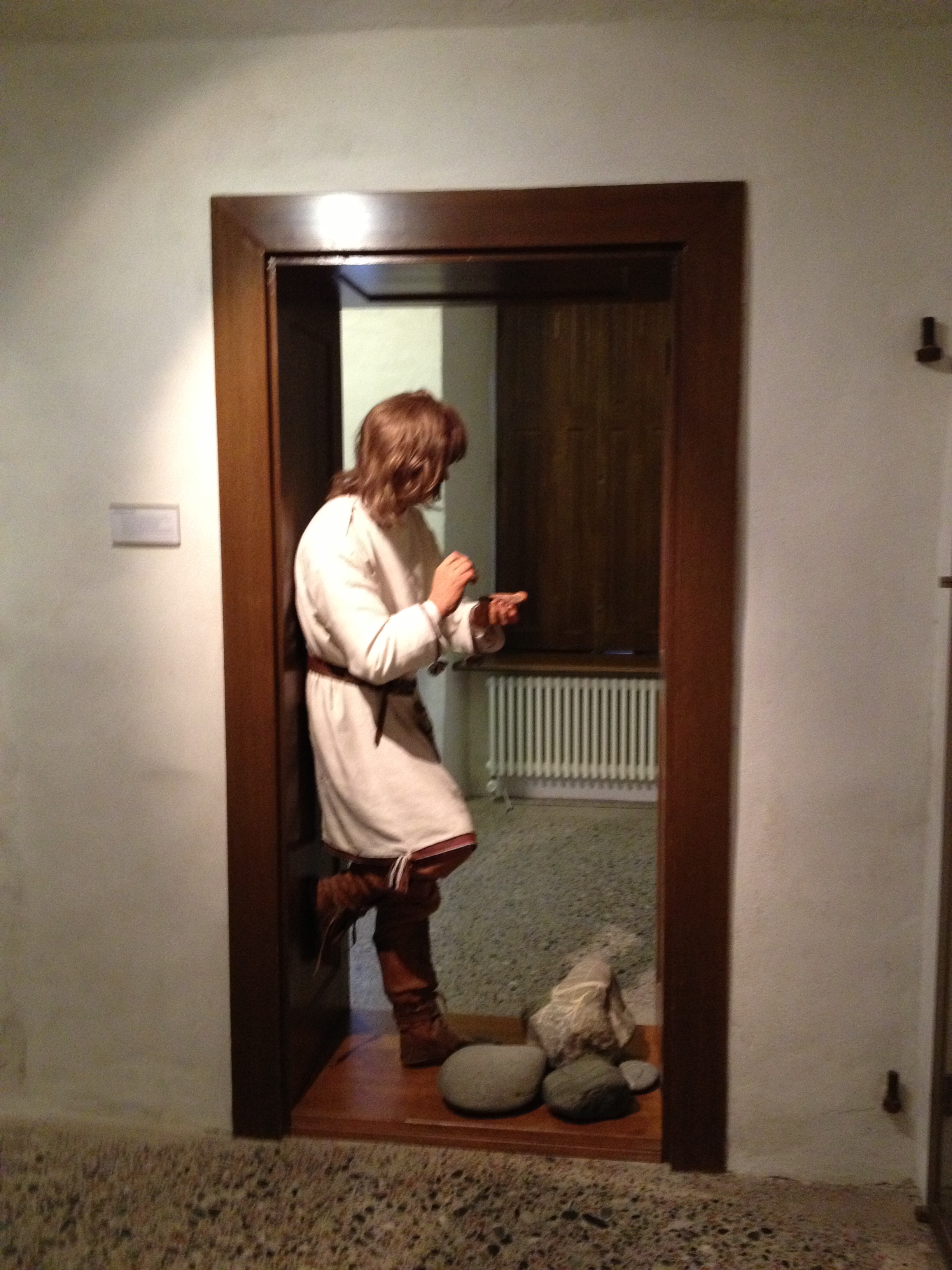
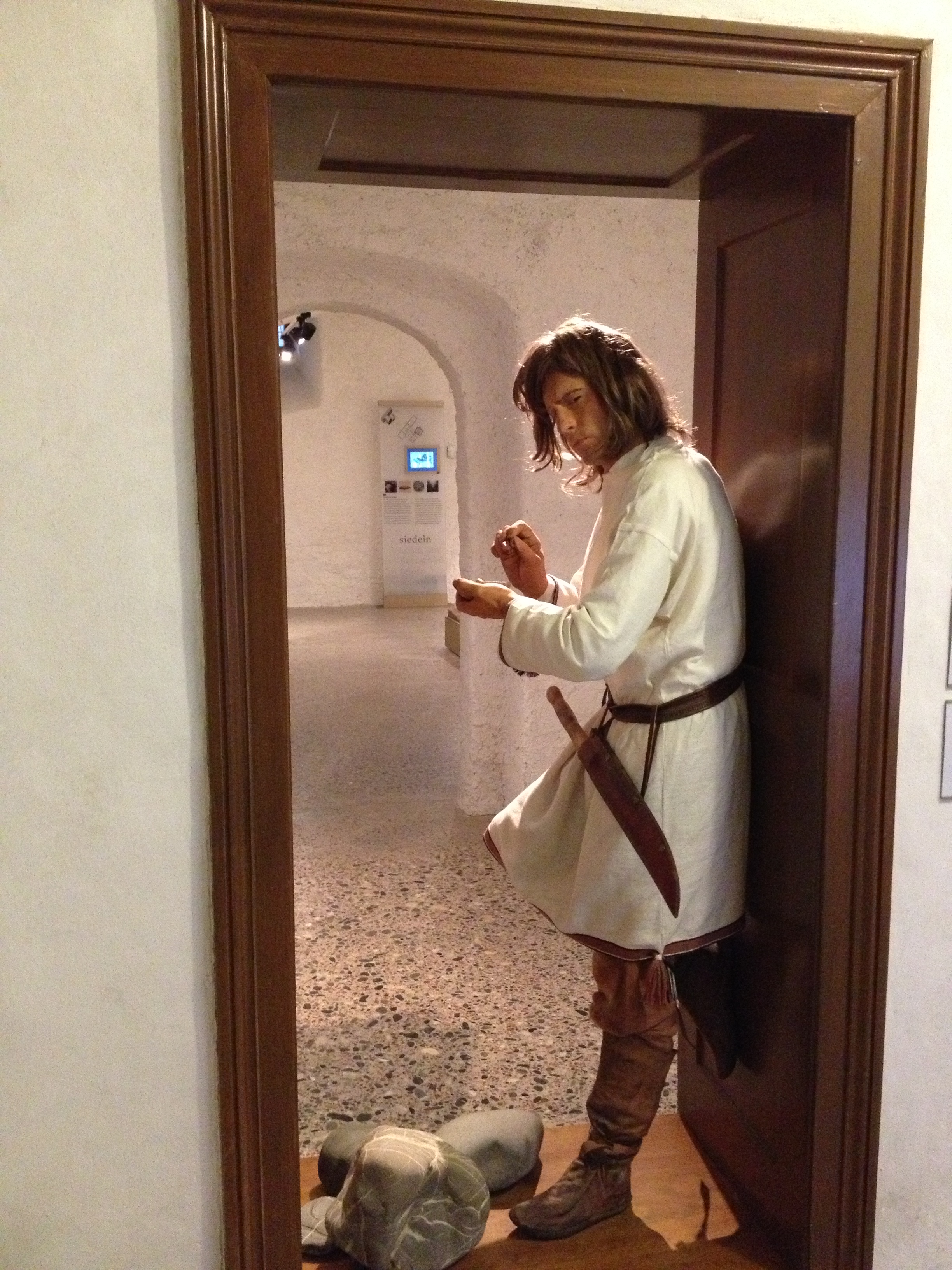
In the Liechtenstein National Museum in Vaduz a couple of months ago, I came upon an oddly dressed tourist checking his cell phone.
No, wait, it was actually a petrified long-ago resident of the town, having a little snack!
He did not look particularly friendly or willing to share, so I moved on. Archaeologists have dug up artifacts going back to prehistory in the tiny country of Liechtenstein. The Liechtenstein National Museum was an absorbing surprise in this tiny country that seems to consist of nothing but banks and a medieval castle on the mountainside. (The castle is not open for visits, but once a year citizens gather on the grounds to greet their current royalty).
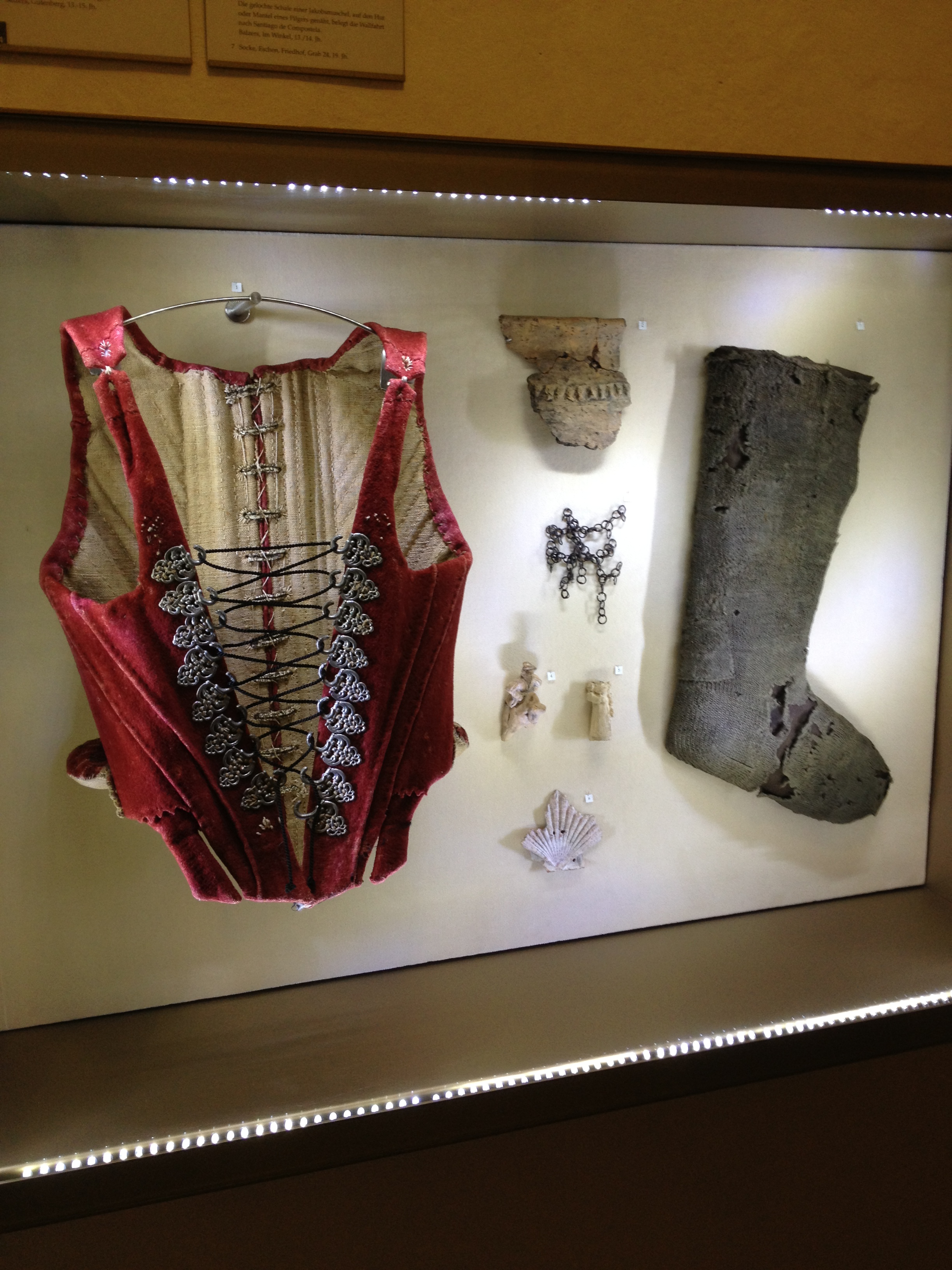
The museum even holds some rare ancient clothing, the most difficult of all old items to preserve.
Several floors of artifacts, creatively displayed, trace the history of this tiny country that has somehow held on to its sovereignty–and its money. Having been to the sumptuous “summer palace” and art gallery the ruling family still maintains in Vienna, I envision troves of treasure and gold socked away in tunnels underneath the mountainside palace. But at least some of that money has been spent on this fascinating history museum.
As I left, my Stone Age friend was still jealously guarding his snack. Join me next time for more explorations into the art and history of Europe!