Category Archives: Cathedrals and Churches

Norwich: Refugees in the Cathedral

IMG_8299

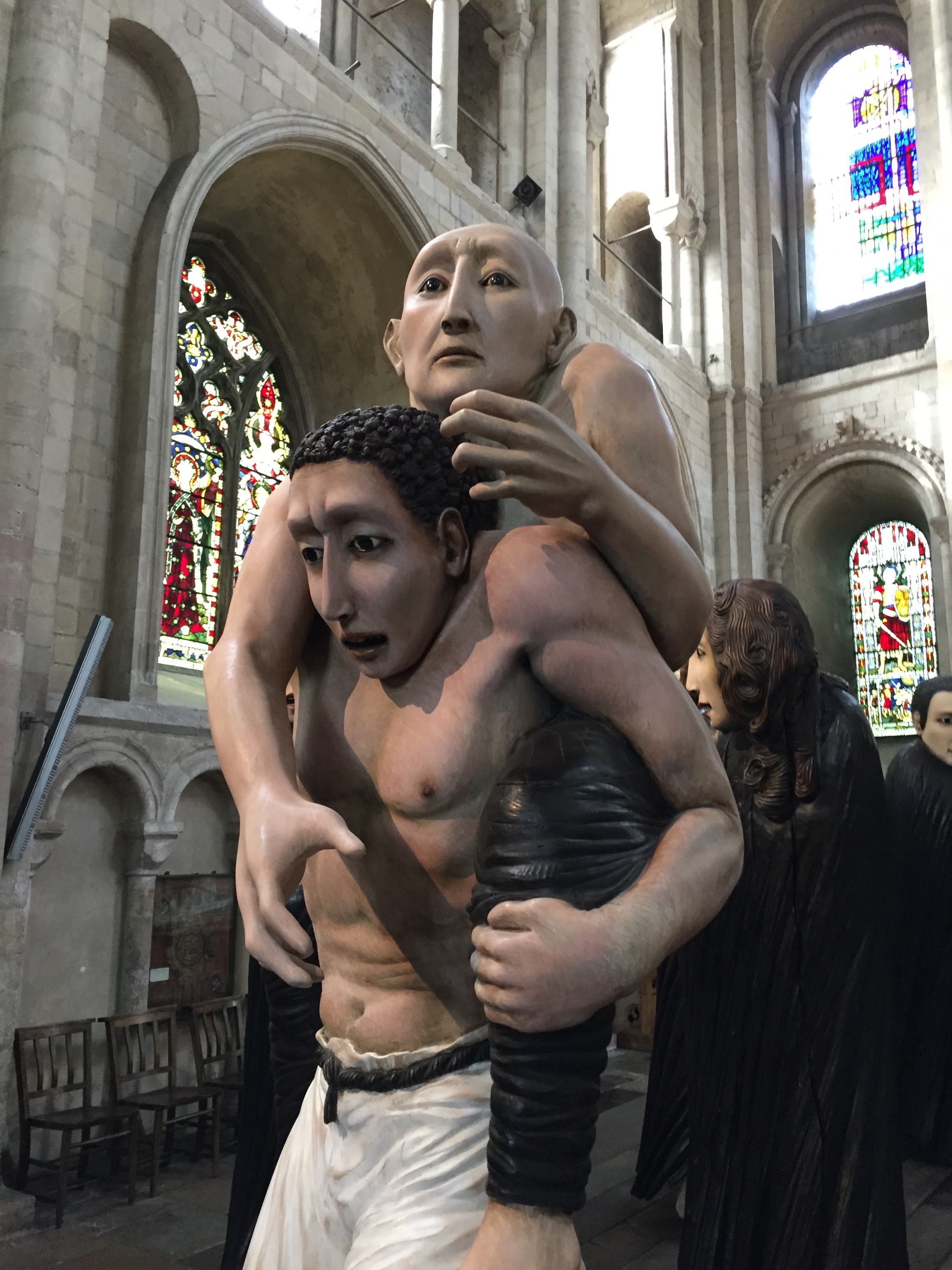
In the middle of the biggest and most heartbreaking refugee crisis in Europe since World War II, I came face to face with larger-than-life refugees in the middle of beautiful Norwich Cathedral in England. Ana Maria Pacheco, a sculptor from Brazil, had her ten-figure group on exhibit in the North Transept.  The installation is called Shadows of the Wanderer. It was created in 2008.  But it is especially powerful today, when people are dying every day in a desperate flight away from violence and grinding poverty in their home countries. The nations of Europe are struggling to come to terms with the vast number of refugees arriving on their shores and at their train stations. All over Europe and Britain, while governments dither, ordinary people get on with the business of helping their fellow human beings.  They collect diapers, food, water bottles, blankets and tents, and they simply appear where they are needed.

The lead figure in the sculpture group is a young man carrying his elderly father on his back. Father and son are carved from the same huge block of wood. The son literally cannot leave his father behind; his father is part of him, and he is part of his father. The origin of this stunning work of art was the story of Aeneas, who carried his aged father Anchises from the ruins of battle at Troy.  The son is about to step off the exhibit plinth and join us, the viewers.

How will we react to these desperate people? All the figures are larger than we are, about 7 or 8 feet tall. The situation they depict is bigger than we are, too.
IMG_8288

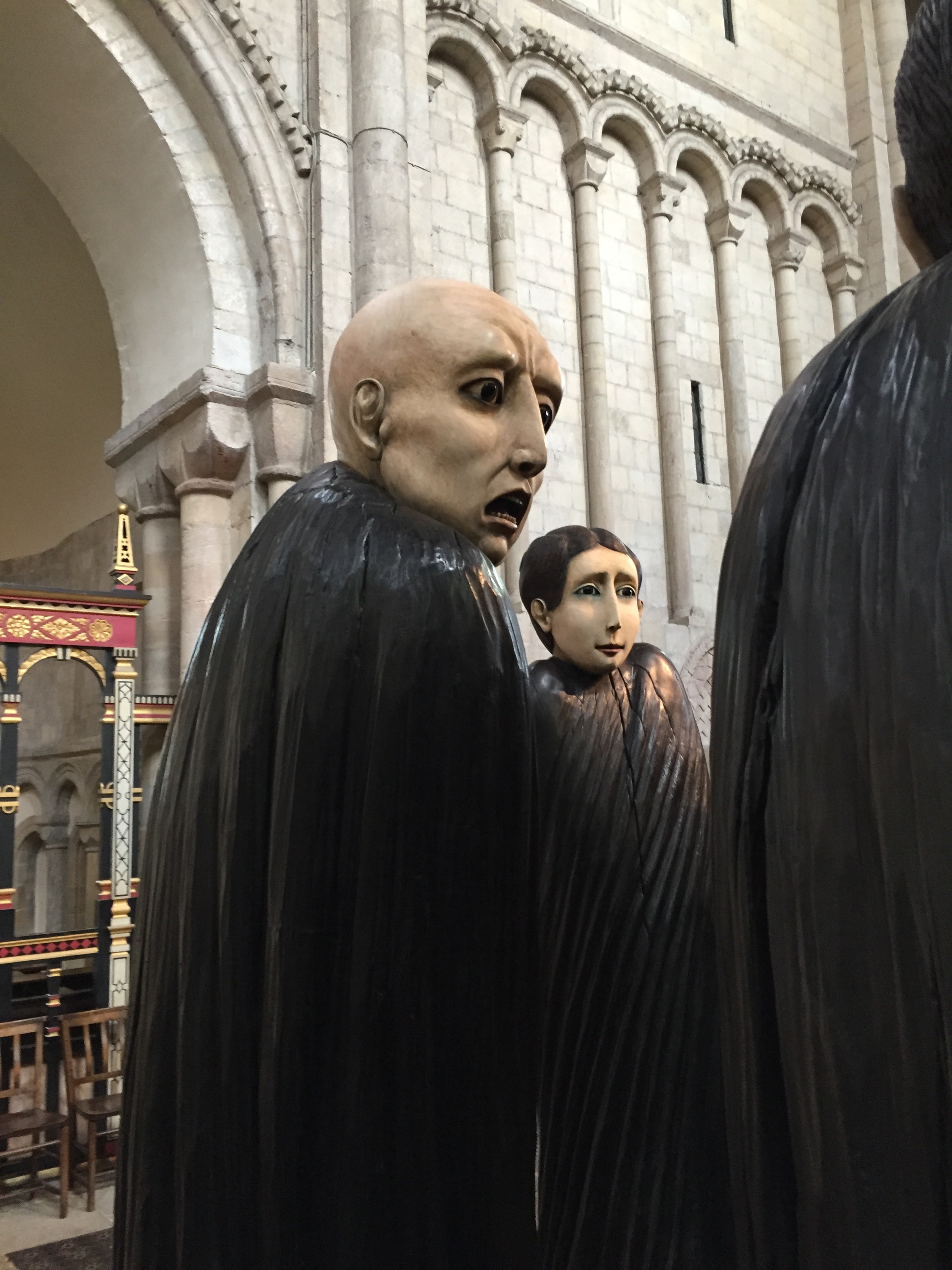
The remaining figures show possible reactions: Shock, dismay, disapproval, indifference.
IMG_8291

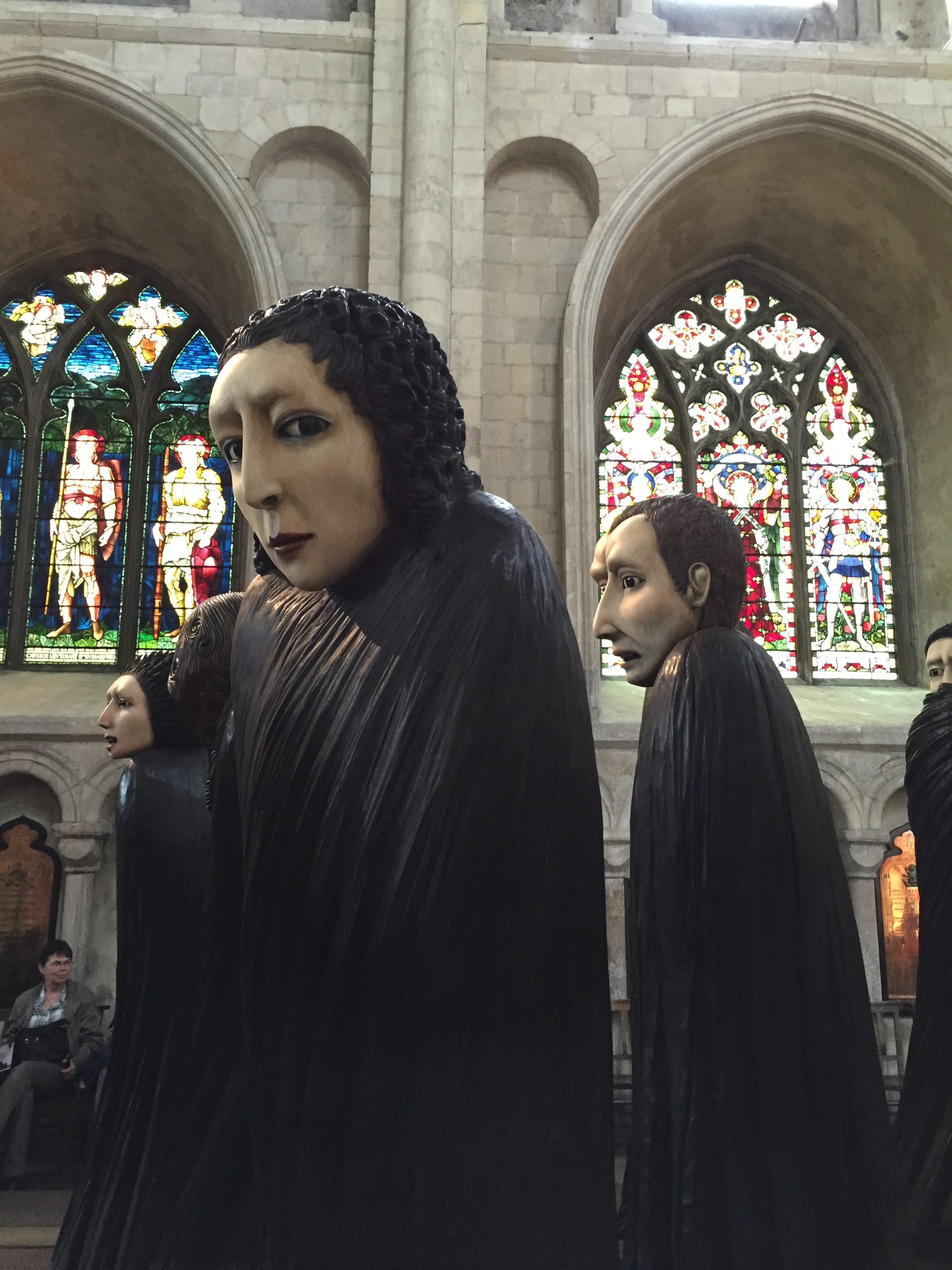
Will we look around, wondering who is going to get this problem out of our sight?
IMG_8276

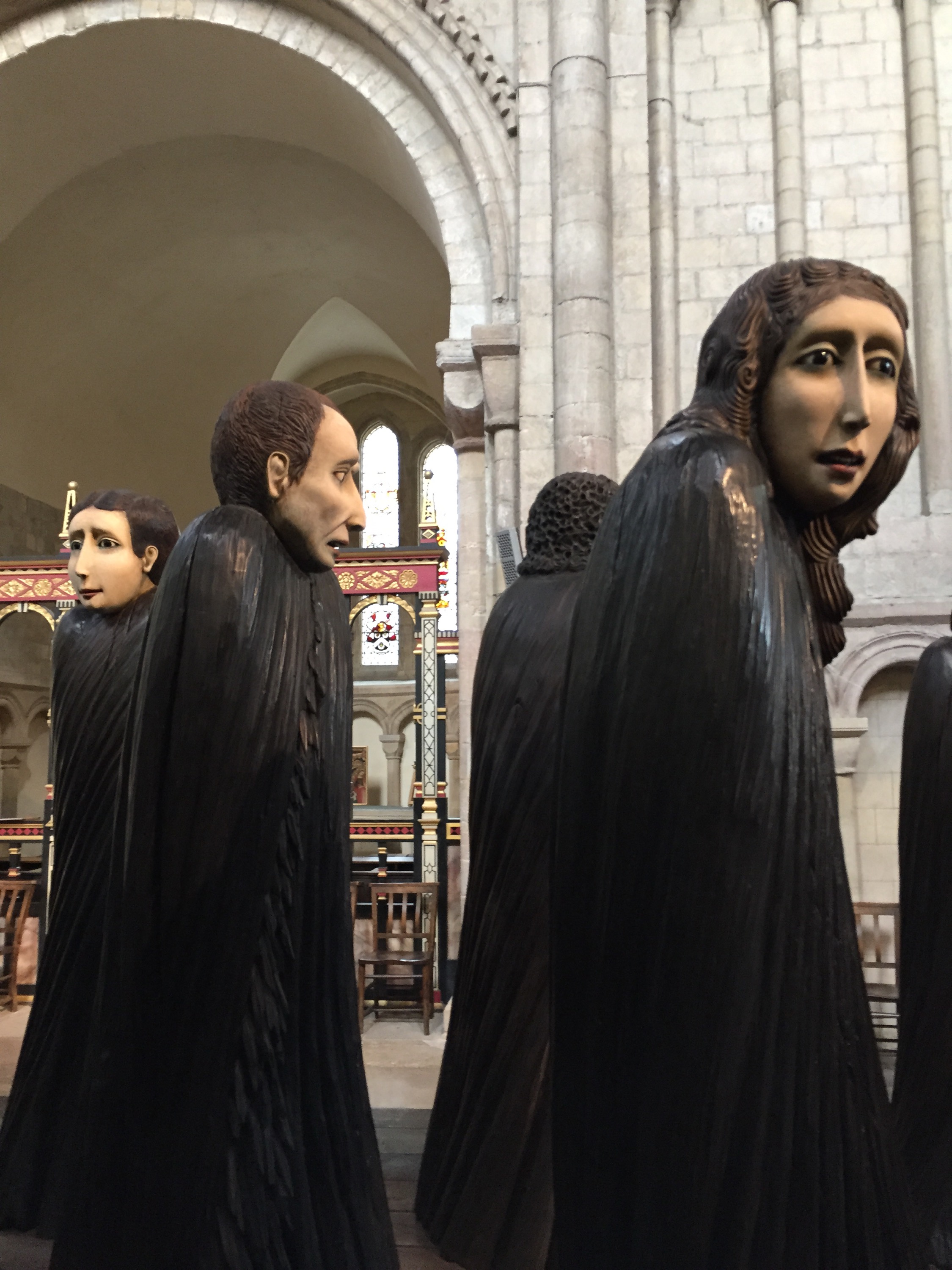
Will we look the other way, complacent as we go about our regular business?

The draped figures following the desperate father and son have their arms and hands hidden.  If the father and son fell backward, would anyone catch them? Will no one reach out a helping hand?  These are the questions that ordinary people are asking their leaders right now.  Each one of us could become a refugee for reasons beyond our control.  The current crisis is a test of our humanity.

Norwich has one of the most welcoming cathedrals I’ve ever seen.  Many great cathedrals charge admission, often as much as $15 or $20.  At Norwich, visitors are greeted by volunteers asking what they are most interested in seeing.  I’m sure donations are gratefully accepted, but I arrived late in the day and didn’t realize until after I’d left that I never saw a place to donate. The business of Norwich Cathedral is to welcome and to minister to its visitors.
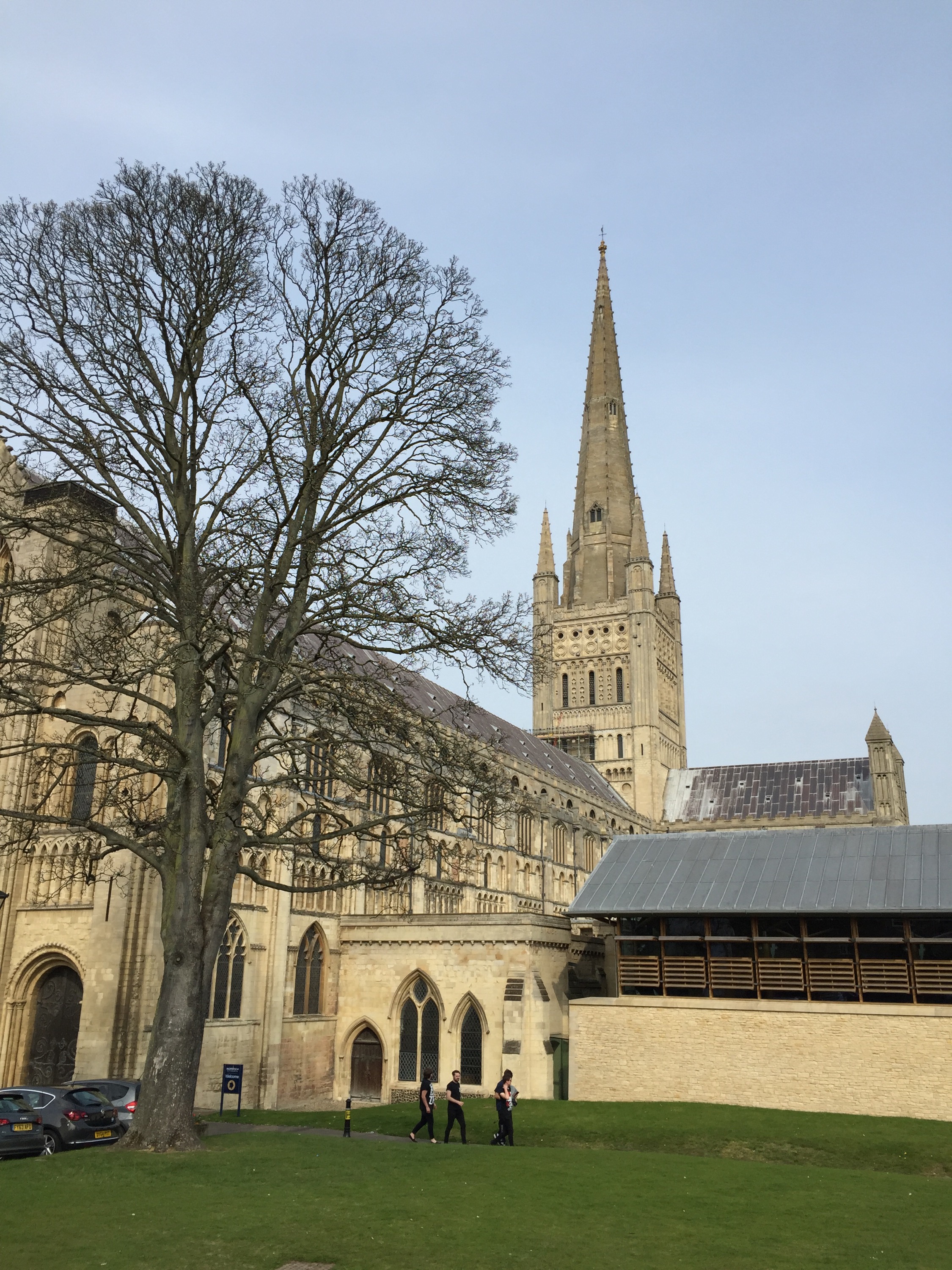

When I arrived, a lovely young volunteer asked about my interests, then described this special exhibit. She offered to lead me directly to the North Transept so I wouldn’t miss this powerful work of art in my limited time.  I am grateful to her.

Join me next time for more explorations into the ever-fascinating and ever-challenging history and art of Europe and the British Isles.
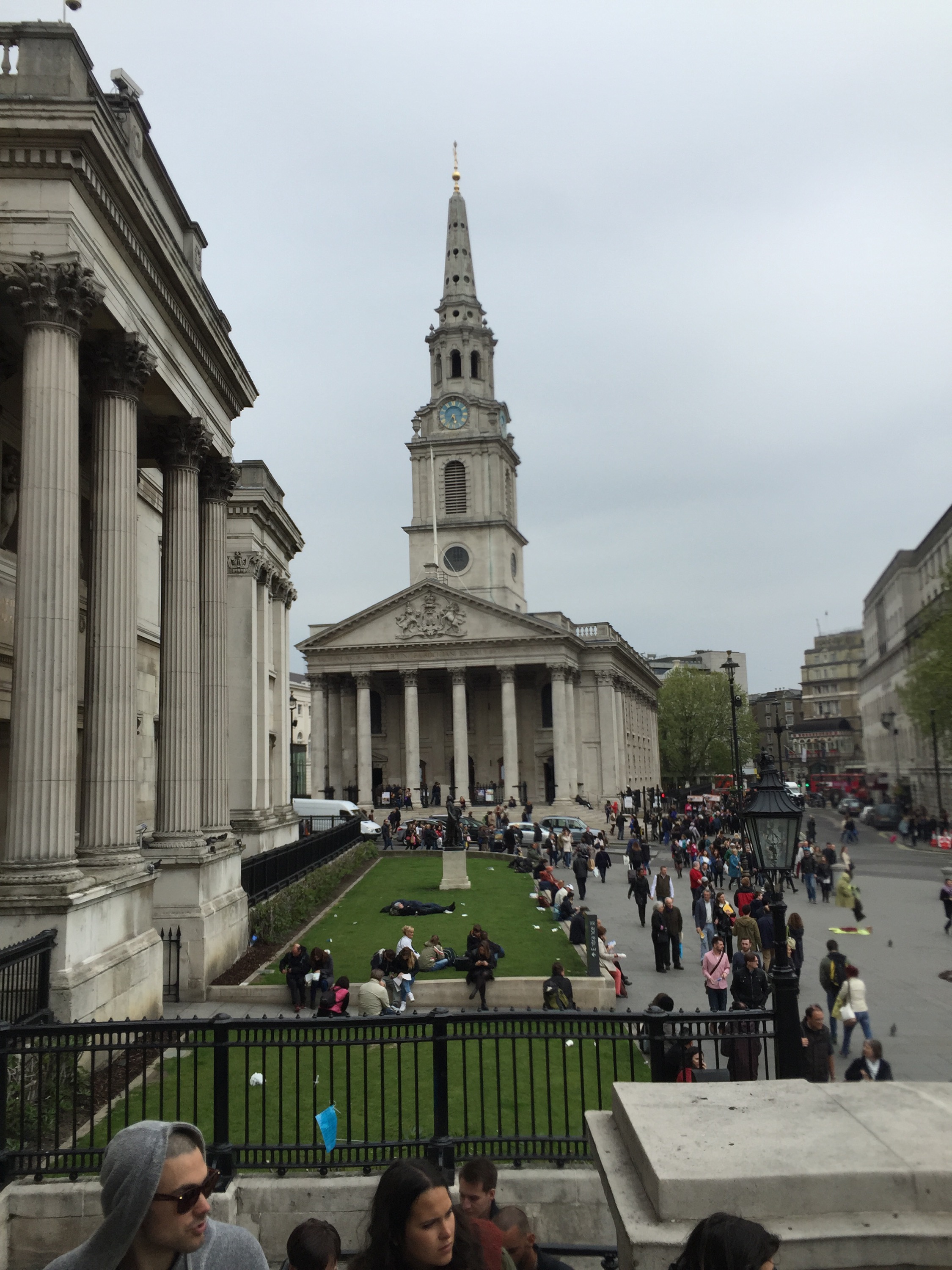
St. Martin-in-the-Fields


IMG_3643

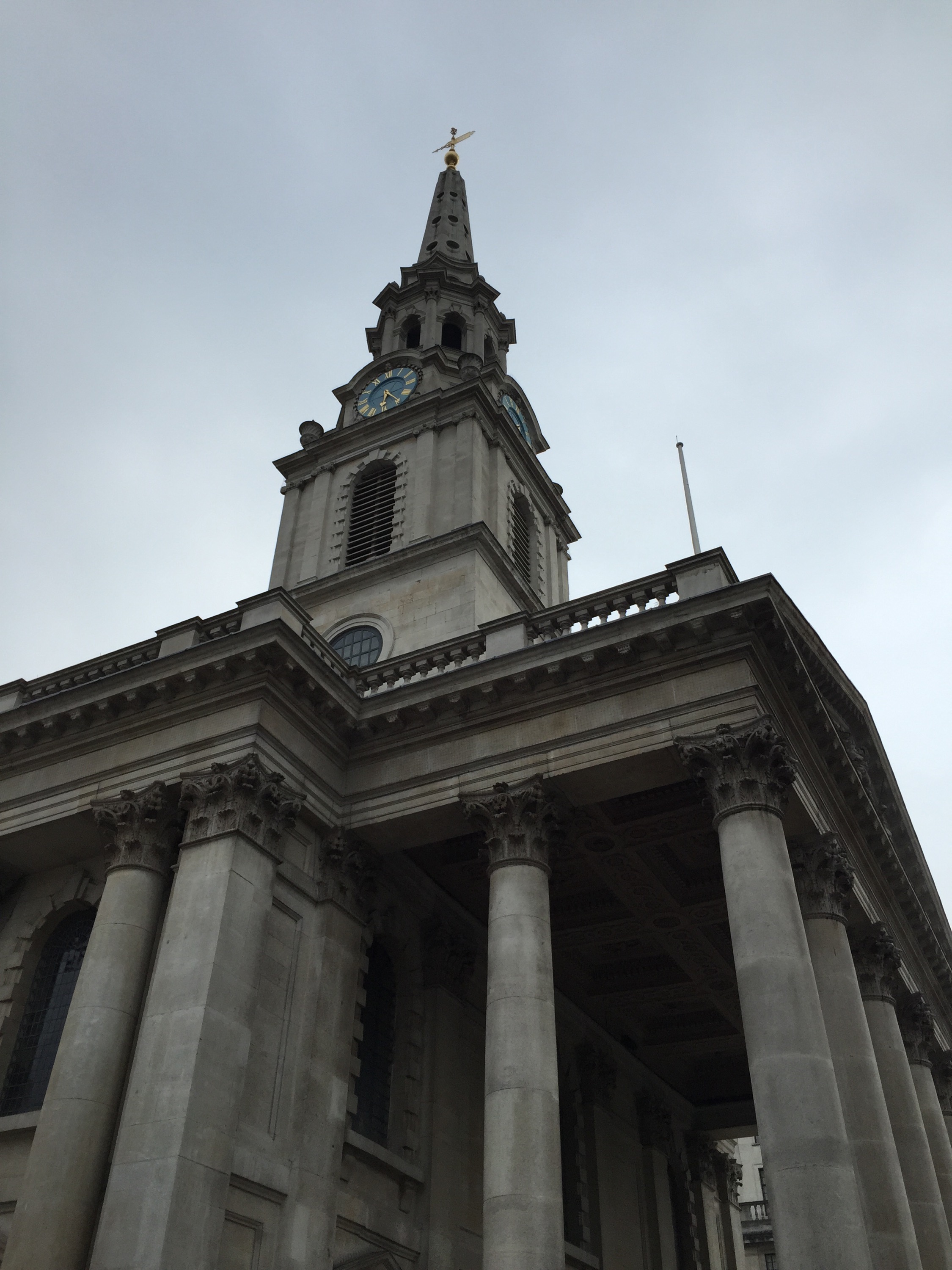
After spending a few hours in London’s National Gallery, I’ve had enough of appreciating great art. I’m more than ready to stagger down the steps into Trafalgar Square, navigate through the crowds, cross the street, and disappear down the well-worn steps into the ancient crypt of St. Martin-in-the-Fields Church. The church was once literally “in the fields,” far outside the center of London. Now it’s at the epicenter. The day before I visited was May Day, when tens of thousands of demonstrators converged on the square. (In most of Europe, May Day is similar to Labor Day in the United States. In Europe, people march in support of working people on this day). On any day, though, Trafalgar is full of people.

IMG_3648

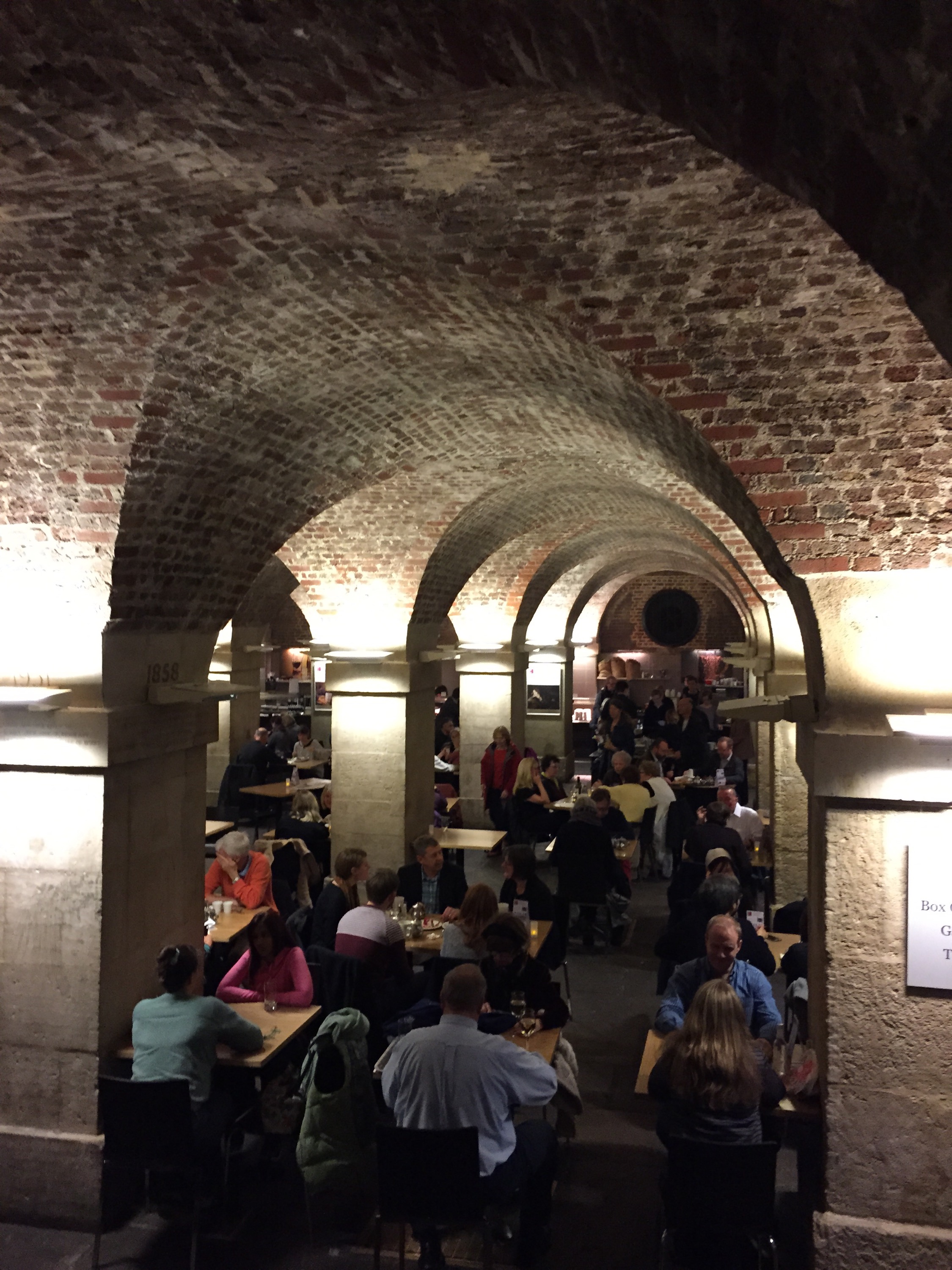
The centuries-old crypt underneath the church has been turned into a cheerful cafeteria and venue for jazz concerts.

IMG_3657
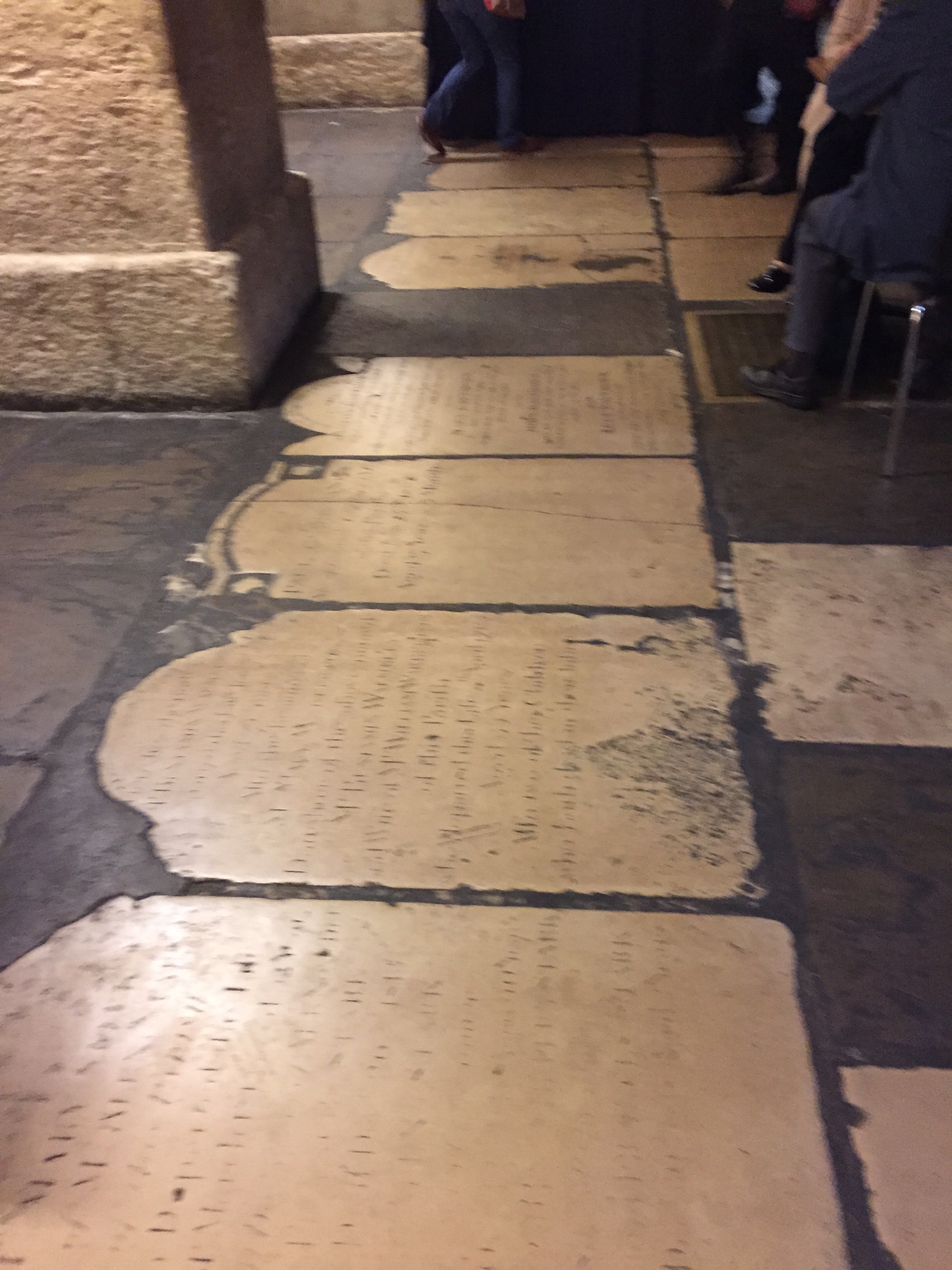
Are we walking on top of very old tombs? I don’t think so. I think these are grave markers from centuries past, when the church still had a churchyard around it. I think that tombs once in the crypt were moved elsewhere during one of the many rebuildings of the church over the centuries. Of course, like many British churches, the site of this one dates back to Roman times–or very likely even pre-Roman pagan times. So there’s no telling what is deep underground. If there are spirits of the departed, I think they enjoy the company.

IMG_3666
The food is cooked onsite, inexpensive, healthy and delicious.

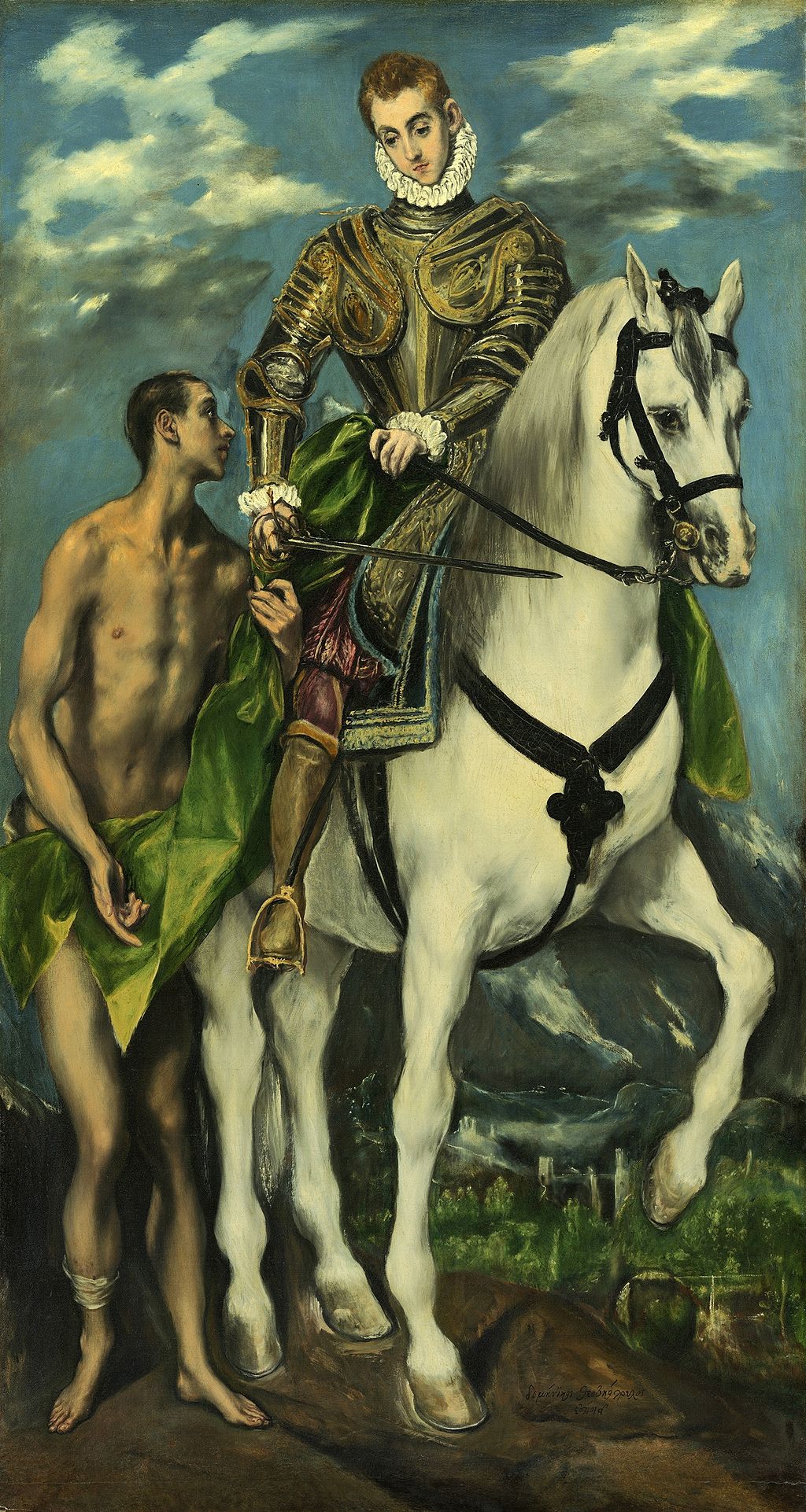
El Greco, St. Martin and the Beggar, circa 1597, Public Domain

El Greco, St. Martin and the Beggar, circa 1597, Public Domain

Who was St. Martin of Tours? He was a 4th-century Roman soldier who became one of the first conscientious objectors when he decided not to fight. He offered to go to the front lines unarmed, but fortunately the enemy sued for peace and he was allowed to leave the army. He eventually became Bishop of Tours, a post he accepted reluctantly because he preferred to serve the poor directly. He was well known enough in his day to have a biographer who followed him around and wrote about him, so it is pretty well documented that he once impulsively cut his warm military cloak in half and gave it to a near-naked vagrant in the dead of winter. Legend has it that the next morning the cloak was made whole again. The rest of his life was devoted to serving the poor and outcast, and that is the mission of St. Martin-in-the-Fields today. The church’s cafe and its many concerts support its work with the poorest of the poor in London.

IMG_3695

I’m happy to contribute to the work of this famous church by joining the lively crowd in the once-silent crypt. Join me next time for more explorations in the art and history of Europe and the British Isles!


The Queen’s Church at Sandringham


Every Christmas I see pictures of Britain’s Royal Family walking from Sandringham House to the local parish church, St. Mary Magdalene. They’re always beautifully turned out, of course, and there’s always at least one pretty child ready to present a bouquet to the Queen. Now I’ve seen the inside of the church, and it’s one of the most beautiful rural churches I’ve ever seen.

  The altar and ceiling are wonderfully carved and painted.  The atmosphere is full of light and joy.
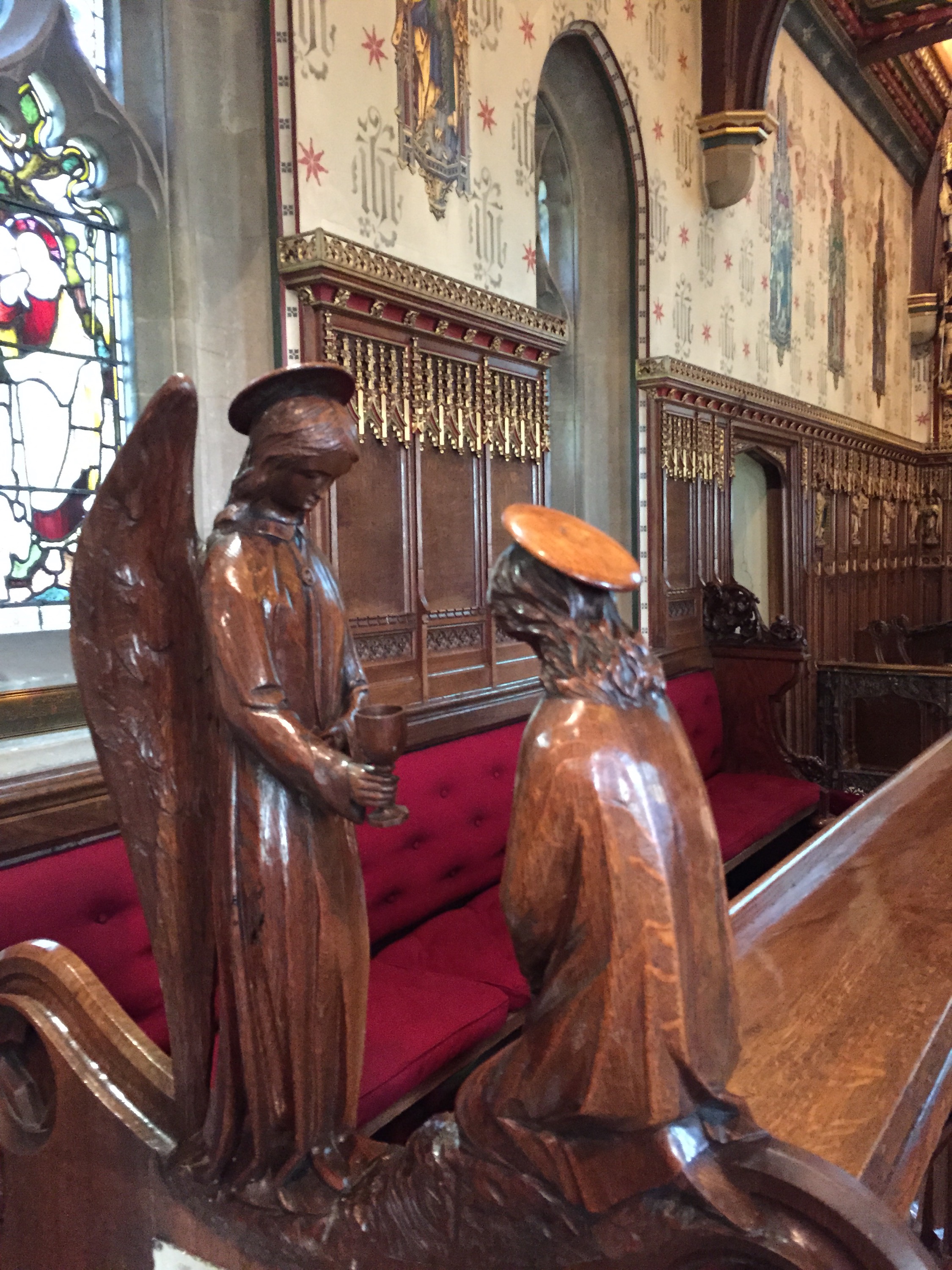
 A beautifully carved angel administers Communion in the choir. There are no royal tombs here, just exquisite memorials to various Royal Family members.

2015-04-23 11.26.07


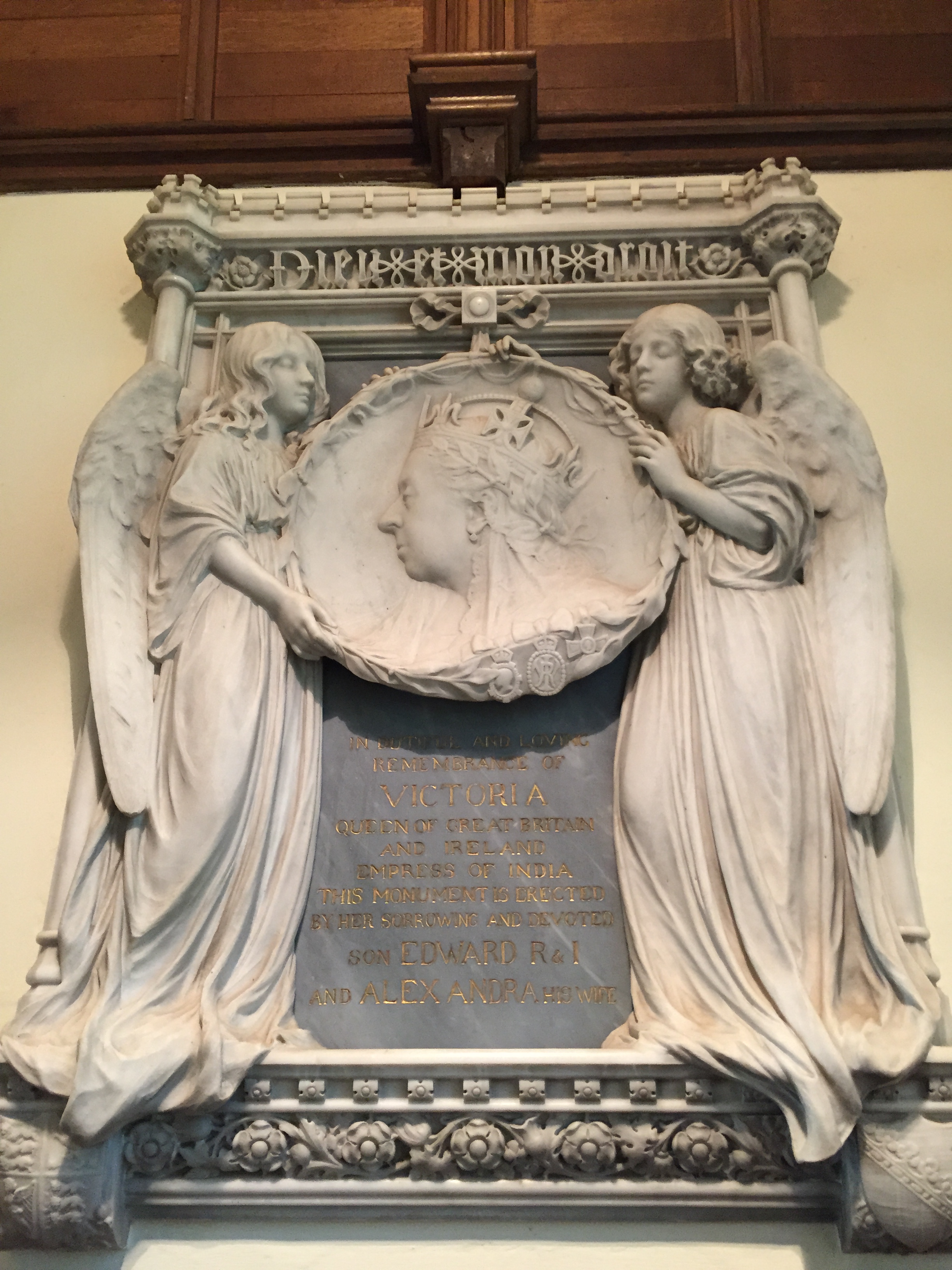
The two angels above lovingly hold a silhouette of Queen Victoria, who had the foresight to buy Sandringham House as a privately owned family retreat.

This post is an experiment–I’m trying to post from my phone. If it works, it will be a whole lot easier to post while traveling!

Mompessons: Resting (With a View) in Salisbury

EffigiesPainted

In glorious Salisbury Cathedral, I came upon these two striking effigies, looking much more colorful than most of the effigies lined up along the nave.  They somehow looked startled.  Also they lay in the opposite direction of most of their companions. The closer I got to them, the more curious I was.

EffigiesPainted2

Who were they, and what was their story?  As luck would have it, the photo I took of their names did not turn out.  What to do?  I posted my photos on one of the Facebook history groups I belong to, and had the answer within minutes.

I was looking at effigies of Sir Richard Mompesson and his third wife Katherine. Sir Richard was a local gentleman and politician, a Member of Parliament.  He died in 1627. He had made judicious marriages and enjoyed a comfortable life.  His family owned an early version of nearby Mompesson House, which is now a beautiful National Trust property.

I think I read a placard in the cathedral stating that the tomb of the Mompessons was facing a different direction from most, because it had once been repositioned during a change in the Cathedral.

IMG_1484

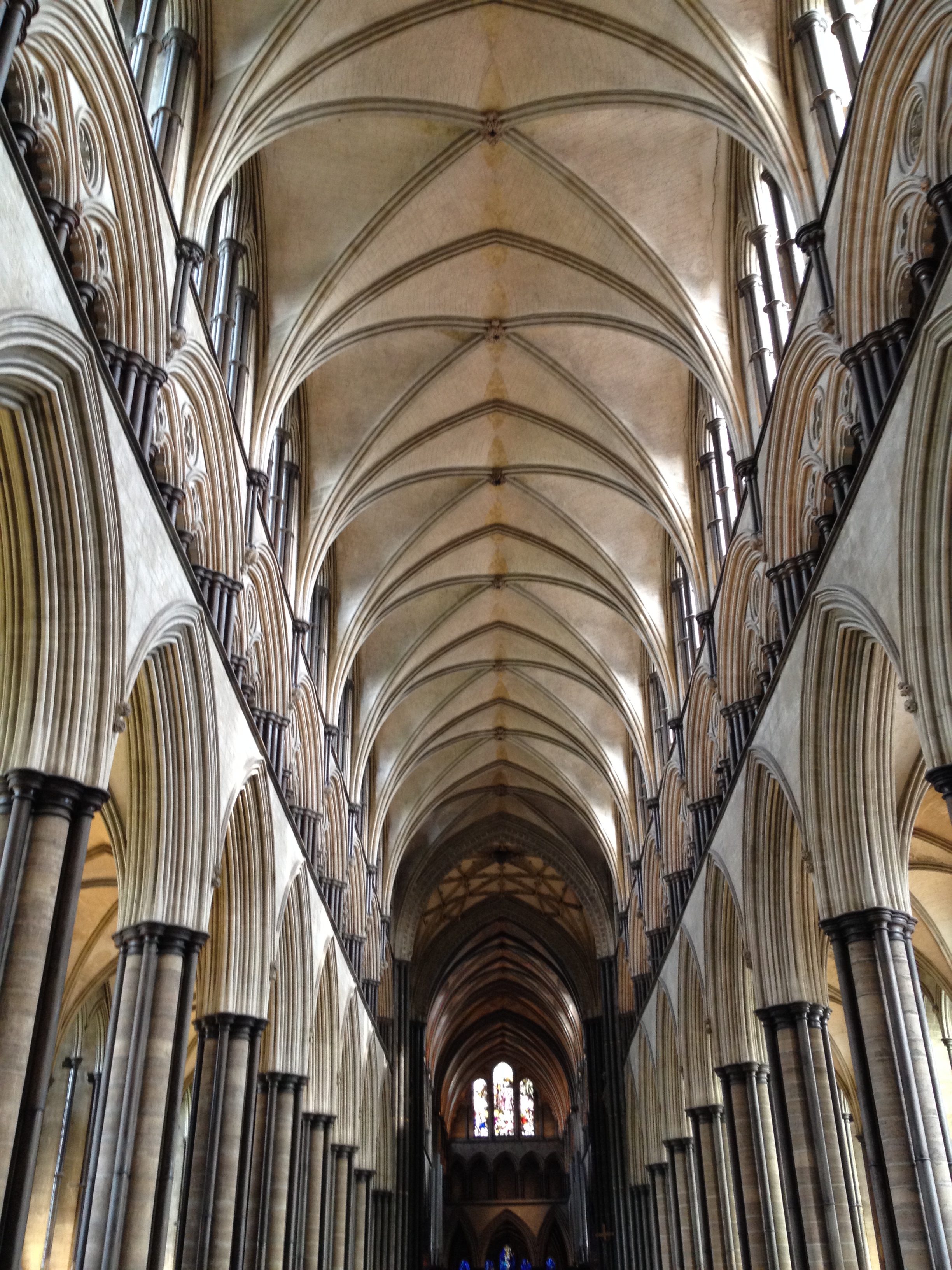
The Mompessons must enjoy their view of the very beautiful Gothic ceiling of soaring Salisbury Cathedral. If those wonderful arches were my view, I’d keep my eyes wide open too.

IMG_1224

Salisbury is one of my very favorite cathedrals.  I’m looking forward to entering its welcoming doors again.

Join me next time for more explorations in the art and history of Europe and the British Isles!

Maria Christina: She Even Got the Canova!


MariaChristinaCanova The Augustinian Church, adjoining the Hofburg Palace in Vienna, contains one of the saddest and most grandiose memorials I’ve ever seen.  It occupies a huge section of wall space in the family church of the Habsburgs. It was exquisitely sculpted by the great Italian artist Antonio Canova in 1805 and remains one of his most famous works.  A procession of downcast mourners slowly climbs the stairs toward an open doorway with nothing but darkness inside. Gazing into the void of that black space is truly terrifying.


MariaChristinaCanova2

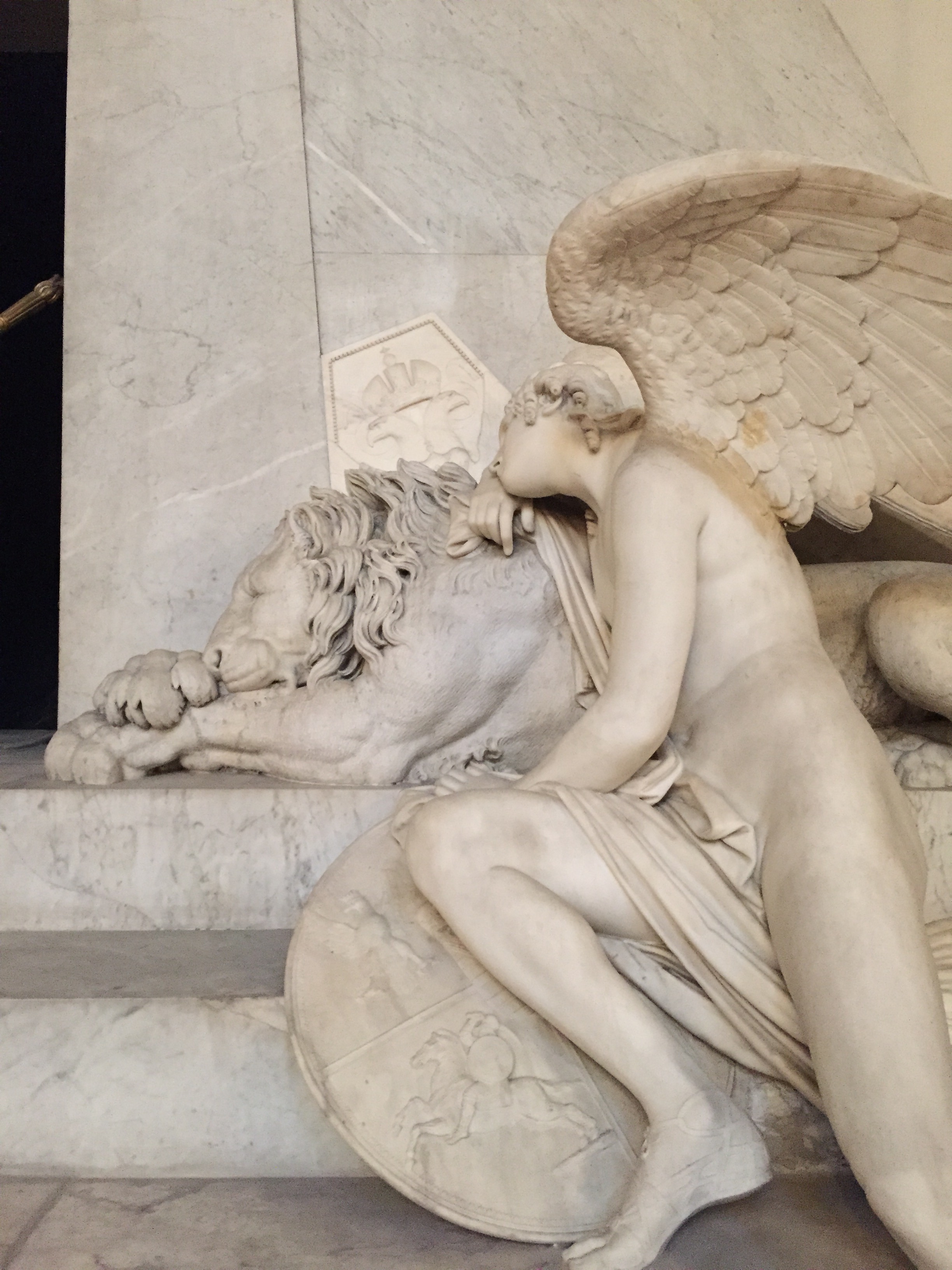
A tearful lion lies beside the doorway, disconsolately resting his mighty chin on his paws.  A handsome male angel leans on the lion’s back, clearly overcome with grief. The whole structure is in gleaming white marble. Canova’s funeral monuments were mostly for Popes and Venetian nobles, plus a small one for the British war hero Horatio Nelson. Most people agree that the monument in the Augustinian Church in Vienna is the grandest and most beautiful of them all.

Maria Christina

Maria Christina

This masterpiece honors a woman who never did much of anything: Archduchess Maria Christina, favorite daughter of Empress Maria Theresa. After her death at age 56, her husband (flush with wealth lavished on the couple by the Empress) commissioned the monument.

Who is buried in Maria Christina’s tomb?  No one.  She is actually buried in the Imperial Crypt along with the rest of the Habsburgs. But apparently her husband, with the blessing of her mother, wanted everyone who attended church at the Augustinian to be reminded of her loss.

I can’t help thinking of Marie Antoinette, the unfortunate younger sister of Maria Christina. After her beheading, she was unceremoniously thrown into a common pit along with other victims of the Terror in Paris.  Reportedly, when Maria Christina heard of her sister’s gruesome death, she remarked, “She never should have married.” Of course Marie Antoinette had nothing to say about whether or whom or when she married, unlike the more fortunate Maria Christina.

Why did Maria Theresa favor one daughter so highly, out of all her 16 children?  Was Maria Christina possibly the most intelligent?  If Maria Christina had been the daughter sent off the France, might she have been intelligent and strong-willed enough to persuade Louis XVI, a bit of a dim bulb, to accept some reforms before mobs marched on Versailles? Failing that, might she have persuaded Louis XVI to decamp to a safe haven until things cooled down at home? As it was, he ignored many chances to escape.  When he finally decided to make a run for it, the carriage he chose  was a huge lumbering vehicle that stuck out like a sore thumb on the rural roadways of France.  The royal family was captured and hauled back to prison in Paris.

A previous post about the Augustinian Church is at:

https://castlesandcoffeehouses.com/2014/12/01/habsburgs-hatc…and-dispatched/

Previous posts about Marie Antoinette are at:

https://castlesandcoffeehouses.com/2014/03/21/another-tragic…rie-antoinette/

https://castlesandcoffeehouses.com/2014/12/02/marie-antoinet…dow-treatments/

Theresia11-12

Maria Theresa was not the most fair or loving mother, but she had her good points.  I wrote about her at:

ttp://castlesandcoffeehouses.com/2014/04/16/maria-theresa-…-lean-in-woman/

Join me next time for more explorations in the art and history of Europe!

Remembrance of Wars Past: A Sea of Poppies at the Tower of London

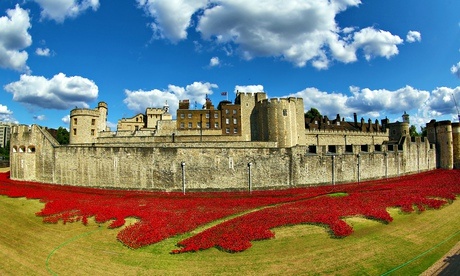
Ceramic poppies fill the Tower of London moat

“Blood Swept Lands and Seas of Red” is the title of an art installation taking place at the Tower of London from August to November of this year, the 100th anniversary of the outbreak of the First World War.  The title comes from a poem written by an unknown soldier. People are invited to buy a ceramic poppy for the installation, up to a total of 888,246 poppies, one for every death in the British forces. The photo above is from The Guardian at http://www.theguardian.com/world/2014/sep/01/tower-of-londons-ww1-remembrance-installation-share-your-photos-and-videos. The designer of the installation is Tom Piper.  Poppies are made by ceramic artist Paul Cummins.

The poppy above was photographed in the small military museum on the estate of Hever Castle, southwest of London.

TownMemorial

The memories of World War I extend all over England this year, into the smallest villages in the country. Most towns have a memorial built to remember the local soldiers fallen in the
“Great War.”  Sadly, within a few short decades new names had to be added from each town, with the outbreak of the Second World War.

Soldiers who fell in battle were buried in identically marked graves, regardless of their social or military rank.

SoldierAge19

Many grieving families put up special memorials to their loved ones close to home. This plaque, in Salisbury Cathedral, poignantly remembers a nineteen-year-old soldier, Edward Wyndham Tennant. the son of a lord. He must have entered the war as an officer. He died in the Battle of the Somme in 1916. On the plaque above his marble relief portrait, a fellow soldier describes the young man’s leadership:  “When things were at their worst he would go up and down in the trenches cheering the men; when danger was greatest his smile was loveliest.”

RedCrossNurse

Those who could not fight helped the war effort in other ways, in both great wars.  All of the great British country houses I’ve visited on this trip have displays recalling their days as hospitals or military bases. Operating rooms were established in kitchens, and convalescent wards occupied Great Halls. Young aristocratic women rolled up their sleeves and cheerfully served as nurses.

Wreath2

This is a year for Britons to recognize the sacrifices of those who served their country in the Great Wars.