Dancing into the 20th Century


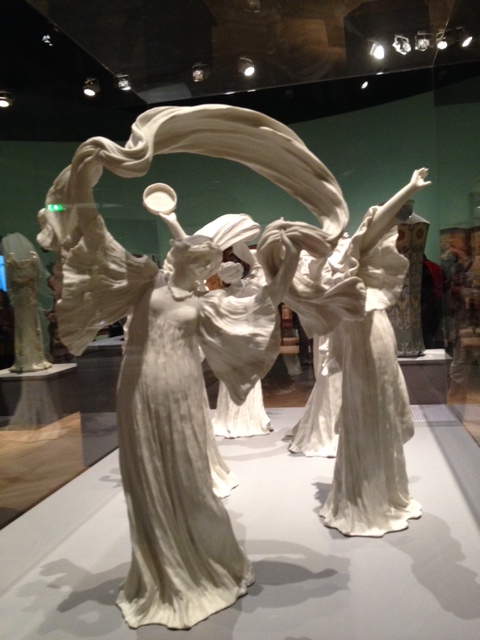
PorcelainDancersThese porcelain dancers from the Paris 1900 Exhibit, in the Petit Palais of Paris in 2014, epitomize the ideals of beauty of the period:  slender, tall, and above all, in graceful motion. The corseted and bustled female form was gone; in its place was a slender silhouette, able to move about the world with new freedom.

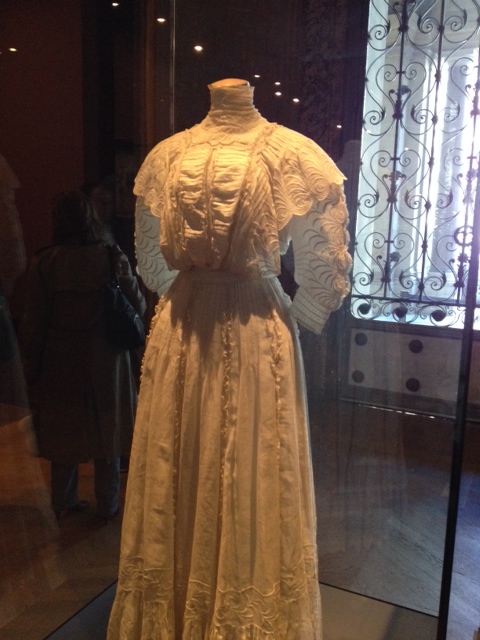
DressFront

Fashionable women of the period cultivated similar ideals as they went about their daily lives. The corseted and bustled female form was gone; in its place was a slender silhouette, perfect for the modern woman.

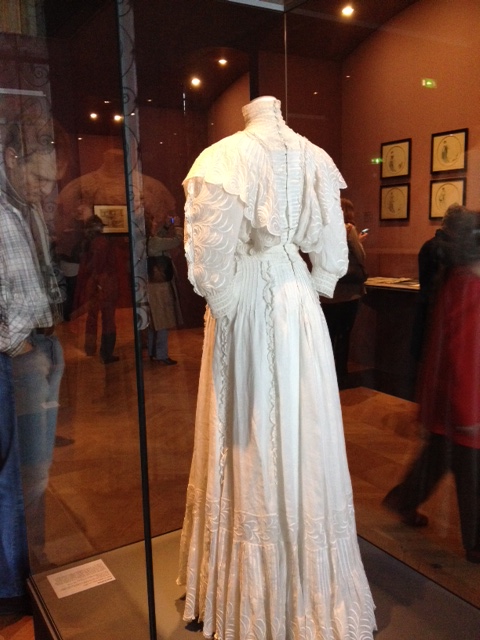
DressBack

Coming or going, the fashionable woman of 1900 exuded femininity and grace.

Paris: Sin City 1900

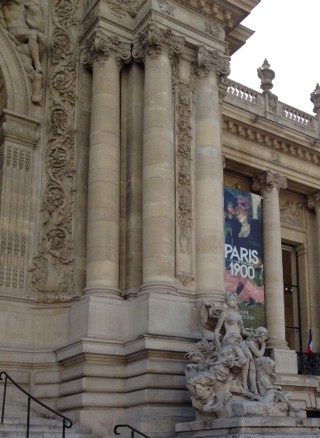
P1900PosterOne of the best reasons to travel to Paris is to take in the special exhibits. This past April, I loved the exhibit called “Paris 1900” at the very grand Petit Palais. In 1900, a huge exhibition occupied 500 acres along the Seine River, at the same time that the very first line of the Metro opened.  The exhibition was a celebration of Paris as THE world center of art, innovation, technology, and above all entertainment. Entertainment in Paris 1900 ran the gamut from sublime theater performances to dance halls to houses of prostitution, tailored to all segments of society.

Annoyingly, all the exhibit captions were in French only.  I had to call on my translating skills, which are pretty good but not great. There was an audioguide, but I was short on time.  (When is there ever enough time in Paris?)

"Redemption," Public Domain

“Redemption,” Public Domain

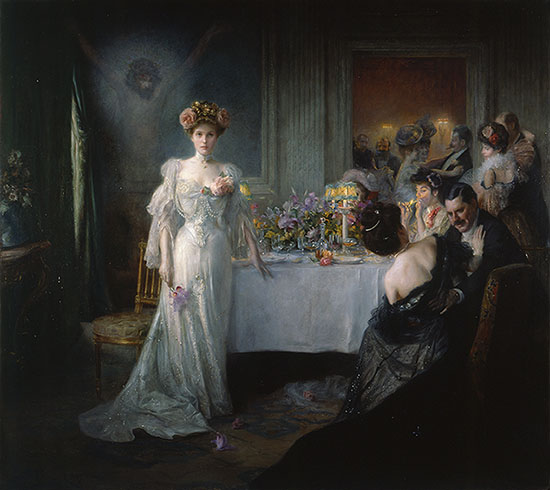
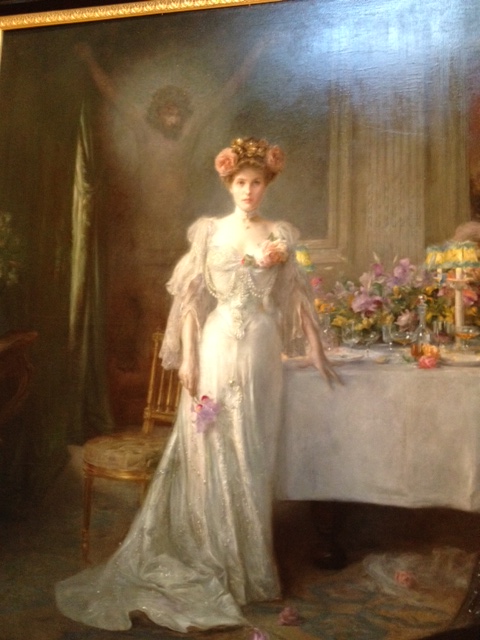
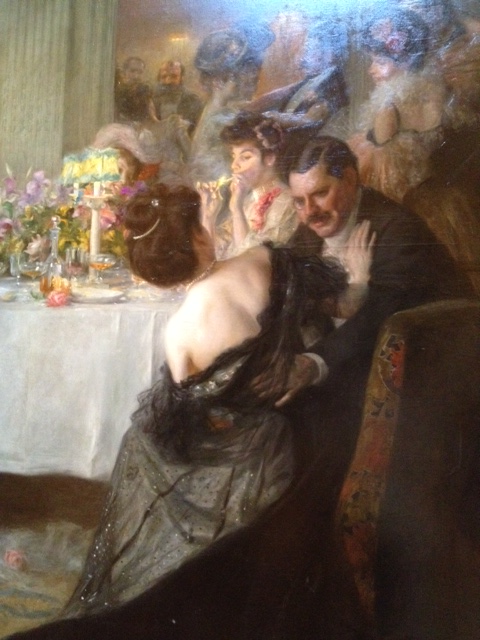
A gorgeous large painting by Julius LeBlanc Stewart poignantly depicts the intersection of high life and low life in the fast-and-loose period known as the Belle Epoque. The title is “Redemption,” painted in 1895. Stewart was an American.  Along with his fellow American, the more well-known John Singer Sargent, he made a nice living doing portraits of society figures. This is a genre painting, on the theme of the repentant prostitute.

Nightlife1

A beautiful young girl, dressed in white, stands alone at one end of a dinner table–or rather, probably a table set for supper during a ball. Will this girl make an advantageous marriage?  Or possibly she already has escaped her former life, and hopes she will not be found out. She looks vulnerable, ready to flee.

Nightlife2


At the other end of the table, a portly gentleman is working on seducing a bare-shouldered woman.  She holds him off with one hand–but for how long?

Join me next time for more explorations into the art and history of Europe!


A Woman Who Could Hold Her Own

MmeBru

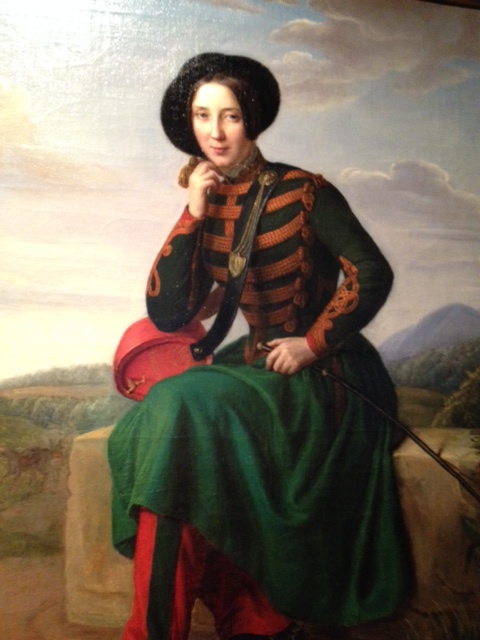
Among the hundreds and hundreds of stiff military portraits and battle scenes in Les Invalides, the military museum in Paris, this sturdy but friendly woman stands out.  She was Madame Bru, one of the few respectable women allowed and even encouraged to follow the French army. She was known as the “cantiniere” of the 7th Regiment of Hussars.  She and no doubt some other women like her organized mobile canteens which provided the soldiers with food, drink and tobacco.  Many times, they also served as nurses. They were sometimes awarded military medals for their services. Madame Bru, painted in 1837, was no doubt a beloved figure in “her” regiment.

Join me next time for more explorations in the art and history of Europe!

Is That You, Lorenzo?

Lorenzo de'Medici, after Andrea del Verorocchio, 1480

Lorenzo de’Medici, after Andrea del Verorocchio, 1480

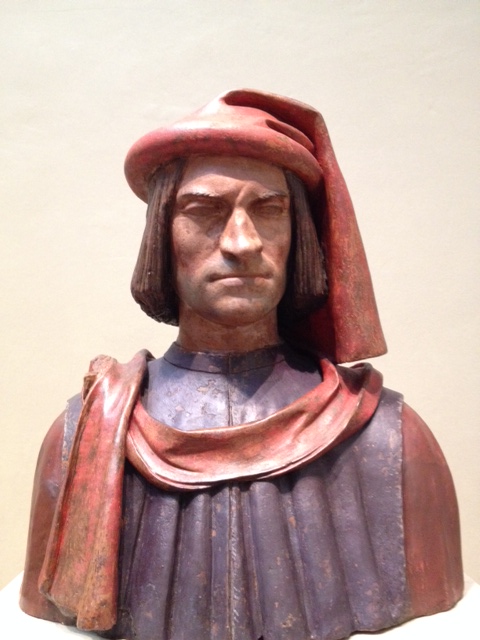
I was startled to see a familiar-looking face among the treasures in the National Gallery in Washington, D.C., and even more startled that I actually knew his name.  It was Lorenzo de’ Medici, known during his lifetime as “Lorenzo the Magnificent.” His image appears all over Florence, Italy.  He lived from 1449 to 1492. This likeness is in painted terracotta.  Reportedly his brother Giulano was much better-looking, but Lorenzo was the one groomed for power.

Lorenzo inherited his family’s banking fortune, built up starting with his grandfather, Cosimo.  The Medicis were great patrons of the arts in the Renaissance, and Lorenzo was privileged to take over the family fortune at about age 20.  He continued  and even expanded his family’s tradition of supporting great artists like Sandro Botticelli and Michelangelo.

Madonna del Magnificat, Botticelli, Public Domain

Madonna del Magnificat, Botticelli, Public Domain

It was common for artists to use members of their patron families as models. In this Madonna by Botticelli, Lorenzo’s mother Lucrezia, a poet and patron of writers, is the Madonna. Lorenzo is the young man obligingly holding the inkpot.

At the time he took over, the family’s banking fortunes were already in decline due to overspending and political struggles. Still, Lorenzo used his wealth, political pull bribes and various strong-arm techniques to maintain a fragile peace among the notoriously fractious rich families of Italy.  His lifetime was known as the “Golden Age of Florence.”

Like his father and grandfather, Lorenzo was the de facto ruler of Florence, important enough and annoying enough to some people that he came very close to being assassinated. On Easter Sunday 1478, he and his entourage were attacked–in Florence Cathedral.  The conspiracy was instigated by the rival Pazzi family, and backed by the Archbishop–and even by the Pope. Giuiano was killed, but Lorenzo escaped with only a stab wound. After he died (later, peacefully), things went downhill for the Medicis in Florence.  In fact, Lorenzo’s successor was known as Piero the Unfortunate.

Join me next time for more explorations into the art and history of Europe!

An Art-Deco Lady in Green

Lempicka Green

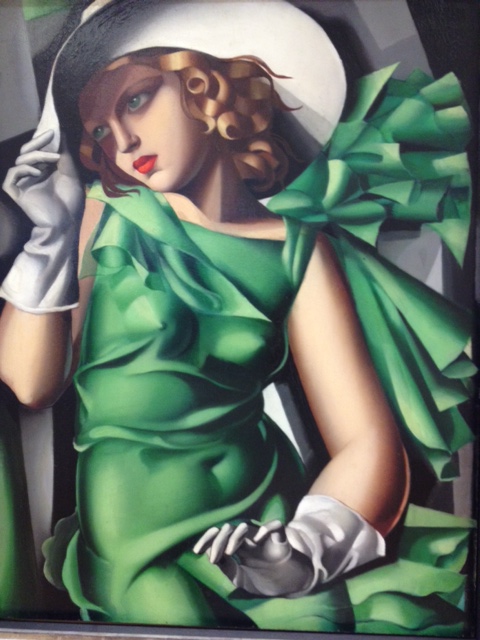
Tamara de Lempicka painted this portrait, “Jeune Fille en Vert,” between 1927-1930. It’s part of the collection of the Pompidou Center in Paris.

The artist was born to Polish-Russian aristocrats in 1899.  Just before the Russian Revolution, she married a well-known lawyer/playboy. He was arrested during the Revolution.  She managed to rescue him from prison and they made their way to Paris, where their money soon ran out.  Tamara began painting as a way to support her family, which by this time included a daughter.

She developed a unique personal style perfectly suited to the Art Deco aesthetic of the Jazz Age.  Her paintings showed the influence of Picasso’s Cubism, combined with Italian Old Masters, which she had been exposed to when she lived with her wealthy grandmother as a teenager in Italy. Soon Tamara was in great demand, charging large fees to paint society figures and even the crowned heads of Europe.

She was wild and difficult, though.  She hobnobbed with the bohemian artist community in Paris, but at the same time conducted a frenetic social life in the highest social circles.  It seems she never really fit in with either group. Her first marriage did not last, and she neglected her only child.  She remarried and moved to the United States, where once again she was in demand for a time, painting portraits of movie stars and society figures.

Eventually, her work fell out of fashion and she retired from painting.  In the 1980s, her work was in demand again. Now, her paintings once more command high prices.

LempickaCover

A recent biography by Laura Claridge sounds like a very entertaining account of this colorful woman’s life.  The title is “Tamara de Lempicka: A Life of Deco and Decadence.” I’m hoping it will soon be available as an eBook. Right now, it seems to be only available in hardcover and paperback, from Amazon. A review is at http://www.nytimes.com/books/99/10/24/reviews/991024.24vincent.html

Join me next time for more explorations into the art and history of Europe!

The French Resistance

Lately I’ve written about two very different members of the French Resistance in World War II: Marguerite, the daughter of the artist Henri Matisse, and Jean de Noailles. How did just a small number of people find the courage to actively resist the tyranny of the Gestapo in France, when most French citizens went about their lives hoping to avoid danger by collaborating with or ignoring the German occupiers? The reasons seem to be as varied as the people themselves.

ArmyCrime

I recently watched an absorbing 2009 film about the Resistance. It is semi-fictional, based on the courageous real-life actions of real people, supplemented by some fictional characters and situations.  The fictional characters serve to humanize the bare-bones stories of the resistance fighters. The director was Robert Guediguian.

The film, which is in French with subtitles, begins with a busload of ordinary-looking people riding through Paris on a sunny day.  They gaze out the bus windows, make small talk, joke with each other, or keep to themselves.  I somehow missed the subtitles, so not until the end of the film did I realize the heartbreaking reason these 22 people were riding that bus.

Next, we see the events that led to that bus ride in 1944, just a few weeks before Paris was liberated. Back in 1941, at the beginning of the German occupation, a ragtag group of resisters began wreaking havoc on the German occupiers. Their leader was the real-life Missak Manouchian, an Armenian poet who was at first ready to die, but not to kill. That changed.

A large number of Resistance fighters were not French. Some of the fighters were Jews; many were Communists. All were implacable enemies of the German occupiers, willing to make the terrible choices dictated by resistance. Even knowing that they were losing the war, the Germans used them in a propaganda campaign which called them an “Army of Crime.” Red posters featuring them appeared all over France in the days before their executions.

Marguerite Matisse and Jean de Noailles are featured in my previous posts,  https://castlesandcoffeehouses.com/2014/07/15/marguerite-a-feisty-daughter/ andhttps://castlesandcoffeehouses.com/2014/06/10/jean-de-noaill…nch-resistance/.  


Photo from NYT review cited below

Photo from NYT review cited below


A review of “Army of Crime” is at http://www.nytimes.com/2010/08/20/movies/20army.html?pagewanted=all&_r=0. The film is streaming on Netflix.

Join me next time for more explorations into the fascinating history (and art) of Europe!

Marguerite: Henri Matisse’s Feisty Daughter

MatisseDaughter

This past April at the Pompidou Center in Paris, I was charmed by this portrait: “Marguerite au Chat Noir,” or “Margaret with Black Cat.”  The young lady was the daughter of Henri Matisse.  He painted this portrait in 1910 and exhibited it in Berlin at the Secession show, and subsequently at the Armory Show in New York City in 1913. The portrait was considered radical and bold in its time; it still is, no less than its model. The artist kept this particular painting in his own possession, and his family has kept it since his death in 1954.

Marguerite was the artist’s only daughter.  He portrayed her many times, no doubt thankful for every moment he spent with her.  At the age of 6, she nearly died of diptheria.  After that, she generally wore either high-necked clothing or a ribbon to cover the scar from the emergency tracheotomy during that illness.

Marguerite grew up to be a brave woman. In 1945, she was arrested and tortured by the Gestapo for her activities in the French Resistance.  She somehow escaped from the train taking her to a concentration camp.  She died in 1982, at age 87.

I wish I could have seen a show in Baltimore last fall, “Matisse’s Marguerite: Model Daughter,” at the Baltimore Museum of Art.  A description of that show, by Tim Smith, is at touch.baltimoresun.com.

Join me next time for more explorations in the art and history of Europe!

“The Age of Innocence”

The_Age_Of_Innocence

One movie I’ll watch over and over:  “The Age of Innocence,” directed by Martin Scorcese in 1993.  It’s a gorgeously realized version of the great novel by Edith Wharton.

It stars Daniel Day-Lewis as Newland Archer, a passionate but repressed man of New York’s upper classes.  His life seems tranquil, with its course set in stone by his engagement to the lovely and sweet May Welland, played fetchingly by Winona Ryder. But her beautiful cousin, Countess Ellen Olenska, played by Michelle Pfeiffer, returns to New York in flight from a terrible marriage to a Polish count who has stolen her fortune and abused her.

Newland, the family lawyer, helps the Countess get legally free of the Count, but falls hopelessly in love with her, and she with him.  It’s touch and go, but he honorably chooses to marry May as planned. The story is about the terrible costs of following social convention instead of following one’s heart.

The movie was nominated for several Academy awards, and won for Best Costume Design.  The acting and storytelling are flawless.  The fine actress Joanne Woodward supplies the ironic but compassionate narration, beautifully weaving in the words of Edith Wharton herself. After several viewings, I still tear up at certain points.

Join me next time for more explorations in the art and history of Europe, which has often intertwined with American history.

Edith Wharton’s Own “Age of Innocence”

WhartonChild

In the National Portrait Gallery in Washington, D.C., I loved this charming portrait of the American author Edith Wharton as a small child.  She grew up as a privileged daughter of a wealthy and well-connected family in New York in the late 1900s.  In fact, the expression “keeping up with the Joneses” was said to refer to the family of her father, George Frederic Jones.

Her life was not easy, though.  She always rebelled against the confines of her social class.  in 1885, at age 23, she made what seemed like a good marriage to Edward Wharton, 12 years her senior, who seemed to share her curiosity and love of travel.  However, he suffered from severe depression which finally turned into very serious mental illness.  Eventually they divorced. Edith never remarried, but took up with a journalist, Morton Fullerton.

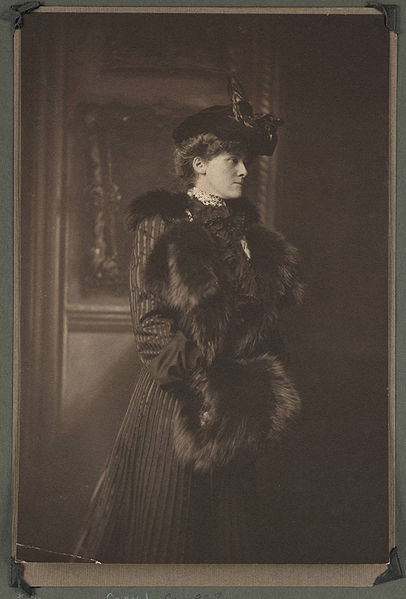
406px-Edith_Newbold_Jones_Wharton_in_hat_with_fur_muff

Edith spent much of her life in Europe, where her satirical view of her upper-class social circle only sharpened. She wrote many novels and short stories.  “The Age of Innocence” was one of her most popular novels.  She received the Pulitzer Prize for it in 1921, making her the first woman to win the award.  She was also nominated for the Nobel Prize for literature in 1927, 1928 and 1930.

Any novel by Edith Wharton is a perfect travel companion.  “The Age of Innocence,” about an impossible romance between a European noblewoman and a strait-laced New York man, is one of my favorites. It’s on my e-reader, ready to dip into on my next trip!

The Real Pocahontas

Pocahontas

I could spend many hours in the National Portrait Gallery in Washington, D.C. I recently encountered Pocahontas there.  The portrait is by an unknown artist, dating from about 1616. It was made from an engraving of Pocahontas during her trip to England as a young bride.

Pocahontas was a Native American “princess,” the daughter of Powhatan. Her father was a sort of chief of chiefs, heading many tribes in the tidewater area of what is now Virginia. As a perk of his high position, Powhatan reportedly married women from all the different tribes, kept each one until she had produced a child, then sent them home without the child. By all reports, Pocahontas was a favorite child of his.

Relations between the Native Americans and the English were sometimes friendly and sometimes hostile–no wonder, since the aim of the English was to exploit the resources of the “New World.”  When I was growing up, every American school child heard the endearing story of how an Englishman, John Smith, was about to be executed by Powhatan (by having his head bashed between two large rocks). Pocahontas, then about 12 or 13, threw herself on the Englishman and begged her father to spare his life.

From the bare bones of this story, there are not one but two Disney movies.  The real Pocahontas was captured by the English during a hostile period in 1613.  While in captivity, she converted to Christianity, and chose to stay with the English when she was offered freedom.  She took the new name “Rebecca.” Shortly afterward, she married an English tobacco planter, John Rolfe.

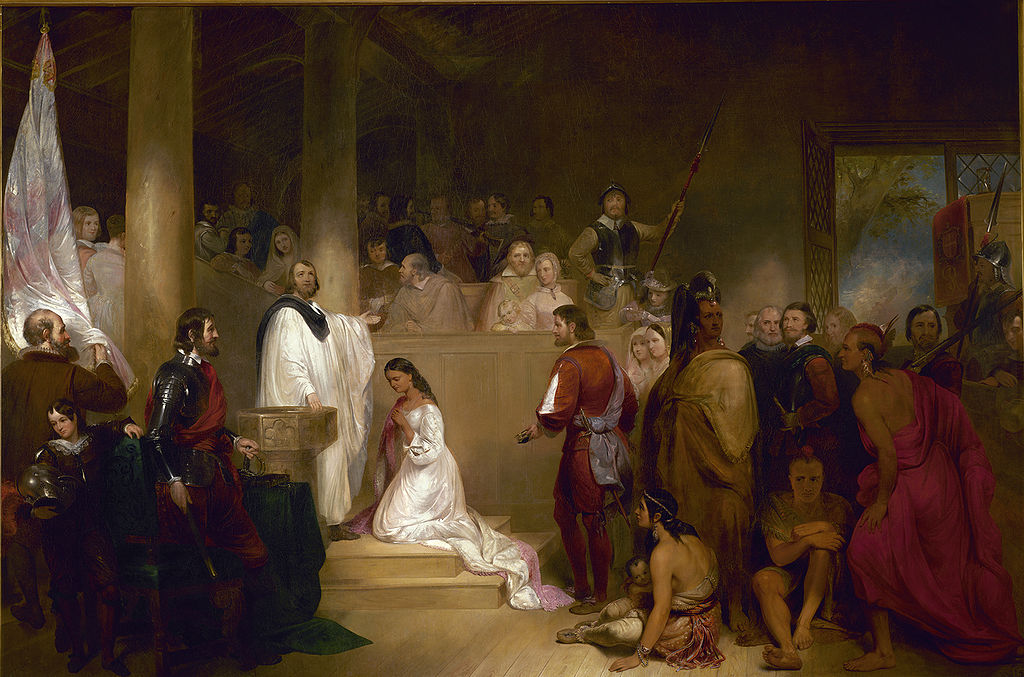
Baptism of Pocahontas, John Gadsby Chapman, 1840, Public Domain

Baptism of Pocahontas, John Gadsby Chapman, 1840, Public Domain

Her baptism and marriage were portrayed in 1840 by the American historical painter John Gadsby Chapman. The painting shows the groom just behind Pocahontas.  Her brother, in Native American dress, is turning away, presumably in disapproval.

The young bride gave birth to a son, Thomas Rolfe.  Then she and John Rolfe journeyed to England in 1616.  She was a bit of a sensation, presented as an example of the “civilizing” effect the English hoped to have on all the native peoples.  She died in England, at the age of only 21 or 22.

The descendants of Pocahontas, through her son Thomas Rolfe, include many notable Americans such as Edith Wilson, wife of Woodrow Wilson; Admiral Richard Byrd; Virginia Governor Harry Byrd; socialite Pauline de Rothschild; Nancy Reagan, wife of Ronald Reagan; and many others.

Join me next time for more explorations in the art and history of Europe!