Category Archives: England

Britain’s Best Travel Bargain

Polesden Lacey, Tyntesfield, Dunham Massey, Cotehele, Castle Drogo, Wightwick Manor, Charlecote Park, Baddesley Clinton… just listing these names gets me itching to buy a plane ticket immediately.  And there are hundreds more.  All these places are part of Britain’s National Trust.  These are just a few of my favorite country homes to visit.  I could cheerfully spend an hour or a day at each one, but another one just down the road always beckons. There are wonderful nature preserves too, and several properties in London.

Tyntesfield, a glorious Victorian mansion

Tyntesfield, a glorious Victorian mansion

The British–including Wales and Scotland–are the best in the world at preserving historic properties.  I’m told the Irish are great too, but I’ve yet to visit Ireland.  (English Heritage is a related organization that also sells passes.  It seems to concentrate more on historic sites that might be in ruins.  I find that for my passion, country homes along with their art and furnishings, the National Trust is better.  With unlimited time in Britain, I would buy both).

Over the years, as economic conditions changed drastically, families who could no longer afford to maintain their beautiful country homes had to face hard realities.  Some, like the Cavendishes of Chatsworth, were able to turn their at least some of their properties into money-making enterprises.  Others sold them and divided the profits among the heirs.  (Many of these properties ended up as golf clubs, upscale hotels, or homes for rich rock stars, and the history was pretty much lost).  Other families generously planned to transition their homes and treasures into historic sites we can all enjoy.  The National Trust of Britain does a stellar job of preserving and maintaining these properties.
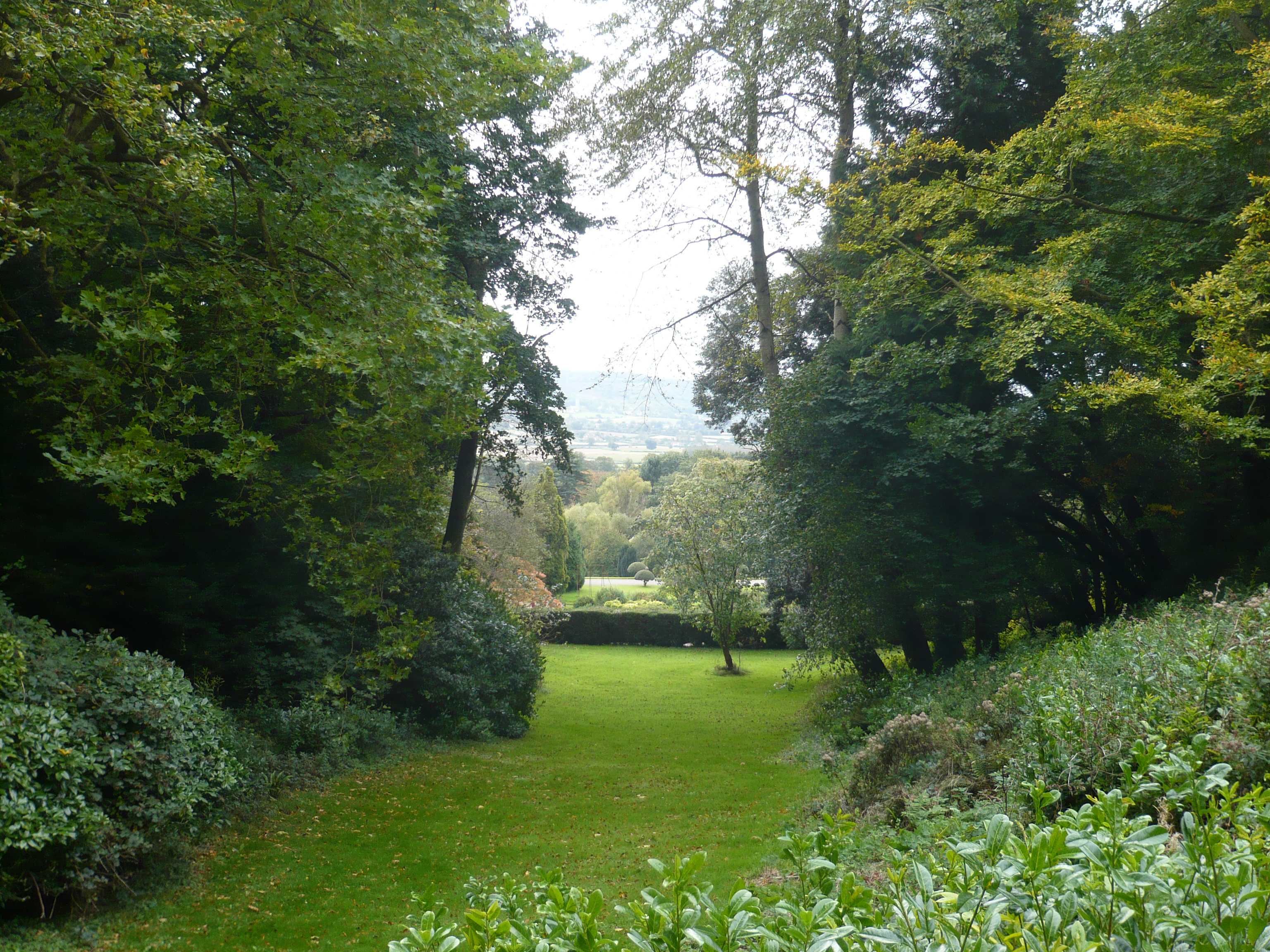
A misty morning on the grounds of Tyntesfield

A misty morning on the grounds of Tyntesfield

Money comes from the National Lottery, generous donations, memberships and the fees visitors pay.  Much of the work is done by dedicated volunteers.  Houses are staffed by kindly local people, standing patiently for hours in old rooms and gardens.  (I always think of Britain as the world headquarters for sensible shoes).  The Trust produces lovely, detailed and reasonably priced little guidebooks which they sell at each property.  They are temptingly slim and easy to stash in a suitcase.

Many of these properties have delightful tearooms.  Fancy a lunch of Stargazy Pie? Toad-in-the-Hole?  Bubble and Squeak?  Or maybe just a nice pot of tea for you, dear.  Perhaps a lovely warm Apple Crumble to go along with it?  The British love their Days Out in the countryside, and it’s a joy to join them.

If I had to choose my very favorite trip to dream of, it would be a very close contest between two:  Vienna in December, or the English countryside in the spring or fall.  Of course I’m blessed with an intrepid husband willing to drive “on the wrong side of the road” while sitting behind the wheel “on the wrong side of the car.”

The best travel bargain in Britain:  the Touring Pass from the National Trust.  It’s available for either 7 or 14 days, at prices ranging from $38 to a high of $90 for an entire family for 14 days. The pass comes with a wonderfully detailed book, including maps, directions, and opening hours.

NatTrustHandbook

Just looking at the maps, with treasures dotted all over England, makes me want to get out my own sensible shoes and travel.  For American visitors, there is also the related Royal Oak Foundation.  A year’s membership for a couple is $95.  It includes all entries to National Trust properties, plus a very nice magazine and various special events in the U.S., mostly it seems in New York.

Alas, I have other plans this year and won’t make it to England.  I guess I’ll have to revisit my favorite places using my photos and guidebooks.

Join me next time for more explorations into the art and history of Europe and the British Isles!

Briticisms

One day in London, I was standing in a customer service line at Harrod’s.  The well-dressed woman in front of me was unhappy with the answers she was getting from the man behind the counter.  I heard the woman say icily, “I find your attitude most reprehensible.”  The man behind the counter, amazingly, blanched, looked around to see who was watching, and gave her what she wanted.  That’s England.  An American customer in the same situation might say, “Hey, gimme a break” or “I want to see your supervisor, ” only to be met with a blank stare.  The British still have a whole layer of civility that Americans are sadly lacking.

Brits take pride in their wit.  Once at Blenheim Palace, I paid extra for a tour of the family’s private quarters–always worthwhile, anyplace it is offered.  The tour guide provided a running commentary about the family’s foibles, as he guided us through grand but surprisingly shabby rooms (Brits still honor “old money,” and Blenheim is about as old as it gets). Someone asked the guide whether the college-age heir hung around the palace he would someday inherit.  “Well,” he replied, “he’s off somewhere having his gap year, don’t you know, but every now and again he stops by and strikes the place a glancing blow.”

Some expressions are just amusing because they’re different.  A trash can is a “rubbish tip.” To be careful when stepping onto a subway car is to “mind the gap.” The equipment needed for, say, a long hike, is “all the kit you need.” An airline attendant might look at an excessive amount of luggage and say, “I’m afraid you can’t bring all that lot.”  If I thought my suitcase was especially heavy, I could say “That thing weighs 10 stone” (140 pounds, at 14 pounds to the stone). To give something a try is to “have a go.”

The Brits have some wonderfully descriptive terms, too.  I like to call myself a “dogsbody” when I find myself doing some menial task no one else wants to do.  When totally amazed, I might say I’m “gobsmacked.”

In the films of Laurel and Hardy, the contrasts between the American Oliver Hardy and the Englishman Stan Laurel account for a lot of the humor.

It’s especially amusing that the Englishman, who aside from his dopey expression looks slim and elegant, is childlike and dim.  He’s always asking unanswerable questions.  The  tubby American is equally clueless, but he doesn’t know it.  So he is ridiculously pompous.

All this has left me feeling a bit knackered.  Maybe it’s time for a bit of a lie-down!

Thrifty Duchesses

Like every other Anglophile, I’m breathlessly waiting for Kate, Duchess of Cambridge, to give birth to a new royal heir.  In the meantime, I’m admiring her common touch–she is, after all, a commoner.  This week she made fashion news by wearing a maternity dress costing L17.50 (about $27), off the rack at a chain called Asos.  Naturally, thousands have been sold.  As far as I can see, she has not put a foot wrong in all the years she’s been Prince William’s main squeeze.

I admire another duchess from an earlier generation, too:  Deborah Devonshire.  She was born into a family of not-very-rich minor aristocrats, the Mitfords.  There were six girls and one boy, and very little money to support them all.  Only the son was properly educated; the girls were expected to marry well.  They begged to go to school and were put off. They were given London debutante seasons instead. But they were all beautiful, brilliant and creative.  So they made their own way in the world.

To make ends meet, Deborah’s mother sold eggs.  Her father dreamed of striking gold in Canada.  In spite of several trips where he personally dug for gold, it never happened for him.  Deborah was the youngest of the family and was considered a little dim as a child.  Nothing could have been further from the truth.

In my last post I described how Deborah became Duchess of Devonshire when the heir to the Cavendish title and property was killed in action in World War II, and then the sitting Duke died unexpectedly.  The dreaded Death Tax took effect:  the authorities demanded millions of pounds, reportedly about 80% of the total value of the inherited estate.

Deborah personally took charge.  The Cavendish family seat, Chatsworth, had always welcomed tourists.  After all, grand country homes were meant to be seen and admired.  Traditionally, the housekeeper conducted tours–for only the right sort of people, of course–and was allowed to keep the resulting tips.  Many housekeepers saved enough money to eventually open their own shops. (In Downton Abbey terms, think of Mrs. Hughes discreetly pocketing money from well-to-do tourists).  The housekeeper was responsible for vetting the tourists who rang the doorbell.  I’m thinking baseball caps, Bermuda shorts and fanny packs would not make it inside.

Anyway, when Deborah took matters in hand, the only facility to welcome tourists was a water tap outside.  That tap still exists.

Water tap outside Chatsworth

Water tap outside Chatsworth

But Deborah decided that people like to buy things, and they like to eat.  She created a restaurant and extensive gift shop, now so large and full of delights that it’s a destination in itself. She created a Farm Store (think a very exclusive Whole Foods, with everything in it produced on the grounds of the estate). She created a children’s farm, where city kids can learn how their food is produced. She oversaw a huge renovation of the grand house.  She created placards describing the house’s treasures. She began formally charging admission and hiring staff to guide tourists. She created guidebooks and eventually audioguides, with help from historians and art experts. She wrote about a dozen books, about the property and about her colorful life.

Today, a visit to Chatsworth can keep a visitor happy for an entire day.  One of my purchases at the gift shop on my last visit was a wonderful book all about the Mitford sisters, The Sisters by Mary Lovell.  Reading it is a fascinating history lesson.

SistersBook

At age 93, Deborah still presides–pretty much as CEO–over the thriving enterprise she created, starting at a time when all seemed lost for the noble Cavendish family.  Let’s hear it for duchesses with good sense and a common touch!

If I Could Choose a Tiara…

My choice would be the Devonshire Tiara. It’s ensconced in a display case among many other treasures at Chatsworth, one of my very favorite English stately homes.

And my favorite wearer of this tiara?  That would be Deborah, Dowager Duchess of Devonshire. Her home, Chatsworth, has been the seat of the rich and influential Cavendish family since 1549, when Bess of Hardwick decided to settle in the area.

Bess of Hardwick was a remarkable woman who deserves a few posts of her own, along with posts about glorious Hardwick House nearby. Both houses are in Derbyshire, in the magnificent walking country that Elizabeth Bennet famously visited in Jane Austen’s Pride and Prejudice. Many people think Chatsworth was a model for Mr. Darcy’s home, Pemberly.  Jane Austen herself was staying in the nearby town of Bakewell while she was writing the novel. But I’m told that Chatsworth was actually mentioned, separately from Pemberly, in the novel. (Some scholars read Jane Austen very carefully!)

Chatsworth, like Highclere, is still in the family of the heirs to the property.  But keeping it so has been a saga of its own.  Credit in recent years goes to my favorite duchess, Deborah Devonshire.  She was the youngest of the six famous Mitford sisters.  She married Andrew, a younger son of the Cavendish family, in 1941.

When the heir, Andrew’s older brother William, was killed in action in World War II, Andrew suddenly became the heir and Deborah was in line to become the Duchess.  In 1950, the 10th Duke died and Andrew became the 11th Duke. Deborah became the Duchess.

In her memoir, Wait for Me, Deborah describes how the Cavendish family had carefully (and legally) planned to circumvent the “death tax” laws by signing over the property to the heir a number of years before the death of the sitting Duke.  But the 10th Duke died very unexpectedly just a few months short of the effective date.  So the tax blow was crushing.  Deborah rolled up her sleeves and turned Chatsworth into a thriving, money-making enterprise that still honors history and shares its glories with the public.

When the American businessman Joseph Kennedy was ambassador to England, his daughter Kathleen “Kick” Kennedy met and married William Cavendish, then heir to the dukedom.  He was killed in combat, and she died in a plane crash shortly after the war.  She is buried at Edensor, the village at Chatsworth.  President John F. Kennedy became a great friend of Deborah’s.  (I’m assuming he called her Debo, as she was always known to her friends.  I imagine she called him Jack). She and her husband were invited to his Inauguration in Washington.  She gleefully attended, but kept committing the faux pas of calling it his “coronation.”  Irrepressible–that’s how I like my duchesses!

Today, Deborah is the Dowager Duchess–which means her husband has died, a new Duke is in place, and the new Duke’s wife is the actual Duchess.  (This is the same situation as on the show Downton Abbey, where Violet Crawley, played by Maggie Smith, is the Dowager Countess of Grantham). Deborah is 93 now, the last of the famous (some say notorious) Mitford sisters.  She lives in the village of Edensor, which is part of the Chatsworth estate. She still oversees the commercial enterprise she created.  She loves Elvis Presley. And she keeps prize chickens, some of which roam the beautiful grounds at Chatsworth.

Chatsworth Chickens

Chatsworth Chickens

Join me next time for more explorations into the art and history of Europe and the British Isles, with a special emphasis on colorful personalities!

Paying the Bills at Downton Abbey

The hit show Downton Abbey is filmed at the real-life Highclere Castle, a little south and east of London in Hampshire.  The castle is still occupied by the heirs of the prominent Herbert family, who acquired the estate in around 1769.  Why not? If I inherited a castle, I would certainly live there.  But it’s not as easy as it seems.

Traditionally, keeping up a large country home required the income from at least 1,000 acres.  This meant intensive work by tenant farmers, with the heir to the property closely supervising, usually through an estate manager.  It has become more and more difficult to turn a profit in agriculture, especially since many large estates have had to sell off acreage.  One big reason is the dreaded Inheritance Tax, popularly known as the Death Tax.  The tax in approximately its present form was begun in 1894.  On the death of the landowner, the heir had to come up with staggering tax payments–often as much as the market value of the estate.  This problem only got worse during and after the two World Wars, as Britain struggled to pay the enormous costs of war.

In the 1840s, the Third Earl of Carnavon went on a building spree and ran out of money.  By the time the Fifth Earl inherited, his debts were crushing. At the time, many financially strapped aristocrats were marrying American heiresses like Cora Levinson, who became Countess of Grantham on the show Downton Abbey.  The Fifth Earl found an heiress closer to home. He married Almina Wombwell, who in spite of her name was actually the beloved biological daughter of banker Alfred de Rothschild. Lady Almina’s inherited fortune saved the house in 1895.

The present 8th Countess of Carnavon has written a book titled Lady Almina and the Real Downton Abbey.  (I haven’t read it yet!)

AlminaBook

In recent years the present Earl was able to negotiate a delay in paying the “death tax” by working out an agreement with the English Heritage organization, whereby the building and grounds are open to public visits for part of the year.  The cost of a day’s visit is about $27.  On a typical summer day, about 1500 visitors pay this fee.  (Due to the popularity of the show, reservations are booked up months in advance, but a few walk-up tickets are available). There is also a gift shop, of course. And the estate is rented out for weddings, about 20-25 per year, at rates starting at about $22,000. During filming of Downton Abbey, the film company pays somewhere around $5,000 per day.

All this seems like big money, but it costs $1.5 million to run the house for a year.  And major repairs are needed.  I’ve seen estimates as high as $18 million, and reports that the upper floors of the castle are uninhabitable. The present Countess is coming in for some criticism for cashing in on the show’s popularity, but I certainly can’t blame her.  Like the family on the hit show, she wants to preserve a property and with it a little piece of a vanished way of life.  She personally cannot even inherit, since the property will go to the son of her husband’s first marriage.  The recent article is in The New York TImes at

http://www.nytimes.com/2013/05/26/fashion/trying-to-turn-a-castle-into-a-cash-register.html?pagewanted=2&_r=0

In coming posts I will explore other ways the great country houses of England have been preserved, and revisit some of my favorites.  Join me next time!

What Jane Austen Saw

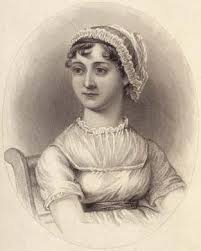
Through the wonders of technology, we are all invited to stand alongside Jane Austen at an art exhibit she attended on May 24, 1813–two hundred years ago.  The date was just a few months after the publication of Pride and Prejudice.  Jane mischievously told her companions that she fully expected to see her heroine, Elizabeth Bennet, in a portrait.  Elizabeth had just become Mrs. Darcy, of course.  “I dare say Mrs. D. will be in yellow,” Jane wrote to her sister.

Jane Austen Jane Austen

The exhibit was a retrospective of work by Sir Joshua Reynolds, who had been painting the rich and famous for decades.

In 1769 he was knighted by King George III, who appreciated the “Grand Style” in which Reynolds painted his mostly wealthy subjects.  When he painted unnamed allegorical or mythological figures, the models tended to be rich and/or famous, and everyone knew who they were.

As it happened, Jane did not find a likely image of Elizabeth.  She joked later that surely Reynolds had painted her, but Mr. Darcy must have valued the portrait too much to put it on public display.  Jane did, however, enjoy mingling with the celebrities who crowded the exhibit.  We could think of this exhibit as the very first edition of the tabloids we all see in grocery checkout lanes (and read as a guilty pleasure). Everyone who was anyone wanted to fall under the gaze of Reynolds, just as our celebrities hire publicists to get themselves on the covers of magazines.

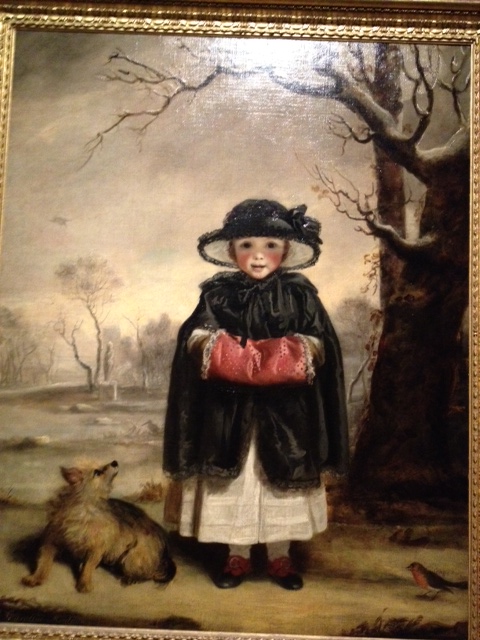
Sir Joshua Reynolds was also renowned for tender portraits of children. My very first post described one of my favorite paintings by Joshua Reynolds, “Lady Caroline Scott as Winter,” painted in 1776. The post is at https://castlesandcoffeehouses.com/2012/11/20/winter-as-a-child/. ‎The portrait is in private hands, but I saw it in a special exhibit at the Vienna Kunsthistorisches Museum two years ago.

“Lady Caroline Scott as Winter”

This child was an exact contemporary of Jane Austen.  I like to imagine that Lady Caroline attended the same exhibit, and maybe rubbed shoulders with Jane.

We tend to think of Jane Austen as a country mouse, a spinster who spent her days waiting on her family and shyly writing her novels in secret, in her spare time.  Actually, she was fun-loving, always ready for a dance or an outing. She knew all about balls and country homes because she attended many balls, large and small.  And she had relatives with grand country homes.

To enter the exhibit, go to www.whatjanesaw.org/.  The complete original catalog of the exhibit is there.  If you click on a picture, an enlargement comes up, along with a description.  If you have trouble getting into the site, go to the article below and click on the link. Historians at the University of Texas at Austin meticulously recreated the original exhibit, using accurate historical sources.  So we can see the arrangement of the actual paintings in the 3 rooms of the exhibit.  We can try to imagine Jane’s assessment of each painting–I’m hearing pithy comments, aren’t you?

There’s an excellent article about the online exhibit in The New York Times at

http://www.nytimes.com/2013/05/25/books/what-jane-saw-is-an-online-trip-for-jane-austen-fans.html?_r=0

Join me next time for more exploration into the art and history of Europe and the British Isles, with some detours into literature too!

Jeeves: the Ultimate Valet

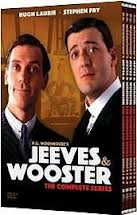
In the British TV series Jeeves and Wooster, ditsy aristocrat Bertie Wooster answers his door to find a dignified personage, his new valet Jeeves, who says, “I was given to understand that you required a valet, sir.”  As usual, Bertie Wooster’s life is in disarray, so Jeeves has arrived not a moment too soon. So begins a howlingly funny saga that says a lot about British social classes.  The series, drawn from the Jeeves and Wooster stories of P.G. Wodehouse, ran from 1990 to 1993.

JeevesDVD

Hugh Laurie, better known to American audiences as the difficult genius Dr. House, plays Bertie.  His real-life friend and collaborator Stephen Fry plays Jeeves.

The joke is that the valet is miles ahead of the aristocrat in intelligence, education, proper behavior, and common sense.  So Jeeves uses his ingenuity to pull Bertie out of one impossible scrape after another, all of them caused by Bertie’s cluelessness.

Jeeves is also at pains to save Bertie from fashion faux pas, as in this exchange, concerning an unsightly white jacket Bertie insists on wearing:

Jeeves: I assumed it had got into your wardrobe by mistake, sir, or else that it has been placed there by your enemies.

Bertie Wooster: I’ll have you know, Jeeves, that I bought this in Cannes!

Jeeves: And wore it, sir?

Bertie Wooster: Every night at the Casino. Beautiful women used to try and catch my eye!

Jeeves: Presumably they thought you were a waiter, sir.

Actually, Jeeves is much more than a valet.  Bertie is a single young man, and the time is the 1930’s when servants are becoming few and far between.  So Bertie only has one servant.  Jeeves is cook, butler, driver, valet, and guardian angel.  Jeeves knows everything. (The search engine “Ask” was originally named “Ask Jeeves”). In his spare time, Jeeves reads Shakespeare and Spinoza, and can come up with a pithy quote for every occasion.

P. G. Wodehouse wrote about Jeeves and Wooster all through his long writing career, over a span of 59 years.  Jeeves’s first appearance was in 1915 and his last in 1974, the year before the author’s death. During that time, ideas about the master/servant relationship changed dramatically.

World War I brought about the greatest change.  As in Downton Abbey, servants often accompanied aristocratic officers to the battlefield.  In the story, footman William accompanies Matthew Crawley to the trenches.

During the war, it became clear to everyone that servants faced battle with at least as much courage as their social betters.  In fact, true or not, there was a popular idea that aristocrats were much more likely to be victims of what was then called “shell-shock.”  The number of servants employed in Britain went from about a million and a half before the war to just over a million afterwards.  Those who returned from the fighting often sought better opportunities.  Wealthy families had less money to keep up their estates, too. And lampooning the rich made P.G. Wodehouse extremely popular.

One of the pleasures of watching British films is trying to recognize film locations.  One episode of Jeeves and Wooster, “Trouble at Totleigh Towers,” was filmed at–you can probably guess–Highclere, the location for Downton Abbey.  All the more reason to visit sometime!

Join me next time for more explorations into the art, literature and history of Europe and the British Isles.

Mark Rylance in Victorian England

Last week the fine actor Mark Rylance finished the Guthrie Theater run of his play Nice Fish, (co-written with the Duluth poet Louis Jenkins).  Minneapolis will miss him, but  I want to recommend his 1995 film Angels and Insects. I think I saw Mr. Rylance on stage years ago in England, but this excellent movie is the first time I remember seeing him.

AngelsMoviePoster

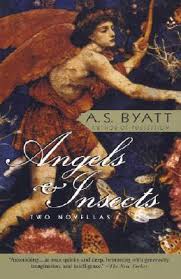
The movie is based on A.S. Byatt’s novella Morpho Eugenia, and she participated in writing the screenplay.

AngelsBook

Mark Rylance plays a penniless naturalist, William Adamson.  He is just back from years studying animals and insects along the Amazon.  Almost all his possessions were lost in a shipwreck on his way home to England, so he counts himself lucky to find a job helping a rich Victorian man catalog his own collections.  The Victorians were great ones for collections, of course.  Every respectable country home had shelves full of curiosities.

Patsy Kensit plays a somewhat dimwitted and seriously  messed-up daughter of the family.  Kristin Scott Thomas plays a razor-sharp governess.  William Adamson finds himself between them.  Of course, complications ensue.  Mr. Rylance, as William Adamson, steals every scene with his quiet dignity that clearly covers a passionate nature. He is the second-most intelligent person on the premises, and yet he falls into a trap that an outsider can see from a mile away.  As always, love is blind.

What I find fascinating about the movie is the depiction of social classes in a grand country house which is very similar to Downton Abbey.  Instead of the formal but friendly relations depicted in the TV series, the servants in Angels and Insects are supposed to either grovel or turn invisible.  When a housemaid encounters a family member in a corridor, the housemaid has to immediately turn and face the wall until the family member passes. And William Adamson has to rescue a maid from sexual abuse by a haughty family member. I have to wonder whether the TV series or the movie has the more accurate depiction of master/servant behavior.

Bedroom arrangements are interesting, too.  In Downton Abbey, Lady Mary teases her parents for sharing a bedroom. The penniless William Adamson has no such luck. When he marries the daughter of the house, he gets certain privileges, but he always knows his place. He is given a small bachelor-like room adjoining his heiress bride’s bedroom.  However, he is only allowed into her grand bedroom when she has her maid unlock the door in between.  If he is not welcome, he finds himself standing in his nightshirt before a silent locked door.

The movie was filmed at Arbury Hall in Nuneaton, Warwickshire.  The descendants of the founding families still occupy it.  It is not part of the National Trust, which in modern times means it has to be run as a money-making enterprise. Like many stately homes, it is now used for corporate events and weddings.  The neo-Gothic rooms shown on the estate’s website are grand indeed. Visiting hours are limited, but I’m putting it on my list for my next trip.

The 19th century writer George Eliot (Mary Anne Evans) was born on the estate. Her father worked as a manager there.  She wrote about the estate as “Cheverel Manor” in her book Scenes of Clerical Life.

For stellar acting and a fascinating look at Victorian life, check out the movie Angels and Insects. And join me next time for more explorations into the art and history of Europe–and the British Isles.

Why Do Americans Love Downton Abbey?

I can’t speak for everyone, but I like the show for the sheer Englishness of it.  The show actually depicts a long-vanished England, so there’s an element of nostalgia, too.  And the England depicted never did really exist except for a very tiny minority of aristocratic people and the comparatively small number of ordinary people who served them in their grand country homes.  So there’s a large element of fantasy.

Even today, as England becomes more and more diverse, I love the uniquely English expressions, habits and ways of looking at the world. For example, here is a sign that stands outside the very old, very ornate gate of the private driveway of Chatsworth House, in Derbyshire:

DeadSlowHoot

The hand-lettered sign reads “Dead Slow. Hoot.”  What does it mean?  I could not think of any legitimate reason that as a lowly tourist, I could drive up to the private gate and demand entry.  But I think the sign means that drivers are to approach the gate as slowly as humanly possible, and then  to sound their horns to be let in.  The word “Hoot” implies, of course, a decorous tap, not a prolonged blast. Apparently there is no automatic opener and no card-recognition system on the 18th-century gate.  Someone will have to run out, confer with the driver, and swing the gate open.

Notice also the gathering of people and animals beside the gate.  The wearing of practical rain gear and the watering of dogs are hallowed activities in the countryside of England. So is the visiting of stately homes–it has been a favorite pastime at least since the days of Jane Austen.  In Pride and Prejudice, Elizabeth Bennet famously changes her fate when against her better judgment she tours Mr. Darcy’s estate, Pemberly, and comes face to face with Mr. Darcy himself. Many people believe that Jane Austen based Pemberly on Chatsworth House.

I just read that the “real” Downton Abbey, Highclere Castle, is completely sold out of pre-bookable tickets for the coming opening times, mid-July to mid-September.  There are some tickets available to walk-ups, usually after 2 pm.  However, if I were traveling to England this summer, I would not let that worry me. I would go instead to Chatsworth House, and then I would go to at least a dozen other stately homes.  They’re all over England, and each has its own story every bit as fascinating as the fictional one so many of us love.

I’m going to write in coming posts about English country houses I have visited.  Join me next time for more explorations into the art and history of Europe–with the British Isles thrown in!