Category Archives: Art

Ballet Shoes and Cowboy Boots

The summer of 2013 marked the 100th anniversary of Perry Mansfield Performing Arts School and Camp in Steamboat Springs, Colorado.  The camp was founded in 1913 by two graduates of Smith College, Charlotte Perry and Portia Mansfield.  Their vision of a rustic camp with the highest standard of arts instruction is thriving today.  What they created is a beloved cultural oasis in a rural western town.  Students come from all over the USA, and the world, for weeks of intensive study–and everyone also learns to care for and ride horses. When I attended an open house recently, one of the first things I saw was a corral full of beautiful horses.

Horse

The second thing I saw was this wall-sized copy of Picasso’s Les Demoiselles d’Avignon–not a photographic reproduction, but a copy lovingly made by art students.

Demoiselles

The third thing I saw was  a ballerina carefully lacing on her pointe shoes for rehearsal.

Shoes Ballet

Graduates of the summer program include the late Julie Harris–there’s a theater named in her honor, where I saw an opera recital this summer.  Mozart, Puccini, Donizetti, and Verdi all thrive in this remote mountain outpost of culture, the vision of two adventurous women a hundred years ago.

A Lion for Luck

The Munich Residenz, home of the Wittelsbach dukes and kings, is guarded by bronze lions.  Locals and tourists alike stop to touch one or more of them for luck. (There are a total of four). Actually, tourists make a big production of touching the lions, pausing to take pictures.  Locals just casually brush the lions with their fingers as they pass, often without even looking at them.

LionOutsideResidenz

Why are these particular lions considered lucky?  One story goes that the tradition started when a young student protested the behavior of King Ludwig I and got away with it. Ludwig I was the grandfather of “Mad King Ludwig II,” builder of the fairy-tale castles Neuschwanstein, Linderhof and Herrenchiemsee.  Starting in the 1830s, Ludwig I’s subjects grew restive, like other people in Europe at the time.  They demanded reforms.  Ludwig I was not an astute politician–in the past, kings did not need to be.

However, Ludwig I was a great womanizer.  That would not have been so bad, but one of his mistresses was the beautiful dancer and actress Lola Montez, who was not exactly discreet.  She used her influence with the king to press for liberal reforms, then pressed for severe repression when rebellions started getting out of hand. Lola Montez was only her stage name; she was born Eliza Gilbert in Ireland.  In defiance of popular opinion, the married Ludwig I went everywhere with her in public, made her a countess, and gave her an independent income.  This situation went on for a little more than a year.

Lola Montez, public domain

Lola Montez, public domain

The story goes that a young student was so incensed by the king’s flagrant behavior that he wrote a complaint and nailed it to the main door of the Residenz.  (Did he get the idea from Martin Luther?)  When the offending document was found, the king demanded that “the writers” be found. Apparently the king believed the dastardly deed required more than one offender, and he put out the word to arrest all the usual suspects.  The student promptly wrote another document claiming sole responsibility–and signing his name.  He nailed that one to the door, too. When he was hauled before the king, Ludwig I had to admire the student’s nerve and style.  So the student was let go.  On his way out of the Residenz, he gave one of the guarding lions a pat, and ever since, people have touched one or the other of the lions for luck.

King Ludwig I of Bavaria, public domain

King Ludwig I of Bavaria, public domain

It’s an amusing story, but Ludwig I’s own luck as a king ran out.  In late 1847, there were widespread student rebellions.  Lola Montez persuaded the king to close the university. Soon he was forced to not only reopen the university, but to abdicate in favor of his son Maximilian II.  Lola Montez fled Bavaria.  She eventually ended up in America, where she had a successful career as actress, erotic dancer, and lecturer.   Ludwig I may have had the last laugh, though. He lived on for another 20 years, pursuing his interests in women and the arts, free of the bothersome business of governing.

Join me next time for more explorations into the art and history of Europe!

And for Royal Backyard Barbecues…

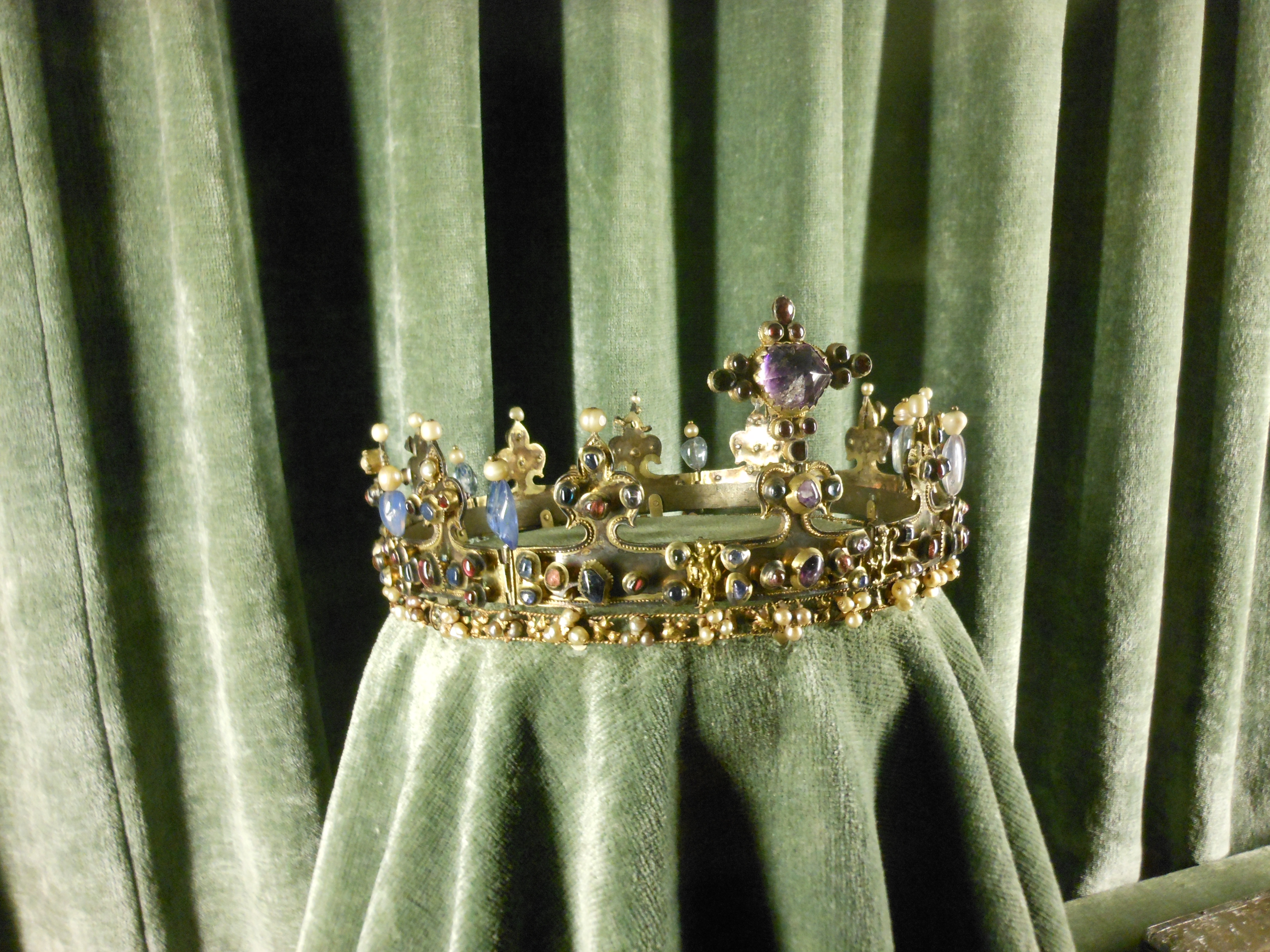
Actually, I’m making that up.  My second-favorite crown is this one, from about the same era as the crown in my last post.  This one is more modest–and looks easier to wear.  Perhaps it was made for a young princess.  Or perhaps a well-dressed queen needed a whole wardrobe of crowns, for both formal and casual occasions.

Crown2ndFavorite

This crown looks to be from the same era as my all-time favorite, but when I took a picture of it I broke my own rule of always taking a picture of the caption. Both of these crowns are in the Munich Residenz Treasury, or Schatzkammer.  I always think I will remember details, but it doesn’t always happen.  For this crown, I’ll just have to say that it’s very old, very beautiful, and it beckons my imagination back into medieval times.  I’m sure those times are much more pleasant to imagine than they ever were to live through, even for royalty.

Like many museums, the Munich Residenz has a lively interactive children’s program where kids can dress up in historic finery.

20130813-125943.jpg

Maybe museums should also have an interactive adults’ programs, for dreamers like me.  I’d be first in line to try on the silks, satins and jewels of days long gone!

My Favorite Crown

What is the oldest surviving English crown doing in the Treasury of the Munich Residenz, home of the Wittelsbach dynasty for centuries? Apparently even the experts are not exactly sure of the sequence of events. But there it is, one of the most beautiful and evocative objects I’ve ever seen.

CrownFavorite

Most crowns considered important enough to be preserved are masculine-looking, as we’d expect in an overwhelmingly patriarchal world. Some of them have a unisex look, suitable for a king or queen, as needed. This crown, known as the “Bohemian” crown, is delicately feminine. It’s made of pure gold, of course. It is enameled and studded with rubies, sapphires, emeralds, diamonds and pearls. It looks lovingly handmade, as no doubt it was. It is quite tall, as crowns and tiaras go: about 7 inches. What I find unique is the airy, open design–not an easy feat to pull off with the many huge gems it holds. The wearer would automatically assume a regal posture, I would think, just in order to live up to this gorgeous object.

The crown was made around 1370-80. It was recorded in a list of jewels in England in 1399. Curators believe it belonged originally to either King Edward II or Anne of Bohemia. Anne was married to King RIchard II. But along came his dashing cousin, Henry IV, star of the Shakespeare history plays. He deposed Richard. Eventually, in 1402, Henry’s daughter Blanche married Ludwig III, an Elector–more or less an elected king in what is now Germany. The crown was part of her dowry, so it ended up in the Treasury of the Wittelsbachs.

The museum’s own write-up about this crown is at http://www.residenz-muenchen.de/englisch/treasury/pic11.htm

Join me next time for more explorations into the art and history of Europe!

Visiting a Hero in Munich: Rupert Mayer

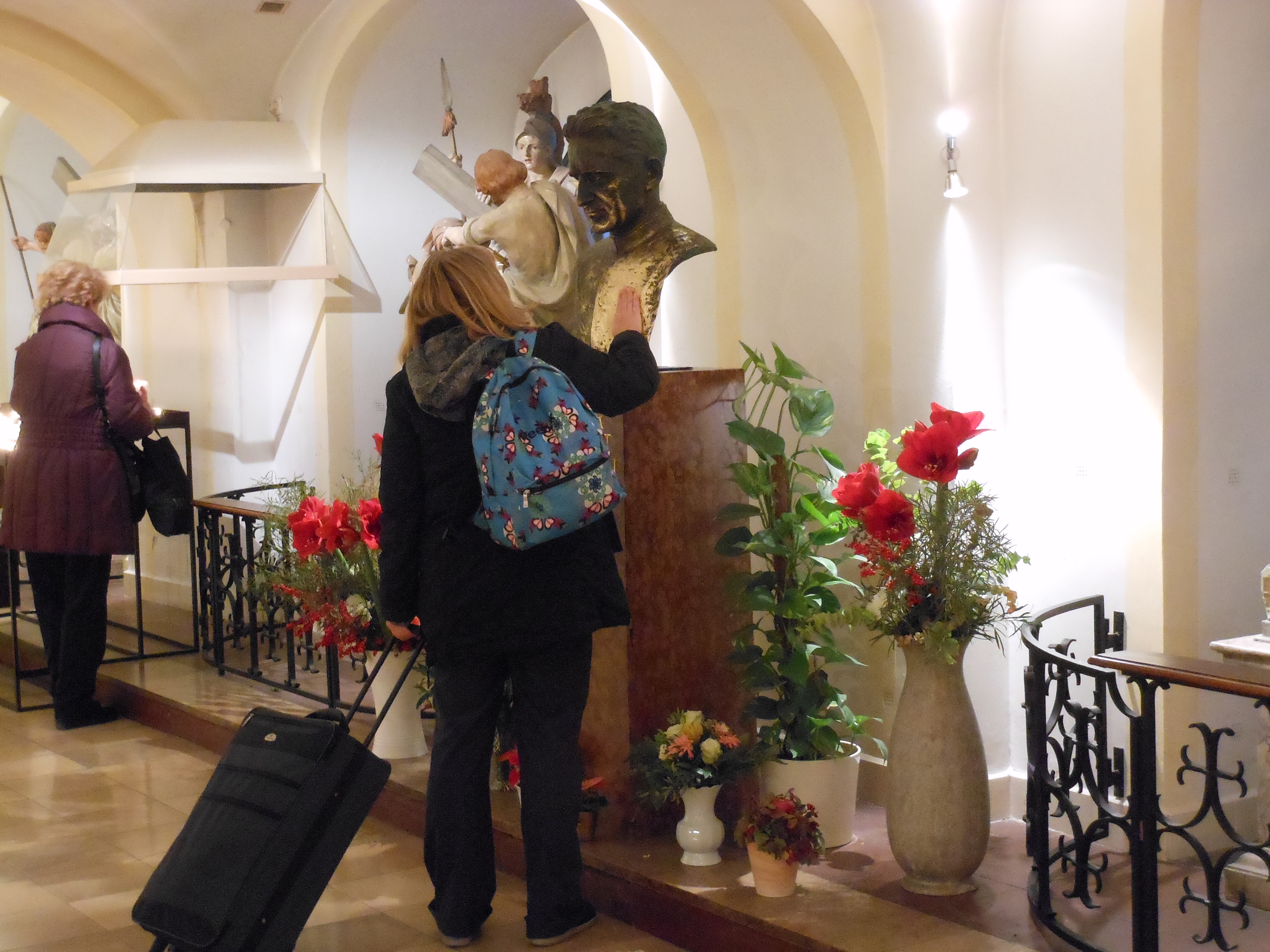
When I stepped inside historic St. Michael’s Church in Munich, I was surprised to see a constant parade of people stopping before the bust of a particular man in the hallway.  Young and old, in a hurry or taking time to linger, they came with suitcases, shopping bags and school book bags.  Some would stand for a few minutes and say a prayer.  Some would just briefly touch a well-worn spot on the bronze sculpture.  All of them were honoring a remarkable man, Father Rupert Mayer.

RupertTouching

Father Mayer was a Jesuit priest born in 1899.  He served as a chaplain in World War I.  He was first sent to a military hospital.  At his own request, he went from there to the front, literally crawling through the mud of battlefields under fire to minister to soldiers–both Catholic and non-Catholic.  He served in France, Poland and Romania.  In 1916, he lost a leg in a grenade attack.  He was the first military chaplain to receive the Iron Cross for bravery in battle.

As the Nazis rose to power in the 1930s, he consistently spoke out against them, both in public places like beer halls and in the pulpit.  In 1937, the Nazis first put him under house arrest, then jailed him several times in Landsberg Prison.  Next they sent him to Sachsenhausen concentration camp for several months.  Many church leaders of various faiths were killed during the course of World War II, but Father Mayer was apparently too well-known for the Nazis to dispose of him so easily.  In Sachsenhausen, his health was failing.  The Nazis did not want to make this popular man a martyr.  So he was finally sent to Ettal Abbey, deep in the Bavarian countryside, and kept confined there, forbidden to preach.  When the war ended, he returned to Munich to a hero’s welcome.  Unlike many opponents of the Nazis, he lived to see them defeated.

The war was barely over when Father Mayer died in 1945.  He actually died while celebrating Mass at St. Michael’s Church, of a stroke.  He is honored there with displays from his life.

Rupert Mayer family photos and artifacts in St. Michael's Church

Rupert Mayer family photos and artifacts in St. Michael’s Church

Rupert Mayer was beatified in 1987, a step toward sainthood.  Many people would like to see him made a full-fledged saint, which would require a verified miracle. For me, a life like Rupert Mayer’s is miracle enough.  I am sure that many people who stop to visit his statue are remembering not only him, but countless others who stood against a murderous regime in the darkest hours of the twentieth century.

RupertMayer12-12

Munich today is cheerful and prosperous.  Shoppers, tourists, students and business people hurry through the downtown pedestrian area, intent on enjoying their lives.  Many of them duck into St. Michael’s Church, though.  Like so many others, I paused and placed my hand on the worn spot on the bust of Rupert Mayer. The bronze was smooth and cool to the touch.

Join me next time for more reflections on the art and history of Europe.

Angel with a Shot Glass

Want an antidote to the recent overload of royal news?  I just saw a wonderful movie about a group of people about as far from the doings of the aristocracy as it’s possible to get in the British Isles.

Movie poster, from NYT review cited below

Movie poster, from NYT review cited below

The Angels’ Share, directed by Ken Loach, takes its title from the traditional name for the 2 percent of the volume of single malt whiskey that somehow gets absorbed or evaporates from every barrel distilled. The movie opens in a Glasgow courtroom, where asorted young petty criminals are being sentenced to community service for their misdeeds.  The most serious offender is a young man named Robbie.  For no good reason other than generalized rage, he has mercilessly beaten another young man to a pulp.  His victim has lost the sight in one eye.  And this is only the last in a long string of violent offenses.  By rights, he should be sent to prison.  But sitting in the courtroom is his girlfriend, about to have his baby at any moment.  The judge gives him a break:  he’s off to community service with the others.

The girlfriend is middle-class, smart and tough with Robbie.  He is strictly on probation with her, though she loves him.  Her family not only detests him, but chases him down and beats him up.  Her father tries to pay him off to disappear.  But the girlfriend sees something in Robbie, and he sees something in her and the newborn son.  He just needs a break.

How many caper movies have you seen where the hero just needs to pull off one more crime in order to escape from his past forever?  How many times have you seen it work? In this movie, miraculously and hilariously, it does work.  Robbie and his misfit friends are taken under the wing of the kindly but tough supervisor of their community service.  He happens to be a devotee of fine whiskies.  After sharing a congratulatory drink with Robbie on the birth of his new son, the supervisor invites him to a very posh whiskey-tasting event in Edinburgh.  His new friends Rhino, Albert and Mo invite themselves along, and we’re off.  It seems Robbie has an incredible nose for fine whiskey–totally unexpected in a young man who previously spent most of his life getting plastered on whatever was cheap.  He also has a fine analytical mind and a talent for leadership.

The version I saw had subtitles, and it needed them.  The Scottish low-life brogue used by the characters is fast-moving, profane, and howlingly funny.  The very dimmest bulb of the group comes up with the very best idea:  wearing kilts to pull off a daring heist.

The story is a bit of a fairy tale; the crime is pretty much victimless.  What is special is the look inside the lives of lower-class Scottish youth, contrasted with the lives of much more refined Scots, Brits, and one American with way too much money. Who knew that whiskey had such an intricate and proud history?  Who knew that single malt whiskey is a way of literally tasting history?

The movie won the Jury Prize at the 2012 Cannes Film Festival.  The stellar cast includes Paul Brannigan, a newcomer totally convincing as Robbie, plus Jasmin Riggins, Gary Maitland, William Ruane, John Henshaw, and Siobhan Reilly.

One of many positive reviews of the movie is in The New York TImes at http://movies.nytimes.com/movie/465769/The-Angels-Share/overview.  It’s by Stephen Holden.

There’s a movie trailer at The Angels‘ Share (2012) – Official Trailer [HD] – YouTube

I visited Edinburgh a couple of years ago and passed on the distillery tour.  Health nut that I am, I wasn’t interested.  Now I’m putting it on my list for the next time I go.


Channeling Freddie Mercury in Buxton

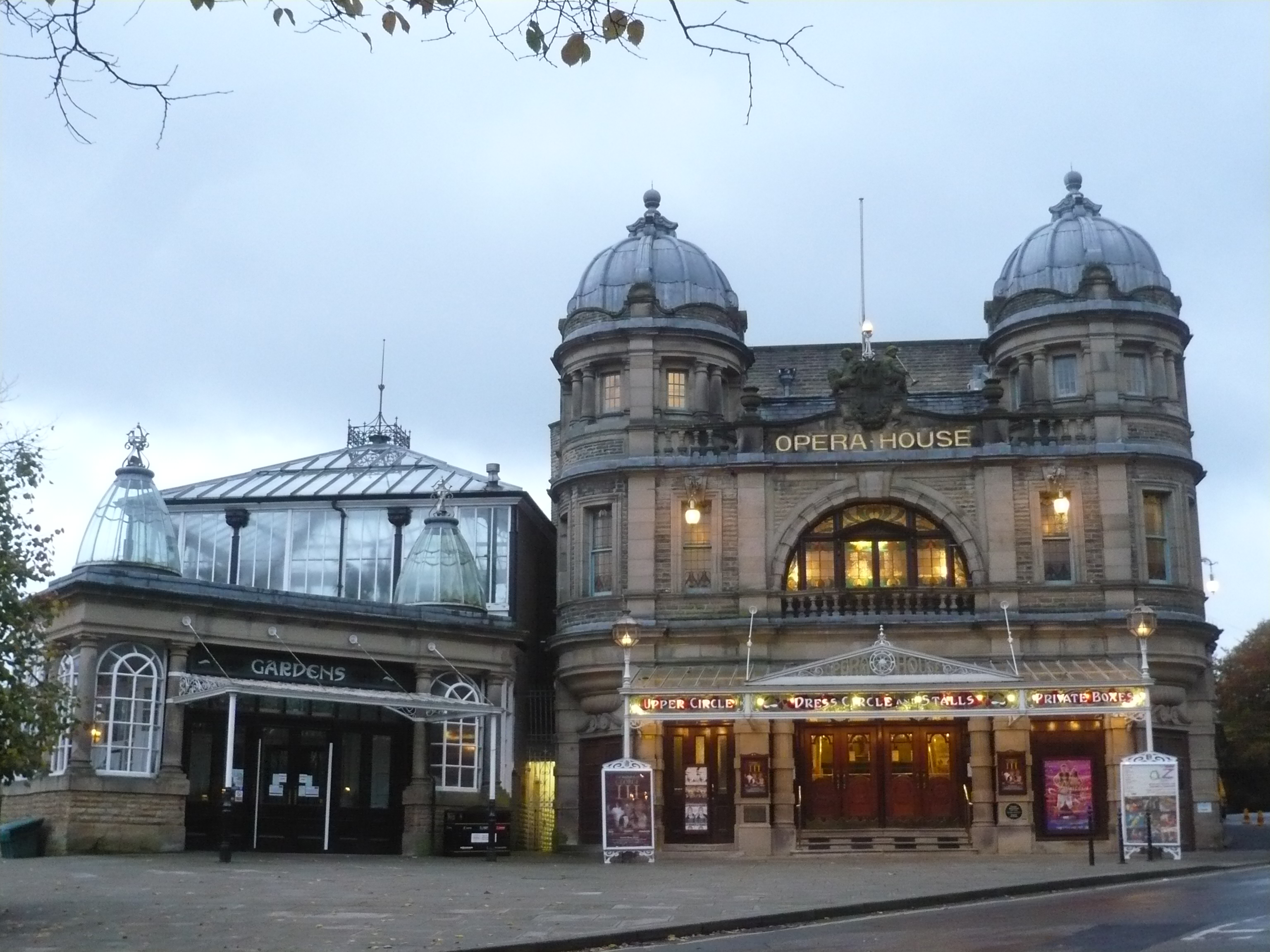
While watching the BBC series Lost Empires, I am sure I recognized one of the locations:  the Opera House in Buxton, England. Built in 1903, the 902-seat theater hosted music-hall shows and other live entertainments in the very period depicted in the series, 1913. (I described this excellent series in yesterday’s post). By 1927, movies had overtaken variety shows in popularity.  The theater turned into a cinema.  In 1979, it was refurbished for live performance, which continue year-round to this day.  I’d love to be there for the annual Gilbert and Sullivan Festival, but I don’t like to travel in the height of summer.  So I take potluck when I go. There is some kind of live entertainment, or a high-quality film, almost every night of the year.
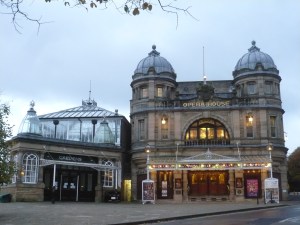
Buxton Opera House
Buxton Opera House

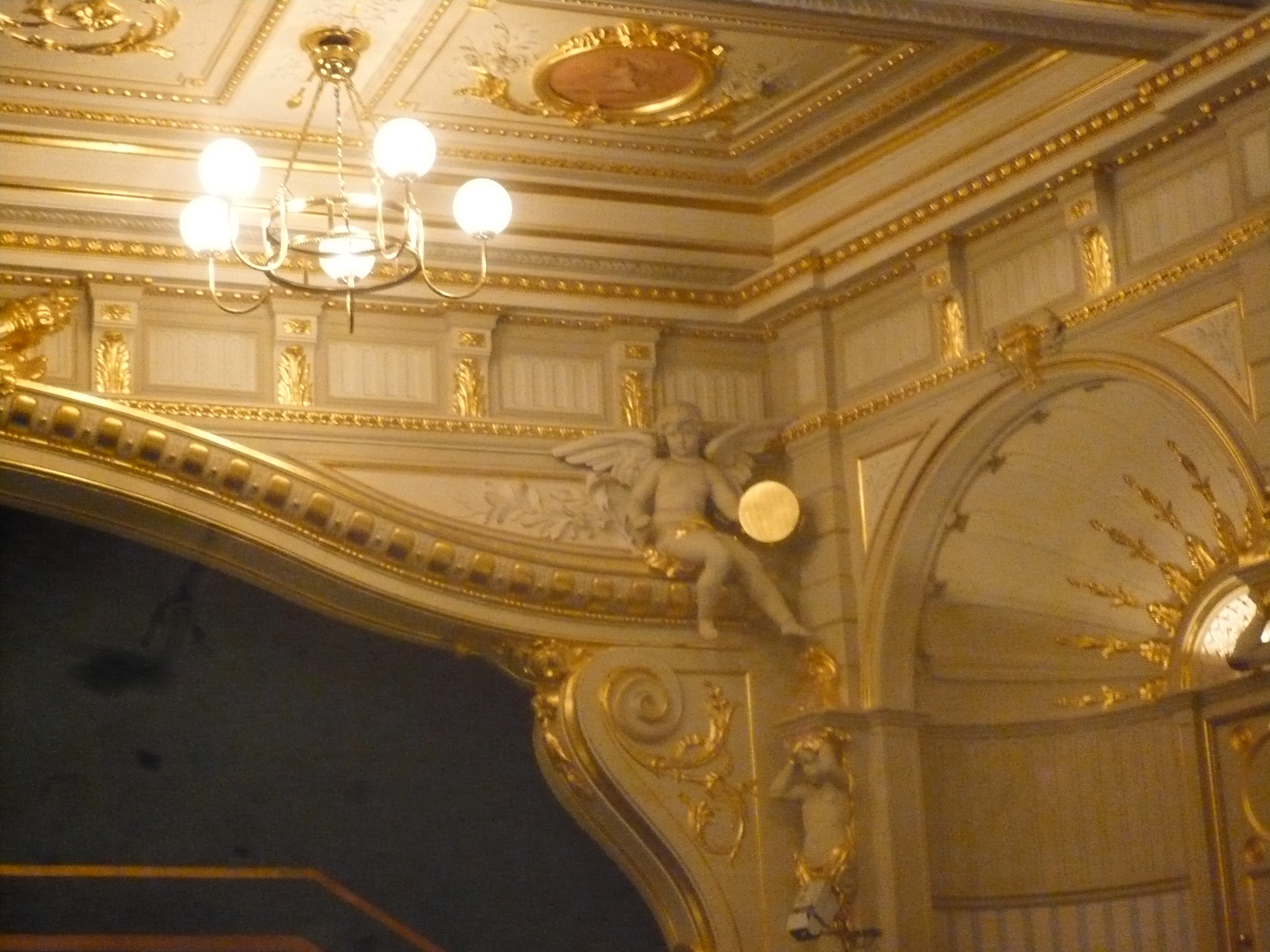
Buxton Opera House Detail

Buxton Opera House Detail

The theater interior is beautiful, white with gilded cherubs, curlicues galore,  and red velvet curtains.  There is not a bad seat in the house, not even way up in “the gods”–theater parlance for the very highest and cheapest seats. In Lost Empires, the seasoned trouper played by Laurence Olivier cautions the young performer played by Colin Firth to always play to “the gods”–the customers in the cheap seats.  They can make you or break you, soon-to-be washed-up performer warns, and he should know.
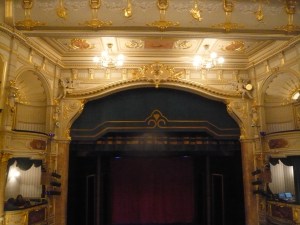
Buxton Opera House Stage

Buxton Opera House Stage

I once saw a mountain-climbing documentary at the Opera House.  Another time, I saw a very good touring performance of the play “The Madness of King George.” Last time I was in Buxton (to visit nearby Chatsworth and to enjoy the beauty of Derbyshire), I bought tickets for an event I probably would have given a miss, if there had been anything else going on.  There was a Queen tribute band, starring Patrick Meyers as the late Freddie Mercury.  As it turned out, I had a great time.  The band is called Killer Queen.  They fill large stadiums, and they put on a smaller-scaled show for venues like the Buxton Opera House.  Patrick Meyers does not quite have the 4-octave range of Freddie Mercury, but he makes up for it in showmanship, passion, knowledge of his subject, and sheer kinetic energy.

Patrick/Freddie danced and sang his heart out, flinging a series of flamboyant satin jackets out into the audience at just the right moments. And so it went, through the great classic rock repertory of Queen: “Bohemian Rhapsody,” “Killer Queen,” “Somebody to Love,” “Don’t Stop Me Now,” “Crazy Little Thing Called Love,” and of course the anthem “We are the Champions.”

The audience was almost as entertaining as the show itself.  The first two rows were filled with teenagers and young adults from a nearby school for people with various disabilities.  To prepare for the outing, they must have been listening to Queen albums nonstop. Many of them knew every song by heart and sang along, with gusto.  They jumped up and danced, too–which Mr. Meyer tried in vain to get the rest of the audience to do.

One young man in particular was in ecstasy through the entire performance.  He kept moving right up to the stage apron, pounding out the rhythms with his hands.  Every now and then, a teacher would gently lead him back to his seat, but he popped up again every time.  He just couldn’t help it.  He sang every word of every song, and he shouted and spun in circles between songs.

When the show ended, and the curtain calls were done, the band’s drummer dashed to the front of the stage and handed his drumsticks–probably still smoking from the heat of the performance–to this young man.

Until I attended this show, I had never quite understood the fuss about Queen, or the influence on the development of rock. Now I get it.  Reportedly Sacha Baron Cohen is developing a film about the remarkable journey that the multi-talented Farrokh Bulsara took to become Freddie Mercury.

Freddie Mercury died of AIDS in 1987.  I like to think that his talent and creativity live on in memory, and in performances like the one I almost didn’t go to see. I imagine the young man who received the special drumsticks still treasures them as a memory of a wonderful night.

The music hall tradition lives on in Great Britain, taking new forms and honoring old ones. Tastes have changed over time, but the need for audiences and performers to connect remains the same.

A Perfect Peach at Stratford-upon-Avon

Some years ago, I found myself with a lot of Frequent Flyer miles that were about to expire.  No one was free to travel with me.  So I treated myself to a solo trip to England.  I decided to see as much live theater as I possibly could. In the course of two weeks, I saw 18 plays.  Some days I doubled up and took in a matinee plus an evening performance.  I saw plays at grand theaters, in the London equivalent of “Off-Broadway,” and in tiny rooms above pubs.

At that time, to get to Stratford-upon-Avon, I had to take a train from London, then transfer to a bus.  (Now, there is a convenient train that goes all the way to Stratford).  I had dreamed for years of seeing the Royal Shakespeare Company in their home theater, the Swan. One evening, I saw a very fine production of a Shakespeare play with the actors in modern dress.  Which play, you might ask?  I think it was Romeo and Juliet, but I can’t be sure. (On the train, I met a woman who had saved the program from every theater performance she had ever attended.  Although she was a theater professor, I thought that was a little obsessive.  Now I wouldn’t mind having all my programs).

The next morning, I went to the bus stop for the trip back to London.  Just outside The Dirty Duck, the pub still frequented by theater folk and tourists alike, I spotted an actor I had seen the evening before.  I stopped and complimented him on his performance.  He seemed delighted to be recognized; he had only a medium-sized part.  I’m thinking maybe he played Juliet’s father. I know how much talent and hard work it takes for any actor to get even a spear-carrying part in the Royal Shakespeare Company. I did remember his performance, I thought he stood out in the character, and told him so.  He thanked me graciously.  Just then, the bus pulled up and I got on.

The bus was about to pull away from the curb when the actor jumped up the steps with a great theatrical flourish. He stood beside the driver, peering down the aisle at all the passengers.  “I am looking for a LADY,” he intoned, in his best Shakespearean elocution.  He spotted me and moved up the aisle toward me.  He took my hand, got me to stand, kissed my hand, and made a great show of presenting me with a perfectly ripened peach.  Everyone on the bus applauded, he took a very grand bow, and he was off with a jaunty wave.

Peach

Like all artists, actors pursue their passion even though they know they are very unlikely to gain riches or fame. Very few of them reach the heights of, say, the late James Gandolfini. I wish I could remember the name of this actor, who shared a magical personal moment with me and went out of his way to entertain a busload of non-paying strangers.  Did all this happen 26 years ago?  Yes, it did.  Travel memories are lifelong!

Join me next time for more explorations into the art, history and literature of Europe and the British Isles.

A Vigorous Voice from the Past

I hurried to visit Tyntesfield within a year or two of its opening to the public.  The house was only partially open, and work was going on all over the estate.  During my visit, I stood with a tour group in the Billiard Room, admiring the vaulted ceiling and the light from the high windows.  The billiard table, custom-made for the family, connected to an electronic scoreboard.  Pressing a button on the side of the table recorded the score–quite an innovation, for Victorian times.

William Gibbs was 75 when his dream home was completed, and he had four sons.  Three of them were still teenagers, so presumably the room was built and furnished for them.  It was not, however, a smoking room–Mr. Gibbs allowed only smoking in the very highest room of the house, a tower on the third floor.  (I’m sure the teenagers found ways around the various house rules–they always do).

We had all just looked at a rather ornate urinal in an adjoining room–another modern innovation. The guide was talking about how the room was built for and used by men.  Suddenly an elderly lady in the back of the group thumped her cane on the floor and interrupted the guide.  She was a family member and had spent a good deal of time in the house.  One of the 19 heirs!  (I hoped she had collected a cool million and not blown it all at the casino).  She proceeded to set us all straight.  Did women use the billiard room?  Yes, they did!  Trust me, you would not have argued with her.

The lady went on with a story about the bats that had infested the former men’s servants quarters nearby.  Later, I read that the colony of protected lesser horseshoe bats had to given another suitable home on the estate before restoration could begin in those rooms.

The tour guide wisely let the lady keep talking.  I’d have listened to her all day.  At the time, I didn’t know about the Great Kidnapping Incident, or I’d have asked her about it for sure.  In 1988, the late Lord Wraxall had been kidnapped at his home. The ruffians knocked him to the ground and demanded his house keys and the combination to his safe.  But the burglar alarm went off–I don’t know whether he was inside or outside the house at the time.  So they threw him into the boot (the trunk, to Americans) of his own car, which they drove about 2 miles away and abandoned.  He was left there for 7 hours until someone found him. According to some reports, all he had to say was, “Good grief, there’s more room in there than I ever thought.”

The National Trust is going to great lengths to collect stories about life in the house.  There is an interactive website where people can contribute their own memories.  It is at http://www.nationaltrust.org.uk/history/stories/. Personal stories are placed in a timeline. Family, servants and friends have contributed their memories.

Recently, the house has been featured on the wildly popular BBC TV series Dr. Who–very appropriately, since Dr. Who is a Time Lord.  Not only can he travel through time, but he is able to regenerate his body in a different form when near death–very handy for showrunners who have to cope with new actors taking over the part.

At Tyntesfield, and at many other National Trust Properties, enchanting doorways continue to lead us into the past, carefully preserved for future generations.

Join me next time for more explorations into the art and history of Europe and the British Isles!

Tyntesfield: Victorian Splendor Rescued

Just outside Bristol, and not far from Bath, stands one of the most beautiful country homes in England. It has only been open to the public since 2002, when the National Trust acquired it.  I visited a couple of years after the opening and can’t wait to return.

By the time the 2nd Lord Wraxall, known as Richard, died in 2001, he was the only person living in the house.  The house had been hit by bombs several times during the Bristol Blitz of World War II, and had never been properly repaired. Birds and bats took up residence in whole wings of the house. Lord Wraxall had maintained the house as best he could, but over the years the four generations of the family had simply closed off areas not in use.  So the house contained a treasure trove of historical belongings. For example, there were packages of shirts dating from the last century, still in their original wrappers as they came new from the shop.  And Tyntesfield was the last High Victorian house available for purchase in all of England.

Lord Wraxall’s will specified that the house be sold and the proceeds divided among 19 heirs.  The market value was about 20 million pounds, or  about $31 million. In addition, double or triple the purchase amount was needed for repairs. Sotheby’s took charge and began cataloging the house’s contents for auction.

Various gazillionaires were interested. (The press reported that Madonna, Kylie Minogue, and Andrew Lloyd Webber were looking).  But the National Trust of Britain, one of the two main preservation societies, managed to raise the purchase money within a period of 50 days.  (Controversy arose when a semi-secret deal with the National Lottery provided some of the money for this project that many considered “elitist”). The Trust took possession in July of 2002. This was the first new acquisition by the National Trust in many years, and the largest in its history.  Today, over 800 paid and volunteer staff work on the estate, 3 times the number at any other National Trust property. First order of business was repairing the roof. A free-standing scaffold the size of 10 tennis courts covered the entire structure for 18 months.  Then the entire house had to be re-wired and re-plumbed.  An elaborate fire protection system was installed. One by one, rooms were cleaned, restored and the furniture carefully arranged, using historic photos and descriptions.

In the meantime, visitors were welcomed.  The Trust had determined that the more people were able to see of the property, the more they wanted to donate and volunteer. Instead of the usual years of construction followed by a great unveiling, the renovation has proceeded with the enthusiastic participation of legions of volunteers.  The renovation itself is a great educational project, unprecedented in National Trust history. Elitist?  Not today.  The estate buzzes with the activity of volunteers, workers, school groups and tourists eager to bask in a lost way of life. I’m writing a number of posts about Tyntesfield because it’s such a fine example of the work of the National Trust. We can learn so many lessons from the ups and downs of a house’s history.  Good or bad, the events of the past help us figure out how to live in the future. I notice that the National Trust has now published a book all about Gibbs family history, Fertile Fortune: The Story of Tyntesfield, by James Miller, National Trust Books, 2006.  If I don’t acquire the book beforehand, I’m sure that on my next visit I’ll walk out of the gift shop with a copy. Join me next time for more explorations into the art and history of Europe and the British Isles!