Author Archives: Claudia Suzan Carley

A Medieval Dancing Dog for Christmas


An unknown artist created this enchanting image of a shepherd playing a sort of bagpipe for his dancing dog between 1370 and 1390. It’s from a lunette–a semicircular fresco, divided into two parts–that once decorated the Monastery of Santa Giuliana in Umbria. Today, what is left of the lunette is in the Galleria Nazionale dell’Umbria in Perugia, Italy.

RFresco
The shepherd and his dog occupy the far right-hand side of the nativity scene above. Why is this simple scene so special?  I love it for the way the ordinary mortals–and the animals–are as important as the Holy Family.

DogCattle

The musical shepherd, his dancing dog, and the cattle on the right-hand side of the lunette (the semi-circular scene)  are hanging out casually on the hillside, unaware of what’s going on in the stable.


I love the lifelike sheep, with their thick winter coats.


The shepherds stand on a flowery hillside, nudging each other in amazement at what’s happening in the sky above them–no doubt there were once angels.


The left-hand side of the lunette does show the missing angels, hovering over what looks like a typical Italian hill town much like Assisi or Perugia. A lucky cow and a donkey are special guests–or rather, they are hosting special guests in their humble stable.


All the elements of the Biblical story are here, in their simplest form. Gathered around the swaddled baby, we have musical angels, friendly cattle, and a proud mom and dad.


 St. Francis of Assisi, very near to Perugia, created the first three-dimensional manger scenes, in order to make the Christmas story seem more real to those he preached to. In early December when I visited , preparations were underway for a manger scene outside the Basilica in Assisi.

Francis is beloved for many reasons, but especially for his love for the working poor and the homeless.  Francis was all about radical humility. He was in demand in the palaces of the great, but he was determined to spend his time with the poorest of the poor.

Great artists like Giotto created wonderfully colorful frescoes illustrating the saint’s life for the Basilica that was immediately begun after his death in Assisi. A new pictorial language developed around the humble life of St. Francis, emphasizing his love for humanity, the joy possible in the most ordinary of lives, and the goodness of the natural world. The challenge was to honor the saint’s life without unduly glorifying him. The frescoes above were part of this artistic and spiritual movement. No doubt the anonymous artist who created these frescoes for a little monastery had seen the work of Giotto in the Basilica.  Although St. Francis is not the subject of the almost-primitive lunette I liked so much, his influence shines through in the simple everyday images.


I spent several happy hours soaking up the great art in this underappreciated museum. But I circled back several times to the damaged but charming fresco of the Nativity with the dancing dog.

How Florence Does Christmas

  Roses still blooming on the terrace of our apartment… 

Elegant handmade dresses for little girls


The shop above seems to have only one-of-a-kind items, destined to be heirlooms.

 
An exquisite Madonna and Child by Filippo Lippi, around 1560, commissioned or snapped up by the art-loving Medicis and still on display in their palace long after the’re gone.

  
A merry-go-round with a Christmas tree.

   
 Tinsel and lights…

  
Brunelleschi’s amazing dome, a treasured view from all over the city…

  
A horse and carriage passing a decorated house at the edge of the Ponte Vecchio…

  
And although I’m a vegetarian, I appreciate the food-loving culture. Pepperoni slices on a tree? Fine with me!
 

Assisi, Hometown of St. Francis

  
The medieval streets of Assisi are no doubt cleaner than they were in 1181 or 1182 when the boy who became St. Francis was born. But the ancient stone buildings and streets would probably look much the same to him today. His life story is fairly well documented, although of course many legends have grown up around the historical figure.

Francis was raised as a rich boy, the son of a successful cloth merchant. He went off to war as a young man and was taken prisoner for a year. At some point after his return, he experienced a religious awakening which annoyed his father to no end.

  
The house where Francis grew up still stands, and the cloth warehouse where his father expected him to carry on the family business. 

  
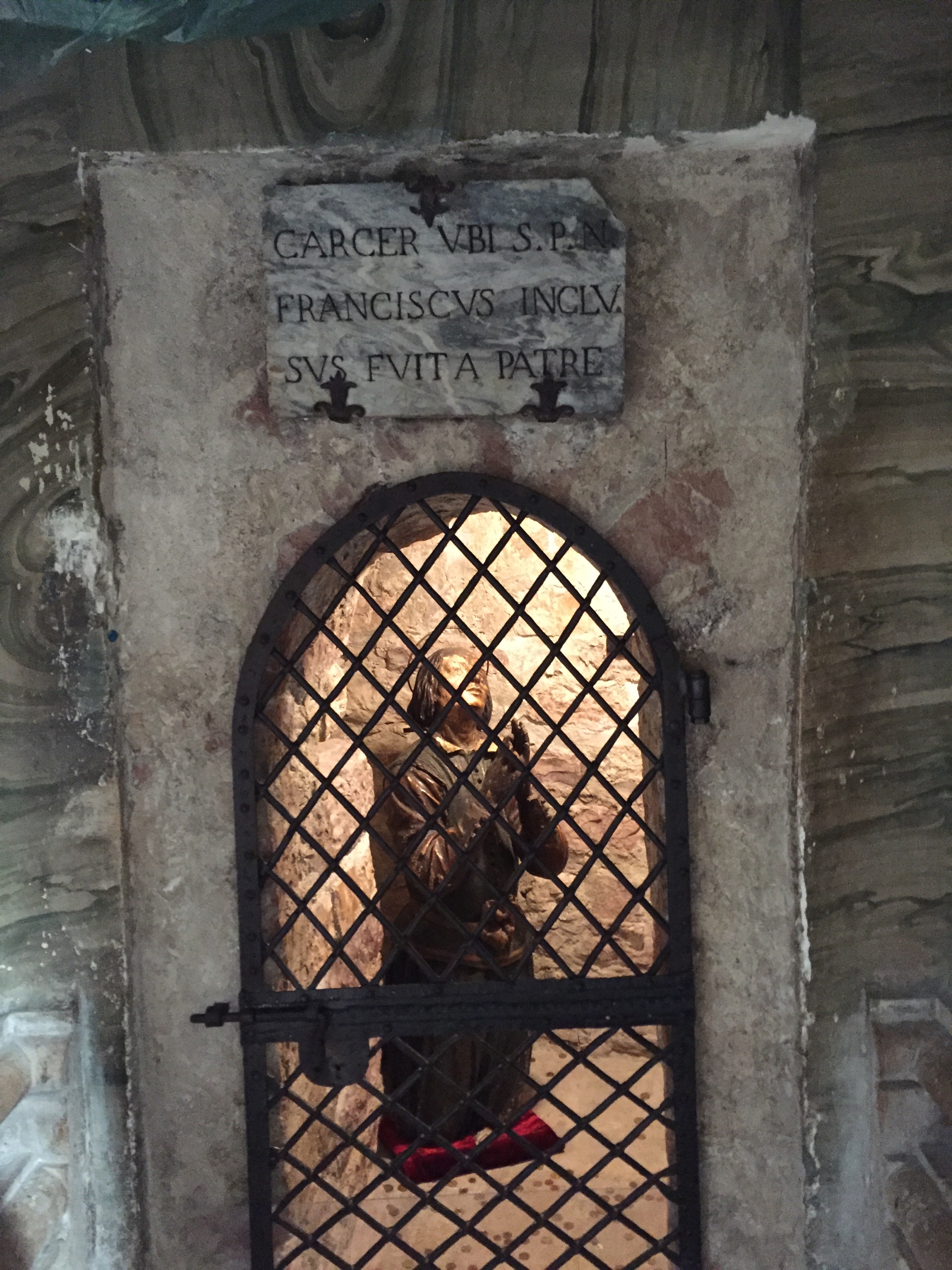
The story goes that at one point, his father placed him on house arrest in a tiny room, which still exists, complete with a model of the young Francis.

Eventually, Francis left parents, home, and even the clothes on his back. He went off to live as a beggar and itinerant preacher. He soon attracted many followers and received official Papal permission to found a religious order. His followers lived alongside the poor people they served. They went barefoot or wore sandals, and dressed in plain rough habits. 

  
Their rope belts had three knots, signifying poverty, chastity and obedience.


S. Francesco, contemporary painting by Carlo Bertocci, detail

 
Francis famously loved nature; he was said to preach to flocks of birds, who listened intently. He was an environmentalist at a time when humans were intent on exploiting nature as much as possible for their own gain (sounds familiar, doesn’t it?) Francis was also a great peacemaker, constantly trying to get enemies to reconcile. In his time as in ours, peace was elusive.

Assisi is not overrun with tourists, although there are plenty of visitors. 

  
Are there tacky souvenirs? Sure, but it’s all pretty tasteful and low-key. I liked this lantern beside someone’s doorway: St. Francis, his friend St. Clare, and the present Pope all cheerfully greeting passersby.

  
Even outside the many historic churches in and around the town, Assisi has a spiritual feel. In other tourist destinations in Italy, people run around with selfie sticks, trying to capture their smiling faces in front of landmarks. In Assisi, I didn’t see a single selfie stick. Instead, I believe I saw many people quietly looking within themselves, measuring their lives in light of the example set by Francis.

Medieval Angels

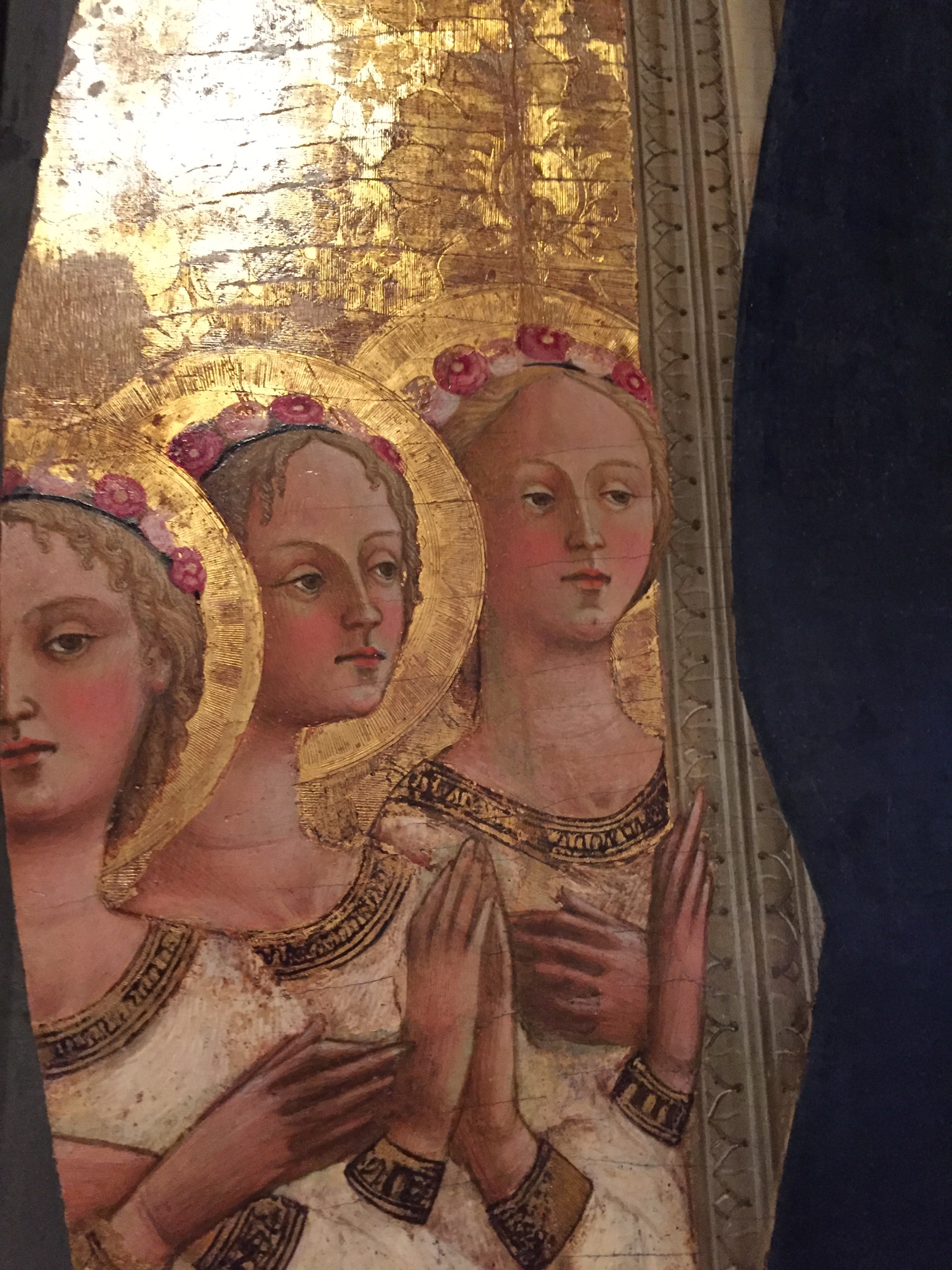
These are from beautiful Umbria, where St. Francis lived and worked. They are by various artists, in paintings 700 to 1000 years old.  The humble Francis became a saint within two years of his death, and the best artists gathered immediately in Umbria to honor his life and work. The art is breathtaking and inspiring.


Living History in Italy

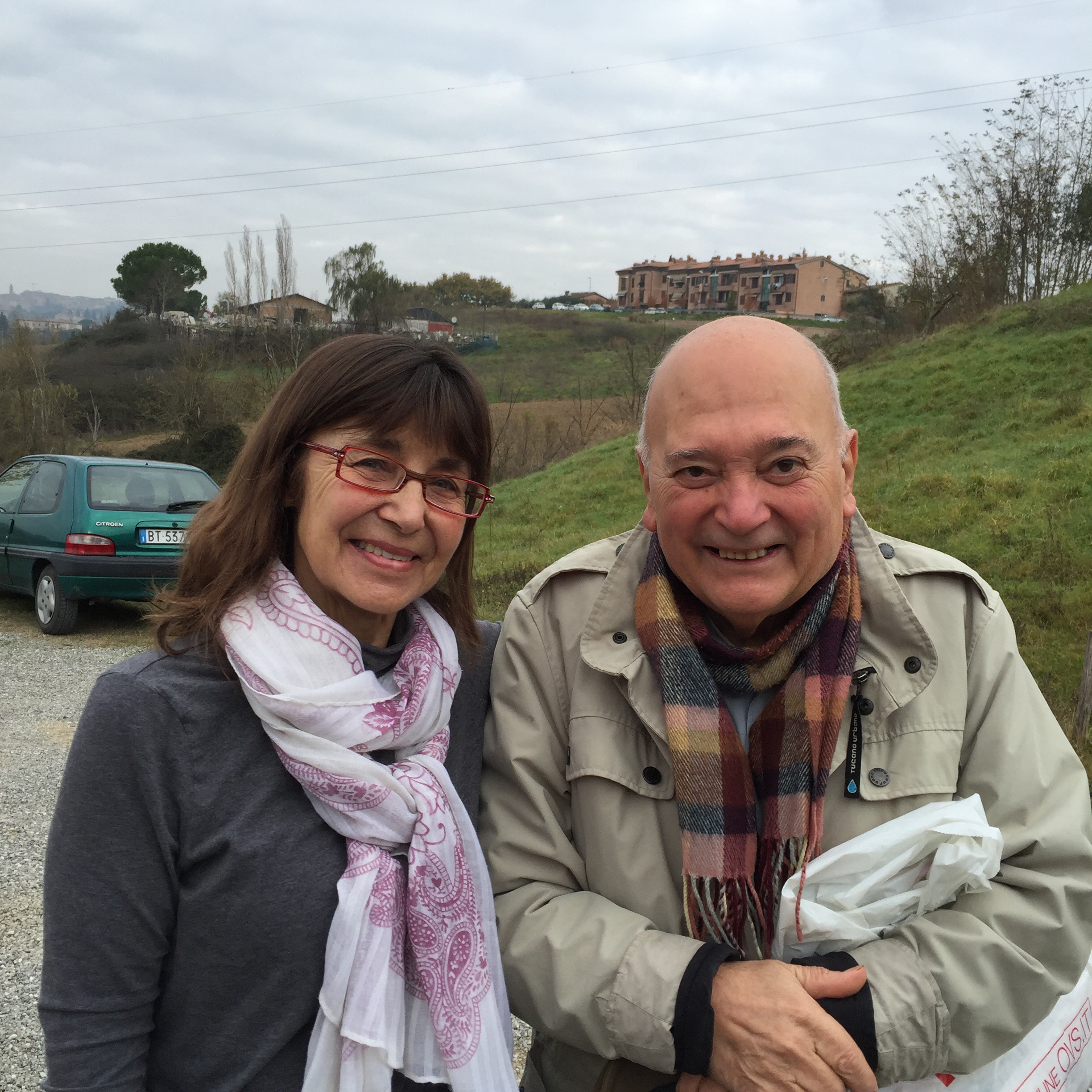
I just met this lovely man in Siena, Italy, about 30 miles south of Florence. He spoke no English and I know very little Italian, sadly. But he learned that I was American and he began excitedly telling me all about “Liberace,” or so I thought at first. Was he a fan of the flamboyant American pianist? Then I realized he was actually talking about “liberation.” When he was a small child during World War II, American Marines marched victoriously right through the outskirts of Siena, exactly where we stood on his family’s farm. He had to get out a handkerchief to wipe tears from his eyes as he described the event and tried to explain what it meant to him. The Americans gave him chocolate, and they brought him freedom. He wanted to thank me, although I deserved no thanks at all.

I think he went on to express sadness for the violence we all live with in our modern world. Americans were recently warned to be extra cautious all over the world. Given recent events, I thought seriously about cancelling my trip. But we must continue to live our lives and not give in to fear. The reward is that strangers reach out to each other in friendship instead of shrinking back in fear. I’m glad I took this trip.


Paris, November 13

eiffel

Watching the terrible events unfold in Paris, there are almost no words.

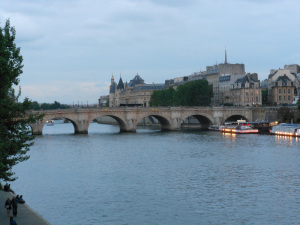
Seine

When will people be able to walk those beautiful streets and cross those beautiful bridges again without fear of violence?

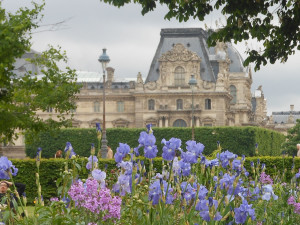
louvre

There are just thoughts and prayers for the city and its people.

Remembering Captain Eustace Lyle Gibbs at Tyntesfield

EustaceGibbs

Eustace Lyle Gibbs, born March 10, 1885, was the second youngest son of Antony Gibbs. He was educated at Eton and Magdalen College, Oxford. Then, as expected of him, he joined the family shipping business.

Eustace was already a member of the North Somerset Yeomanry.  When World War I broke out on July 28, 1914, he was among the first British troops sent to France. Wealth and rank did not exempt men from serving; in fact, those of high rank mostly felt even more obligation to fight than those less fortunate. They generally entered the war as officers.

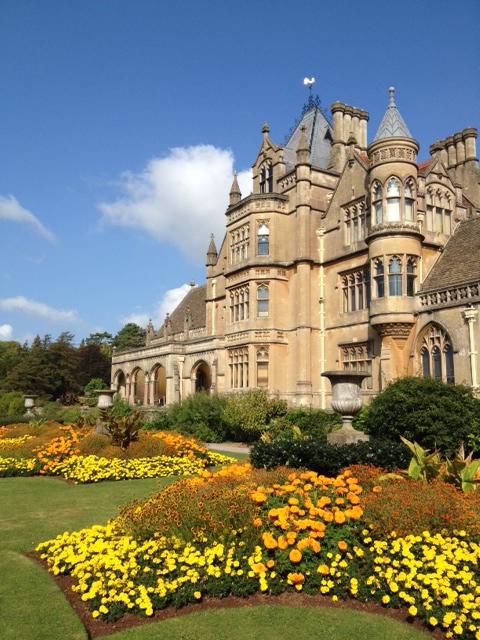
TyntFlowers

Eustace had a short home leave in December 1914. While visiting his family at their beautiful Victorian country house, Tyntesfield, he gave an interview to the Western Daily Press. Asked how people at home could help soldiers at the front, he said the troops always needed gloves and socks.  And they really missed chocolate. When he returned to the front, he brought donations of these items with him, and handed them out to the men of his “B” Company, British Expeditionary Force.

TynBilliard

During his leave, Eustace no doubt spent time in the Billiard Room at Tyntesfield, a wonderfully masculine space designed for the men in the family. Eustace would never see his home again.

Eustace died on February 11, 1915 of wounds received fighting near Ypres. He was 29 years old. His portrait was painted in 1916 from a photograph of him in his uniform. The artist was Albert Henry Collings.

Ceramic poppies fill the Tower of London moat

1915 was the 100th anniversary of the beginning of the Great War. I wrote about the spectacular display of close to a million ceramic poppies in honor of fallen British soldiers at the Tower of London. The The photo above is from The Guardian at http://www.theguardian.com/world/2014/sep/01/tower-of-londons-ww1-remembrance-installation-share-your-photos-and-videos. The post is at https://castlesandcoffeehouses.com/2014/09/26/remembrance-of-wars-past/.

soldierage19

That post also remembers another aristocratic young man who gave his life for his country, Edward Wyndham Tennant.  He died at age 19 in the Battle of the Somme, 1916. On the plaque above his marble relief portrait, a fellow soldier describes the young man’s leadership:  “When things were at their worst he would go up and down in the trenches cheering the men; when danger was greatest his smile was loveliest.” His grieving parents commissioned the touching memorial to him in Salisbury Cathedral.

Fighting in the Great War ended “at the eleventh hour of the eleventh day of the eleventh month” of 1918.  Virtually every town and village in Britain (and also in other countries like France) lost young men to the carnage of the First World War. About 20 million people lost their lives. On Armistice Day, in England and in other places, there are ceremonies honoring the fallen.

Americans actively entered the war in its last few months, after supporting the Allied side indirectly. No one knows exact numbers, but about 110,000 Americans lost their lives in the fighting. In the United States, November 11 is Veterans’ Day, when all who have served their country in the military are honored. Today, women serve as often as men do. And as in times past, whole families and communities feel the effects of loved ones marching off to serve. We need to salute them all.

Mary Russell, Flying Duchess–and Much More

IMG_1407

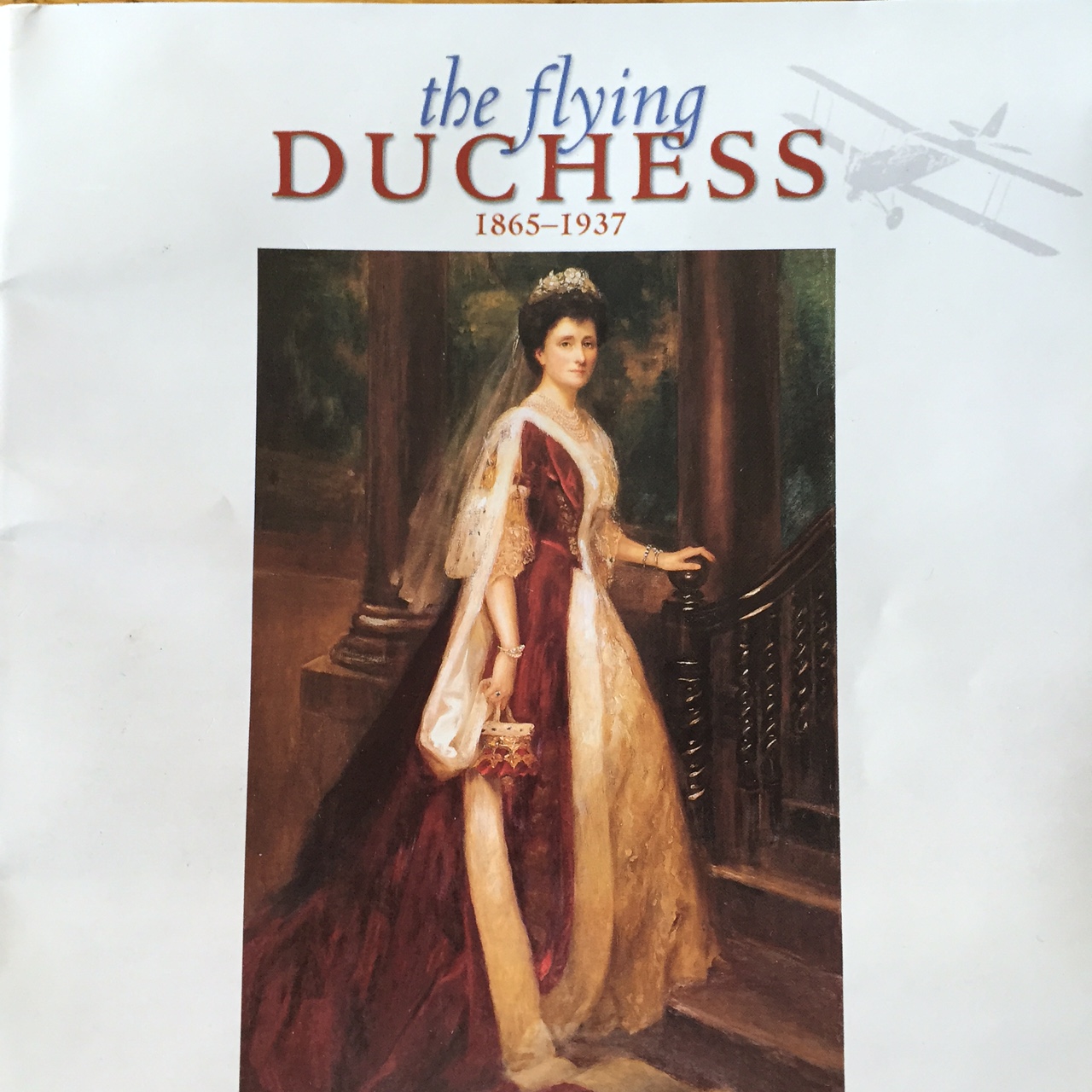
How did the free-spirited daughter of an obscure English clergyman become the famous Duchess of Bedford, best known as The Flying Duchess? The little book above, written by Mary’s great-grandson the Marquess of Tavistock, tells her story. Mary Du Caurroy Tribe was born and educated in England, but as a young teenager she went to join her family, stationed in India.  Her father’s chaplaincy duties took him on dirt roads and over mountain passes to Indian villages.  For six years, Mary happily went along for the ride, taking turns with her father on their one pony. She loved every moment of outdoor adventure.

Lord Herbrand Russell, my photo taken from book "The Flying Duchess," cited above

Lord Herbrand Russell, my photo taken from book “The Flying Duchess,” cited above

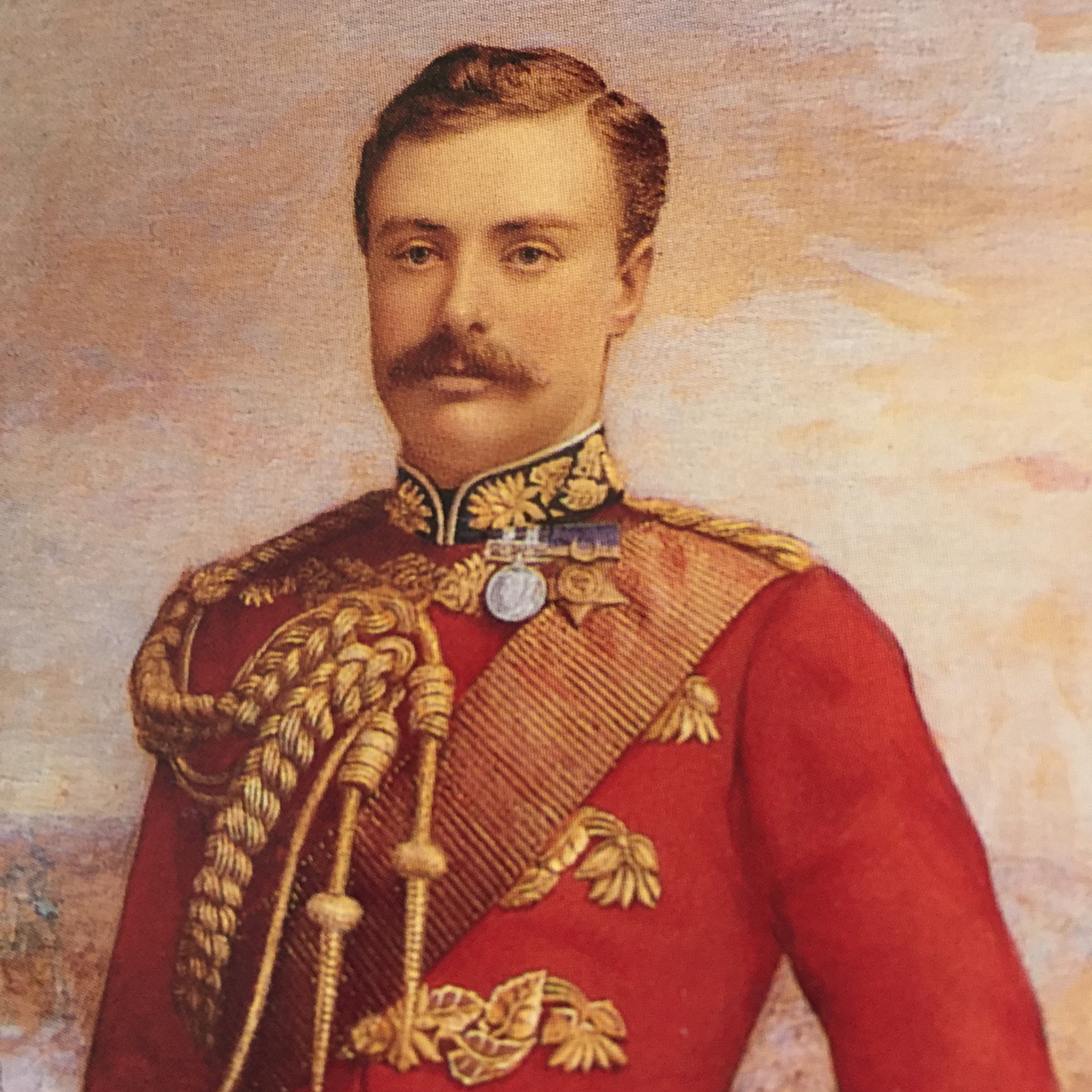
In 1888, at age 23, she married the dashing Lord Herbrand Russell, aide-de-camp to the Viceroy. He was 27, and as an aristocratic younger son he had to make his own way in the world. A life serving Queen Victoria in India seemed likely for the young couple.

Mary Russell, Duchess of Bedford, Public Domain

Mary Russell, Duchess of Bedford, Public Domain

But in quick succession, Lord Herbrand’s father and childless older brother died, and hey presto! the young couple became Duke and Duchess of Bedford.

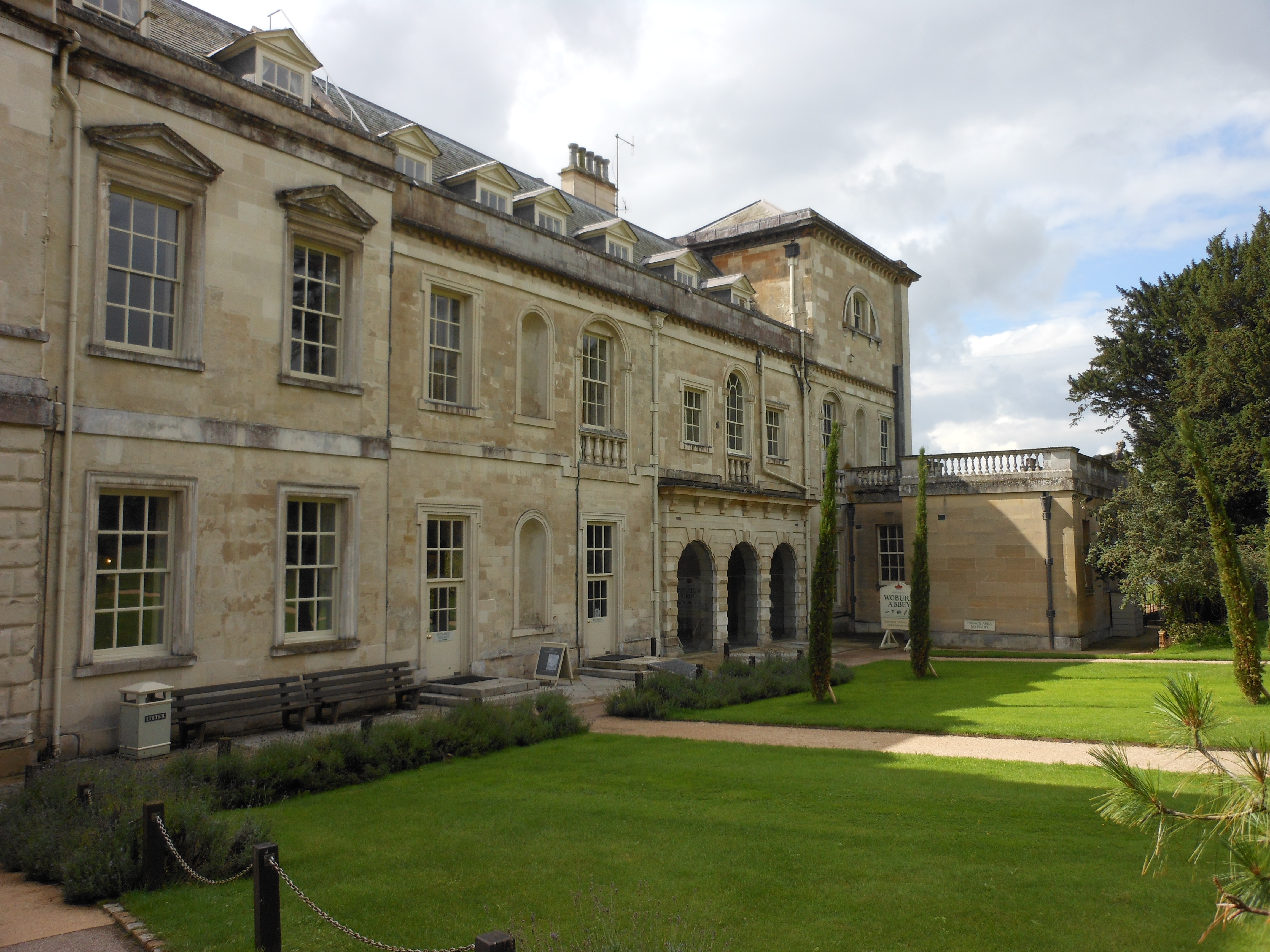
Woburn

Along with the title came Woburn Abbey, seat of the Dukes of Bedford for over 300 years. In the twentieth century, war and industrialization took a toll on all great country houses. Woburn opened to the paying public in 1953, preserved from steep tax bills thanks to pragmatic plans that included a golf club. But it is still the family’s home. And rare breeds of deer still roam the park.

In her early married years, the Duchess gave birth to her only child, a son named Hastings.  Besides dressing up and wearing a tiara when required, she did all manner of good works in her community. She loved nature and being outdoors. She traveled on her yacht, hunted, fly-fished, and canoed, often alone, down rivers where she “shipwrecked” more often than she probably cared to admit. She took up bird-watching. Never one to do things by halves, she became a world authority on birds.

One of her prized pets was a rare swan named Sabina, a rescue bird who ferociously attacked any creature, man or beast, that ventured near her pond. She was no match for Mary Russell. The Duchess wrote in her diary, “I made a stand and gave Sabina to understand that in my case at least such behavior could not be tolerated.” Soon Sabina was following the Duchess around and allowing herself to be picked up. She haunted the terrace in front of the house, watching for the Duchess. She even asked for kisses. A male swan was drafted into service as a mate for her. Sabina tolerated him, but her first love was the Duchess.

Duchess of Bedford as a nurse, my photo taken from "The Flying Duchess" book cited above

Duchess of Bedford as a nurse, my photo taken from “The Flying Duchess” book cited above

The Duchess designed and built a state-of-the-art community hospital in Woburn. But she didn’t stop there.  For 34 years, she actually worked in the hospital, shoulder to shoulder with her employees. If she noticed a dirty floor, she scrubbed it. 

When World War I came, she converted large outbuildings on the estate into a war hospital. She hired an eminent London surgeon, Mr. Bryden Glendining, as her head of staff.  She trained as a surgeon’s assistant and stood by his side for about a dozen operations a week.

Realizing that the new science of radiology was crucial to diagnosis, she learned radiology and headed that department.  I can just hear her saying, “How hard can it be?” The War Office had so much confidence in the Duchess’s hospital that wounded soldiers were sent to Woburn directly from the Front.

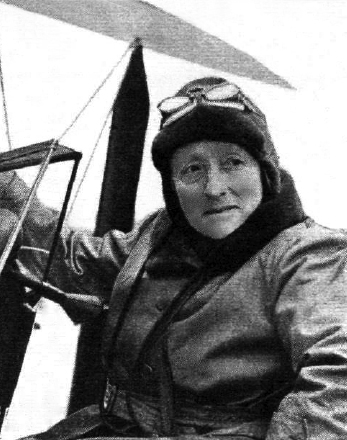
MaryRussellBedford

At age 61, the Duchess took up flying.  Again, how hard could it be? In 1937, at age 71, she had 199 hours of solo flight under her belt when she took off from the park at Woburn, alone in her De Havilland Gipsy Moth. She was never seen again. It seems likely that she strayed over the Channel and went down at sea.  Pieces of her plane eventually washed up on shore, but she was never found. Her beloved husband survived her by three years.

If the Duchess had lived on into the years of World War II, no doubt she would have tossed her flying helmet onto a shelf, rolled up her sleeves, and marched straight back into her hospital work.  A BBC article about her life is at http://www.bbc.co.uk/threecounties/content/articles/2008/08/12/flying_duchess_feature.shtml


All Saints’ Church at Kedleston Hall

KedlestonHall

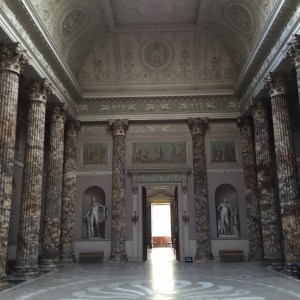
Kedleston Hall is the spectacular showplace home of the Curzon family, designed by Robert Adam, finished in 1765 and open to visitors before all the plaster was dry. The housekeeper led visitors (of the right sort, of course) on a tour through the state rooms. The point was to impress visitors with the wealth, power and taste of the family. Not everyone cared for the place, though. Dr. Johnson remarked, “It would do excellently for a town hall.” I have to agree.  Entering the lofty Marble Hall feels like entering a courthouse. Visitors stop in their tracks and speak in hushed voices.

AllSaintsKedleston

My favorite part of the estate is All Saints Church on the grounds outside. The church is an important historic site, cared for by a special organization separate from the National Trust, which manages the house.

CurzonMedieval

Curzon ancestors, dating all the way back to Norman times, were buried inside and in the churchyard. When Sir Nathaniel Curzon inherited the estate in 1758, he lost no time in razing the medieval village where his ancestors had lived quietly for centuries. But he kept the village church where they slept in their tombs.

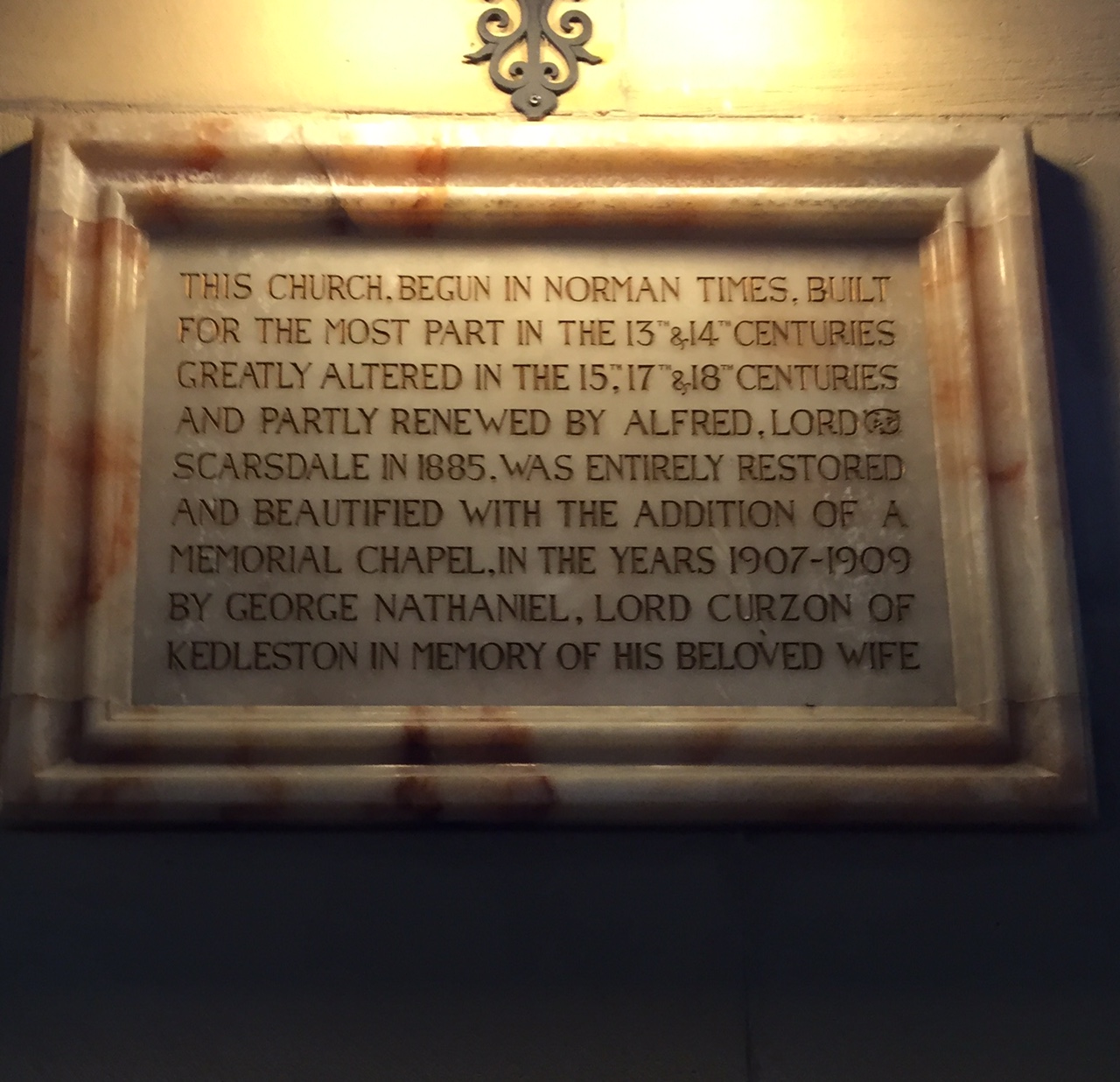
AllSaintsPlaque

As the plaque above explains, various Curzons maintained and restored the church over the years.  But its pristine condition today is mostly because of a sad love story.
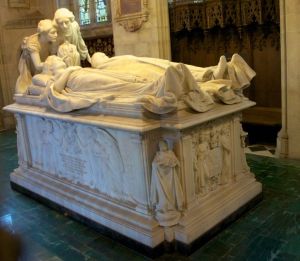
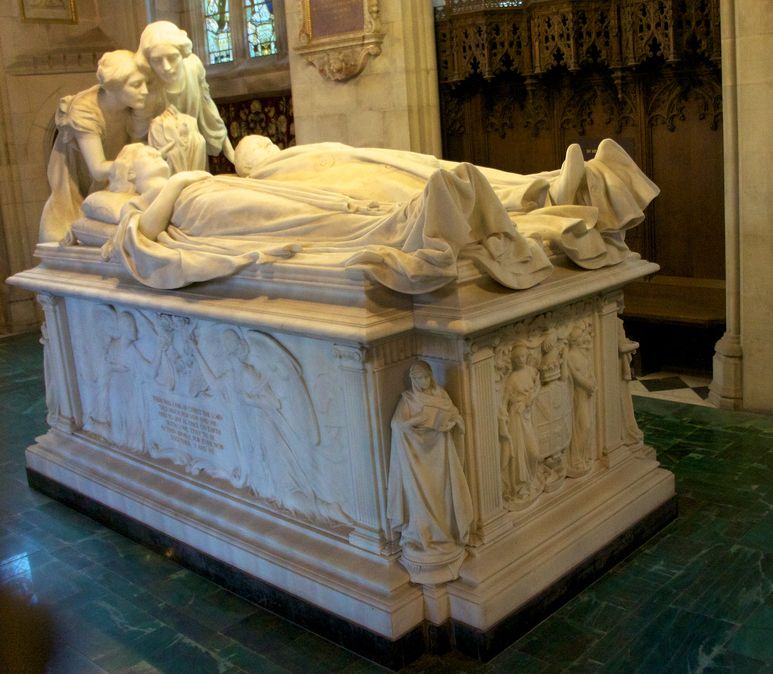
Photo by Chris Hoare, Creative Commons Attribution 2.0 Generic

Photo by Chris Hoare, Creative Commons Attribution 2.0 Generic

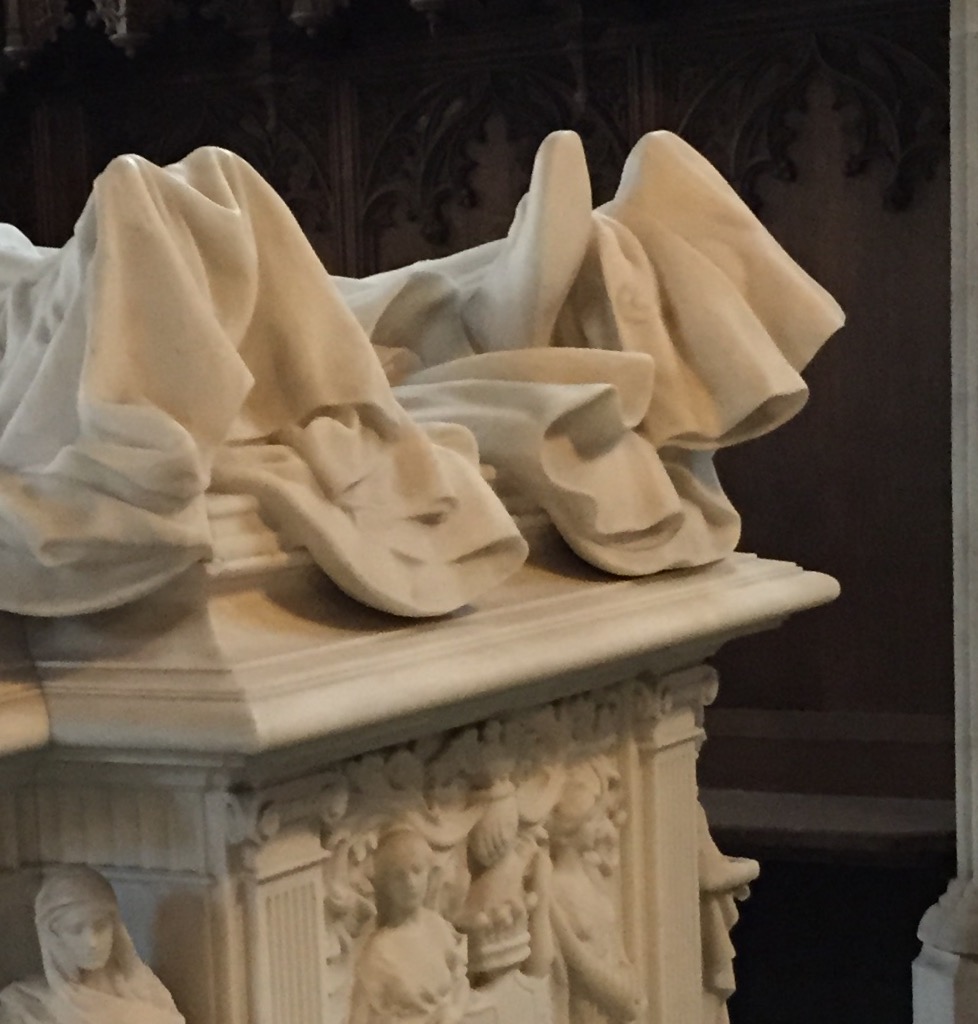
The photo above shows the exquisite marble memorial of Lord George and Lady Mary Curzon.  It was created between 1907 and 1913 by Bertram Mackennal. (Visitors can’t get the complete view above, because the side chapel is separated from the main church by a gate). This is one of the most beautiful and intriguing of all the many tombs I’ve seen in old churches. Who were these people?

MaryCurzon

Mary Leiter was a fabulously wealthy, cultivated and beautiful young woman from Chicago.  Her father was Levi Leiter, founder of Field and Leiter stores, which eventually became Marshall Fields. (Yes, Mary Leiter was an inspiration for Cora, the perfect wife of Lord Grantham on the TV show “Downton Abbey.”)  Mary Leiter married George Curzon in 1895. He very soon afterward became Viceroy of India, the highest title available to an Englishman, during the heyday of Victorian empire. Mary gave birth to three daughters, but failed to produce the all-important son. The years she spent in India were happy ones, but her health suffered and she died in 1906, aged only 36.

KedlestonSideChapel

Her husband immediately set to work memorializing her, even as he moved on to various mistresses and an eventual second wife. He never really recovered from his grief at losing Mary. So he built a neo-Gothic addition to the family church. The addition blends almost seamlessly with the original medieval church.   He commissioned the beautiful marble memorial. Mary was buried in the newly-created family vault underneath.  My understanding is that Lord Curzon had Mary’s effigy placed on the plinth as soon as the chapel was complete.  His own effigy was finished and kept in storage until he died.  Then it was placed next to his beloved Mary, and he took his place in the vault below.

Victorian technology allowed Lotrd Curzon to install a hidden elevator in the marble floor next to the memorial, so that coffins could be lowered into the vault at the push of a button.  The friendly church guide recalled the spooking of a lady in recent years. She walked into the church just as a workman rose slowly from underground, standing on the moving section of floor. The terrified lady fled.

FullSizeRender (12)

The guide pointed out that Lord Curzon’s right foot is uncovered, a Victorian convention indicating that the effigy was created while the person was still alive. Lord Curzon was a stickler for detail, and he expected the same from his family and everyone who worked for him.

MaryCrown

The sculpture depicts two angels hovering over the sleeping figures.  What are they holding? It’s the Crown of Life–a fairly obscure Biblical reference. The crown is wrapped in a veil. Why?  My thought is that nobody gets to see their heavenly reward until they actually receive it in the Great Beyond.

The sculpture stands serenely in its own side chapel, surrounded by nine stained glass windows depicting various Marys from the Bible and other sources. Impertinent questions come to mind. Considering that there are two people lying in state, why is there only one crown? Is the sleeping couple somehow supposed to share the crown, or is it meant for only one of them? If it is for one of them, would that be Mary? In some traditions, Mary the mother of Jesus became Queen of Heaven after her death. But this is an Anglican church, and as far as I know has no such tradition. Anyway, wouldn’t it be just a bit sacriligious to insinuate that one’s wife was destined to be Queen of Heaven? The guide had an information booklet, but there was very little explanation of the mysterious veiled crown. I would not use a vulgar term like “control freak” for Lord Curzon, but I half expected his ghost to tap me on the shoulder and set me straight about the crown. He did not suffer fools gladly.

Lord Curzon never found another person who could compare to his Mary, and by all accounts he often said so. How could any actual living person compete with a sainted ghost? After Mary’s death, Lord Curzon was soon battling his daughters for their shares of the money Mary had left. He ended up estranged from them. Toward the end of his life, he was also estranged from his second wife, Grace. All the same, according to the guide, Lord Curzon kindly reserved a space for her in the family vault. But Grace did not care to spend eternity directly underneath the effigies of her husband and his first wife, depicted in everlasting marital bliss. Instead she chose a burial plot for herself in the far corner of the churchyard.
Viceroy's Daughters
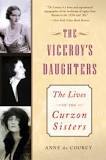
Every trip leads me to buy books which I may or may not find time to actually read. I’ve already devoured the book above, The Viceroy’s Daughters by Anne de Courcy. The Curzon family history, especially in the 20th century, is riveting.  The book is a window into British aristocratic life from Victorian times all the way through World War II.  I’ll be writing more about the glamorous Curzons.
Join me next time for more explorations in the art and history of Europe and the British Isles!