Nurturing Genius

One of my most unforgettable sights in a museum was a young child crouched on the floor of the Musee Picasso in Paris.  As her mother waited nearby, the little girl moved from one Picasso painting to another, intently drawing in a notebook. She was oblivious to anything around her, and people respectfully stood back to let her work.  What she was doing WAS work, not play.  Was she a budding genius, or just a kid going through a stage, as kids will?  Hard to tell, but I applaud her mom for patiently spending the day letting this child pursue her passion.

ChildPicasso

In his essay on Gianlorenzo Bernini, Simon Schama describes what happened when Bernini’s father, a sculptor himself, took the boy to visit the Pope:

Brought before the Borghese Pope Paul V, the eight-year-old did a shrewdly ingratiating lightning sketch of Saint Paul “with free bold strokes” that moved the astonished Pope to hope that he was looking at the next Michelangelo. To nurture his talent, Paul V appointed Cardinal Maffeo Barberini to watch over the young Bernini and shape his education.

Years of what all sculptors had to do – study and draw from classical models – followed. Even boy wonders had to learn the rules.

http://www.guardian.co.uk/artanddesign/2006/sep/16/art

Art education is not just for boy wonders.  It’s for all of us. Imagine being a child lucky enough to take art classes at the Louvre!  It happens every day, there and at other centers of art.

LouvreArtClass

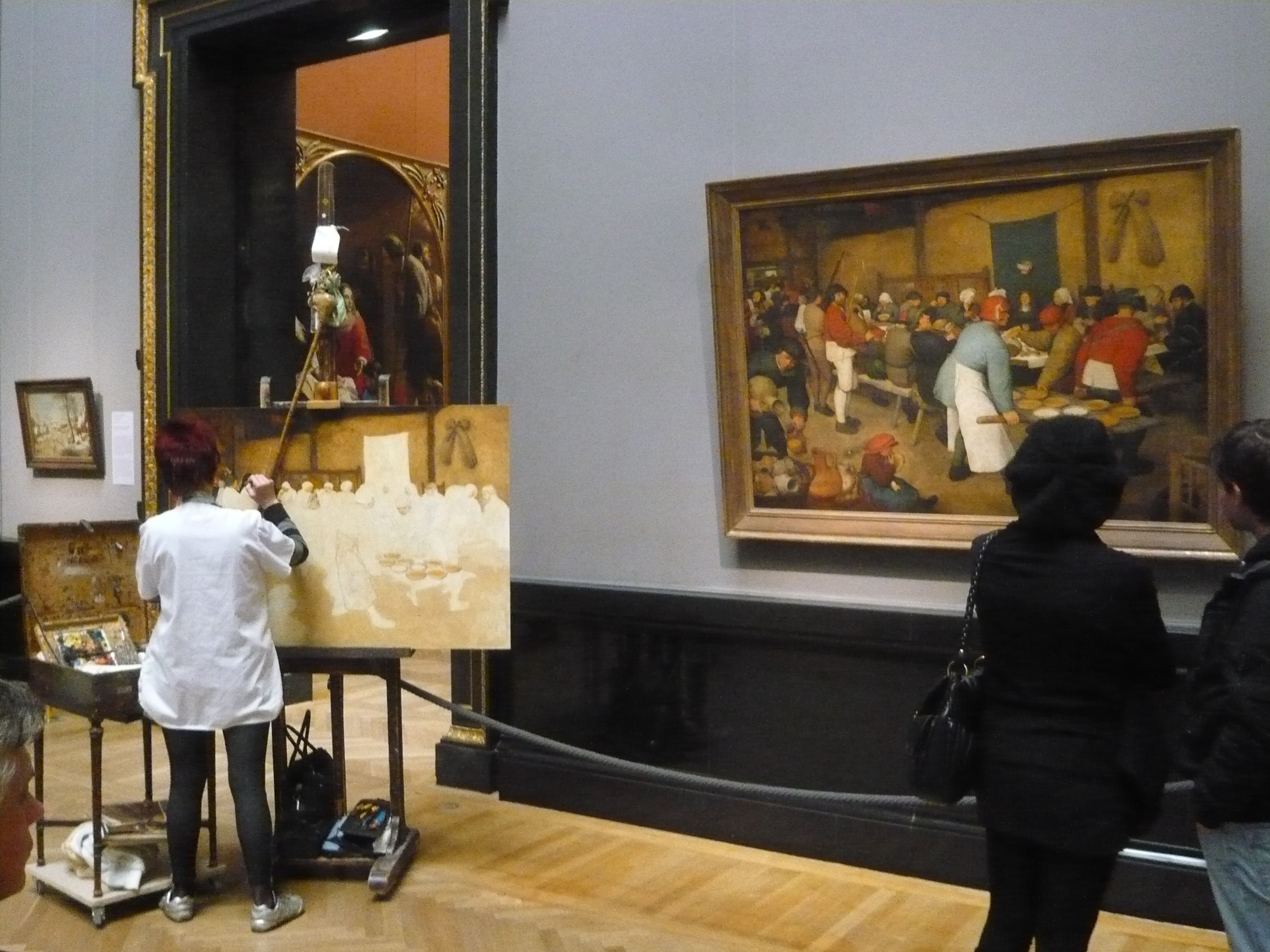
And every day, in every great museum, aspiring artists old and young set up their easels in front of masterpieces, in order to learn from the masters. This artist is copying The Peasant Wedding, painted in 1567 by Pieter Bruegel the Elder.  It’s in the Kunsthistorisches Museum in Vienna.
BreugelStudent

We all have just a little touch of genius inside us. Maybe I’d better get out my own easel and paints today!

The Musee Picasso, located in a 17th century mansion in the Marais district, is under renovation.  Its long-anticipated reopening is in summer of 2013.

Join me next time for more adventures exploring the art and history of Europe.

Winter into Spring

Long winter nights are for remembering past trips and dreaming of future ones.  But for me, winter days are for getting outside.  Last December and January in Minnesota, we had several glorious weeks where the lakes (11,842 of them, according to Yahoo!) froze over with hardly any snow on top of the glassy ice.  All I wanted for Christmas was a new pair of skates!

newskatesSkating

In my adopted hometown of Steamboat Springs, Colorado, we had enough snow (we always want more, of course).  But we had plenty of powder days.

MeSnowboard

The mountain closes in just a few days.  As usual, we have dueling forecasts for tomorrow.  Maybe we will get rain, or an inch of snow, or 5 inches, or 15 inches.  I’m hoping for the last option, of course.  After that, it will be spring, time to start looking for crocuses and planning my next venture into exploring the art and history of Europe.  Meanwhile, I’ll be writing about trips past, future, and dreamed-of.

Join me tomorrow.  I’ve been thinking about some of the free sights in Rome!

Rome Culture Week 2013 Cancelled (but go anyway!)

Roman Forum

Roman Forum


The first time we went to Rome, we were amazed when we stopped at the ticket office of the first museum on our list.  Our tickets were free!  We had arrived during the Settimana della Cultura, a week in which all city and state owned museums were free.  We took full advantage, taking in museums we might otherwise have skipped:  the Napoleon family museum, the Corsini Gallery, and the Villa Farnesina, where Raphael entertained his mistress while he created the latest in home decor for his wealthy boss.  Best of all, we had the luxury of short, repeated visits to the big, exhausting museums like the Capitoline and the various locations of the National Museum of Rome.  Ever since, we have tried to plan a trip around the Settimana.  But dates are a closely guarded secret, announced with hardly any lead time.

The reason for the secrecy is that the free week was always meant to benefit locals more than tourists.  But this spring, for the first time in 14 years, there is no Settimana at all.  Authorities decided that with the current economic crisis, they cannot give up a week of admission fees.  To add insult to injury, non-residents have to pay 1 Euro on top of the regular admission price, all the time.  This rule was adopted in 2011, the same year the “tourist tax” of 2 to 5 Euros per person per night was imposed on all Roman lodging.  The amount depends on the number of stars the hotel claims.  Even campsites are taxed, though.

These extra fees seem minor compared to the total cost of a trip to Italy, but they are annoying to the traveler, the ticket seller, and the hotel keeper.  The lodging fee has to be paid in cash, separate from the hotel bill.  Considering what tourists contribute to Italy’s economy each year, this nickel-and-diming of visitors seems short-sighted.

Italy is expensive to begin with, and travel there can be frustrating.  Italian cities and towns are stuffed with priceless art treasures, yet the museums are some of the worst-kept in Europe.  Many buildings are crumbling, dusty and dark.  Hours change without warning.  Admission fees are high. It sometimes seems as though the cultural authorities exploit their treasures but fail to safeguard them.

In spite of all this, I love Italy.  The cities and towns themselves, large and small, are free open-air museums of art, architecture and history.  The churches contain some of the greatest treasures and are generally free, or they ask for a small donation.  Italian people are friendly, kind and proud of their heritage.  A bewildered tourist clutching a map on a street corner will soon have a local resident offering to help.  Since Italians generally live in small homes, they spend a lot of time in parks, cafes and strolling their cities.  Street life is colorful and endlessly fascinating.  The food is wonderful.  A little research makes a trip affordable (For me, the research is almost as much fun as the trip itself). And the memories are lifelong.  Bella Italia will always beckon!

Campo de' Fiori

Campo de’ Fiori

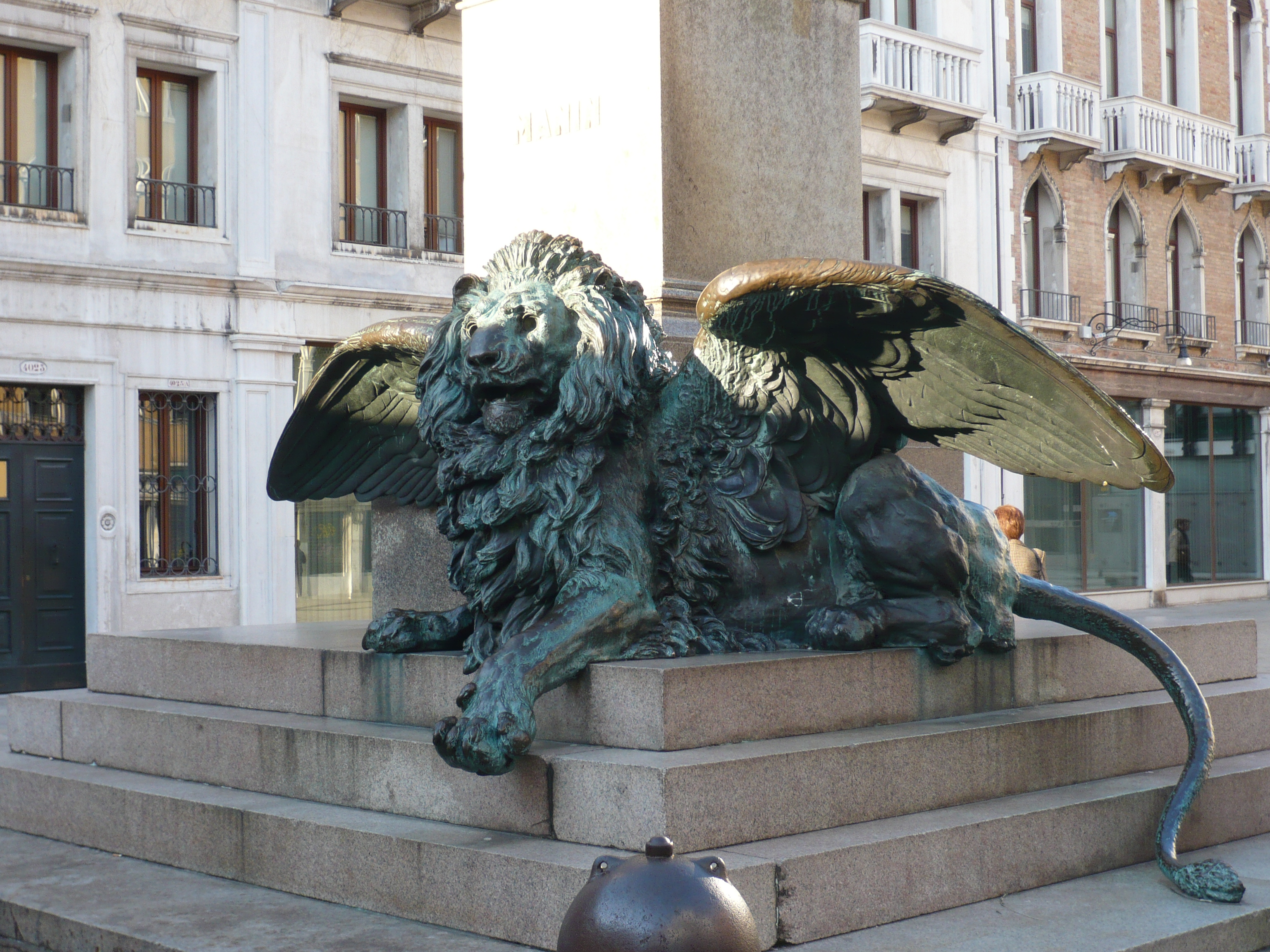
Winged Lion of Venice

WingLion

The winged lion, seen everywhere in Venice, represents St. Mark, one of the four evangelists (Matthew, Mark, Luke and John). The Biblical Book of Revelation identifies four “living creatures,” all winged, who pull the throne-chariot of God.  (Matthew is traditionally depicted as a winged man, or angel.  Luke is depicted as a winged ox,  and John as an eagle).

St. Mark did not have much to say about becoming the patron saint of Venice.  Little did he know that his winged lion image would eventually be the symbol of the Venice Film Festival, coveted by movie stars from all over the world.  Hollywood awards the Oscar, but Venice awards the Golden Lion.

Golden Lion, photo by Saliko, GNU Free Documentation License

Golden Lion, photo by Saliko, GNU Free Documentation License

How did this happen?  In the year 828, according to tradition, two enterprising Venetian merchants stole Mark’s remains from his burial place in Alexandria, packed them in a basket,  and smuggled them all the way to Venice by boat.  They were placed in the new basilica, which was named San Marco. Over the years, the basilica grew into one of the most spectacular and unusual churches in the world. Perhaps to justify the theft, a story developed that during his lifetime,  Mark had visited the area and had a vision telling him that Venice would be his final resting place.

In the year 828, Venice already had a patron saint: Theodore.  But poor Theodore was relegated to the background once Mark arrived.  After all, St. Mark was one of the four evangelists–a much more powerful patron than an obscure Greek or Turkish soldier-martyr.  (Actually, there were two St. Theodores, and no one was quite sure which of the two was the patron of Venice). Anyway, Mark was an “Italian” saint, having written his Gospel in Rome.  Mark was closely associated with St. Peter, founder of the Church of Rome.  Venetian leaders at the time wanted to separate themselves from Byzantium.  They saw a glorious future for their city in a closer association with Rome.

Photo by PeterJ.StB.Green, GNU Free Documentation License

Photo by PeterJ.StB.Green, GNU Free Documentation License

So the elegant and powerful figure of a winged lion, representing St. Mark, appears in countless forms all over Venice:  in mosaics, paintings, architectural ornaments, flags, and atop a column in the Piazzetta San Marco.  SInce this column was built around 1268, the winged lion has watched over countless events in the turbulent history of Venice.

Venice at Easter

SanMarco

On Easter morning two years ago, my husband and I got up early and ventured into the almost-empty streets of Venice to see if we could get into a service at Saint Mark’s Basilica.  Of course we could, and what a perfect time to be there!  Typically, tourists get about 10 minutes to shuffle through the darkened cathedral, peering up in a vain effort to see the spectacular 12th and 13th century mosaics. Once in awhile some lights come on, and attendants periodically call for silence.  I’d rather look at the mosaics in a book.

But during all of the many services on Easter Sunday, the interior is brightly lit.  And worshippers get to sit down! We entered through the side door and found plenty of seating. Although we are not Catholic and could not even understand the language, we felt entirely welcome.  There were even some printed copies of the sermon in English.  We spent a wonderful hour soaking up beautiful sacred music, mysterious (to us) words, and an ambiance of golden light.  There was time to gaze up at the 8,000 square meters of breathtaking mosaics depicting events from the New Testament and lives of various saints.  Of course, St. Mark, the patron saint of Venice, is  prominently featured. (The Old Testament is depicted mostly in the narthex, or grand entryway, outside the church itself).

As a bonus, the Pala d’Oro, a golden altarpiece usually covered, was wide open and brightly lit. The Easter experience at St. Mark’s was so spectacular that we actually went back for another service later in the day.  Then we emerged into the beauty of Venice itself, feeling that we’d had a once-in-a-lifetime Easter.

GrandCanal

St. Francis in Vienna

On a Saturday evening late in November, we wandered into an out-of-the-way Vienna church where we heard music.  We were greeted with smiles and given slim wax candles and a musical score including words, some in German and some in English. We took seats toward the back of the beautiful Gothic church lit only by candles and settled in to listen to the choir and small orchestra.  The music was simple, not grandiose. After puzzling over the program, we realized that the music came from the Taize community in Burgundy, France. This is an ecumenical community especially concerned with young people, with a focus on simplicity, peace and reconciliation. Our local church in Colorado often uses small hymnals from Taize, so the music was somewhat familiar.  Halfway through the program, there was a period of silence (“Stille” on the program). Singers and musicians left their places and dispersed into the congregation.  Far from being a bore, the silence was profoundly peaceful.  In the back of the church, a few people left, but more kept arriving, each welcomed with a lit candle.  We noticed two people arriving with dogs.  They chose places at the very back of the church, next to the door.  But the dogs settled down immediately and curled up at their owners’ feet.  Only later did we learn that this was a Franciscan church.  Of course animals would be welcome in the home of St. Francis.

After the silence, a priest or monk stood up and spoke quietly for a couple of minutes.  Then the music resumed. We learned later that this was the Minoriten Church, built on land given to the Franciscans in the 1200s. It was built in the French Gothic style and never much altered.  At one point, it became an Italian church with the name ” Church of Mary of the Snows,” which it retains today.

We were amazed that our candles burned cleanly the whole time without a single drip.  Actually, the whole experience seemed like a small miracle in the hustle and bustle of Vienna shoppers and revelers:  a peaceful hour spent in a Gothic church that has stood since 1350, listening to sublime music and watching candlelight flicker on the ancient stone columns.

Gods in Colour

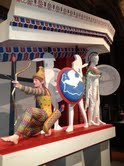
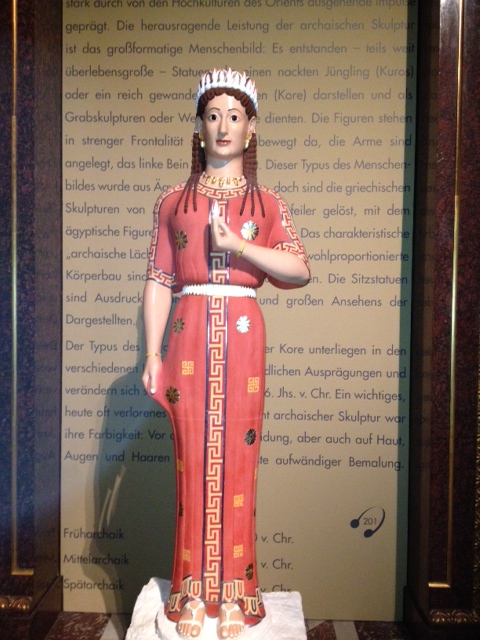
I’ve always heard that the ancient Greeks and Romans painted their statues, and that the pristine marble pieces that fill our museums were never intended to be pristine or white.  I never quite could picture antique sculpture in color.  This year, the Vienna Kunsthistorisches Museum has an ongoing exhibition showing just  how statues from antiquity might have appeared to the original viewers.

The exhibit is integrated into the existing collections.  So we can look at the original sculpture and at a reconstruction, painted as it may have been.  Using science I can’t begin to understand, tiny traces of surviving pigment have been analyzed and compared to pigments known to have existed during the time periods.

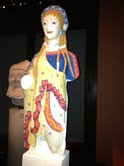
Then the pieces have been reproduced in plaster with the best guess of colors.  For example, fragments of a marble frieze might have looked like this:

A goddess might have appeared in a bright dress like this:

To the modern eye, the colors take some getting used to.  They are a little garish–like carousel ponies, say. And I have to wonder whether the ancients really applied their colors in solid fashion.  Wouldn’t they have done some shading, at least?  Still, seeing ancient sculpture in full color is fascinating and thought provoking.  A link to the exhibit is at http://www.khm.at/en/exhibitions/current-exhibitions/gods-in-colour/.

Snow and Strudel

One of the great pleasures of Austria is strudel, both sweet and savory.  A very popular restaurant in Old Town Innsbruck is ALL, strudel, all the time:  the Strudel-Cafe Kroll.  It is not always easy to find vegetarian meals in Austria, so we jumped at the chance to have spinach and cheese strudel for lunch in a charming small cafe.

Of course the classic apple strudel is served everywhere in Austria, with a choice of either warm vanilla sauce or or a small mountain of whipped cream–or both.  The truly decadent can always add a scoop of vanilla ice cream.

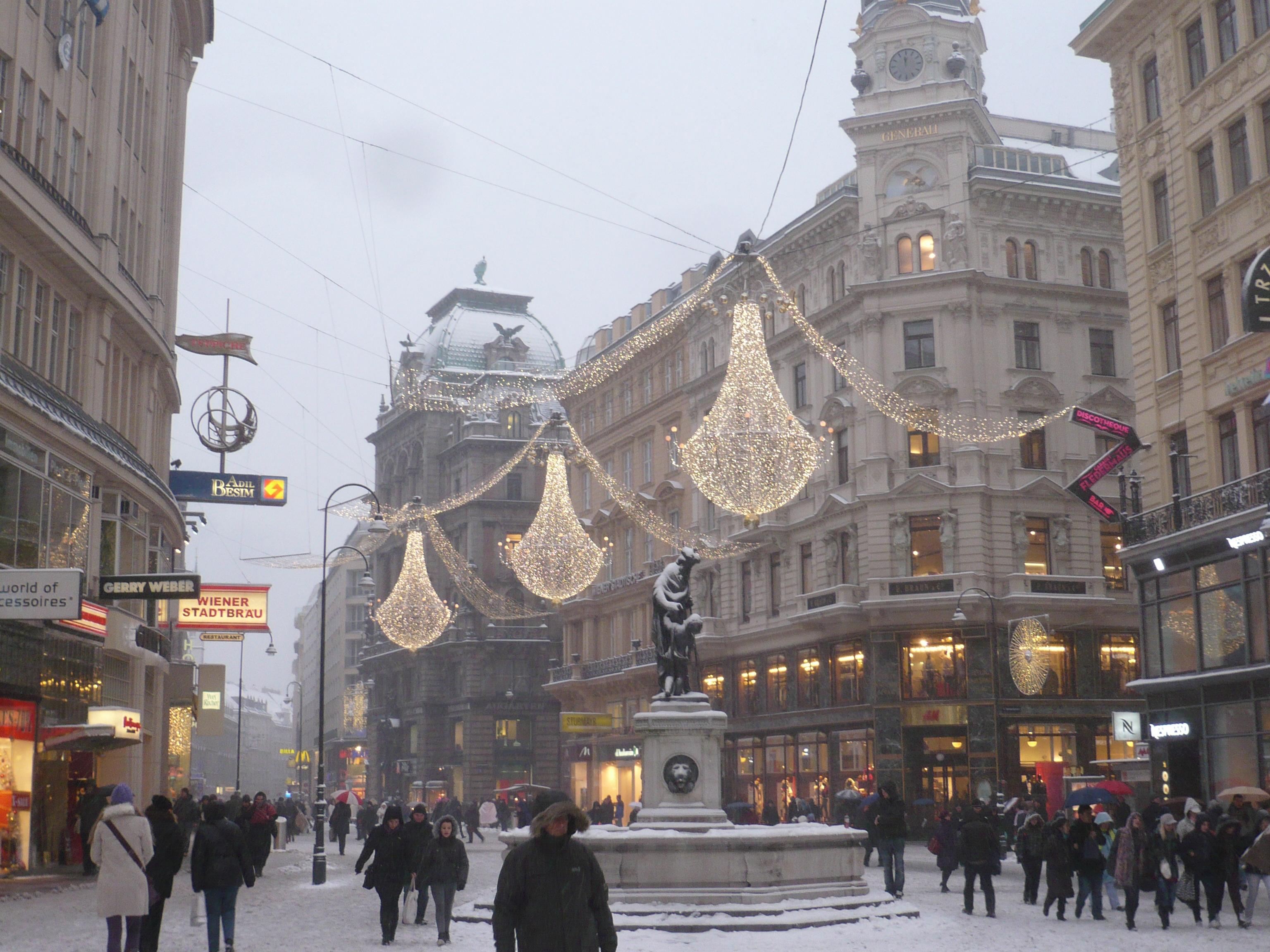
What about snow? The holiday season in Vienna starts toward the end of November, when the Christmas markets open, sparkling lights go up all over the city, and beautiful music fills the churches and concert halls.  In the past, we’ve been lucky enough to wake up to a city frosted with snow.

This year? We shall see.  We may not be lucky enough to have snow, but for sure there will be strudel.

Happy Birthday, Gustav Klimt!

Vienna is celebrating the 150th birthday of one of its most iconic artists, Gustav Klimt.  They’ve built him a bridge! Actually the bridge is a temporary scaffolding in the main staircase of the Vienna Kunsthistorisches Museum.  It’s been a huge success, so its time was extended through January 6, 2013.  I can hardly wait! Instead of craning our necks to see the dimly lit images twelve meters up in the air, we will be up close and personal with them.

Klimt and other artists were commissioned to do a series of paintings representing various periods of art history.  Thirteen of the paintings are the work of Mr. Klimt, painted in his studio and later glued to the wall just under the grand ceiling. Each historic period is represented by a person, either male or female.  Klimt was only 28 at the time, so these paintings represent some of his early work. At the time, historical subjects were all the rage.  No doubt Mr. Klimt put his own special spin on art history, always pushing the limits of what polite society was willing to accept.  Possibly the museum authorities in 1891 were happy to have these paintings out of easy reach.  “All art is erotic,” the artist famously said. Happy birthday, Gustav Klimt!