Category Archives: History

Ludwig’s Local Starbucks at Linderhof

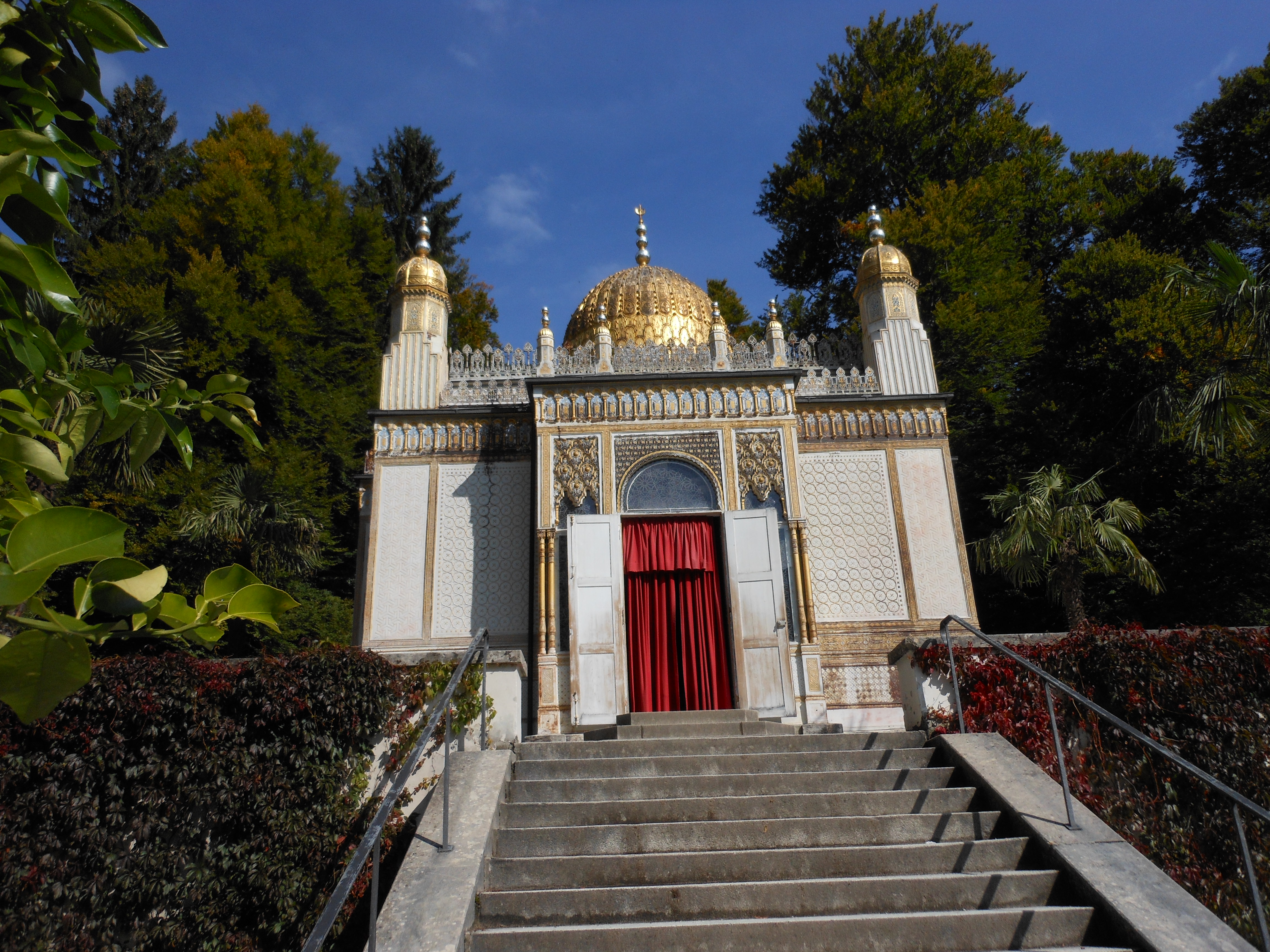
After the Siege of Vienna by the Ottomans was broken in 1683, the conquering army of Austrians found sacks of Turkish coffee left behind.  Immediately coffee became a popular drink, and coffeehouses sprang up.  Of course, Ludwig was not a sociable man, and he had no use for internet access.  So instead of heading to his local watering hole, he savored his morning coffee in his very own Moorish Kiosk on the grounds of Linderhof Palace.

Moroccan House at Linderhof

Moroccan House at Linderhof

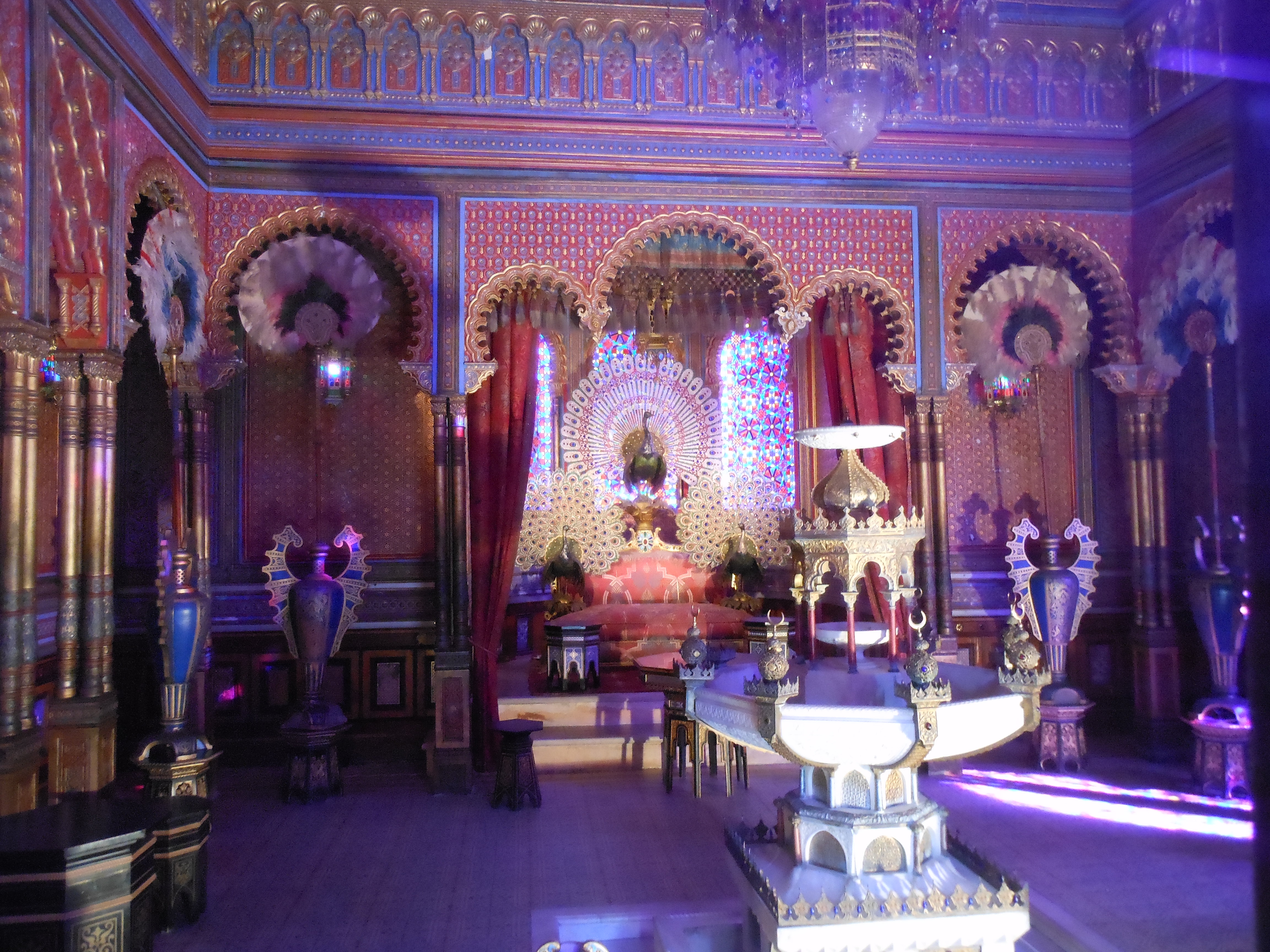
The structure was built for the International Exhibition in Vienna in Paris in 1867.  Ludwig wanted to buy it, but a railroad mogul beat him to the punch.  He had to wait until a little later, when the railroad went bankrupt. The interior is otherworldly, lit mostly by sunlight streaming through stained glass.

Moroccan House Interior

Moroccan House Interior

The most distinctive feature is the Peacock Throne.  Unfortunately, tourists are only allowed to peer into the doorway, so it’s hard to say whether the throne was built for comfort.

Ludwig was always dressed impeccably for any occasion.  History does not record what he wore for his jaunts to his favorite morning coffee spot, but I can use my imagination.

Join me next time for further exploration into quirky corners in the art and history of Europe!

Linderhof: “Mad” King Ludwig’s Real Home

Last fall I was finally able to visit Linderhof Palace, King Ludwig II’s favorite home, at a time when the grotto was open.  I was anxious to see it, especially after watching Luchino Visconti’s very fine film Ludwig, about the life and mysterious death of the notorious Bavarian king.
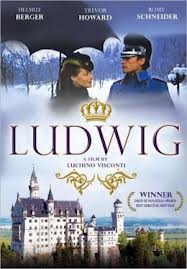
LudwigPoster

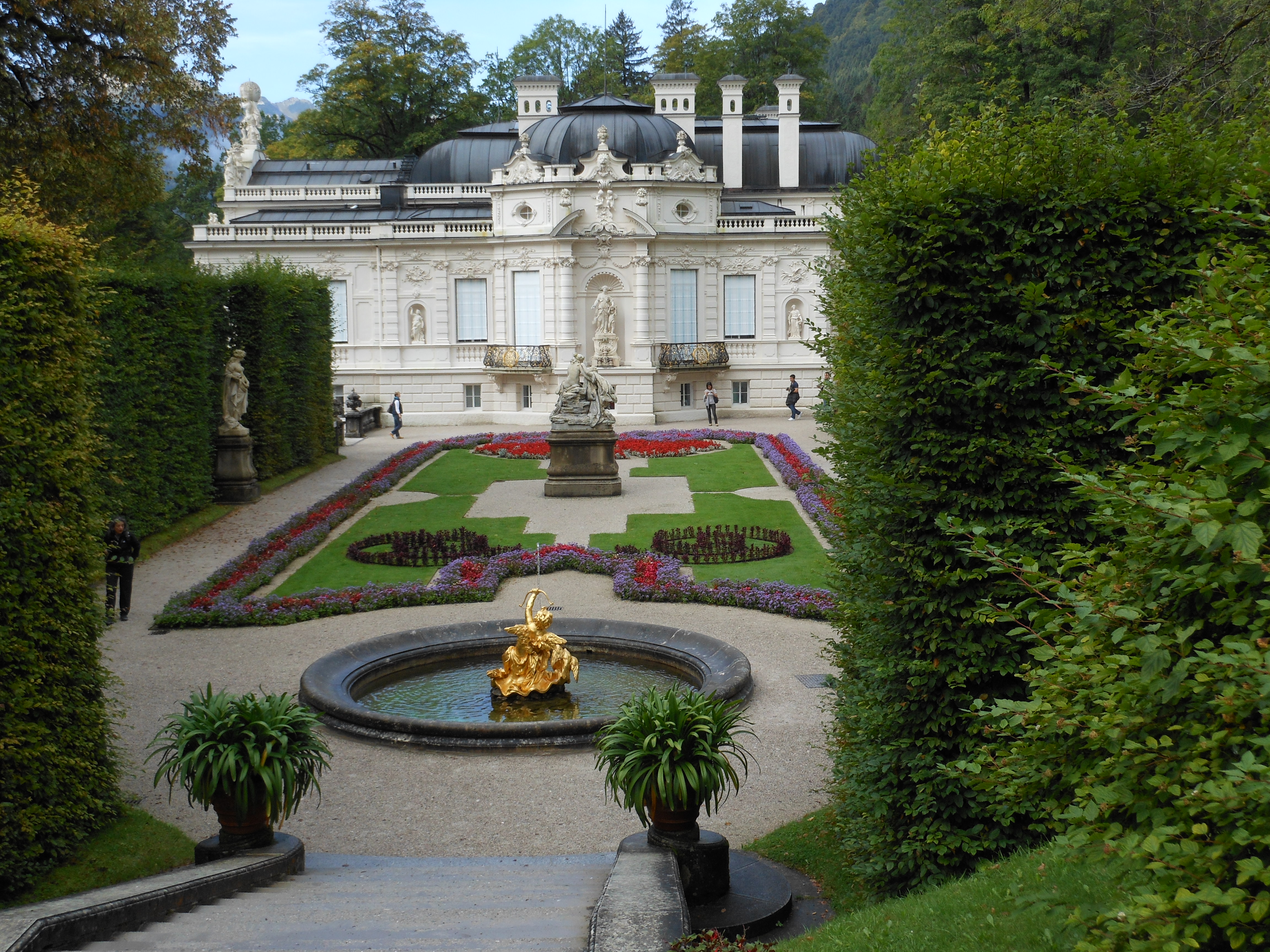
Ludwig built Linderhof as his own personal getaway.  In fact, it was the ultimate bachelor pad.  But he enjoyed the place in solitary splendor; he rarely if ever had visitors.  He built a special music room for his favorite composer, Richard Wagner, but Wagner never saw it. The grounds are breathtaking, and because the palace is quite small, each room looks out onto a beautiful manicured view with pristine mountains in the background.

Linderhof Palace

Linderhof Palace

In Visconti’s 1972 film Ludwig, the king is played by Visconti’s real-life romantic partner and muse, Helmut Berger.

It is hard to say how accurate the life story is.  But it is certain that Ludwig was an eccentric and  dreamy romantic.  His people loved him, but he was not much of a king when it was time to hang the ermine in the closet and get some work done.

One of Ludwig’s very few friends was his cousin, the Austrian Empress Elisabeth, nicknamed Sisi. She was famously married to the Emperor when she was only 15, and spent the rest of her life wanting out.  She is played by Romy Schneider (who also played Sisi in the very silly but entertaining semi-fictional series of Sissi movies).

The grotto was built up the hill behind the castle.  The entrance looks like a fort a very ambitious child might build.

GrottoEntry

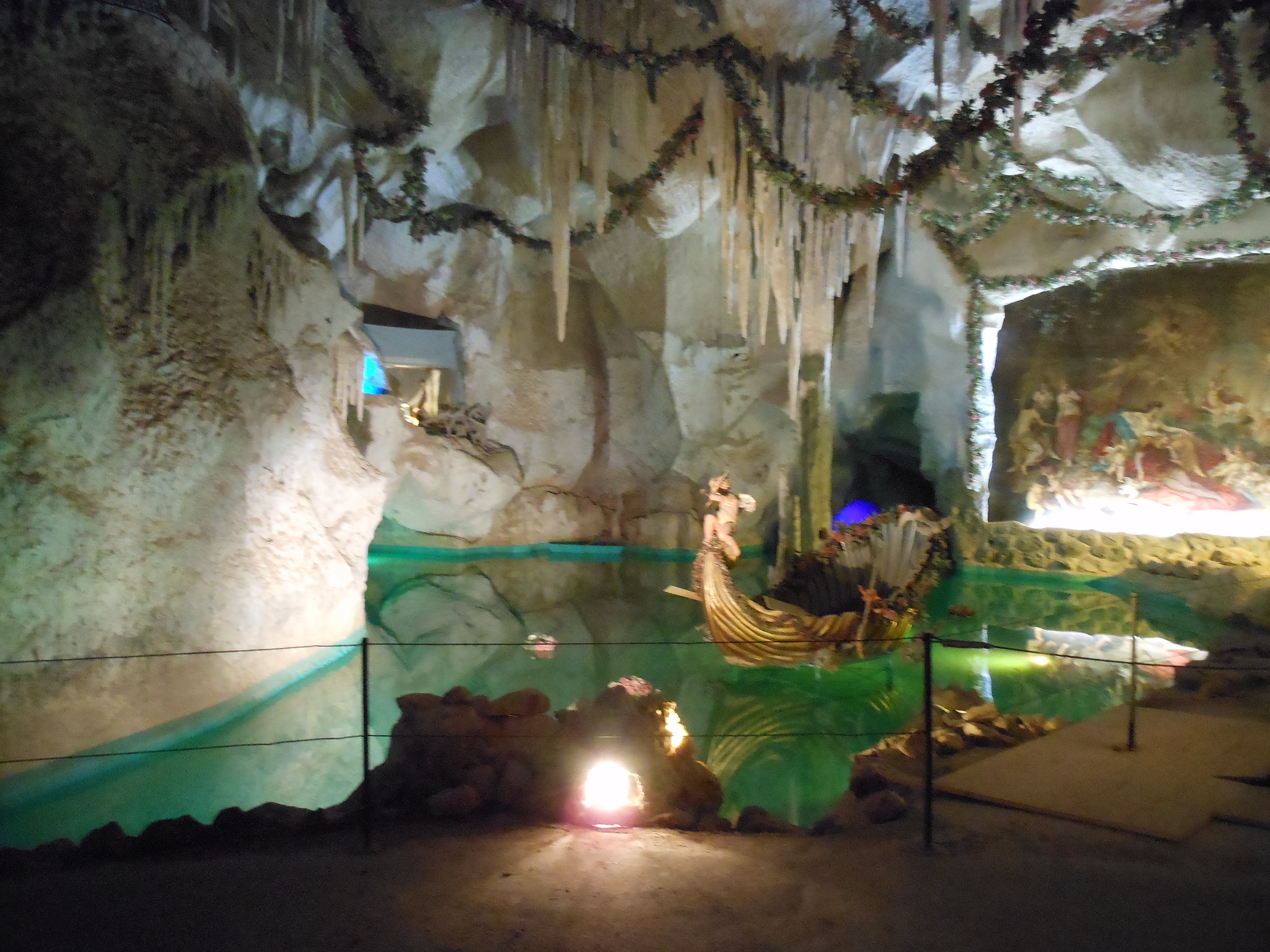
But the grotto itself is as jaw-droppingly weird and beautiful as it was in Ludwig’s day.  He had Wagner’s operas performed inside for his own personal pleasure.  The water was heated, so that he could swim in it if he tired of being rowed around in his gilded shell boat.  And the lighting could change colors depending on his mood, or the mood of the opera scene.
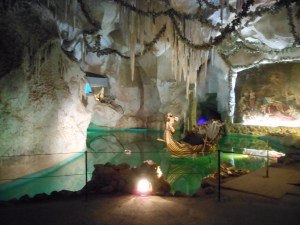
Ludwig's Grotto

Ludwig’s Grotto

The grotto is still festooned with the floral swags that Visconti’s movie crew put up.  The film has a fantastic scene where an Austrian actor is taken into the grotto to meet Ludwig, who wants him to recite dramatic speeches 24/7.  Helmut Berger, as Ludwig, floats out of the gloom in his shell boat, wearing a dark overcoat and a black Homburg–with an enormous diamond brooch pinned to the side. He fixes the actor with an imperious, piercing stare. The actor tries hard to be Ludwig’s New Best Friend, but the friendship ends badly and Ludwig is alone again.

Nearby Neuschwanstein and Hohenschwangau Castles are justly famous, but they are overrun with tourists.  Armed with a Bavarian Castles Pass, I actually went to Linderhof twice during my last trip.  One day it was rainy, the next it was sunny.  I can’t say I had the place to myself, but there was time and space enough to ponder the mysterious life of Ludwig.

Join me next time for more explorations in the art and history of Europe!

Winter as a Child

Travel is not just about being there.  Travel is about memory and anticipation.  As I pack my one small suitcase for Vienna in November, I am full of memories of past trips and high hopes for this one.

Lady Caroline Scott as Winter; image from Commons Wikimedia Lady Caroline Scott as Winter; image from Commons Wikimedia

Last year, the Vienna Kunsthistorisches Museum had a special exhibit:  “Winter Tales.”  Paintings, sculpture and artifacts from all over the world were gathered in a glorious celebration of winter.  My very favorite piece was this portrait of a child with a fur-and-velvet muff and a scruffy little dog impatient for her to play:  “Lady Caroline Scott as Winter,” by Sir Joshua Reynolds.  Winter is so often personified as Death, or as a creaky old man.  Here, though, winter is a child full of hope and wonder.  She gazes out at us from the barren winter grounds of her British home, her face as fresh as the day she was painted in 1776 at the age of two or three.

This is not a glamorous society portrait.  It is only about 57 x 45 inches (just the right size to place over my fireplace, if I could afford such a thing!)  I can imagine the artist Sir Joshua Reynolds, age 51 at the time, encountering Lady Caroline in the bare winter grounds of her home.  Anyone would be captivated by her rosy-cheeked face and direct gaze.  I can see Sir Joshua dashing off a sketch and finishing the portrait back in his studio.  It would have made a nice break from painting his more demanding adult subjects, who proudly posed with the emblems of their wealth and power:  swords, globes, weighty books, jewels and fine silks.

The British Peerage tells us that Lady Caroline was the daughter of the 3rd Duke of Buccleuch. She married the 6th Marquess of Queensberry (slightly lower in rank than a Duke, but who’s keeping score?) She had 6 surviving children and lived to the age of 80.  So she was an exact contemporary of Jane Austen, although Jane died at age 41.  I’d like to think Lady Caroline read Jane’s books.

Lady Caroline was a privileged child.  As she grew up, no doubt she learned that many children were cold and dirty and hungry.  Her rank would come with some responsibilities to take care of the less fortunate.  She lived through the American Revolution, the Terror in France, and the Napoleonic Wars.  And we all know that even for the most privileged, life holds heartbreak and disappointment.  But on this wintry day, all that is in the future.  In this perfect moment, Lady Carolin stands on her sturdy little legs, happy to be walking about in the wide world.

Vienna is an enchanting city in any season, but my favorite time there is winter.  The Christmas season begins in late November, an ideal time for crowd-free travel.  I do not have a fur muff or a scruffy little dog, but I am setting off for Vienna with all the anticipation of a child at Christmas.