Category Archives: Film and TV

Paying the Bills at Downton Abbey

The hit show Downton Abbey is filmed at the real-life Highclere Castle, a little south and east of London in Hampshire.  The castle is still occupied by the heirs of the prominent Herbert family, who acquired the estate in around 1769.  Why not? If I inherited a castle, I would certainly live there.  But it’s not as easy as it seems.

Traditionally, keeping up a large country home required the income from at least 1,000 acres.  This meant intensive work by tenant farmers, with the heir to the property closely supervising, usually through an estate manager.  It has become more and more difficult to turn a profit in agriculture, especially since many large estates have had to sell off acreage.  One big reason is the dreaded Inheritance Tax, popularly known as the Death Tax.  The tax in approximately its present form was begun in 1894.  On the death of the landowner, the heir had to come up with staggering tax payments–often as much as the market value of the estate.  This problem only got worse during and after the two World Wars, as Britain struggled to pay the enormous costs of war.

In the 1840s, the Third Earl of Carnavon went on a building spree and ran out of money.  By the time the Fifth Earl inherited, his debts were crushing. At the time, many financially strapped aristocrats were marrying American heiresses like Cora Levinson, who became Countess of Grantham on the show Downton Abbey.  The Fifth Earl found an heiress closer to home. He married Almina Wombwell, who in spite of her name was actually the beloved biological daughter of banker Alfred de Rothschild. Lady Almina’s inherited fortune saved the house in 1895.

The present 8th Countess of Carnavon has written a book titled Lady Almina and the Real Downton Abbey.  (I haven’t read it yet!)

AlminaBook

In recent years the present Earl was able to negotiate a delay in paying the “death tax” by working out an agreement with the English Heritage organization, whereby the building and grounds are open to public visits for part of the year.  The cost of a day’s visit is about $27.  On a typical summer day, about 1500 visitors pay this fee.  (Due to the popularity of the show, reservations are booked up months in advance, but a few walk-up tickets are available). There is also a gift shop, of course. And the estate is rented out for weddings, about 20-25 per year, at rates starting at about $22,000. During filming of Downton Abbey, the film company pays somewhere around $5,000 per day.

All this seems like big money, but it costs $1.5 million to run the house for a year.  And major repairs are needed.  I’ve seen estimates as high as $18 million, and reports that the upper floors of the castle are uninhabitable. The present Countess is coming in for some criticism for cashing in on the show’s popularity, but I certainly can’t blame her.  Like the family on the hit show, she wants to preserve a property and with it a little piece of a vanished way of life.  She personally cannot even inherit, since the property will go to the son of her husband’s first marriage.  The recent article is in The New York TImes at

http://www.nytimes.com/2013/05/26/fashion/trying-to-turn-a-castle-into-a-cash-register.html?pagewanted=2&_r=0

In coming posts I will explore other ways the great country houses of England have been preserved, and revisit some of my favorites.  Join me next time!
Jeeves: the Ultimate Valet

In the British TV series Jeeves and Wooster, ditsy aristocrat Bertie Wooster answers his door to find a dignified personage, his new valet Jeeves, who says, “I was given to understand that you required a valet, sir.”  As usual, Bertie Wooster’s life is in disarray, so Jeeves has arrived not a moment too soon. So begins a howlingly funny saga that says a lot about British social classes.  The series, drawn from the Jeeves and Wooster stories of P.G. Wodehouse, ran from 1990 to 1993.

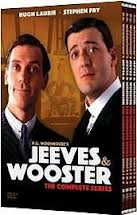
JeevesDVD

Hugh Laurie, better known to American audiences as the difficult genius Dr. House, plays Bertie.  His real-life friend and collaborator Stephen Fry plays Jeeves.

The joke is that the valet is miles ahead of the aristocrat in intelligence, education, proper behavior, and common sense.  So Jeeves uses his ingenuity to pull Bertie out of one impossible scrape after another, all of them caused by Bertie’s cluelessness.

Jeeves is also at pains to save Bertie from fashion faux pas, as in this exchange, concerning an unsightly white jacket Bertie insists on wearing:

Jeeves: I assumed it had got into your wardrobe by mistake, sir, or else that it has been placed there by your enemies.

Bertie Wooster: I’ll have you know, Jeeves, that I bought this in Cannes!

Jeeves: And wore it, sir?

Bertie Wooster: Every night at the Casino. Beautiful women used to try and catch my eye!

Jeeves: Presumably they thought you were a waiter, sir.

Actually, Jeeves is much more than a valet.  Bertie is a single young man, and the time is the 1930’s when servants are becoming few and far between.  So Bertie only has one servant.  Jeeves is cook, butler, driver, valet, and guardian angel.  Jeeves knows everything. (The search engine “Ask” was originally named “Ask Jeeves”). In his spare time, Jeeves reads Shakespeare and Spinoza, and can come up with a pithy quote for every occasion.

P. G. Wodehouse wrote about Jeeves and Wooster all through his long writing career, over a span of 59 years.  Jeeves’s first appearance was in 1915 and his last in 1974, the year before the author’s death. During that time, ideas about the master/servant relationship changed dramatically.

World War I brought about the greatest change.  As in Downton Abbey, servants often accompanied aristocratic officers to the battlefield.  In the story, footman William accompanies Matthew Crawley to the trenches.

During the war, it became clear to everyone that servants faced battle with at least as much courage as their social betters.  In fact, true or not, there was a popular idea that aristocrats were much more likely to be victims of what was then called “shell-shock.”  The number of servants employed in Britain went from about a million and a half before the war to just over a million afterwards.  Those who returned from the fighting often sought better opportunities.  Wealthy families had less money to keep up their estates, too. And lampooning the rich made P.G. Wodehouse extremely popular.

One of the pleasures of watching British films is trying to recognize film locations.  One episode of Jeeves and Wooster, “Trouble at Totleigh Towers,” was filmed at–you can probably guess–Highclere, the location for Downton Abbey.  All the more reason to visit sometime!

Join me next time for more explorations into the art, literature and history of Europe and the British Isles.