Category Archives: Explore Europe

“In Santa Croce with no Baedecker”

I can’t leave A Room with a View without revisiting one of my favorite scenes from both the novel and the movie:  “In Santa Croce with no Baedeker.” Lucy Honeychurch finds herself unaccompanied in the grand church of Santa Croce. Even worse, she has no guidebook.  A Baedeker–the equivalent of a Rick Steves guide–would tell her what to see, and how to see it.  From the novel A Room with a View by E.M. Forster:

She walked about disdainfully, unwilling to be enthusiastic over monuments of uncertain authorship or date. There was no one even to tell her which, of all the sepulchral slabs that paved the nave and transepts, was the one that was really beautiful, the one that had been most praised by Mr. Ruskin.

Then the pernicious charm of Italy worked on her, and, instead of acquiring information, she began to be happy. 

But just when she’s beginning to enjoy herself, the dreaded Mr. Emerson and his handsome but impertinent son George appear. They were baffling enough at dinner the night before:

And Mr. Emerson insists on talking to her in a most alarming way:

I don’t require you to fall in love with my boy, but I do think you might try and understand him…. Make him realize that by the side of the everlasting Why there is a Yes!

Of course what Lucy needs is to learn to say “Yes!” herself.

Santa Croce is a Franciscan church, so it is no accident that E.M. Forster places his characters here.  The author wants his stuffy Victorian English characters to unwind in the warmth and charm of Italy.  St. Francis is the very warmest and friendliest of saints.  Mr. Forster’s characters can well use the directness, humility and freshness of the beloved saint.  So, of course, together they look at the glorious Giotto frescoes of the life and death of St. Francis:

In 2010, frescoes of Giotto were “rediscovered” under centuries of neglect and old paint.  As far as I can tell, they’re been left alone so far.  But there’s a BBC video showing them under ultraviolet light at http://news.bbc.co.uk/2/hi/europe/8556930.stm.

Surely we’re all a little like Lucy in Santa Croce:  instead of constantly acquiring information, we can just look around us and be happy.  And surely great art can help make us happy.

Join me next time for more explorations of the art and history of Europe, with some sidetracks into literature too!

A Room with a View

When the movie A Room with a View came out in 1985, I had never been to Italy.  Within the first 20 minutes, I made up my mind to get there, especially to Florence and the countryside of Tuscany.  That’s what movies can do for us.  The story is from E.M. Forster’s 1908 novel of the same name; the chapter titles are charmingly used to name the chapters of the movie.  In Britain, The Guardian named this movie one of the 10 best romantic films of all time, and it’s no wonder.

RoomPoster

Helena Bonham Carter, playing a somewhat muddled girl named Lucy Honeychurch, has to choose between two equally handsome men:  Julian Sands, passionate and unconventional, and Daniel Day Lewis, bookish, inhibited, and full of himself.

Maggie Smith, as her cousin and older chaperon Charlotte Bartlett, is deliciously dithery but finally comes down on the side of true love.

Judy Dench, as a not-very-good lady novelist, writes some immortal prose about a scandalous kiss that takes place in a very real Tuscan meadow.

Daniel Day Lewis, as Cecil Vyse,  makes the mistake of mocking the passage at a crucial moment. (The very different movie My Beautiful Laundrette came out on the very same day as this one.  It was hard to believe Daniel Day Lewis was the same actor in both of them.  His incredible range as an actor put him well on the way to stardom).  But I’ve given enough away already.  Watch the movie!  It’s available streaming on Netflix.

The screenwriter, Ruth Prawer Jhabvala, won an Oscar for her screenplay.  She won another Oscar six years later for Howard’s End, from another E. M. Forster novel. She collaborated for many years with the directing-producing team of James Ivory and Ismail Merchant. She died on April 3 of this year, at age 85.  Throughout her life, she also wrote wonderful fiction.  Her most recent story, “The Judge’s Will,” was just published in the March 25 issue of The New Yorker.

Florence is not just a location, but a starring character in this movie.  And the Tuscan countryside just outside the city is a place where dreams can come true.  I did make it to Florence, and to the Tuscany countryside.  Both destinations were everything I wished for, and more.  Travel gives each of us a personal and lifelong “room with a view,” even after we return home.  Movies can give us each a little boost in getting to those views.

Join me next time for more reflections on the art and history of Europe!

Nurturing Genius

One of my most unforgettable sights in a museum was a young child crouched on the floor of the Musee Picasso in Paris.  As her mother waited nearby, the little girl moved from one Picasso painting to another, intently drawing in a notebook. She was oblivious to anything around her, and people respectfully stood back to let her work.  What she was doing WAS work, not play.  Was she a budding genius, or just a kid going through a stage, as kids will?  Hard to tell, but I applaud her mom for patiently spending the day letting this child pursue her passion.

ChildPicasso

In his essay on Gianlorenzo Bernini, Simon Schama describes what happened when Bernini’s father, a sculptor himself, took the boy to visit the Pope:

Brought before the Borghese Pope Paul V, the eight-year-old did a shrewdly ingratiating lightning sketch of Saint Paul “with free bold strokes” that moved the astonished Pope to hope that he was looking at the next Michelangelo. To nurture his talent, Paul V appointed Cardinal Maffeo Barberini to watch over the young Bernini and shape his education.

Years of what all sculptors had to do – study and draw from classical models – followed. Even boy wonders had to learn the rules.

http://www.guardian.co.uk/artanddesign/2006/sep/16/art

Art education is not just for boy wonders.  It’s for all of us. Imagine being a child lucky enough to take art classes at the Louvre!  It happens every day, there and at other centers of art.

LouvreArtClass

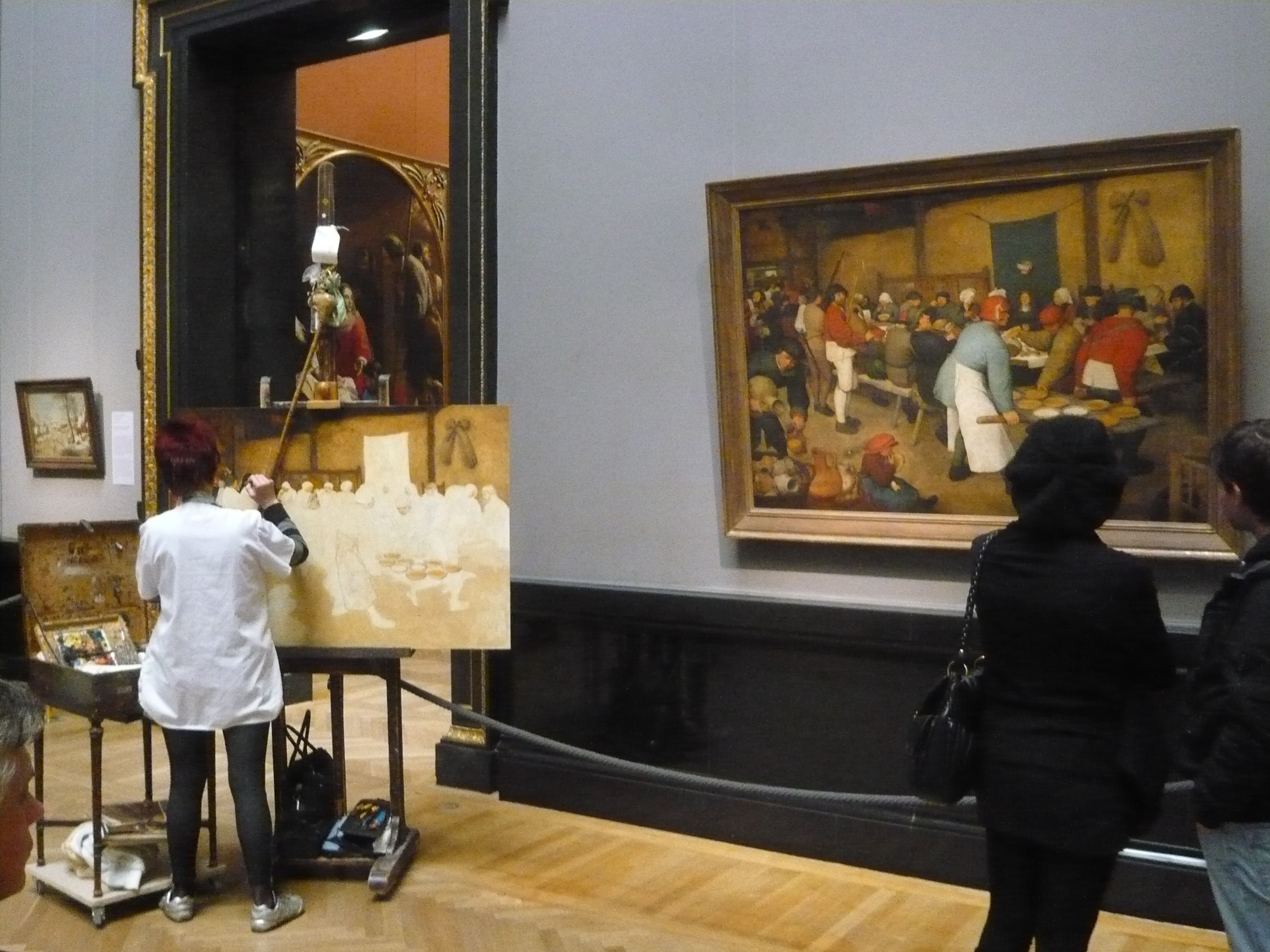
And every day, in every great museum, aspiring artists old and young set up their easels in front of masterpieces, in order to learn from the masters. This artist is copying The Peasant Wedding, painted in 1567 by Pieter Bruegel the Elder.  It’s in the Kunsthistorisches Museum in Vienna.

BreugelStudent

We all have just a little touch of genius inside us. Maybe I’d better get out my own easel and paints today!

The Musee Picasso, located in a 17th century mansion in the Marais district, is under renovation.  Its long-anticipated reopening is in summer of 2013.

Join me next time for more adventures exploring the art and history of Europe.

Winter into Spring

Long winter nights are for remembering past trips and dreaming of future ones.  But for me, winter days are for getting outside.  Last December and January in Minnesota, we had several glorious weeks where the lakes (11,842 of them, according to Yahoo!) froze over with hardly any snow on top of the glassy ice.  All I wanted for Christmas was a new pair of skates!

newskatesSkating

In my adopted hometown of Steamboat Springs, Colorado, we had enough snow (we always want more, of course).  But we had plenty of powder days.

MeSnowboard

The mountain closes in just a few days.  As usual, we have dueling forecasts for tomorrow.  Maybe we will get rain, or an inch of snow, or 5 inches, or 15 inches.  I’m hoping for the last option, of course.  After that, it will be spring, time to start looking for crocuses and planning my next venture into exploring the art and history of Europe.  Meanwhile, I’ll be writing about trips past, future, and dreamed-of.

Join me tomorrow.  I’ve been thinking about some of the free sights in Rome!