Category Archives: British Isles

Why I Love England, Mid-Trip

SalisburyFacade

Country towns that used to be powerful have magnificent cathedrals.  The one at Salisbury is breathtaking. This cathedral was completed in 1258 and has not changed since then.

photo (23)

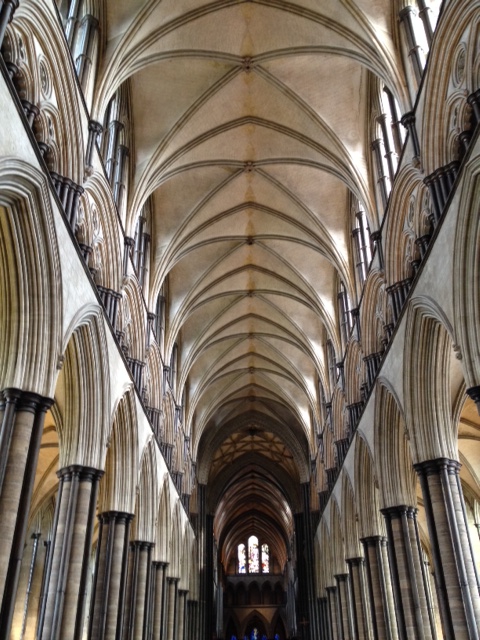
The Gothic ceiling of Salisbury Cathedral is a marvel of engineering.  These beautiful Gothic ceilings always make me feel like I’m in an orderly forest of tall majestic trees whose branches intertwine far above the ground.

photo (22)

In the countryside, a horse is still transportation.  This pretty girl was contentedly chomping grass outside the National Trust property of Mottisfont, while her owner visited the museum and probably also had a spot of tea in the tearoom.

GardenUppark

Have I mentioned gardens, part of every historical and literary sight?  This lawn and flower bed grace the grounds at Uppark, a mansion where Queen Victoria’s son the Prince of Wales whiled away his time carousing.  The notorious playboy owner of Uppark finally settled down at age 70 when he married his milkmaid.  The writer H. G. Wells spent part of his boyhood at the mansion, where his mother worked as the housekeeper.

FlowerboxWoodstock

And then there are the flowerboxes right outside my bed and breakfast in Woodstock.  Yes, I love England!

Jane Austen and Me: Six Degrees of Separation

JaneHouseJane Austen lived the last few years of her too-short life in tranquil Chawton, Hampshire, with her mother, her cherished sister Cassandra, and and a family friend. The women were in a precarious financial state after the death of Jane’s father.  Like most single women of their time, they had to depend on the kindness of relatives for a roof over their heads.

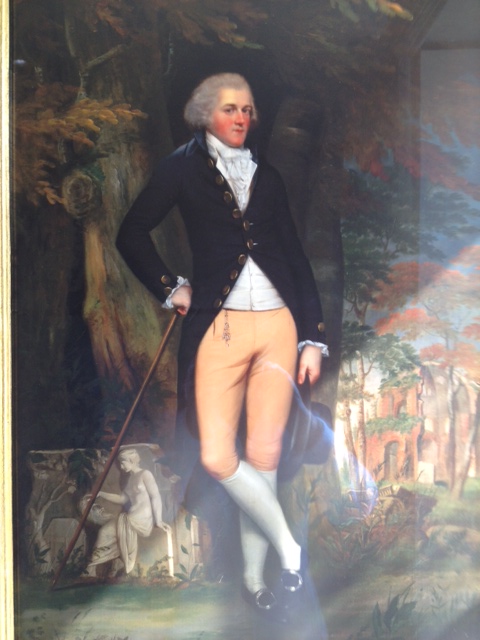
Edward Knight

Edward Knight

It was their good fortune that Jane’s brother Edward Knight was able to come to the rescue. Why was his name Edward Knight, not Edward Austen?  He had been formally adopted by a childless cousin of Jane’s father, Thomas Knight.  Thomas and his wife Catherine were wealthy and childless.  They made Edward their heir.  He inherited several estates, among them a grand house at Chawton.  The house came with a sizable but cozy cottage, which Edward made available to his mother and sisters for their lifetimes.

At last, in her thirties, Jane had a stable home.  She had begun writing as a teenager but had more or less given it up during the years that she had no settled home.  In Chawton, she established a routine of writing every morning at a little round table in front of the dining room window.  Her sister Cassandra took over morning household chores, giving Jane the freedom to write. In the afternoons, they took long walks in the countryside–just like Jane’s heroines. They also spent a lot of time visiting friends and relatives, including the wealthy connections Edward Knight was able to give them.

Jane's TableOn this humble little table, Jane wrote the classics we know and love: Persuasion, Pride and Prejudice, Sense and Sensibility, Northanger Abbey, Mansfield Park, and Emma. Some of them she had begun earlier and had put away. Family lore had it that a squeaky door was purposely never oiled, so that Jane always had warning of visitors.  She would hastily hide her manuscript until the visitors had left.

Jane’s books dealt gently and humorously with the serious problems of women dependent on men for economic security.  As she knew all too well from her own life, an unmarried woman without a fortune of her own had very few options for survival.

I was deep in a discussion about Austen family history with a man stationed in the house, when I noticed that his name tag said, “Mr. Knight.”  Could it be?  Yes!  My Mr. Knight was a living, breathing, direct descendant of Jane’s brother! I think he looks just like his ancestor.

MeKnightIn England, it always seems to me that history comes to life!

Why I Love England

TyntFlowers

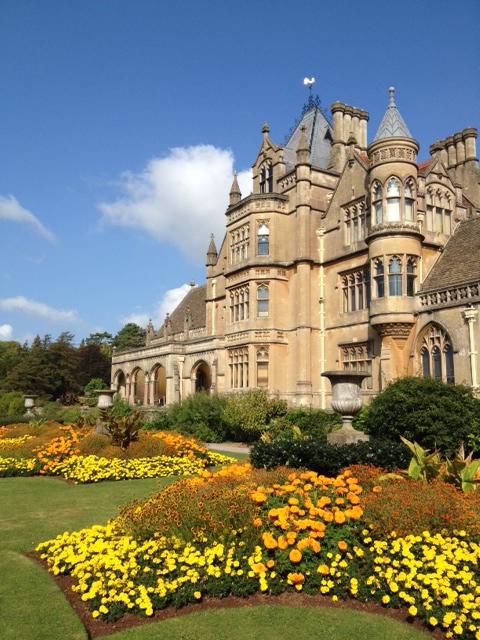
England is a nation of gardeners.  The flower beds above are at glorious Tyntesfield, a Victorian property rescued by the National Trust about 12 years ago.  Thanks to the Trust, it’s open to everyone.

Castles and cottages alike have lovingly tended flower beds everywhere.  The steady, temperate climate must have something to do with it, but it also takes people who have loved and cared for their land for generations.

FlowersAvebury

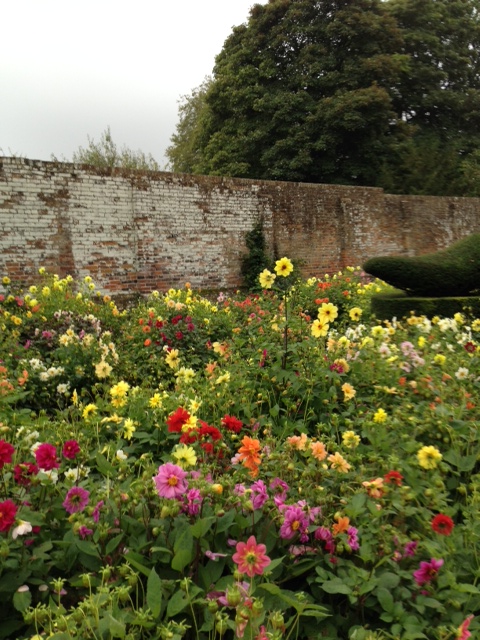
An old garden wall is as beautiful as the garden it shelters.

Westie

A British dog knows its place in the world. This Westie is a connoisseur of cultural sights and also of scones with clotted cream and jam.

Topiaries

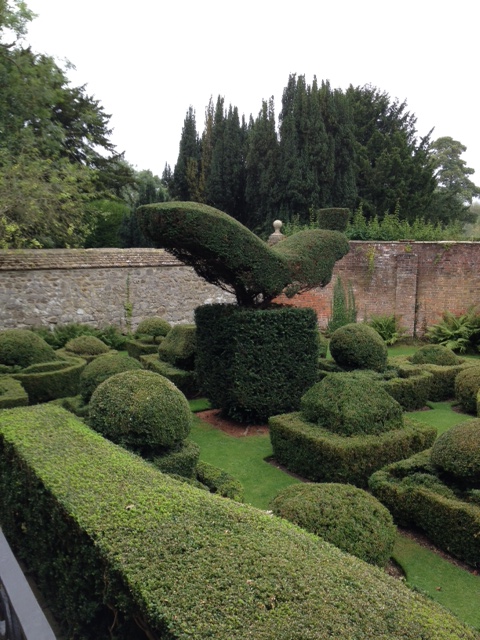
Topiaries?  The British are masters.  Nothing is too much trouble. This topiary looked at first like a dental chair, but I’m pretty sure it’s a peacock.

ReadSigns

English is my native language, so there’s no struggle to understand what I’m hearing or reading. I can read all the signs, and the signs tend to be friendly.  This one, at Tyntesfield, invites me: “Have a sit down!” Thank you.  I don’t mind if I do!


Stonehenge Without the Crowds

DSCN7646

The Autumn Equinox is nearly upon us, and many people like to celebrate it at an ancient sacred sight such as Stonehenge.  I hadn’t planned to visit Stonehenge on this trip, having been there before.  But my route took me within two miles right at sunset, and I couldn’t resist.  The highway passes right beside the ancient stone circle.  Traffic crawled along; there was plenty of time to take in the awesome sight right from the highway.  Maybe it was the equinox, or maybe it was just some kind of Sunday evening rush hour.  Whatever the reason, I joined a long line of cars slowly making its way past the circle. Magic! No parking, no tickets, no shuttlebus from the parking lot, no grousing about the new roads and high-tech visitor’s center.

DSCN7424

I did make a visit to nearby Avebury, a pretty village that has grown up inside a stone cirlce believed to be even older and more important than Stonehenge.

DSCN7363

Some people were dressed in special Equinox finery. I saw a lot of happy-looking people in capes and floral wreaths.

DSCN7425

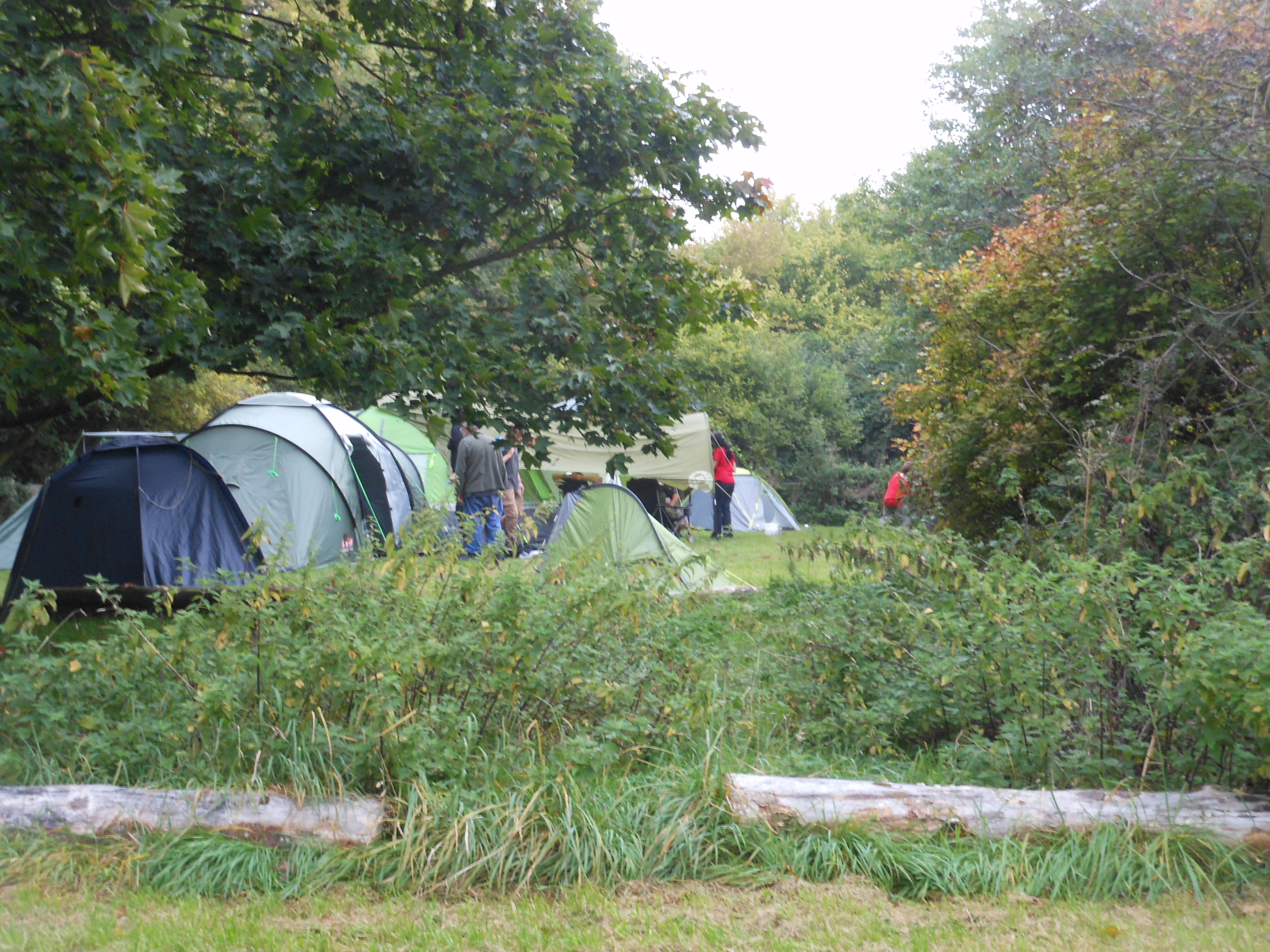
Quite a few people were camping nearby, with the approval of the National Trust organization. Children climbed trees and dogs frolicked.

DSCN7422

Actually, I prefer Avebury to Stonehenge.  It has all the mystery and none of the hype of the more famous circle.  The Avebury stones are smaller but the circle is much larger. The site is more relaxed but every bit as awe-inspiring as Stonehenge. How many thousands of generations of sheep have been calmly grazing around the ancient mysterious stones of Avebury?


A Siren and a Siren Suit

The birth of Winston Churchill, the future Prime Minister, was a shocking surprise and a bit of a scandal. His father, Randolph Churchill, was related to the Dukes of Marlborough, whose seat was (and still is) the over-the-top Blenheim Palace just outside Woodstock.  His mother was the famous American beauty Jennie Jerome.  The couple’s engagement went on longer than they wished, due to financial negotiations, and the bride was very soon noticeably pregnant.  Jennie was a headstrong free spirit.  She was not about to give up the admiration of everyone on the dance floor just because of her condition. By all accounts, she was as lovely and alluring as ever in the final stages of pregnancy.

Jennie Jerome Churchill, , circa 1880, Public Domain

Jennie Jerome Churchill, , circa 1880, Public Domain

So Jennie was dancing, with abandon, in a diaphonous flowing gown when she suddenly went into labor–“prematurely,” or so the story went.  Winston was born about two months sooner than anyone expected, in the Palace that many people consider more grand than any palaces of actual British royalty.

photo (12)

The surprise birth took place in a small and rather plain bedroom close to the grand state rooms, where the band played on. A glass box displays the baby’s infant vest.

photo (13)

Much later in life, when he was Britain’s wartime Prime Minister, Sir Winston wore a “siren suit” during air raids.  Many people, men and women, had one. We’d call it a “jumpsuit:” a loose full-length garment, designed to be zipped into over pajamas on the way to the air raid shelter.

sirensuit

By today’s standards, Jennie Jerome would be considered a terrible mother–selfish before her child was born, and even more selfish afterward in pursuing her often scandalous social life. She paid very little attention to Winston as he grew up. He was raised almost entirely by a beloved nanny.  Yet in later life, Jennie became almost like a sister to her son, advising him and using her wide social and political connections to further his career.  The little bedroom in Blenheim Palace is where a remarkable life began.

Scotland’s Still In

Braveheart

The people of Scotland voted yesterday, pretty resoundingly, to remain in the United Kingdom. Considering the turmoil and violence of the past, this was a very civilized historic event. British government leaders made impassioned appeals to the people of Scotland to reject independence, and promised significant changes if they did. Now it’s time to make good on those promises. I’m in England, watching British TV, and this is the big news story of the week.

It’s surprising to learn how important the 1995 movie, directed by and starring Mel Gibson, was to Scots in their drive for independence.  The 13th century real-life William Wallace was probably a much darker and more complex man than he appears in the movie, but the stirring scenes of battle and eloquent speeches on freedom are still affecting Scots two decades after the Academy Award-winning movie. Leaders of the independence drive regularly referred to the movie as a source of Scottish pride.

photo (14)

British people seem to have a special fondness for Scots.  In large cities, it is fairly common to encounter a bagpiper in kilt and full Scottish regalia, playing on a street corner. Today at Blenheim Palace I spotted a Scottish soldier in a display of hundreds and hundreds of accurate models, made by the British Model Soldier Society. The Society, founded in 1935, meets monthly in London. Its members do extensive historical research before approving any of the wonderfully detailed models (which are about 3-4 inches tall). The model above depicts a private in the Black Watch regiment in 1815.

photo (15)

Above is an even earlier Scottish soldier from 1684, the Royal Scots 1st of Foot. The union of England and Scotland has deep historical roots.  I hope the Scots get the changes they were promised and the union continues with benefits to both sides.

The Braveheart image above is the theatrical release poster.  The film is available from Amazon.


Winston Churchill: How the Bulldog Got His Scowl

Digitally restored vector portrait of Sir Winston Churchill.

The iconic photograph of Winston Churchill, with his famous bulldog scowl, appeared on the cover of “Life Magazine” in 1945, toward the end of World War II.  When newsman Edward R. Murrow saw it, he remarked, “Ah, there is the face which marshalled the English language and sent it to battle when we had little else.” The photo was taken by Yousuf Karsh in 1941.

All through the war, starting when England faced the enemy alone, Churchill roused and encouraged his people with his words.  His most famous phrase was “I have nothing to offer but blood, toil, tears and sweat.” The words were first spoken at Churchill’s first cabinet meeting as Prime Minister on May 13, 1940. He repeated them in the House of Commons the same day, and soon his words of defiance and courage went out over the airwaves to every British home and workplace.  The stirring words were, in part, “We have before us many, many months of struggle and of suffering. You ask, what is our policy? I can say:  It is to wage war, by sea, land and air, with all our might and with all the strength that God can give us; to wage war against a monstrous tyranny…You ask, what is our aim? I can answer in one word:  victory, victory at all costs, victory in spite of all terror, victory, however long and hard the road may be; for without victory, there is no survival.” The words, even on the page decades later, cause goosebumps. Victory looked very unlikely when the words were spoken.

How did Mr. Karsh, one of the greatest portrait photographers of all time, capture this iconic image?  He was sent to photograph the great man on a visit to Canada in 1941, before Pearl Harbor and before the United States became fully committed to the fight.  Churchill had just addressed the Canadian Parliament.  He was weary. He told the photographer he had exactly two minutes.  Then Churchill began chomping on a cigar. The photographer politely held out an ashtray. Churchill continued chomping. So Mr. Karsh walked up, begged Churchill’s pardon,  and pulled the cigar out of the Prime Minister’s mouth.  (Where did he get the nerve?)  By the time the photographer got back to his camera, the bulldog scowl was there.  And amazingly, Mr. Churchill softened.  He allowed more photographs, but the one that had taken him by surprise became his most famous image.

The photo is from the article cited below.

http://www.huffingtonpost.co.uk/2013/03/06/winston-churchills-bulldog-scowl-yousuf-karshs-iconic-photograph_n_2818281.html

The Bulldog and the Marmalade Cat


Photo from Daily Mail article cited below

Photo from Daily Mail article cited below

When the family of Sir Winston Churchill left the family’s country estate, Chartwell, in the care of England’s National Trust organization in 1966, there was an important condition:  there must always be a marmalade cat with a white bib and four white socks, and the cat’s name must always be Jock.

Jock V recently retired to the Scottish countryside when his person, a staff member at Chartwell, retired.  Jock VI just took up residence.

I’ve been reading a biography of Winston Churchill, The Last Lion, by William Manchester. The man who stood up to Nazi tyranny when the situation seemed hopeless had a very unhappy childhood.  His parents, Randolph Churchill and the American Jennie Jerome, were socially and politically prominent–and they had very little time for their son.  They wrote him off as a dullard, not even fit for university.  Instead he went into the military–a choice that later served him well.  As a child of only seven years old, WInston was put on a train all by himself and sent off to an expensive but abusive boarding school where he was miserable.  He only escaped two years later, when he had a chance to show his beloved childhood nanny the welts he carried from regular beatings. He rebelled against authority all through his childhood and young adulthood, even as he pursued his own political ambitions.

When Sir Winston had his own family, he wanted to create a happy home life.  Jock the marmalade cat was part of that secure, loving home Sir Winston wanted to provide for his own family.  I’m hoping to meet Jock VI when I travel to England soon. I’ll salute the man whose own struggles taught him to be both tough and tender.

http://www.nationaltrust.org.uk/chartwell/visitor-information/article-1355828124885/

http://www.dailymail.co.uk/news/article-2578050/New-marmalade-kitten-installed-Sir-Winston-Churchills-country-estate-honour-dying-wish-wartime-prime-minister.html


Top Hats and Toppled Trees

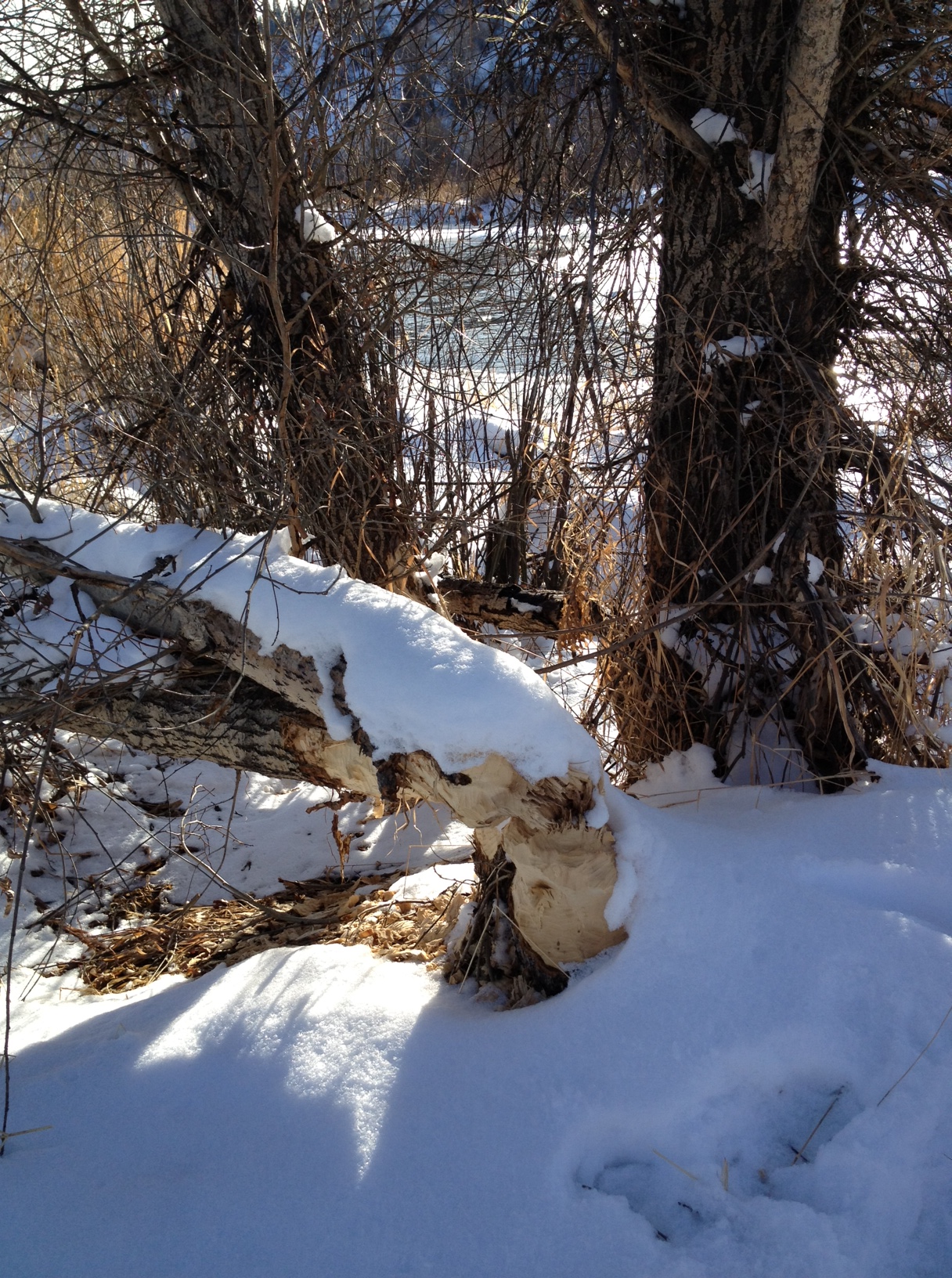
Recently I went running in Minnesota and encountered a beaver-chewed tree.  Where was the beaver? Scared off? On a coffee break? Sent off by the Chief Beaver to chew another tree instead? This particular beaver never did return.  Alas, the tree is done for.  It fell over in the last high wind.

Beaver-chewed tree

Beaver-chewed tree

The expression “beaver hat” came to mind, the kind of hat I would call a “top hat.”

TopHat


I noticed that at the recent wedding of Brad Pitt and Angelina Jolie, the children were allowed to choose what to wear, and one of the boys chose a black top hat, which he wore, elegantly, with shorts. (I’m also going to go out out a limb and say that Angelina’s wedding dress and veil, embroidered with drawings by her six children, was the most beautiful and meaningful wedding attire I’ve ever seen.  What an inspired use for refrigerator art!)

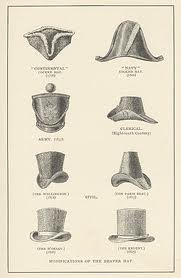
I started wondering why hats in the past couple of centuries were made from beaver fur. I learned that the beaver’s fur, sheared off, boiled, and pressed into thick felt, was so pliable it could be made into almost any shape of hat.  Beaver hats were warm, soft, and resistant to water. Between 1550 and about 1850, huge numbers of such hats were made, for both civilian and military use.

Some varieties of the beaver hat

Public Domain

Everyone had to have at least one. Wealthy men, like Jane Austen’s Mr. Darcy, had several. The European beaver was hunted and trapped to near-extinction.  Traders turned to North America, where the American beaver was plentiful. In fact, demand for beaver pelts was a big factor in colonial expansion in the New World, especially in Canada.  The Hudson’s Bay Company, founded in 1670, made a fortune in the beaver trade.  The company still exists today.

Finally, in the mid-1850’s, silk hats became more fashionable.  The beaver could relax a bit.

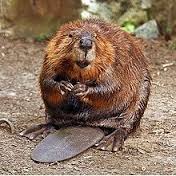
American Beaver by Steve, Creative Commons Share Alike 2.0

American Beaver by Steve, Creative Commons Share Alike 2.0

As far as I can see, the American beaver is thriving wherever there is water. I encountered this beaver-chewed tree in the middle of winter next to a stream in Colorado.

Beaver-chewed tree on Yampa River in Steamboat Springs

Beaver-chewed tree on stream in Colorado

People trying to maintain waterside property are not fond of the beaver.  Still, I have to admire the little guy’s energy and ambition.

Join me next time for more explorations into the art and history of Europe, and the many connections with development elsewhere in the world.

The Real Pocahontas

Pocahontas

I could spend many hours in the National Portrait Gallery in Washington, D.C. I recently encountered Pocahontas there.  The portrait is by an unknown artist, dating from about 1616. It was made from an engraving of Pocahontas during her trip to England as a young bride.

Pocahontas was a Native American “princess,” the daughter of Powhatan. Her father was a sort of chief of chiefs, heading many tribes in the tidewater area of what is now Virginia. As a perk of his high position, Powhatan reportedly married women from all the different tribes, kept each one until she had produced a child, then sent them home without the child. By all reports, Pocahontas was a favorite child of his.

Relations between the Native Americans and the English were sometimes friendly and sometimes hostile–no wonder, since the aim of the English was to exploit the resources of the “New World.”  When I was growing up, every American school child heard the endearing story of how an Englishman, John Smith, was about to be executed by Powhatan (by having his head bashed between two large rocks). Pocahontas, then about 12 or 13, threw herself on the Englishman and begged her father to spare his life.

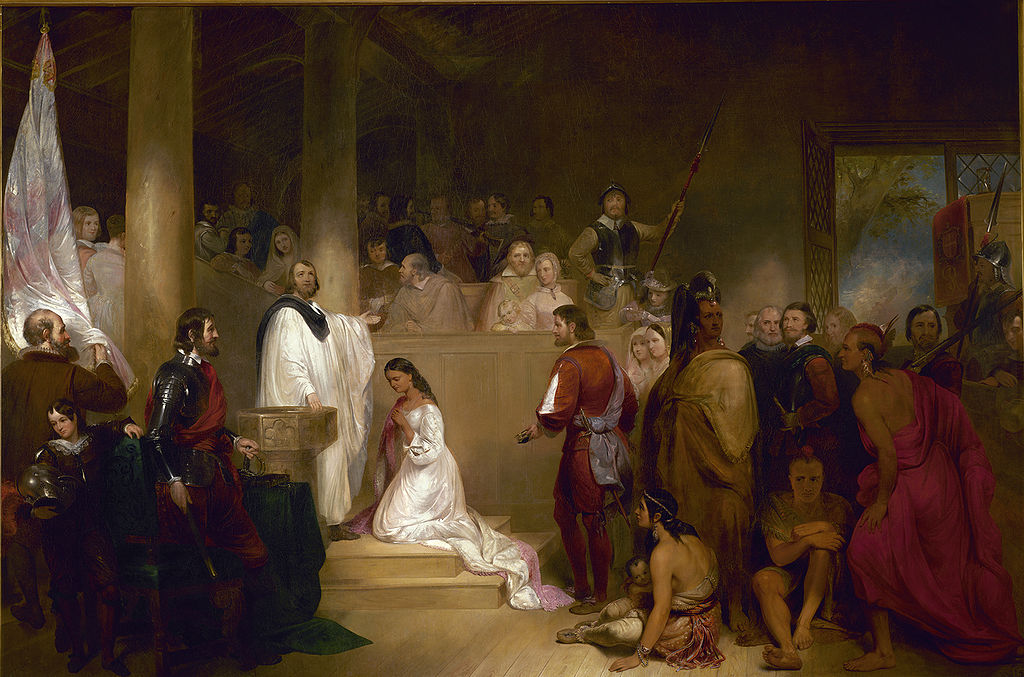
From the bare bones of this story, there are not one but two Disney movies.  The real Pocahontas was captured by the English during a hostile period in 1613.  While in captivity, she converted to Christianity, and chose to stay with the English when she was offered freedom.  She took the new name “Rebecca.” Shortly afterward, she married an English tobacco planter, John Rolfe.

Baptism of Pocahontas, John Gadsby Chapman, 1840, Public Domain

Baptism of Pocahontas, John Gadsby Chapman, 1840, Public Domain

Her baptism and marriage were portrayed in 1840 by the American historical painter John Gadsby Chapman. The painting shows the groom just behind Pocahontas.  Her brother, in Native American dress, is turning away, presumably in disapproval.

The young bride gave birth to a son, Thomas Rolfe.  Then she and John Rolfe journeyed to England in 1616.  She was a bit of a sensation, presented as an example of the “civilizing” effect the English hoped to have on all the native peoples.  She died in England, at the age of only 21 or 22.

The descendants of Pocahontas, through her son Thomas Rolfe, include many notable Americans such as Edith Wilson, wife of Woodrow Wilson; Admiral Richard Byrd; Virginia Governor Harry Byrd; socialite Pauline de Rothschild; Nancy Reagan, wife of Ronald Reagan; and many others.

Join me next time for more explorations in the art and history of Europe!