Category Archives: England

Katherine Parr: The Wife Who Survived

Katherine Parr was the 6th wife of King Henry VIII.  Considering his marital history, she must have thought twice before she showed up for that wedding in 1543, when she was 31.  The already-ailing Henry died in January 1547.  Katherine had already survived two husbands. She did marry Henry, and lived to tell the tale.  Then she married Thomas Seymour, believed by many to have been her real love all along. She was unlucky in that marriage, though. She did become pregnant, for the first time, at age 35.  But she died a few days after giving birth to a daughter. Her fourth husband, for his part, was involved in various scandals and worse.  He was executed for treason in 1549.

In The Wall Street Journal, the British writer Elizabeth Fremantle writes about the process she used in writing her new historical novel about Katherine Parr.  The article is titled “The Life of the Wife of Henry VIII.”  It is at http://online.wsj.com/article/SB10001424127887323610704578627820370655036.html. The article reproduces a fine portrait of Katherine.
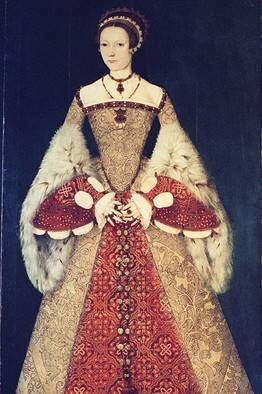
Katherine Parr, Public Domain in USA

Katherine Parr, Public Domain in USA

The book, “Queen’s Gambit” (Simon and Schuster),  will come out in a few days.   Elizabeth Fremantle writes eloquently of how this Tudor-era queen came alive for her when she visited Hampton Court Palace, where Katherine married Henry VIII. The day of the writer’s visit, actors happened to be portraying the wedding festivities.  Afterward, the writer visited the kitchens, all extensively preserved and restored, and gained insight into the lives of people who must have served the royals.

I’ve been to Hampton Court Palace too.  It is truly steeped in history, and much easier to take in than many of the sights in central London.  The best way to get there from the city is by train.  Visitors who buy a day return on the train receive a nice discount on admission to the Palace.

HamptonGarden

It’s easy to see why Henry VIII appropriated this peaceful and luxurious river retreat from his right-hand man, Cardinal Wolsey.  I will certainly be reading Elizabeth Fremantle’s new book about this very intelligent woman who navigated her way through perilous times in the Tudor era.

Join me next time for more explorations into the art, history and literature of Europe and the British Isles!

Travels with Jane

Reuters image from artsbeat-austen-blog480, featured in NYT article cited below Reuters image from artsbeat-austen-blog480, featured in NYT article cited below

I have to comment again on the new ten-pound banknote that will begin featuring Jane Austen in 2017.  I was curious about the images in the background.  The image in the center of the round seal shows Jane Austen bent over her little writing table.  She famously wrote in the drawing room, in the middle of family life.  Some years ago I visited Chawton Cottage, where Jane spent much of her time during the last years of her life.  She wrote on a little round table placed in front of a window overlooking the road outside.  I stood awhile in front of the table, trying to imagine the drawing room door creaking.  That was the signal for Jane to tuck her pages away and turn her attention toward a visitor.

I wondered if the mansion in the background was meant to represent Pemberly, the home of Mr. Darcy in Pride and Prejudice. But then, Pemberly was a fictional creation.  Instead, it appears the mansion pictured is Godmersham Park.  Jane’s brother was adopted by a wealthy family and eventually inherited the mansion and property.  Jane and her family spent a lot of time there–welcomed as poor but genteel relations, I gather.

The planned quote below Jane’s portrait is “I declare after all there is no enjoyment like reading!”  Some people object because the line is spoken by a decidedly mercenary character, Caroline Bingley.  In The New York Times article I cited in my last post, “Jane Austen, Wallet-Sized,” there’s a suggestion for a different quote.

John Mullan, a professor at University College London, proposed another line from Pride and Prejudice.  His suggestion comes from the middle of the novel, when Elizabeth Bennet is invited on a road trip with her aunt and uncle.  The dastardly Mr. Wickham has just deserted Elizabeth for a certain very rich Miss King.  On a three-week trip, they hope to travel as far as the Lakes.  Elizabeth was not in love with Wickham, but still she welcomes the diversion.  She exclaims, “What are men to rocks and mountains?”

RuskinLake

Then as now, getting to the Lake District in northern England takes some doing.  As it happens in the story, Elizabeth’s aunt and uncle have to cut their trip short because of business–they are in a class that works for a living.  So instead of going to the Lakes, they can go only as far as Derbyshire.  “Elizabeth was excessively disappointed; she had set her heart on seeing the Lakes…But it was her business to be satisfied–and certainly her temper to be happy; and all was soon right again.”   Every reader of the novel knows that the shortened trip put Elizabeth Bennet at Pemberly at the same time Mr. Darcy happened to be there, sealing her fate and his.

Her biographers agree that Jane Austen herself was traveling in Derbyshire at the time she was writing the novel.  I can only imagine that she was as agreeable and happy a travel companion as her beloved heroine, Elizabeth Bennet.

http://artsbeat.blogs.nytimes.com/2013/07/26/jane-austen-bank-note-earns-huzzahs-and-nitpicking/?_r=0

Jane Austen, Wallet-Sized

It was big news this week when the Bank of England announced that Jane Austen’s face will appear on 10-pound notes beginning in 2017.

Reuters image from artsbeat-austen-blog480, featured in NYT article cited below

Reuters image from artsbeat-austen-blog480, featured in NYT article cited below

Notice the quotation below Jane’s portrait?  It reads, “I declare after all there is no enjoyment like reading!”  Now critics are complaining that these words were spoken not by one of Jane’s heroines, but by a materialistic snob in Pride and Prejudice, Caroline Bingley.  When she speaks the line in the book, it’s only to try to gain the attention of Mr. Darcy, which to her consternation Elizabeth Bennet is monopolizing in the drawing room.

I look forward to a  lively debate about what quotation would be more suitable.  I don’t mind this one, though.  After all, Jane Austen was a wise enough writer to allow characters other than her heroes and heroines to speak the truth once in awhile.  I’m thinking of Elizabeth Bennet’s mother, described as “a woman of mean understanding, little information, and uncertain temper.”  Yet she speaks sincerely and truthfully about the difficulties of marrying off five daughters with no fortunes of their own. “If I can but see one of my daughters happily settled at Netherfield…and all the others equally well married, I shall have nothing to wish for.”

This brings me to one of my favorite lines in Jane Austen, and indeed in all of literature: the opening line of Pride and Prejudice.  It reads, “It is a truth universally acknowledged, that a single man in possession of a good fortune must be in want of a wife.”  That one line encompasses not only the whole plot of the great novel, but the workings of an entire social and economic system.

In a recent interview, another of my favorite authors, Hilary Mantel, commented, “I love Jane Austen because she’s so shrewdly practical; you can hear the chink of cash in every paragraph.”

I’m sure Jane would be amused and delighted to find herself on the face of a ten-pound note, whatever the quotation under her portrait.

The article about the new currency is at

http://artsbeat.blogs.nytimes.com/2013/07/26/jane-austen-bank-note-earns-huzzahs-and-nitpicking/?_r=0

The interview with Hilary Mantel, author of Wolf Hall  and Bring Up the Bodies, is at

Join me next time for more explorations into the art, history, and literature of Europe and the British Isles.

..

What’s Up with the Garter?

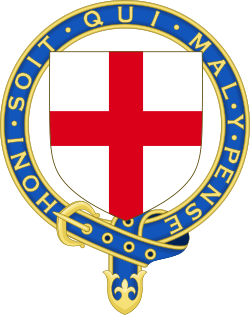
Now that the new heir to the throne of England has arrived and been named George, we will probably hear more about the Order of the Garter.  Why?  The Order has been dedicated to the patron saint of England, St. George, since its founding in 1348. Next to becoming a Peer or receiving the Victoria Cross or the George Cross, the Order of the Garter is the highest honor anyone can achieve in England.  Deciding where to bestow it is one of the very few personal and absolute privileges still left to the King or Queen. It’s a very exclusive club, including only the King or Queen, the current Prince of Wales, and a maximum of 24 handpicked members, who are called Companions.  New members are always announced on April 23, St. George’s Day in England.

Arms of the Most Noble Order of the Garter; image from Wikipedia

Arms of the Most Noble Order of the Garter; image from Wikipedia

I don’t quite understand why the date is so definite, when the origins of the Order are lost in the mists of time.  The most entertaining legend is that a high-ranking lady was dancing at court when her garter fell off–a mildly erotic event which provoked knowing smirks from bystanders.  Supposedly King Edward III picked it up and gallantly said, “Honi soit qui mal y pense,” (“Shamed be the person who thinks evil of it.”) This event took place (if it took place) in France, in the port of Calais, which the English at the time controlled. I have to assume that the King subsequently decided the words would be a good motto for his own particular in-crowd, his trusted friends and advisors who would never snicker at the King.

Another legend, not as much fun, claims that King Richard I, fighting in the Crusades, decided to have his knights wear garters somehow related to St. George the Martyr into battle.  They won. And yet another explanation is that the words actually refer to the ever-problematic claims of the English King to the French throne. Very likely all these explanations are somehow related.

Garter Day occurs in May, at Windsor Castle. The lucky members and inductees wear elaborate outfits, meticulously preserved and recreated from medieval times.  They wear actual garters, of course.

A story about the 2013 Garter Ceremony appears at http://www.dailymail.co.uk/femail/article-2343223/Beaming-Queen-flanked-Charles-William-Order-Garter-today-Duke-Edinburgh-recovers-home.html, along with photos of the occasion.

I read recently that Prince Charles actually has a footman apply toothpaste to his toothbrush every morning.  Some time ago, I read that Prince Philip thinks nothing of having the bathroom repainted in his favorite color each time he visits one of the castles. I also read that Princess Diana insisted on nothing but pure linen sheets, carefully pressed, for her bed.  And the sheets had to be changed even if she only took a short nap. I have no real way of knowing whether these stories are true or not. But reports like these make anti-Royalists call for an end to the monarchy.  I personally hope that the new generation of royals is able to shed the more ridiculous aspects of royal privilege.  I’d like to continue seeing the elegance of truly historic traditions like the Order of the Garter.

Join me next time for more explorations into the art and history of Europe and the British Isles.


Top 10 Reasons Americans Can’t Get Enough of the British Royal Family

The American press took up a lot of the pavement space in front of the hospital where the new Prince of Cambridge was born this week.  Why our fascination with British royalty?  Following is my own very personal and opinionated list of reasons.

1. We’re safe from a monarchy ourselves, having gained our independence 237 years ago.  We get to enjoy the spectacle without paying the bills.

2. Nowhere in the world is the tension between the antique and the modern more visible than in the traditions of the British Royal Family. Prince William in the velvet and ostrich feathers of the ancient Order of the Garter? Irresistible, at least to many of us. To read about the 2013 Garter Ceremony, go to http://www.dailymail.co.uk/femail/article-2343223/Beaming-Queen-flanked-Charles-William-Order-Garter-today-Duke-Edinburgh-recovers-home.html.

3. We won’t admit we’re a little envious.  But we’re both dreading and secretly anticipating the day the royals trip themselves up and create another riveting story like the Charles and Diana Show of the 1990s.

4. We have a new appreciation for Princess Diana, who, in spite of all her colorful personal failings, gave the British Monarchy a well-deserved kick in the pants.

5. We’re embarrassed about the media “royalty” we create for ourselves:  overpaid sports heroes shown to cheat by taking banned substances, dysfunctional families like the Kardashians who cynically exploit their fame, reality “stars” who waste our time with their lame antics.  Is this the best we can do, 237 years after getting British royalty out of our lives?

6. We love our dogs.  We have to admire a Queen who is able to keep as many dogs as she wants.  Besides the much-photographed corgis, the Queen reportedly keeps any number of cocker spaniels and dorgis—a corgi-dachshund mix.  (No doubt there are also kennels full of dogs used for hunting, but these days hunting is kept on the down-low because of public disapproval).

7. We’re looking for stories of redemption.  Queen Elizabeth II appeared to be a classic coldhearted mother, especially to Prince Charles, but (if you ask me) she redeemed herself in the moment during Diana’s funeral procession when she briefly bowed her head as the coffin passed.  We’d like to think the Queen has learned her lesson and became a better parent from that day forward. We especially like telling ourselves that a Queen NEEDS to be humbled once in awhile.

8. The current crop of royals shows signs of having more good sense than greed.  I was won over when William and Kate asked for charity donations rather than wedding gifts.

9. We appreciate good PR, especially when it does not seem like PR. When Kate was photographed pushing her own grocery cart a few days after the Wedding of the Century, that was great PR–and we all knew she had been shopping for her own groceries for years.  When Prince William personally placed the new baby’s car seat in the royal Land Rover and drove off with his expanded family, that was great PR. Commenting that the baby had more hair than his prematurely-balding dad was frosting on the cake.

10. We’d like to think that if we were born to untold wealth that we did nothing to deserve, we’d behave humbly and generously.  William and Kate appear to be doing just that. And they’re making it look easy.

If the British Monarchy survives this century, I think people will look back on the personalities and events of the past few years as the reason. Join me next time for more explorations into the history of Europe and the British Isles–even as history is being made before our eyes!

Her Majesty STILL Knows Best

The Duchess of Cambridge just entered the hospital to give birth to her second child.  She’s in the luxurious Lindo Wing of St. Mary’s Hospital, Paddington. She and Prince William will have a two-room suite with Wifi, satellite TV, and a chef on call.  Of course none of that matters very much to a mother embarking on what we now call “natural childbirth.” The “natural” process, these days, does get a little help from medical science.  I decided to re-post an article I wrote a couple of years ago, when the new baby’s great-great-great-great-great grandmother, Queen Victoria, changed childbirth for most mothers by insisting on having some anesthesia.

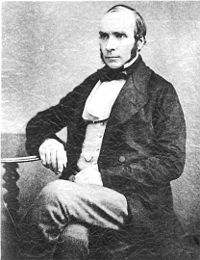
Mothers all over the world owe a debt of gratitude to Her Majesty, Queen Victoria of England.  At the time she was doing her duty for England by giving birth to 9 children, women still suffered through childbirth with no anesthetic of any kind.  In 1850, before she gave birth to her 7th child, her physicians investigated the possible use of anesthetic with Dr. John Snow.

Dr. John Snow, public domain

Dr. John Snow, public domain

Dr. Snow was a pioneer in the use of chloroform and ether to ease the pain of various medical procedures.  It sounds as though Victoria’s beloved Prince Albert was especially interested in alleviating her pain in childbirth. The procedure was unheard-of at the time, though. For whatever the reasons, nothing came of it and Victoria suffered as usual.

Queen Victoria with her eldest daughter, public domain

Queen Victoria with her eldest daughter, public domain

But in 1853, prior to the birth of Victoria’s 8th child, Dr. Snow was finally asked to administer chloroform to Victoria.  He had studied the use of anesthetics for many years.  He knew just when to administer the anesthetic, so as to provide the best pain relief without slowing the natural process of labor. He agreed to attend Victoria.  Was he a little nervous?  Maybe, maybe not.  By all accounts, he knew exactly what he was doing. The chloroform was a resounding success.  Victoria used it again for her 9th child.

The (male) religious leaders of the day treated the news with some consternation–after all, the Bible taught that women were supposed to suffer during childbirth.  But no one was about to argue with the judgment of their beloved Queen. In any case, the Queen was the head of the Church of England. Women all over England, and then women all over the world, began demanding anesthetic during childbirth.

Queen Victoria in her coronation regalia, public domain

Queen Victoria in her coronation regalia, public domain

An article from UCLA,  detailing the history of Dr. John Snow’s medical innovations, is at http://www.ph.ucla.edu/epi/snow/victoria.html.

As Kate, the Duchess of Cambridge, awaits her turn in history, she can be confident that the birth will be as comfortable as possible.  No doubt Prince William is as anxious about her well-being as Prince Albert was about Victoria’s. I wish Kate a safe and easy delivery of the long-awaited heir!

Queen Victoria WOULD be Amused

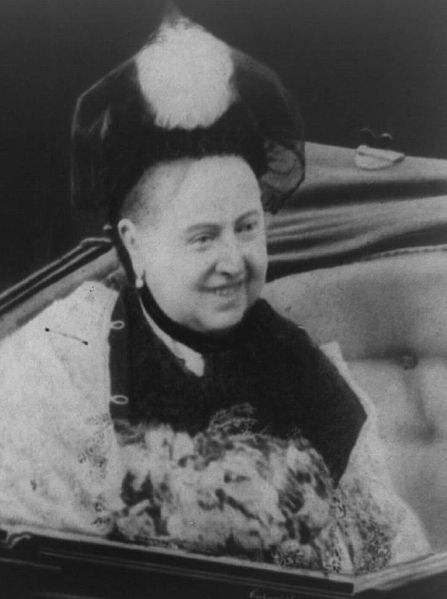
Prince William’s ancestor, Queen Victoria, was widely reported to have said icily, “We are not amused,” when confronted with some risque joke or other.  (She was using the royal “we,” of course). But her biographers deny she ever said it.  In fact, she was known to enjoy life and laugh uproariously when the occasion called for it.

Victoria Amused; photo in public domain

Victoria Amused; photo in public domain

Queen Victoria was known as the “Grandmother of Europe” because her sons and daughters married crowned heads all over Europe during her reign, all of the marriages judiciously arranged.  Victoria’s own marriage was semi-arranged; she was presented with various options.  She fell in love with one of the suitors, her first cousin, Albert of the Saxe-Coburg-Saalfeld dynasty. (Victoria’s overbearing mother was German; actually, the present-day British royals all have mostly German ancestry).  The young Albert returned her feelings.  She made him wait, though.  He cooled his heels during various visits until she finally proposed to him.

Queen Victoria's family, public domain

Queen Victoria’s family, public domain

In a way, we can think of Queen Victoria as the “grandmother of tabloids,” because she was the first British monarch to hit on the idea of holding up the royal family as an example of virtuous family life.  This involved opening up the family to some public scrutiny, which of course carried some risks in her day, and still does.  But during Victoria’s reign, and with the capable help of her beloved Prince Albert, Britain fully became a constitutional monarchy.  No longer did the monarch have much real power; she could mostly lead only by example.  She retained “the right to be consulted, the right to encourage, and the right to warn.”

I like to think Victoria would applaud Prince WIlliam’s decision to marry for love, to take his time, and even to finally marry the commoner Kate Middleton. I was in Edinburgh a few months before the royal engagement was announced.  I read a long magazine article that disparaged “Waity Katy,” who by that time had dated Prince William on and off for years with no resolution in sight.  I cheered for her when the long-awaited engagement was announced.

We all know the British Royal Family has not been a very good example of family happiness in recent years.  Am I the only one who could see trouble coming for Prince Charles and Lady Diana right from the official engagement press conference, when they were asked whether they were in love?  She answered, “Of course.”  He moodily replied, “Whatever ‘in love’ means.” Be that as it may, the monarchy is getting a new lease on life right now as the world breathlessly awaits the birth of a new heir.

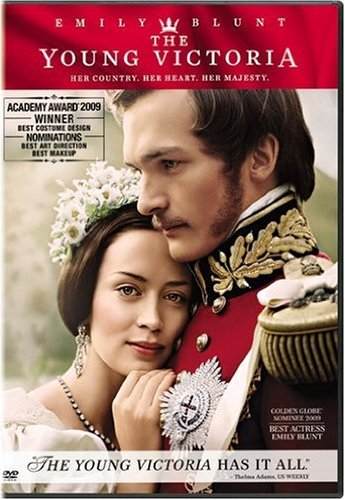
While I’m waiting, I think I’ll watch again the 2009 movie The Young Victoria. It was written by Julian Fellowes, who also wrote Gosford Park and is probably at this moment working on the next season of Downton Abbey. The movie shows a young Victoria who is practically kept under house arrest until she accedes to the throne at age 18.  She had to sleep in her mother’s room, and was never even allowed to walk down a flight of stairs without a trusted person holding her hand.  All that changed, though, as she grew into her role of being the Queen Victoria who ruled England for 63 years.  She was not always a dumpy and grumpy-looking old lady.

The Young Victoria, Amazon

The Young Victoria, Amazon

The lovely Emily Blunt plays Victoria and the very handsome Rupert Friend plays her beloved Albert. The movie is available at Amazon.

Join me next time for more explorations into the art and history of Europe and the British Isles, while we all wait for new history to be created!

Be the First on Your Block

One of my favorite catalog stores, The Vermont Country Store, just thoughtfully sent me an opportunity to buy a commemorative plate to celebrate the birth of the soon-to-arrive new prince or princess.  Of course the plate will be pink for a girl and blue for a boy.  Delivery is promised in October.

Commemorative Plates available at The Vermont Country Store

Commemorative Plates available at The Vermont Country Store

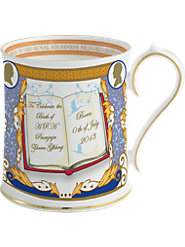
Or maybe I would prefer a mug instead.

Commemorative Mug available at The Vermont Country Store

Commemorative Mug available at The Vermont Country Store

I would love to be in England right now, anticipating the royal birth along with everyone else, whether they care to admit it or not.  I understand William, the Duke of Cambridge is even now on duty as a rescue pilot while he awaits the birth.  He gets two weeks off when the baby is born. Kate, Duchess of Cambridge, is no doubt getting a little impatient like all moms everywhere. Even anti-Royalists must wish this new young family well. I can only imagine the cornucopia of commemorative items in British markets right now.  I’ll resist, though.

Jelly Babies available at The Vermont Country Store

Jelly Babies available at The Vermont Country Store

On the other hand, The Vermont Country Store offers a lot of other hard-to-find British products…like old-fashioned Jelly Babies.  Hmmm…


Beach Reading for Anglophiles

Have you ever wondered what it would be like to actually own a stately home in England? Recently I picked up a perfect bonbon of a novel: A Much Married Man, by Nicholas Coleridge.

Photo from target.com

Photo from target.com

The protagonist inherits not just the stately home, but the entire village that goes with it. Barely out of what we would call high school, he falls madly in love with a beautiful but totally unreliable girl, whom he manages to marry. He can hardly believe his good luck. He happily moves with her into a tiny cottage in the village. (His decrepit and confused mother occupies the stately home itself, and pretty much monopolizes the grand old rooms.). But his luck doesn’t last long; off goes his true love, leaving him with a much-cherished baby daughter and greatly reduced prospects. Instead of going to Oxford or Cambridge, he works on the farm of the estate so that he can take care of the little girl. The family money comes from a venerable London banking firm that can get along very nicely without this gullible young man.

Soon enough, there are more assorted wives and mistresses, and more children. The honorable and kind-hearted hero is generous to a fault with all of them, and all of the romances end in disaster of one kind or another. Without fail, though, he loves and cares for all the children. The third wife is the worst nightmare. She moves everyone out of the stately home and undertakes a year-long modernization which makes hash of the history of the place. Worse yet, she brings with her a psychopathic and violent son. In her eyes, the son can do no wrong. So the hero has to bail him out of outrageous scrapes, and worse.

Eventually, the hero finds himself toiling in London in the family’s bank. Much to his and everyone else’s surprise, he is good at it. But times being what they are, the bank is ripe for collapse. The hero nearly loses his home and his village. At least partial salvation comes when some of the hangers-on he has put up with persuade him to make the estate a venue for rock concerts and such.

The fun of the book is the intimate look at life in the upper crust. Things look glamorous from the outside, but there is never quite enough money. Heating a huge old uninsulated pile is so costly that family members routinely wear overcoats and mittens around the house. The quaint cottages and rectories on the estate are chilly and damp, with hopeless or nonexistent plumbing. All manner of disasters begin and are exposed at impossibly fancy parties and clubs like Annabel’s. Mr. Coleridge makes fun of his own very posh social set. I’m sure I don’t get half the references to people and the brand names of their material possessions. But I get the idea.

Against all odds, there is a happy and unexpected ending–one the hero deserves just because he is such a good-hearted fellow.

Nicholas Coleridge; photo from Wikipedia

Nicholas Coleridge; photo from Wikipedia

Only after I finished the book did I realize that Mr. Coleridge is the head honcho of Conde Nast Publications. He owns an actual stately home in Worcestershire, the 1709 Wolverton Hall. It was featured in the December 2007 issue of Conde Nast’s World of Interiors magazine. (I don’t think the house is open for tours).

A review of the book, from The Guardian, is at http://www.guardian.co.uk/books/2006/apr/30/fiction.features3.

Did I call this a beach read? Better yet, read it on a plane on the way to England! Join me next time for more explorations into the art and history of Europe and the British Isles.

Coming Soon: A New Prince or Princess

Queen Elizabeth announced (or rather, had her people announce) that the soon-to-be born baby of Prince William will be called His (or Her) Royal Highness the Prince (or Princess)– of what?  Royal watchers think it will be Cambridge, since Prince William was made Duke of Cambridge at his wedding in 2011.  This is a burning question in England.  I seem to remember that one of the lowest blows Princess Diana sustained during her divorce was that she was stripped of the all-important “Her Royal Highness” or “HRH” designation.  The Queen herself was named “Her Royal Highness the Princess of York” when she was born, because her father was the Duke of York.

Her Royal Highness Princess Elizabeth of York; photo from abcnews.go.com

Her Royal Highness Princess Elizabeth of York; photo from abcnews.go.com

I find all this just a little annoying.  But mostly I find it endearing.  The British doggedly stick to their traditions.  If we didn’t have real live holders of titles walking among us, we’d have a hard time imagining the nobility of the past.  To me, the titles, though shopworn, are living history.  Titles have their practical uses, too. Crowds turn out to see the royals, especially the more likable ones.  Vast sums are raised for the charities they support. And items like tea towels are manufactured and sold in great quantities, providing jobs.

I once attended a ballet performance in London where Princess Margaret, the late sister of the present Queen, was the honored guest.  I must admit it was a thrill to watch her sweep through the lobby with her entourage. And it was fun to see her sitting in the center of the balcony (no tiara, but plenty of jewels and taffeta).

I won’t be posting much about the new royal baby when he or she arrives–our magazine covers will be doing more than enough of that for all of us.  But I salute Prince WIlliam for marrying  commoner Kate Middleton and bringing a breath of fresh air into the British Royal Family.  May they all keep their feet firmly on the ground.